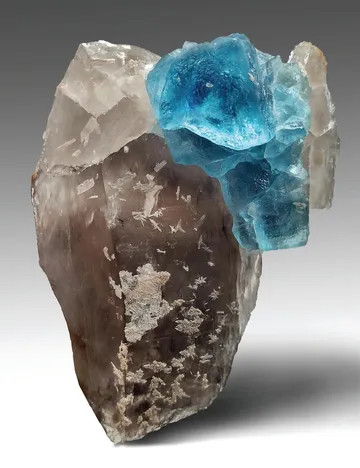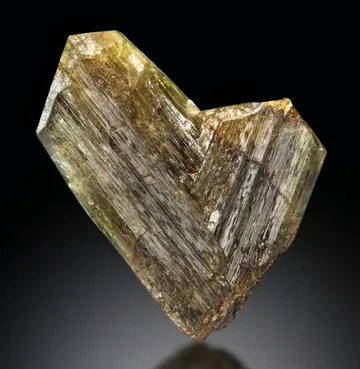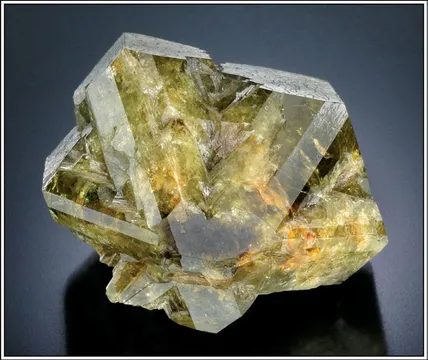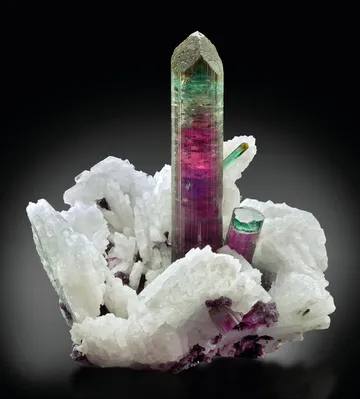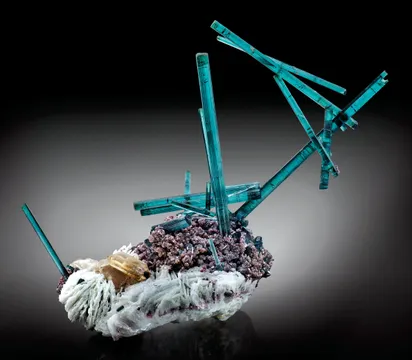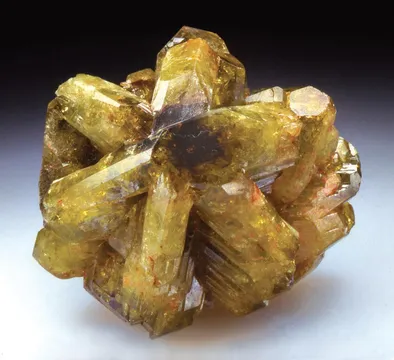
Mimoso do Sul, Brazil — a classic pegmatite locality renowned for water-clear topaz and sculptural aquamarine, often on matrix, prized by collectors.
Key facts
Mimoso do Sul is one of the classic southern Espírito Santo pegmatite localities for gem topaz and aquamarine, best known in the specimen trade through the Fazenda Concórdia pegmatite, long labelled simply as the “Mimoso do Sul Mine.” It sits in the eastern Brazilian pegmatite realm, near the meeting ground of the Araçuaí and Ribeira orogenic systems, where late granitic and pegmatitic bodies cut older high-grade basement rocks and post-collisional intrusive complexes. For collectors, the locality matters less for diversity than for a sharply recognizable style: transparent to water-clear topaz crystals, pale blue to blue-green topaz, aquamarine in tapered or “pencil” forms, aquamarine-on-microcline and aquamarine-with-topaz combinations, and the occasional phenakite association that gives the locality real pegmatite pedigree.
The best Mimoso do Sul specimens have an old-Brazilian feel: glassy, compact, and architectural rather than showy in the modern Pakistani manner. Topaz may occur as sharply formed, lustrous crystals with chisel-like terminations, sometimes water-clear and sometimes faintly blue, greenish-blue, or colour-zoned. Aquamarine is the locality’s other signature: deep blue to sea-green, commonly etched or tapered, with steep terminations and a sculptural habit that makes many pieces immediately recognizable. Fine matrix specimens are much scarcer than loose crystals; when aquamarine, topaz, quartz, albite, muscovite, and microcline appear together on matrix, the specimen moves from “nice Brazilian gem crystal” into true locality piece territory.
Regional View
Country View
Modern mineralogical work places Fazenda Concórdia among the pegmatites of southern Espírito Santo, and distinguishes it from the nearby São Domingos pegmatite in Muqui. Both bodies are scientifically useful because they preserve a comparatively simple pegmatite evolution rather than the highly evolved lithium-cesium-tantalum style of some Minas Gerais districts. That relative simplicity is part of Mimoso do Sul’s appeal: it is not a locality for a long checklist of rare phosphates, but for handsome Be-F-rich gem-mineral crystallization in a quartz-feldspar-mica pegmatite.

Photo: Rob Lavinsky, iRocks.com via Wikimedia Commons

Search for specimens: View all specimens from Mimoso do Sul, Brazil
The collector locality represented by Mimoso do Sul is centered on the Fazenda Concórdia pegmatite, with older specimen labels commonly using the broader names Mimoso do Sul, Mimoso do Sul Mine, or simply Espírito Santo, Brazil. Mindat’s regional entry for the municipality also records the Usina mine, Pedra Riscada pegmatite, and Santo Antônio do Muqui within Mimoso do Sul, but the fine topaz-aquamarine specimen suite that collectors recognize most readily belongs to Fazenda Concórdia.
Geologically, Fazenda Concórdia is a granitic pegmatite with simple internal zoning. Published mineral-chemistry work records quartz, feldspar, and mica as the principal pegmatite minerals, with Fazenda Concórdia further carrying tourmaline, beryl, and topaz. The associated feldspar suite includes K-feldspar, microcline, perthitic feldspar, albite, and oligoclase; the mica is muscovite; the black tourmaline analyzed from the pegmatite is schorl. The body is hosted in monzodioritic to monzonitic rocks of the Torre pluton, part of the Mimoso do Sul Intrusive Complex, itself tied to late to post-collisional magmatism in the Araçuaí orogen. Nearby São Domingos, in Muqui, is hosted differently and is less evolved than Fazenda Concórdia in the comparative geochemical study, which helps explain why Fazenda Concórdia produced the more famous collector suite of beryl, topaz, tourmaline, and phenakite.
The mineralization is the classic pegmatite pocket style: feldspar-quartz-mica bodies with open-space gem crystallization and later alteration to kaolin-rich clay in places. The locality’s most desirable specimens are not ore in the industrial sense; they are pocket products. Aquamarine crystals may be loose, singly terminated, doubly terminated, clustered, or perched on microcline and albite. Topaz occurs as loose crystals, parallel groups, floaters, and intergrowths with quartz, especially smoky quartz. Collector photographs and specimen records also document clay-filled crevices, etched surfaces, and cavity-lined beryl pieces with smaller aquamarines inside, all features consistent with pocket growth and later alteration in a weathered pegmatite environment.
Mining and collecting at Mimoso do Sul have been small-scale rather than large corporate mining. Brazilian gem-deposit surveys describe the southern Espírito Santo field around Mimoso do Sul as a topaz and aquamarine region worked for decades by rudimentary or semi-mechanized operations. Such work was not always financially robust; some pegmatite workings were abandoned or displaced by quarrying of the enclosing rocks for ornamental stone. Specimen records show active access to the mine owner in the 1990s and 2000s: pieces were acquired from the owner in 1995 and again in January 2009, including aquamarine on feldspar, topaz with aquamarine, and large muscovite books.
Production appears to have come in pulses rather than as continuous, high-volume specimen mining. Older market references place aquamarine material in the 1960s and 1970s; dealer and collector labels document finds around 1990, 1995, and 2009; and later sales recycle older material through established collections. The best-documented Mimoso do Sul aquamarines include intense sea-blue tapered crystals, “jackstraw” clusters, steeply terminated groups, and aquamarine associated with topaz. Topaz finds include crystals to at least 9.1 cm in published photographic records, parallel groups to around 12 cm in older Mineralogical Record index entries, and a broader Espírito Santo tradition of large topaz crystals that sometimes blurs older locality naming.
Collecting access today should be treated as private-property and mineral-rights controlled. The old Mimoso do Sul Mine/Fazenda Concórdia area is not a public fee-dig locality, and no collector should attempt to visit or dig without prior permission from the landowner and, where applicable, the holder of mining rights. Weathered pegmatite workings in tropical terrain can be unstable, deceptively steep, and clay-slick, and old pocket zones may be undercut or obscured by later quarrying and vegetation. Most collector access to Mimoso do Sul material is therefore through older collections, dealers, and occasional market releases rather than field collecting.
Mimoso do Sul topaz is prized for glassy transparency, sharp form, and the pale blue to blue-green cast seen in the better crystals; colourless pieces are commonest, bluish tones are well documented, and rare yellowish material is reported from the southern Espírito Santo field. Good crystals show textbook orthorhombic habit with bright faces, chisel-like or pyramidal terminations, and minimal edge wear; ordinary pieces are more etched, contacted, clay-filled, or cleaved at the base. Matrix pieces are significantly scarcer than loose crystals, with the most desirable examples showing topaz intergrown with smoky quartz, perched on albite, or associated directly with aquamarine from Fazenda Concórdia. Documented specimen sizes range from small thumbnail crystals to fine cabinet pieces, including crystals around 7–9 cm and older references to parallel growths reaching roughly 12 cm; the top locality pieces have a “read-through,” water-clear quality that separates them from the more common cloudy or damaged Brazilian topaz crystals.
Aquamarine from Mimoso do Sul is among the most distinctive Brazilian aquamarines because of its tapered, etched, and steeply terminated habits, often with unusually saturated blue to sea-green colour for the locality. Crystals may appear as slim pencils, sculptural clusters, triangular-looking groups on feldspar, or compact jackstraw arrangements; many show growth striations, curved or modified prism faces, and etched surfaces rather than the long, straight, perfectly hexagonal prisms familiar from some Minas Gerais and Pakistani localities. Associations include microcline, albite, muscovite, topaz, quartz, smoky quartz, and locally phenakite. Sizes documented in specimen records range from thumbnails around 3 cm to miniatures and small cabinet specimens of about 4–9 cm, with better examples judged by depth of blue colour, intact steep termination, transparency, absence of bruising on the termination and prism edges, and whether the crystal remains aesthetically seated on feldspar or mica matrix.
Beryl at Mimoso do Sul is represented chiefly by aquamarine, but Fazenda Concórdia also produced heliodor and paler non-varietal beryl tones, matching Brazilian survey descriptions of beryl in white-yellowish, green, and blue colours. The locality’s beryl is not merely lapidary rough: its collector importance rests on well-formed gem crystals with tapered morphology, etched cavities, and sharp to steep terminations, some on microcline or albite and some carrying smaller aquamarine crystals in cavities. Good Mimoso beryl shows strong transparency, lustrous faces, clean colour, and locality-character habit; lesser material may be contacted, opaque, heavily etched, or simply labelled as generic Brazilian aquamarine without the visual or documentary evidence that ties it securely to Fazenda Concórdia. Heliodor is much rarer than aquamarine here, typically seen as small slender crystals with greenish-yellow colour, and should be considered a special locality variant rather than a common production.
Other documented minerals from the Mimoso do Sul/Fazenda Concórdia suite include albite, oligoclase, microcline, perthitic K-feldspar, kaolinite-group alteration material, muscovite, quartz, smoky quartz, schorl, and phenakite. Phenakite is the standout rarity: published photo records show phenakite with aquamarine from the Mimoso do Sul Mine, an unusual association for the locality and one of the few species here that attracts specialist pegmatite collectors beyond the topaz-aquamarine audience. No mineral species appears to be formally established with Mimoso do Sul as its type locality in the principal mineralogical databases; its importance is instead as a classic Brazilian specimen locality for distinctive gem beryl and topaz.
Mimoso do Sul material is often mislabelled by omission rather than by outright fraud. Older labels may say “Mimoso do Sul,” “Mimoso do Sul Mine,” “Mimoso do Sol,” “Espirito Santo,” or “Brazil” without Fazenda Concórdia. Some pieces circulated historically under broader or inconsistent district names, and older literature indexes even preserve locality phrasing that can confuse Mimoso do Sul with other Espírito Santo gem areas. For a serious collector, the strongest labels are those naming Fazenda Concórdia pegmatite or Mimoso do Sul Mine, Espírito Santo, Brazil, and ideally preserving a dealer, collector, or find-date history.
The most common authenticity problem is substitution by visual similarity. Pale blue topaz from Mimoso do Sul can be confused with other Brazilian blue topaz localities, and aquamarine from Mimoso do Sul can be blended into the vast Brazilian aquamarine trade. The tapered aquamarine habit is a useful clue but not absolute proof; comparable tapered aquamarines are known from a few other regions. Likewise, a loose water-clear topaz crystal without a reliable label is difficult to reassign confidently to Mimoso do Sul after the fact. Provenance matters.
Treatment concerns differ by species. Blue topaz in the gem trade is routinely irradiated and heated, but Mimoso do Sul specimen topaz is valued for natural crystal form and locality provenance, not for cut-stone enhancement. A suspiciously intense, uniform electric-blue loose topaz sold without old collection history deserves caution. Mimoso aquamarine is typically judged as natural-color crystal material; heating of aquamarine to improve blue colour is widespread in the gem world, but there is no well-documented locality-specific scandal for treated Mimoso specimen crystals. Still, any very saturated loose crystal should be assessed with the same skepticism applied to all Brazilian beryl specimens.
Condition is crucial. Topaz has perfect basal cleavage, and Mimoso do Sul topaz commonly shows contacts, basal breaks, small edge bruises, or pocket-wall scars. A pristine-looking terminated crystal should be examined under strong side light for cleavage flashes, repaired corners, and polished chips. Aquamarine is tougher in a practical handling sense, but the thin tapered tips and steep terminations chip easily. Many good Mimoso aquamarines also have natural etching, clay inclusions, or contacted bases; these are not necessarily defects, but they affect value depending on how visible they are.
Matrix examples command a premium because loose crystals are much more common. Aquamarine on microcline, aquamarine with topaz, topaz with smoky quartz, and intact feldspar-mica pocket plates are all more desirable than isolated single crystals of comparable size. Phenakite associations should be documented carefully because they are rare for the locality and easily overlooked. Kaolin or clay in cavities is part of the locality’s weathered pegmatite character; aggressive cleaning can remove useful pocket context or destabilize fragile matrix.
On the market, Mimoso do Sul is available but not abundant. Small aquamarine crystals and occasional topaz pieces appear in dealer inventories and auctions, while fine older matrix combinations are much less frequent. The strongest examples tend to come from old collections, 1970s Brazilian buying trips, late-20th-century dealer stock, or documented 1990s–2000s mine-owner acquisitions. For EarthWonders buyers, the ideal Mimoso do Sul specimen is one that combines clean aesthetics with locality-specific habit: a tapered blue aquamarine, a water-clear chisel-terminated topaz, or a true topaz-aquamarine combination from Fazenda Concórdia.
One of the pleasures of Mimoso do Sul is that the best specimens carry small human traces from a locality that was never a giant industrial operation. A Kuno Stoeckli specimen record captures the pocket-mining immediacy perfectly: a clear topaz, 4.1 x 3.7 x 3 cm and 77 g, was found at the mine on January 10, 2009, with “the foot” found in the morning and “the beautiful head” in the afternoon. It is the sort of note that every field collector understands: the first fragment proves the pocket is real, the second turns the day into a story.
Stoeckli’s 2009 records also show how direct the trade could still be at that time. Aquamarine groups on feldspar, large etched beryl with cavities lined by small aquamarines, and even a 12 x 11 x 7 cm muscovite weighing 1.235 kg were recorded as acquired from the mine owner in January 2009. These are not anonymous parcels from a cutting house; they are pieces tied to a working pegmatite and a named moment in the mine’s later collecting history.
The older aquamarines carried a different romance. A 1970s aquamarine from the Rich Kosnar collection was described as a gemmy miniature with light blue colour, lustrous hexagonal prism faces, light surface etching, and tube-like inclusions partly filled with tan clay. Its historical interest is not just its shape but its timing: in the 1970s, before the modern flood of fine gem aquamarines from Pakistan and Namibia, a sharp, gemmy, euhedral aquamarine crystal from Brazil was a far more unusual thing to hold in the hand. Kosnar’s Brazilian buying trips helped move such pieces into the American specimen market, where they became old-collection references for the locality.
Mimoso do Sul also has a small gallery of specimen nicknames and collector superlatives. One matrix topaz rising among quartz crystals, partly dusted with pearly lepidolite-like mica on albite, was called “The King” by its collector. Other records speak of an aquamarine “triangle” on feldspar, a big etched beryl with cavities of tiny aquamarines, and a topaz-on-aquamarine combination acquired from the mine owner in 1995. These details are valuable because they show what Mimoso do Sul really produced at its best: not just faceting rough, but complete pegmatite objects with pocket architecture, mineral associations, and enough personality to remain recognizable decades later.
Costa, F. C. da; Scholz, R.; Marques, R. de A.; Queiroga, G. N.; Castro, M. P. de. “Geoquímica de Feldspato, Mica, Berilo e Turmalina e Geocronologia U-Pb em Monazita dos Pegmatitos Fazenda Concórdia e São Domingos - Espírito Santo, Brasil.” Anuário do Instituto de Geociências - UFRJ, 43(3), 2020, 1–22. The key modern scientific paper on Fazenda Concórdia and São Domingos pegmatites, with mineral chemistry, zoning, and geochronological context.
Costa, F. C. da; Scholz, R.; Marques, R. de A.; Queiroga, G. N.; Castro, M. P. de. DOI record for “Feldspar, Mica, Beryl and Tourmaline Geochemistry and U-Pb Geochronology in a Monazite from Fazenda Concórdia and São Domingos Pegmatites - Espírito Santo, Brazil.” Persistent DOI landing route for the same Fazenda Concórdia/São Domingos study.
Benitez, L.; Chaves, M. L. de S. C.; Vieira, V. S.; Silva, S. M. da. “Depósitos de Minerais Gemológicos no Estado do Espírito Santo.” 46º Congresso Brasileiro de Geologia, 2012. Useful regional synthesis identifying the southern Espírito Santo field around Mimoso do Sul as chiefly topaz and aquamarine, worked for decades in small-scale operations.
Rodrigues, R. D.; Coelho, M. V. S.; Souza, A. M.; Geraldes, M. C.; Macedo, I. M. L.; Hubner, I. C. “Geocronologia U-Pb dos Pegmatitos da Fazenda São Domingos e Fazenda Concórdia (Mimoso do Sul, Espírito Santo - Brasil).” 51º Congresso Brasileiro de Geologia, 2024. Recent conference abstract reporting U-Pb zircon age constraints and tying the pegmatites to post-collisional Araçuaí magmatism.
Fontes, Cid Queirós et al. “Projeto Mimoso do Sul: Relatório Final.” CPRM, 1981, 4 volumes. Brazilian Geological Survey technical report for the Mimoso do Sul project area; important regional geological background.
Morteani, G.; Preinfalk, C.; Horn, A. H. “Classification and mineralization potential of the pegmatites of the Eastern Brazilian Pegmatite Province.” Mineralium Deposita, 35, 2000, 638–655. Broader Eastern Brazilian Pegmatite Province classification; relevant to nearby Pedra Riscada and the regional pegmatite framework.
The Mineralogical Record general index, Volumes 26–35: Topaz entries for Mimoso do Sul Mine. Index entries preserve older specimen-literature references to Mimoso do Sul topaz, including blue and green crystals, smoky quartz associations, and parallel growths.
The Mineralogical Record general index, Volumes 26–35: Beryl entries for Mimoso do Sul Mine. Index entries documenting deep blue aquamarine prisms with topaz and jackstraw clusters from Mimoso do Sul.
The Mineralogical Record general index, Volumes 1–25: Beryl entries for Mimoso do Sul and Fernandes quarry. Older index references to odd-habit aquamarine and “glass cigar” aquamarine material from the Mimoso do Sul area.
Mindat: Mimoso do Sul, Espírito Santo, Brazil Regional Mindat page for the municipality, with locality hierarchy and the documented mineral list from Mimoso do Sul.
Mindat: Fazenda Concórdia pegmatite, Mimoso do Sul, Espírito Santo, Brazil Principal collector-locality page for the Mimoso do Sul Mine/Fazenda Concórdia pegmatite.
Mindat photo gallery: Fazenda Concórdia pegmatite Best single visual reference for the locality’s topaz, aquamarine, microcline, muscovite, and phenakite associations.
Mindat: Aquamarine from Fazenda Concórdia pegmatite Occurrence record summarizing aquamarine at Fazenda Concórdia and its observed associated minerals in photo data.
Mindat: Topaz from Fazenda Concórdia pegmatite Occurrence record for topaz at the locality.
Mindat forum: locality update for Mimoso do Sul Mine / Fazenda Concórdia Useful discussion tying the older “Mimoso do Sul Mine” usage to the Fazenda Concórdia pegmatite and noting schorl identification.
Wikimedia Commons: Minerals of the Mimoso do Sul Mine Open-license image category with topaz, aquamarine, and phenakite-beryl photographs from the locality.
Gemdat: Espírito Santo, Brazil Gem-locality cross-reference listing Fazenda Concórdia as the Mimoso do Sul Mine and placing it among Espírito Santo gem occurrences.
Mineral Auctions: 1970s Mimoso do Sul aquamarine, ex Rich Kosnar Market-history example of an old Brazilian aquamarine crystal with provenance and price record.
Fabre Minerals: Brazil reference specimens Dealer archive with documented Mimoso do Sul aquamarine and topaz reference pieces.
Crystal Mine: Mimoso do Sul topaz listing archive Dealer record illustrating typical modified topaz crystals and clay-filled etching from Fazenda Concórdia.
Mineral Mike: Mimoso do Sul aquamarine crystal archive Small specimen-market example documenting a 31 mm blue-green aquamarine crystal.