Castelo, Brazil — pegmatite locality yielding blue to blue-green fluorite, etched topaz, chrysoberyl, and quartz; prized for cabinet-quality color and matrix.
Key facts
Castelo, in the mountains of southern Espírito Santo, is one of those Brazilian names whose mineral reputation has arrived in layers. The oldest layer is gold: the town’s origin is tied to alluvial gold working, a chapter that later faded behind the much larger Minas Gerais gold rush. The collector layer is more recent and far more gemmy. Around Fazenda do Centro, a pegmatitic occurrence produced etched topaz and, in much smaller numbers, striking blue to blue-green fluorite—an uncommon style for Brazil, where countless pegmatites are famous for beryl, tourmaline, topaz, chrysoberyl and quartz, but not usually for fluorite of cabinet-specimen quality.
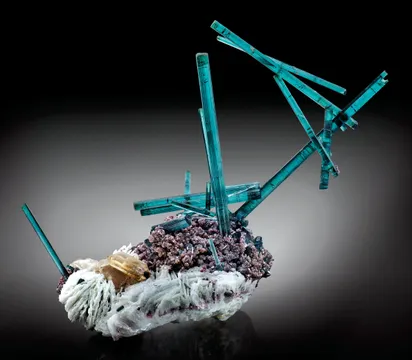
The best Castelo fluorites look unlike the classic hydrothermal vein fluorites of Europe, China or the American Midwest. They are pegmatite pieces: translucent aqua to teal-blue cubes and modified cubes, commonly with stepped or wavy growth on the cube faces, internal phantoms, and associations with K-feldspar, pale green microcline sometimes described in the trade as amazonite, muscovite, albite, quartz and locally lepidolite. Good specimens are judged not merely by size, but by whether the blue color survives normal display lighting, whether the cubes are intact along their stepped edges, and whether the matrix gives a clean pegmatitic context rather than simply serving as a broken support.
Regional View
Country View
Castelo also sits within the broader Espírito Santo gem-province story. Chrysoberyl is documented from the Castelo municipality, particularly the Forno Grande area, and historic Espírito Santo chrysoberyls are prized as Golden Era Brazilian gem-crystal classics: sharp yellow-green to olive-green twins and partial cyclic twins, many of them thumbnails, preserved from a period when such crystals were often treated first as gem rough and only secondarily as mineral specimens. Quartz, too, is part of the locality record, both as pegmatitic crystal matrix for fluorite and as agate documented from Castelo in older Brazilian gem literature.
Search for specimens: View all specimens from Castelo, Brazil
Castelo’s collectible minerals come from more than one geological and historical setting, and that is the first point a serious collector should keep straight. The blue fluorites and etched topaz are pegmatite specimens, usually labelled Fazenda do Centro or Castelo pegmatite, Castelo, Espírito Santo. The gold and maldonite record belongs to alluvial material from the Castelo region. Chrysoberyl attributed to Castelo is tied in the gem-locality literature to the Forno Grande area of the municipality, not necessarily to the same pegmatite pocket that produced the modern fluorite-topaz material.
The pegmatite context is part of the Eastern Brazilian Pegmatite Province, the immense belt of Brasiliano-age granitic pegmatites extending through eastern Brazil, including Minas Gerais, Bahia, Espírito Santo and Rio de Janeiro. In broad terms, these pegmatites are related to late Neoproterozoic to Cambrian tectonothermal events and granitic magmatism along the eastern margin of the São Francisco craton and adjacent mobile belts. Castelo lies in the northern Ribeira Belt domain of Espírito Santo, where pegmatites and related gem occurrences are set among high-grade metamorphic and granitic terranes. In the collector record, the Castelo pegmatite is not known as a large industrial mine but as a specimen-producing pegmatitic pocket system.
The mineralized pocket or pockets at Fazenda do Centro are best known for etched topaz and blue fluorite. Dealer and specimen records describe a 2017 topaz find that produced more than 80 kg of topaz before the spot was exhausted. The remarkable pieces from that find were skeletal, heavily etched, three-dimensional topaz floaters, some bicolored in pale blue and champagne tones. Fluorite from the same Fazenda do Centro collecting episode, or from closely related later work at the same pegmatitic occurrence, was much scarcer. Reported fluorite specimens include loose intergrown cube clusters, cubes on quartz, cubes on albite, fluorite with muscovite, and fluorite on or with pale green microcline/K-feldspar. EarthWonders’ own specimen record notes that the small mining operation began by chance, produced only a modest number of blue fluorites, and had no new production after early 2024.
The ore-body geometry, in the sense relevant to collectors, appears to have been pocket-controlled rather than a continuous fluorite ore shoot. The best descriptions are of crystal-lined cavities and etched open-space growth within pegmatite. The fluorite cubes range from miniature-scale pieces to cabinet plates; documented crystals reach several centimeters on edge, and show reports described some unusually large greenish-blue fluorite crystals up to about 20 cm on edge, though the largest pieces were not always the most aesthetic. The most desirable specimens are the ones that combine the oddity of pegmatitic fluorite with clean crystallography: aqua-blue stepped cubes, transparent enough to show internal blue-to-purple phantom zoning, perched on contrasting white quartz, albite, muscovite or pale feldspar.
Modern operators are not clearly documented in the public mineralogical literature. The material reached the collector market through dealers and show networks, including Brazilian and European dealers, and was discussed in show reports after its appearance at major mineral venues. That absence of a clearly published mine plan or operator history is important: Castelo fluorite should be understood as limited-pocket specimen production from a farm-area pegmatite, not as an established commercial fluorite mine with predictable output.
The alluvial gold story is older and separate. Recent geochemical work recovered 1,129 alluvial gold grains from the Castelo region, analyzed 133 of them by electron microprobe, and documented a high-fineness gold population with copper and bismuth signatures. One complex gold grain contained maldonite, Au2Bi, an uncommon gold-bismuth mineral that is significant not because it forms showy specimens here, but because it points toward possible intrusion-related or skarn-related primary gold systems still not identified in bedrock. Historical records cited for Castelo note approximately 58 kg of gold registered from the mines of Castelo between August 1751 and July 1759, and additional alluvial gravel mining in the first half of the twentieth century without preserved production figures.
Collecting access today should be treated as private and permission-only. Fazenda do Centro is a named historic rural community and heritage area rather than a public mineral-collecting site, and the specimen locality is not presented in reliable sources as open to casual collecting. The modern fluorite and topaz pieces on the market are best pursued through documented provenance, old dealer labels, Mindat photo/minID records, and established dealers who handled the original production.
Fluorite is the modern calling card of Castelo, and the Fazenda do Centro material is exceptional precisely because it is Brazilian pegmatite fluorite rather than ordinary vein fluorite. Specimens are typically aqua, teal, sky-blue to blue-green, sometimes with darker blue or purple-blue cores and phantom zoning; habits are cubic to modified cubic, with stepped, etched, convex or wavy cube faces that can give the crystals a soft “pillow” look while still preserving the basic cube architecture. Documented specimens range from miniatures of about 3.5 cm across to cabinet plates over 13 cm, with individual cubes commonly in the 2.5–5 cm range and show reports mentioning much larger crystals up to about 20 cm on edge. Associations include quartz, albite, muscovite, K-feldspar/microcline, pale green amazonite-like feldspar, and lepidolite. The elite pieces are not simply the largest; they are the ones with saturated blue color in normal side lighting, visible internal zoning, sharp or attractively stepped cube faces, little extraction wear on exposed edges, and a matrix that advertises their pegmatitic origin.
Quartz from Castelo matters to collectors in two distinct ways. In the Fazenda do Centro pegmatite it appears as pegmatitic crystal matrix for fluorite, including partial terminated crystals and larger quartz blades or plates carrying blue fluorite cubes; the best combinations use quartz as a bright, glassy or milky-white foil for the saturated blue fluorite, while lesser pieces are simple contacted fragments with fluorite added aesthetically only on one side. One documented small-cabinet fluorite-on-quartz specimen measured 10.2 x 5.0 x 3.5 cm and carried two light aqua-blue fluorite cubes on a partial quartz crystal, with minor nicks on the quartz terminations and recrystallization along a contacted side. Separately, older gem references document quartz var. agate from Castelo at the municipality level, so “Castelo quartz” may refer either to pegmatite-associated quartz in the modern specimen market or to agate in the older Brazilian gem-locality record; for EarthWonders-style specimen collecting, the fluorite-on-quartz pegmatite pieces are the more distinctive and locality-defining material.
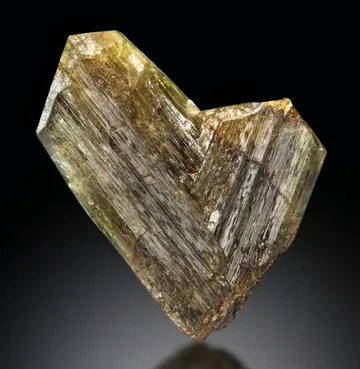
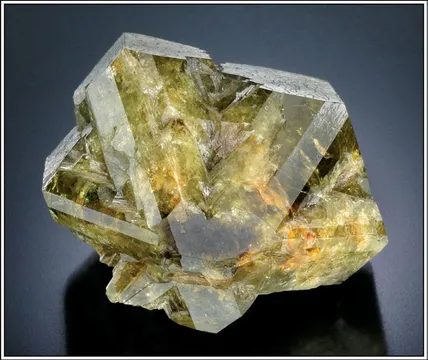
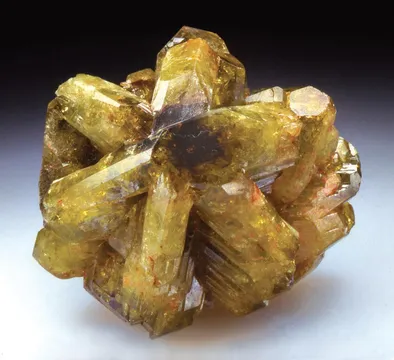
Chrysoberyl from Castelo is best approached as part of the classic Espírito Santo chrysoberyl suite, with the Castelo municipality represented in gem-locality literature by Forno Grande. The prized habit is the sharp yellow-green to olive-green tabular or short-prismatic twin, including partial cyclic twins and sixling-style aggregates with re-entrant angles and glassy luster. EarthWonders-listed Castelo chrysoberyl material includes thumbnail-scale historic crystals collected in the 1940s–1950s, with a documented 2.3 x 1.9 x 1.8 cm cluster described as probably half of a cyclic sixling twin, accompanied by a smaller just-over-1 cm sixling and old collection provenance through Willard Perkin and Rock Currier. The best Castelo-attributed chrysoberyls are sharp, bright, saturated and unrolled; ordinary examples are waterworn, bruised, brownish, or so poorly labelled that they cannot be separated confidently from other Espírito Santo localities such as Colatina, Itaguaçu, Santa Teresa or Pancas.
Other documented minerals from Castelo include K-feldspar and microcline, muscovite, albite and lepidolite as pegmatitic associates of the blue fluorite, plus topaz from the dramatic Fazenda do Centro etched-topaz pocket. At the municipality scale, agate is documented as a quartz variety. The notable rarity is maldonite, Au2Bi, identified as inclusions in alluvial gold from Castelo rather than as freestanding display crystals. No well-established type-locality mineral species is documented from Castelo in the sources consulted; the locality’s rarities are instead occurrence rarities—pegmatitic blue fluorite in Brazil, historic Espírito Santo chrysoberyl, and maldonite-bearing high-fineness alluvial gold.
The main authenticity issue for Castelo is not widespread fakery, but label discipline. “Castelo,” “Fazenda do Centro,” “Castelo pegmatite,” “Forno Grande,” and broad “Espírito Santo” labels do not all mean the same thing. Fluorite and etched topaz should ideally carry Fazenda do Centro or Castelo pegmatite provenance. Chrysoberyl is more complicated: literature documents Castelo: Forno Grande as a chrysoberyl locality, but many historic Espírito Santo chrysoberyls circulated with broad or shifting locality names, and at least one well-known chrysoberyl specimen marketed as Castelo has also appeared in a Mindat minID record under Colatina. For a serious locality collection, insist on retaining every old label and modern dealer note, and record whether the specimen is “Castelo municipality,” “Forno Grande,” or “Fazenda do Centro” rather than silently collapsing them into one pocket.
For fluorite, condition is the great separator. The stepped cube faces and soft convex edges are part of the growth style, not automatically damage, but extraction wear on cube corners, edge bruising, cleaved backs, and scuffed high points are common enough to affect value. Backlighting can make these fluorites look paler; side lighting usually brings out the glacial blue and purple-blue core zoning. Because fluorite is soft and cleaves perfectly, avoid ultrasonic cleaning, mechanical scraping and tight mounting pressure. Some specimens were heavily overgrown when recovered and required long, careful cleaning, so residues in recesses are not surprising; aggressive recleaning risks doing more harm than good.
For quartz-associated pieces, examine the quartz terminations and contact points. A contacted or recrystallized quartz side may be acceptable if the fluorite display face is undamaged and the specimen is honest about its growth history. For matrix pieces, look for natural attachment and continuity between fluorite and feldspar, albite, muscovite or quartz. Because the best fluorite specimens are uncommon and market availability has been intermittent since the early 2024 end of reported production, repaired or reconstructed matrix pieces would be especially problematic if they appeared; check under magnification around cube bases and along feldspar-quartz contacts for glue, filled gaps or unnatural luster differences.
For chrysoberyl, the key problems are abrasion, broken twin arms, and locality inflation. Historic Brazilian chrysoberyls were often saved as gem rough, and many older crystals show rolling, bruising or careless handling marks. Sharp old thumbnails with strong yellow-green color, bright luster, and credible old collection provenance command a premium. Be cautious of vague “Brazil” or “Espírito Santo” chrysoberyls upgraded to “Castelo” without documentary support.
Castelo’s mineral story begins before the pegmatite fluorites, before the etched topaz, even before most collectors would have thought of Espírito Santo as a source of classic chrysoberyl. It begins with gold. The modern town in southern Espírito Santo originated as a gold-mining settlement, but its early mining memory was overshadowed when the great inland rush drew attention toward the highlands that became Minas Gerais. Recent work on the alluvial gold brought that buried history back into focus with numbers: 1,129 grains recovered for morphological study, 133 grains analyzed by electron microprobe, and a high-fineness gold population carrying a distinctive bismuth-copper signature. One grain with a complex outline contained maldonite, Au2Bi, a minute inclusion that turned an old placer story into a modern exploration clue.
The surviving production figures from the eighteenth century are tantalizingly small but concrete. Approximately 58 kg of gold from the mines of Castelo were registered at the Mint of Rio de Janeiro between August 1751 and July 1759. Then the record thins. There are later references to alluvial gravel mining in the first half of the twentieth century, but no comparable production ledger. For collectors, that makes Castelo’s gold history feel almost archaeological: not a parade of famous nuggets and cabinet specimens, but an old mining center whose metal signature had to be reconstructed grain by grain.
Fazenda do Centro adds a different, human texture to the locality. The historic farm lies near Castelo and is remembered in local histories as a nineteenth-century rural center associated with settlement, coffee, slavery, immigration and cooperative agriculture. Its main building is traced to 1845, and local accounts place it on the right bank of the Rio Castelo in an area where a military figure had established an active mining center. The farm’s name, “Centro,” was said to reflect its geographic role as a meeting point for regional landowners, whose annual festivities could last a week. By 1910, coffee and cereal production, processing facilities and cooperative systems had made the place a social and commercial pole for the region.
The modern specimen story is more sudden. Around Fazenda do Centro, a pocket of etched topaz produced material so distinctive that dealers treated it as a one-time event. More than 80 kg of topaz were reportedly unearthed before the spot was exhausted. The showpieces were not conventional textbook prisms but sculptural, skeletal, etched forms—some pale blue, some champagne, some bicolored, with caves, clefts, jagged surfaces and fully crystallized floater geometry. One described specimen stood 33 cm high and was presented as the centerpiece of the find; another weighed 3.6 kg and measured 22.5 cm across its largest dimension. These were not ordinary Espírito Santo pegmatite accessories but the kind of odd, dramatic topaz forms that could define a pocket by themselves.
Then came the blue fluorite. At first it was almost an improbability: Brazil, the land of pegmatite icons, had never been known for abundant world-class fluorite, and pegmatitic fluorite of this quality is globally uncommon. The Fazenda do Centro pieces emerged in small numbers, some as loose cubes, some on quartz, some with albite, muscovite or pale feldspar. A 2024 show report described greenish-blue fluorite crystals up to a remarkable 20 cm on edge, along with pale green microcline. Other dealer records emphasized that the best pieces were mysteries until cleaning: heavily overgrown when extracted, only revealing their blue cores, stepped growth and phantom zoning after hours of careful work. In the space of a few seasons, Castelo had become a name fluorite collectors had to learn.