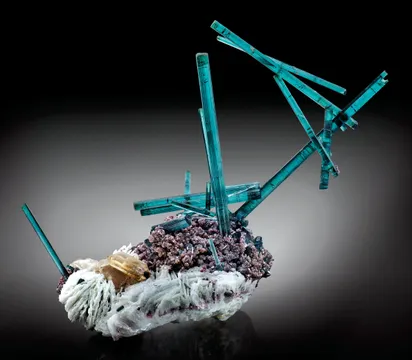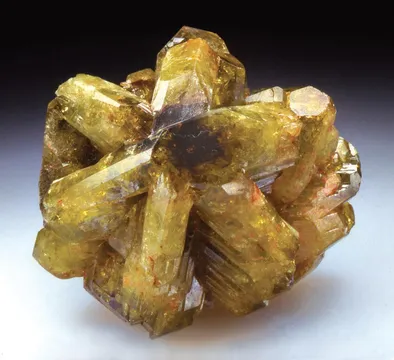
Espírito Santo, Brazil — a famed pegmatite locality yielding chrysoberyl, aquamarine, beryl, topaz, and phenakite; prized for pencil aquamarine, color zoning,…
Key facts
Espírito Santo is one of the great Brazilian names that serious collectors encounter first through chrysoberyl: sharp yellow-green to olive-green twins, cyclic trillings, and blocky gemmy crystals from the Colatina–Santa Teresa–Itaguaçu–Pancas belt, many of them detached floaters from deeply weathered pegmatitic and eluvial ground. The state also belongs to the eastern Brazilian pegmatite province, and its southern pegmatites around Mimoso do Sul and Muqui are best known for aquamarine, heliodor, pale beryl, topaz, phenakite, feldspar, muscovite, and quartz assemblages. The finest Espírito Santo specimens have a look quite different from the better-known Minas Gerais pegmatites: chrysoberyl is typically valued for architecture, twinning, translucency, and a lemon-to-olive color rather than for matrix display, while the Mimoso do Sul aquamarines are remembered for slender “pencil” habits, pale to saturated blue color zoning, and associations with albite, microcline, muscovite, quartz, topaz, and phenakite.
Regional View
Country View
The locality name “Espírito Santo” on older labels can mean several quite different things. On chrysoberyl it often points to the classic central-northern district, especially Itaguaçu, Colatina, Santa Teresa, or Pancas. On aquamarine, beryl, topaz, or phenakite it commonly indicates the southern pegmatites of Mimoso do Sul, particularly Fazenda Concórdia, historically also sold as the Mimoso do Sul mine or Concórdia mine. On metamorphic and skarn-related material it may refer instead to the marble and gneiss terranes around Cachoeiro de Itapemirim and Itaoca. For collectors, that makes precise labels unusually important: “Espírito Santo” is a famous regional brand, but the mineralogical meaning changes markedly from one municipality to the next.
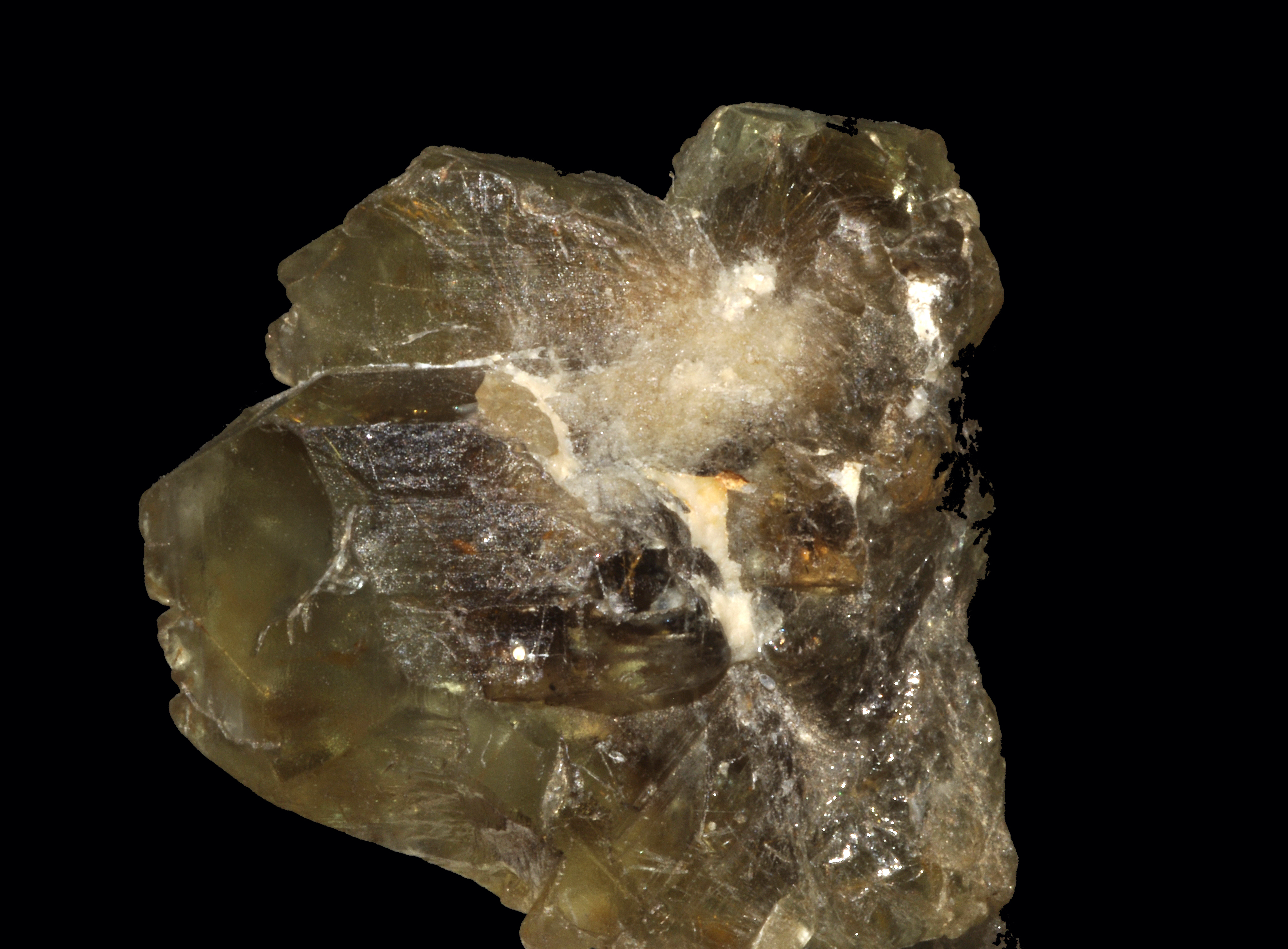
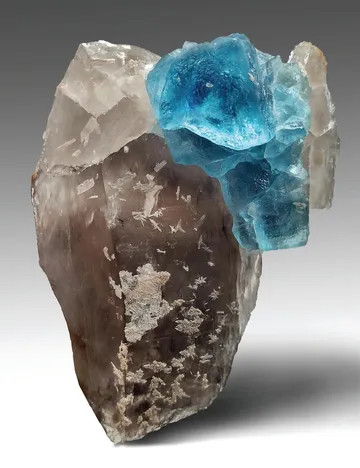
Photo: Géry Parent, Wikimedia Commons

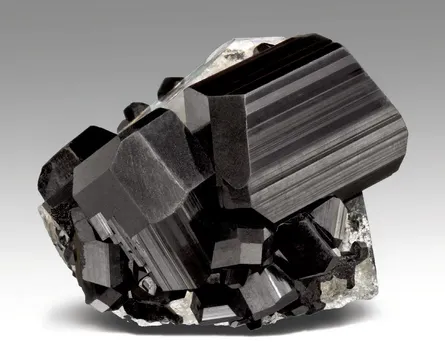
Photo: Rob Lavinsky, iRocks.com, Wikimedia Commons
Search for specimens: View all specimens from Espírito Santo, Brazil
Espírito Santo’s collectible minerals come from several geological settings rather than a single mine. The gem-pegmatite story is tied to the Eastern Brazilian Pegmatite Province and to the Araçuaí–Ribeira orogenic framework of southeastern Brazil. In the south of the state, the Fazenda Concórdia and São Domingos pegmatites sit near the boundary of those orogenic belts: Fazenda Concórdia is in Mimoso do Sul and São Domingos in Muqui. Published geochemical work describes them as simply zoned pegmatites, with Fazenda Concórdia carrying the more evolved collector assemblage: quartz, K-feldspar, albite, muscovite, black tourmaline, aquamarine, colorless topaz, heliodor, phenakite, and related Be-F minerals. The body at Fazenda Concórdia is described as irregularly distributed through an area roughly 300 m by 200 m, trending northwest–southeast, with coarse quartz–plagioclase–muscovite zones, aplite, large zoned K-feldspars, and kaolinized feldspar-rich portions.
The dating and geochemical data are important because they temper the romantic “gem mine” label with a more precise picture. These are not giant complex lithium pegmatites of the kind collectors associate with some Minas Gerais districts; they are relatively simple to moderately evolved bodies that locally became good enough in Be and F to produce aquamarine, heliodor, phenakite, topaz, and attractive feldspar-mica-quartz combinations. A 2020 study interpreted Fazenda Concórdia as more differentiated than São Domingos, while still not highly evolved compared with the classic complex pegmatites of eastern Minas Gerais. Later U-Pb work on zircons from the Fazenda São Domingos and Fazenda Concórdia pegmatites reported a 490 ± 2.1 Ma concordia age for Fazenda São Domingos zircon populations and a 596.2 ± 8.8 Ma upper-intercept age for a dispersed Fazenda Concórdia zircon set, supporting a history tied to the magmatic evolution of the Araçuaí orogen.
Mining history at Mimoso do Sul can be followed at least as far back as Brazilian federal authorizations for aquamarine prospecting. In 1944, Antero Duarte da Fonseca and Constante Vivas were authorized to prospect aquamarine and associated minerals over 40.1786 hectares at the Fazendas Concórdia and Harmonia in the district of São Pedro de Itabapoana, Mimoso do Sul. In 1948 another decree authorized Sebastião Jorge da Silva to prospect aquamarine and associated minerals in Mimoso do Sul. By the 1990s, collector material from the Concórdia/Mimoso do Sul pegmatite was entering the international market as distinctive aquamarine crystals and clusters, including tapered blue to pale green beryl “pencils,” aquamarine on albite or microcline, aquamarine with quartz and muscovite, and rare phenakite-aquamarine combinations.
The chrysoberyl localities form a second, equally important collecting story. Espírito Santo has documented chrysoberyl from Colatina, Itaguaçu, Pancas, Santa Teresa, Água Doce do Norte, and Serra Pelada in Afonso Cláudio, with older literature also referring to the Doce River region around Colatina. The famous specimens are not typically matrix pieces from open pockets in the modern cabinet-mineral sense; they are often loose, etched, or partly contacted crystals recovered from weathered primary or secondary deposits. Itaguaçu, roughly southwest of Colatina, is the name most often attached to the great cyclic sixling twins, including the classic Allan Caplan find of 1940. Colatina and Santa Teresa are also strongly represented in museum and private collections by twinned chrysoberyl, cat’s-eye material, and gemmy yellow-green to green crystals.
Access today should be treated as private-property and mining-title access, not casual rockhounding. Fazenda Concórdia, São Domingos, the Itaguaçu chrysoberyl grounds, and the older Colatina–Santa Teresa occurrences are historically mined or prospected areas on rural land, not managed public collecting sites. Productive specimen recovery has generally been by local miners, claim holders, dealers, and organized field collectors with permission. The collector market now sees Espírito Santo material mainly as older-stock chrysoberyl, 1990s Mimoso do Sul aquamarine, occasional topaz and phenakite pieces, and scattered more recent small finds rather than as a steady stream from a single active specimen mine.
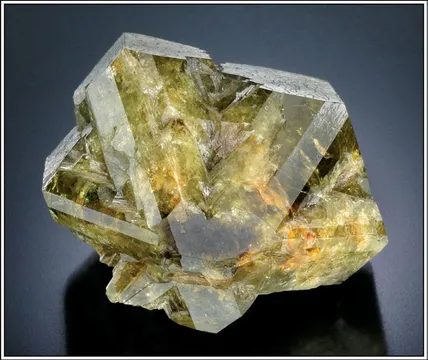
Espírito Santo chrysoberyl is the state’s signature collector mineral, especially from Itaguaçu, Colatina, Santa Teresa, Pancas, and nearby central-northern occurrences, where crystals range from small sharp twins of only a few millimeters to cabinet-size cyclic sixlings; the legendary Itaguaçu pocket produced superb trillings reported up to 9.5 cm, while documented Colatina specimens include large cyclic twins in the 6–7 cm range. The best pieces show crisp V-twinning or complete sixling symmetry, bright vitreous luster, translucency to gemminess, and yellow-green, lime-green, olive, or brownish-green color; many are floaters or loose crystals rather than matrix specimens, and ordinary examples are duller, more abraded, heavily contacted, or poorly resolved twins. Associations in the region include quartz, smoky quartz, albite, beryl, garnet, and other pegmatitic or metamorphic minerals, but value is dominated by crystal architecture: a clean, lustrous, undamaged Espírito Santo trilling with obvious cyclic form is a Brazilian classic.
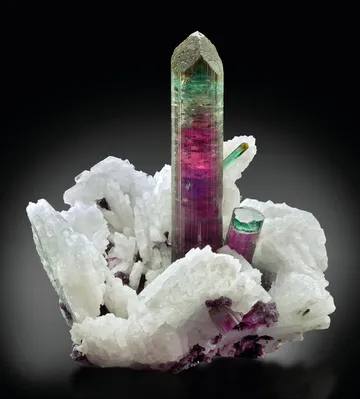
Aquamarine from Espírito Santo is centered on the southern pegmatites of Mimoso do Sul and Muqui, especially Fazenda Concórdia, the São Domingos claim, and related Mimoso do Sul workings, with additional records from Fundão, Ibiraçu, Itaguaçu, and Rio Novo do Sul. The most collectible Mimoso do Sul aquamarines are slender, elongated, sometimes tapered crystals in pale blue to stronger sky-blue or blue-green tones, commonly on albite or microcline and sometimes with muscovite, quartz, smoky quartz, colorless topaz, or phenakite; fine miniatures and small-cabinet specimens from the 1990s are particularly sought after when the termination is complete, the prism faces retain luster, and the base-to-tip color zoning remains visible. Ordinary pieces are pale, etched, contacted, or incomplete, but an elegant “pencil” crystal on contrasting feldspar, or an aquamarine-phenakite association from Mimoso do Sul, has a locality character that is immediately recognizable to collectors.
Non-aquamarine beryl from Espírito Santo overlaps the same southern pegmatite field and is documented at Fazenda Concórdia as common beryl, aquamarine, and heliodor, with the geochemical literature specifically treating beryl chemistry from Fazenda Concórdia and São Domingos. Specimens may be colorless to pale green, blue-green, yellow, or golden-yellow, in hexagonal prisms that can be blockier or more etched than the finer aquamarines; pieces with albite, muscovite, microcline, quartz, topaz, or phenakite are most informative because they preserve the pegmatite paragenesis rather than presenting as anonymous loose beryl. Better Espírito Santo beryl specimens show clean prism geometry, good luster, honest natural terminations, and strong locality association, while lower-grade material may be industrial-looking, heavily altered, or too generically labeled as “Brazil” to be meaningful.
Quartz is a major component of the Espírito Santo pegmatites rather than the headline species, but it gives many Mimoso do Sul and Fazenda Concórdia specimens their setting: clear to milky quartz, smoky quartz, and massive pegmatitic quartz occur with microcline or orthoclase, albite, muscovite, schorl, topaz, aquamarine, and phenakite. At Fazenda Concórdia, quartz is part of the main pegmatite mineralogy, and smoky quartz is a documented association on aquamarine and topaz specimens; in the chrysoberyl district, quartz and smoky quartz are also recorded with chrysoberyl in photo-based associations. For collectors, quartz from this state is most desirable when it is part of a multi-species specimen—blue topaz with smoky quartz, aquamarine on quartz, or chrysoberyl with smoky quartz—rather than as a standalone quartz crystal, unless the label preserves an unusual Espírito Santo locality such as Santa Maria de Jetibá or a named quartz occurrence.
Fluorapatite is a minor but collector-relevant Espírito Santo phosphate, documented from Itarana and represented in the regional mineral list alongside the Be-F pegmatite suite. The available specimen record is far thinner than for chrysoberyl or aquamarine, so Espírito Santo fluorapatite should be judged conservatively: look for well-formed hexagonal crystals, intact terminations, glassy luster, and an old or otherwise credible Itarana/Espírito Santo label. Because fluorapatite is abundant from many more famous Brazilian and international localities, the appeal here is locality specificity rather than world-class size; a modest but sharp Itarana fluorapatite with secure provenance is far more meaningful than a showier apatite carrying only a vague “Brazil” label.
Other documented Espírito Santo minerals broaden the state well beyond its five most traded EarthWonders species. Fazenda Concórdia has produced colorless topaz, phenakite, schorl, microcline or orthoclase, albite, muscovite, and heliodor, and is especially admired for uncommon aquamarine-phenakite and beryl-phenakite combinations. The regional list also includes alexandrite, euclase, Brazilianite, monazite-(Ce), zircon, xenotime, allanite-group minerals, garnet, spinel, corundum, diopside, clinohumite, humite, fluorite, calcite, dolomite, ilmenite, rutile, and native gold from Castelo alluvials. The Cachoeiro de Itapemirim area and Itaoca are important for marble, calc-silicate, skarn, and gneiss-related assemblages rather than pegmatitic gem crystals, and they account for many of the metamorphic species that appear under the broader state heading.
The first rule with Espírito Santo specimens is to insist on locality precision. “Espírito Santo, Brazil” is acceptable for older chrysoberyl labels, but a specimen labeled Itaguaçu, Colatina, Santa Teresa, Pancas, Mimoso do Sul, Fazenda Concórdia, São Domingos, Muqui, or Itarana is far more useful. Mislabeling is most likely where a Brazilian gem species is visually generic: aquamarine from Minas Gerais, Bahia, Pakistan, China, or Namibia can be relabeled loosely as “Brazil,” and older Brazilian stock can drift from a precise mine name into a state-level label after passing through several hands. Conversely, true Mimoso do Sul aquamarine has a recognizable tapered habit and feldspar-mica pegmatite context, but habit alone is not proof.
For chrysoberyl, authenticity concerns are less about treatment and more about locality and condition. Espírito Santo chrysoberyls are commonly loose, naturally etched, or contacted, so a flat contact should not automatically be read as breakage; however, repaired cyclic twins, glued composites, and polished or over-cleaned surfaces should be examined carefully. A true cyclic sixling should show coherent twin geometry, not simply several fragments joined to imitate a trilling. Chips on prism edges, bruised terminations, and internal fractures are common because chrysoberyl is hard but brittle, and many specimens were recovered from weathered gravels or decomposed pegmatite rather than pristine open cavities.
Aquamarine and beryl bring the usual gem-material cautions. Heat treatment is common in the aquamarine trade to reduce greenish or yellowish tones in cut stones, though it is less often the central issue for crystallized specimens. Strongly blue, cheap “aquamarine” should raise suspicion: irradiated blue topaz, glass, synthetic spinel, dyed quartz, coatings, and glued crystals on mica or feldspar are all familiar market problems in the broader aquamarine trade. For Mimoso do Sul pieces, check that crystals emerge naturally from matrix, that contacts make geological sense, and that no glue line or powdered feldspar fill hides the junction.
Condition standards differ by species. A slightly contacted but sharp Espírito Santo chrysoberyl twin may still be important; a broken or poorly terminated Mimoso do Sul aquamarine pencil loses much more of its value. Phenakite associations are fragile and should be handled as delicate pegmatite miniatures rather than as robust beryl specimens. Topaz from Fazenda Concórdia has perfect cleavage and must be protected from shock. Fluorapatite is softer than quartz and beryl, so Itarana pieces should be kept away from harder minerals in storage.
Market availability is uneven. Small Espírito Santo chrysoberyl twins appear regularly, but top-quality Itaguaçu sixlings and large Colatina or Santa Teresa crystals are classic-level specimens and are difficult to replace. Mimoso do Sul aquamarine is obtainable but not abundant in fresh production; many attractive pieces trace to 1990s material and circulate from older collections. Fluorapatite from Espírito Santo is much scarcer on the market than apatite from Minas Gerais, Bahia, Portugal, Pakistan, Mexico, or Canada, and its value rests heavily on verified locality.
The great Espírito Santo chrysoberyl story belongs to Allan Caplan and Itaguaçu. In 1940, Caplan recovered the material that made the locality famous among collectors: a single pocket that produced most of the world’s finest chrysoberyl sixlings. Later accounts emphasize the almost unbelievable concentration of quality—one pocket, a “gunny sack full,” and roughly a dozen great specimens known from the find. The best examples entered major private and institutional collections, including the William Larson collection, the Wayne Leicht collection, the Houston Museum of Natural Science, the Smithsonian Institution, and the Gene and Roz Meieran collection. The story has endured because it sounds like the dream version of field collecting: not a steady mine output, not a commercial parcel assembled over years, but one extraordinary pocket of twinned chrysoberyl that permanently fixed Itaguaçu in mineral-collecting history.
The government paper trail for Mimoso do Sul has its own quieter drama. On August 23, 1944, a Brazilian federal decree authorized Antero Duarte da Fonseca and Constante Vivas to prospect for aquamarine and associated minerals over 40.1786 hectares at the Fazendas Concórdia and Harmonia, in the district of São Pedro de Itabapoana. The decree reads like a surveyor’s walk across a rural gem field: a vertex 815 m from the first fall of the Cachoeira do Ribeirão São Pedro, bearings given by magnetic compass, sides of 200 m east, 680 m at 58°15' northeast, 162 m at 6°30' northwest, 802 m at 82° northwest, 320 m at 25° southwest, and 388 m at 26° southeast. It is a useful reminder that celebrated mineral localities often begin not with a display case but with property lines, waterfalls, farm names, and a legal right to look.
A later generation of collectors remembers Mimoso do Sul for the aquamarines that came out in the 1990s: slim, tapering blue to pale green crystals that looked like natural pencils. Dealers and collectors recognized them quickly because they did not look like the thicker, more familiar Minas Gerais aquamarines. Some were single terminated crystals, others were perched on albite or microcline, and the most memorable examples combined blue beryl with phenakite—an association that gives a small specimen much more mineralogical personality than a loose gem crystal of greater size.