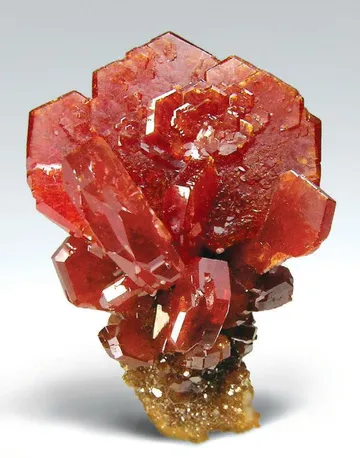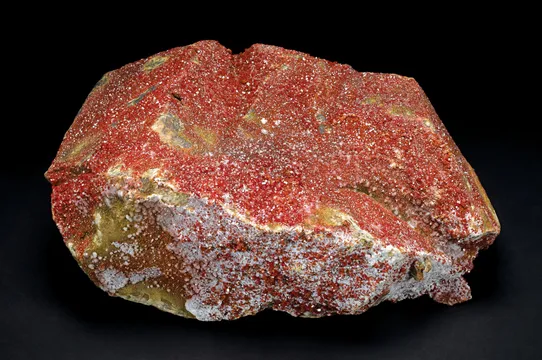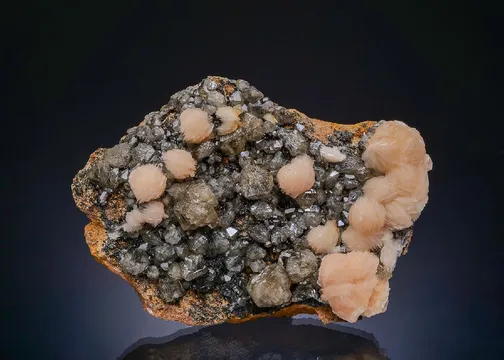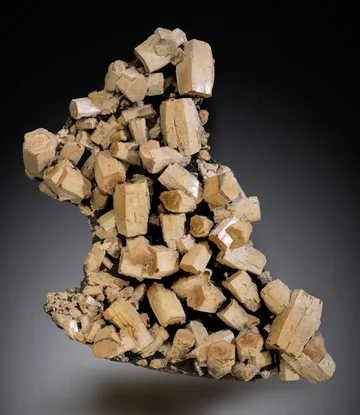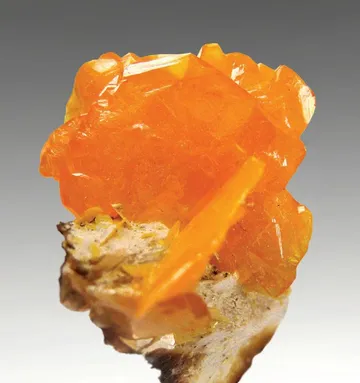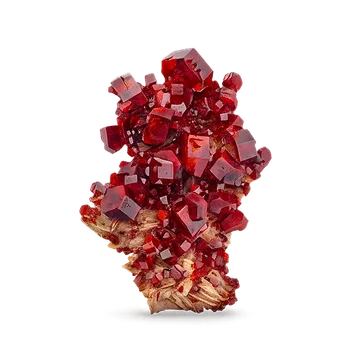
Vanadinite — red to orange-red hexagonal crystals with luster on baryte; iconic Mibladen, Morocco specimens formed as late lead vanadate in arid limestone.
Key facts
Vanadinite from Mibladen is the modern standard by which most collector-grade vanadinite is judged: red to orange-red hexagonal crystals, often brilliantly lustrous, set against pale bladed baryte or light carbonate matrix. The finest pieces have a visual immediacy that is hard to overstate—glassy “hot coal” crystals perched on snowy white baryte, or thick tabular prisms with wine-red centers and orange edges. In cabinet light, good Mibladen crystals can read as both opaque and gemmy at once, flashing through their edges while holding a saturated brick-red body color.
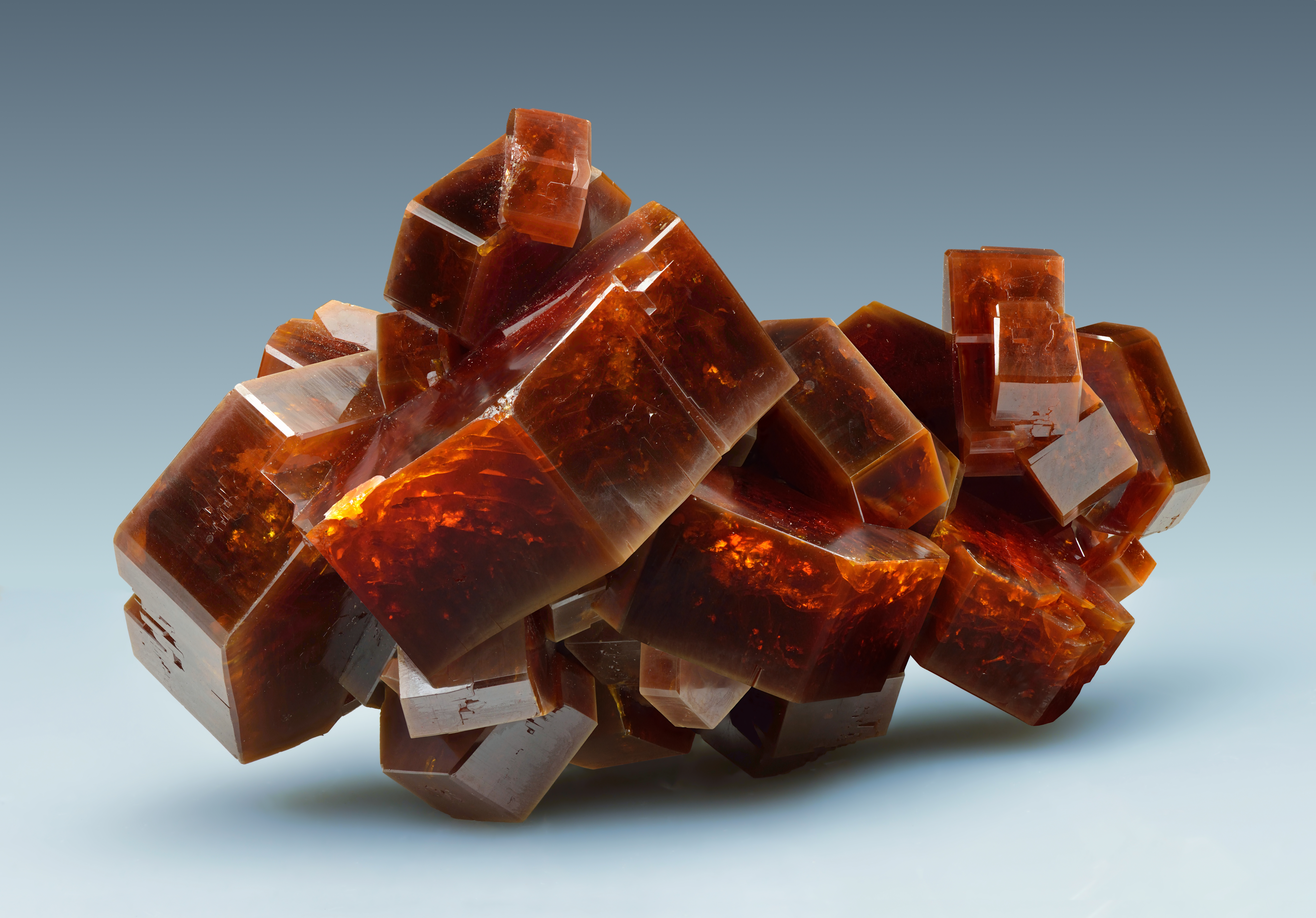
Photo: Ivar Leidus, Wikimedia Commons
Mineralogically, the appeal rests on a very specific setting. Mibladen is a lead-baryte district in the Upper Moulouya area near Midelt, where stratiform baryte and galena mineralization occurs in Liassic limestones and dolomites. Vanadinite, Pb5(VO4)3Cl, is a late supergene lead vanadate: it formed after the primary galena-baryte ores were oxidized and vanadium-bearing solutions interacted with lead in cavities, fractures, and karstic openings. The arid High Atlas climate was important because slow oxidation, limited flushing, and evaporation favored the concentration of vanadate, chloride, and lead-bearing solutions.
Mibladen is not a single neat mine name so much as a district of old shafts, workings, pits, and later specimen diggings. Collectors will encounter locality labels such as ACF Mine, Assif, Coud’a Workings, Bou el Maden, Les Dalles, Les O, Adeghoual, Les AB, Les S, Les T, and other sector names. These labels matter. Bou el Maden material is often recognized by isolated crystals on light carbonate matrix, while the ACF and Coud’a sectors are famous for red vanadinite on white or manganese-darkened baryte.

Photo: Klaproth, Wikimedia Commons
Historically, Mibladen changed from an industrial lead-mining district into one of the world’s great specimen-producing districts. Industrial exploitation began in the early 20th century and expanded under French mining companies, but after the closure of the principal lead operations, local miners increasingly turned to specimen extraction. By the late 20th and early 21st centuries, Mibladen’s name was inseparable from vanadinite. In a 1970 note in , Moroccan vanadinite from Mibladen was already being described as among the finest ever produced, praised for sharp habit, large crystals, and a color range from bright red to rich brown.
For serious collectors, the checklist is precise: crystal size, luster, saturation, isolation, sharpness, damage, matrix contrast, and provenance. A fine Mibladen specimen should show more than just red color. The best examples have architectural spacing, crisp hexagonal form, bright glassy faces, and a matrix that supports the composition rather than smothering it. White baryte with vivid red crystals remains the classic look; skeletal, hollow, thick tabular, parallel-growth, and gemmy translucent crystals add specialist interest.
Search for specimens: View all vanadinite specimens from Mibladen, Morocco
The Mibladen mining district lies in the Midelt area of central Morocco, in the Drâa-Tafilalet Region, between the Middle Atlas and High Atlas domains of the Upper Moulouya district. It is best understood as a carbonate-hosted lead-baryte district rather than a single mine. The main ore system consists of stratiform baryte and galena hosted by Liassic limestones and dolomites, with later oxidation producing the collector minerals that made the locality famous: vanadinite, cerussite, wulfenite, baryte, aragonite, calcite, and associated manganese and iron oxides.
The deposit belongs to the broader Aouli–Mibladen–Zeïda lead province. Mibladen differs from Aouli, which is a vein-style deposit in older basement rocks, and from Zeïda, which is hosted in Triassic sandstones. Mibladen’s mineralization is carbonate-hosted, stratabound, locally karstic, and rich in baryte and lead. Later supergene processes converted primary galena into secondary lead minerals. Vanadinite formed in the more oxidizing, near-surface vanadium-bearing zones, commonly on baryte or carbonate matrix.
The district has at least two important mineralogical horizons. One association is dominated by galena, baryte, cerussite, and wulfenite; another, a few meters higher in parts of the sequence, is the baryte-vanadinite zone. This separation helps explain a feature that collectors should notice: true vanadinite-wulfenite associations from Mibladen are not expected in the classic material, because the two minerals formed under different physicochemical conditions in different parts or stages of the oxidation system.
Industrial lead mining developed through the first half of the 20th century. Between 1926 and 1949, hundreds of shafts were worked, many originally shallow and later deepened or expanded. A flotation plant operated at Mibladen, and lead concentrate was shipped out through the colonial mining network. Production rose during the mid-20th century, then declined as reserves became less profitable and attention shifted to other deposits such as Zeïda. The main industrial phase ended in the 1970s, though some accounts place final closures of associated operations in the early 1980s.
After industrial mining waned, the district’s second life began. Former miners and local diggers turned the old workings, dumps, and new shallow shafts into a specimen-mining landscape. In the 1980s and 1990s, Bou el Maden and other accessible sectors supplied important vanadinite, but the most dramatic collector transformation came with the Coud’a discoveries around 1999 and especially the early 2000s. Those finds produced the red-on-white baryte combinations that reshaped the international vanadinite market.
Several sublocalities deserve special attention:
The ACF Mine, also known in older collector literature as Assif, is one of the district’s most important sources of high-quality vanadinite. It produced tabular, prismatic, hollow, skeletal, red, orange-red, and honey-brown crystals, commonly on white baryte. It is also known for cerussite and baryte, and later pockets from the 2010s and 2020s continued to feed the market with strong material.
The Coud’a sector became famous after discoveries beginning around 1999. It produced some of the most coveted modern Mibladen specimens: large, sharp, intensely lustrous vanadinite crystals, sometimes reaching several centimeters, on white baryte or baryte darkened by manganese oxides. The best Coud’a pieces are among the most competitive Mibladen specimens on the high-end market.
Bou el Maden, meaning “mountain of mines,” is an older sector east of the main village area. It is known for isolated, well-formed vanadinite crystals on light-colored limestone or dolomitic matrix, commonly without the showy white baryte contrast of ACF and Coud’a material. The crystals are often brownish red to orange-red, typically around the centimeter scale, and the best examples show strong geometry and purity of form.
Les Dalles and Les O are better known to many collectors for cerussite, baryte, galena, and wulfenite, but they are part of the same broader lead-mineral story. These workings remind collectors that Mibladen is not only a vanadinite locality: it is a complex secondary lead-mineral district in which different sectors produced different specialties.
Collecting access is not casual field collecting in the modern sense. The area contains old shafts, unstable underground workings, artisanal pits, and active local claims or diggings. Visits require local permission, experienced guidance, and serious safety awareness. Much of the material reaching collectors has been produced by Moroccan miners and dealers from the Midelt area rather than by visiting collectors.
Mibladen vanadinite is most admired for its crystal form and contrast. The classic habit is hexagonal, commonly tabular to short prismatic, with flat pinacoidal terminations and bright prism faces. Crystals may be thick tablets, squat barrels, elongated prisms, parallel-growth stacks, skeletal or hollow forms, and, more rarely, complex hoppered or cavernous crystals. Older descriptions already noted sharp-edged, smooth-faced crystals and occasional cavernous, curved, parallel, or fanlike growth.
The color range is broader than the market’s preference suggests. Mibladen vanadinite can be bright cherry red, ruby red, brick red, orange-red, honey orange, reddish brown, chocolate brown, and, in less common or lower-demand material, yellowish to brownish tones. Deep red on white baryte is the most famous and often the most valuable color contrast, but some advanced collectors also prize thick translucent brown-red crystals, skeletal orange forms, and isolated Bou el Maden crystals on pale carbonate matrix.
Crystal size varies strongly by sector and pocket. Many market specimens show crystals from a few millimeters to around 1 cm. Better pieces may have crystals in the 1–3 cm range. Exceptional Mibladen crystals, especially from Coud’a and certain ACF pockets, can reach several centimeters, with some reported around 5 cm in the best material. Size alone is not enough: large crystals with dulled luster, heavy contacts, or poor composition usually trail smaller, sharper, better-composed pieces.
Matrix is central to the locality’s identity. White baryte blades, crests, and rosettes are the ideal stage for red vanadinite, creating the iconic Moroccan contrast. Baryte may also be colorless, cream, pinkish, honey-toned, or blackened by manganese oxides. Carbonate matrix—limestone or dolomitic marble—is common in Bou el Maden material. Aragonite and late calcite may appear with vanadinite, sometimes as white sprays or coatings. Goethite, manganese oxides, and mottramite are also encountered in some assemblages.
The highest-quality Mibladen specimens combine several factors:
Specialist collectors often separate Mibladen material into several recognizable styles. ACF pieces may show thick tabular crystals and rich red to honey-brown color on baryte. Coud’a specimens often have dramatic red crystals on white or manganese-darkened baryte, sometimes with exceptional luster and size. Bou el Maden pieces tend toward isolated crystals on pale carbonate, valued for geometry and locality character rather than snow-white contrast. Recent unusual material includes vanadinite-coated Jurassic fossils from the Mibladen area, a rare paleomineralogical association in which orange-red crystals cover shells rather than baryte.
Mibladen vanadinite is abundant enough that entry-level specimens remain widely available, but truly excellent pieces are far scarcer than the volume of Moroccan material might suggest. Small red crystals on baryte are common in the market. Fine miniatures with sharp, isolated, lustrous crystals and strong contrast are selective. Cabinet plates with large, damage-free, bright red crystals on attractive white baryte are genuinely competitive specimens.
The most common condition issue is micro-chipping. Vanadinite has a low hardness, around 2.5–3, and a brittle nature. Edges, terminations, and exposed crystals chip easily during mining, trimming, transport, and cleaning. Under magnification, look for rubbed pinacoid faces, broken corners, shattered crystal edges, and areas where crystals have detached from baryte. Baryte itself is also prone to cleavage and edge bruising, so check the matrix as carefully as the vanadinite.
Many specimens carry natural clay, iron oxide, or manganese oxide residues. A little dark manganese staining can be attractive, especially on Coud’a-type baryte, but muddy residues may hide damage. Overcleaned specimens can look harsh, with dulled baryte or exposed contacts. Late calcite or aragonite coatings may be natural; they should be evaluated as part of the paragenesis rather than automatically regarded as dirt or damage.
Documented treatments and outright manufactured fakes are not a major published problem for vanadinite as a species, and specialist references have not recorded a significant fake tradition for Mibladen vanadinite. The more realistic concerns are mislabeling, vague Moroccan locality data, repaired matrix, glued or stabilized areas after mining damage, and exaggerated quality descriptions. Ask for locality precision when it matters: “Morocco” is not equivalent to “ACF Mine, Mibladen,” and Mibladen is not the same as Taouz or other Moroccan vanadinite localities.
Because the mineral contains lead and vanadium, sensible handling is appropriate. Intact display specimens are not dangerous sitting in a cabinet, but avoid inhaling dust, do not grind or cut specimens without proper controls, wash hands after handling, and keep fragile pieces away from children and pets. Avoid soaking in acids or aggressive cleaners; vanadinite can be chemically sensitive, and the associated baryte, calcite, aragonite, and oxide coatings may respond differently.
Market availability remains strong. Moroccan dealers, show tables, online specimen dealers, and auction platforms regularly offer Mibladen vanadinite in all price tiers. The challenge is not finding one—it is finding one with the right combination of luster, color, condition, matrix, and provenance. For a serious collection, prioritize a well-documented specimen from ACF, Coud’a, or Bou el Maden over a larger but anonymous “Morocco” plate.
In 1985, Victor Clay Yount presented “Vanadinite from Mibladen, Morocco” at the Seventh Joint Symposium of Friends of Mineralogy and the Mineralogical Society of America in Tucson. His short abstract reads today like a time capsule from the period when Mibladen had already become legendary but before the great Coud’a rush changed the market again. He placed the district between the Middle Atlas and High Atlas, with the old mines strung along the road from Midelt toward Mibladen, and named Bou el Maden, Assif, and Les T Ouest among the principal vanadinite sources.
Yount’s numbers are the kind collectors remember. He wrote that in his 58 trips to the area there had been only three major strikes. Bou el Maden, he said, was by far the largest producer of vanadinite at Mibladen, but its crystals grew on tan dolomitic marble and only rarely achieved the luster and brilliance of the more renowned Assif material. One large strike at Bou el Maden ran from October 1975 through January 1976, when “a rather large quantity of the finest quality brilliant red crystals” was recovered by the miner MohaBen-Ali. Another strike followed in January 1979. Assif’s fame rested on a different image: white to orange baryte with brilliant red vanadinite crystals perched on top. Yount singled out March 1980 as the most famous strike of that material.
The industrial mine story in Yount’s account had already reached an ending. He wrote that production had always been sporadic, and that with the mine closing in December 1983, the supply was more limited. Mining directors told him the mine would never reopen because the reserve had been depleted to the point that continuing work was no longer economically viable. That conclusion was true for industrial lead mining, but not for collectors. The district’s afterlife was only beginning.
After the lead operations closed, Mibladen became a specimen landscape. The old guarded workings gradually gave way to small-scale local mining. In the 1980s, abandoned peripheral areas and old pits became sources for specimen recovery. By the 1990s, Midelt was developing into a mineral-trading center, with European and American dealers buying directly from Moroccan sources. Then Coud’a changed the rhythm of the district. Discovered around 1999, the sector produced exceptional red vanadinite on baryte beginning in the early 2000s, and the rush drew hundreds, then more than a thousand miners into a maze of small shafts and artisanal diggings.
Field accounts from the early 2000s describe the ACF area less as a tidy mining district than as a living camp of hope and improvisation. One visiting account called it a “mineralogical woodstoock” camp, with miners from different parts of Morocco digging by hand in search of the life-changing pocket. The same account noted the seasonal extremes: cold in winter, summer temperatures climbing toward 35–40 °C, and prospecting carried out mainly by manual labor. That is the human underside of the immaculate red crystals in a display case: hand-dug shafts, sun, dust, waiting, and the chance that a narrow cavity in limestone might open into a pocket of baryte and fire-red vanadinite.
The newest Mibladen story is quieter but scientifically striking. Around 2020, a small number of fossil shells coated with vanadinite were discovered in shallow fossiliferous levels near Jurassic outcrops and later appeared on the market. Instead of forming on baryte, orange-red vanadinite crystals had grown directly on gastropod, bivalve, Nerinea, and other fossil substrates. These specimens connect two events separated by immense time: Jurassic marine life preserved in carbonate sediment, and much later Cenozoic supergene mineralization that carried lead and vanadium into the porous fossil material. For a district already famous for aesthetic perfection, the fossil-coated vanadinites added something rarer: a specimen that is simultaneously mineral, ore-deposit evidence, and paleontological object.