






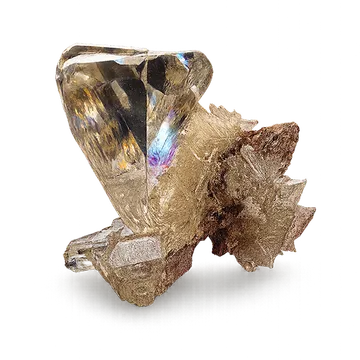
Cerussite from Mibladen, Morocco: glassy PbCO3 crystals in colorless to honey-yellow hues, often with baryte and galena on matrix; UV and collectors' allure.
Key facts
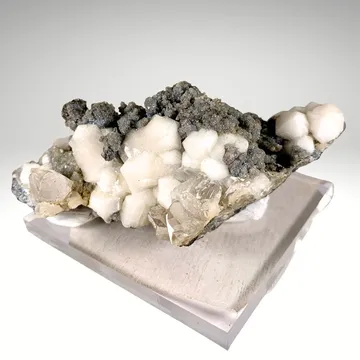
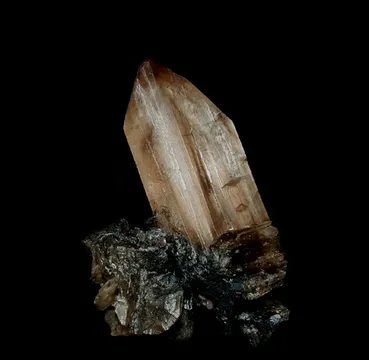
Cerussite from Mibladen has the kind of visual tension collectors remember: glassy lead-carbonate crystals, often colorless to smoky honey-yellow, perched against pink, peach, or white baryte and dark remnants of galena. The best pieces have a distinctly Moroccan palette—warm baryte rosettes or blades, metallic-gray galena, and bright, twinned cerussite that seems too heavy for its delicacy. Under ultraviolet light, many Mibladen cerussites add a second identity, glowing yellow in a way that has made the locality especially interesting to fluorescent-mineral collectors.

Photo: Wikimedia Commons — Didier Descouens
Mibladen is part of the Upper Moulouya lead district near Midelt, on the high plateau between the Middle Atlas and High Atlas. The district is famous above all for vanadinite, but the cerussites belong to a different and more lead-mine-flavored assemblage: baryte, galena, cerussite, and locally wulfenite, especially in the old Les Dalles and Les O workings. Mineralogically, the cerussite records the late supergene life of the deposit. Primary galena in the carbonate-hosted lead system was oxidized in the arid near-surface environment, producing PbCO3 as sharp twins, translucent masses, reticulated growths, and lustrous crystals on the barytic matrix.

Photo: Wikimedia Commons — Géry Parent
For collectors, Mibladen cerussite is not usually about one enormous perfect crystal. Its appeal is the association: a complete miniature or cabinet plate where the cerussite rises from baryte in sculptural, three-dimensional groups. Top examples show sharp cyclic twinning, strong luster, warm yellow or smoky transparency, balanced placement on matrix, and—when present—yellow longwave and shortwave UV response. Older pieces with firm mine attribution to Les Dalles, Les O, or the broader Mibladen district have become Moroccan classics, and the finest can stand comfortably beside better-known cerussite localities such as Tsumeb, Touissit, and Broken Hill.

Photo: Wikimedia Commons — Dguendel
Search for specimens: View all cerussite specimens from Mibladen, Morocco
Mibladen lies in the Upper Moulouya mining district of central Morocco, near Midelt, in what is now Midelt Province, Drâa-Tafilalet Region. In collector usage, “Mibladen” often refers not only to the village but to a roughly district-scale spread of old mines, shafts, pillars, quarries, and artisanal specimen workings. The locality names most relevant to cerussite are Les Dalles Mine, Les O Mine, Les R Mine, Les S Mine, ACF Mine, Adeghoual, Marguerite mine, and related workings in the Mibladen district.
Geologically, Mibladen is a carbonate-hosted lead district. The mineralization is generally described as Mississippi Valley-type, stratabound and locally karstic, hosted by Liassic to Jurassic carbonate and marly carbonate rocks along the Upper Moulouya structural zone. The primary ore was galena, commonly baryte-bearing; the collector minerals—cerussite, anglesite, vanadinite, wulfenite, pyromorphite, and related species—formed through oxidation and remobilization of lead under near-surface conditions.
Mining history at Mibladen is layered. The district was worked industrially for lead in the twentieth century, with French-period mining followed by Moroccan state and local activity. Sources differ in how they bracket the end of major production: collector accounts commonly describe commercial operations ending in the mid-1970s, while environmental and mining literature treats the Mibladen Pb-Zn mine as active into the early 1980s. For collectors, the important shift is clear: after industrial lead mining waned, local miners increasingly worked the abandoned and peripheral zones for specimens, especially vanadinite, baryte, cerussite, and wulfenite.
The cerussite-bearing assemblage is especially associated with the older large-scale lead workings, principally Les Dalles and Les O. These are not the same environment as the narrow, hand-cut vanadinite shafts of Coud’a. Les Dalles and Les O are room-and-pillar-style mine workings where mineralized pillars, ceilings, and barytic seams yielded galena-barite-cerussite material. Mindat lists Les Dalles as a significant underground working, historically also called Lidal, Leedal, or Chantier des Dalles; it was visited during the second Mindat.org conference in November 2012.
Collecting access today should be understood as local, informal, and hazardous. The productive specimen areas are old mine workings and artisanal shafts, not managed public collecting sites. Serious collecting or field visits require local guidance and permission, and old openings should never be entered casually. The mines contain unsupported rock, altered pillars, narrow shafts, and the usual hazards of abandoned lead workings. Most collectors encounter Mibladen cerussite through Moroccan dealers, show supply, and established specimen dealers rather than by field collecting.
Notable finds include classic yellow cyclic-twinned cerussite on pink baryte and galena from older material, gemmy honey crystals on baryte from Les Dalles, smoky matrix-free or nearly floater groups, and fluorescent yellow cerussite specimens. A documented Fabre Minerals specimen from the Uwe Niemeyer collection, labeled Mibladen and dated 1970–1980, is notable for yellow cyclic-twinned dipyramidal cerussite on pinkish baryte and galena and for having been published in The Mineralogical Record. More recent dealer and database examples show that the district continues to release attractive specimens, though the best balanced, undamaged, strongly twinned cabinet pieces remain far less common than ordinary baryte-galena-cerussite fragments.
Mibladen cerussite is first and foremost a twinned cerussite locality. The crystals may be simple prismatic to dipyramidal, but the characteristic pieces show repeated twinning: cyclic twins, flattened twinned blades, reticulated or skeletal aggregates, sheaf-like forms, and wheel-like growths. Some groups are translucent and glassy, while others are satiny, milky, or smoky, with finely stepped faces and complex re-entrant angles.
Color ranges from colorless and water-clear through milky white, smoky gray, straw-yellow, honey-yellow, and warm brownish yellow. The yellow crystals are especially prized when they are transparent enough to show internal light and bright enough to contrast with pink or orange baryte. Mibladen cerussite can also form gray crystalline crusts and small sparkling druses on galena-rich matrix; these are attractive association pieces but usually do not command the same interest as sharp, isolated twins.
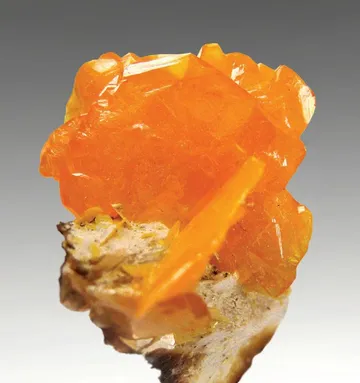
The typical collector matrix is baryte with galena. Baryte may be white, cream, peach, orange, or pink, and it often forms bladed clusters or rosettes that set off the cerussite beautifully. Galena may appear as dark metallic remnants, granular gray masses, or altered patches partly replaced by cerussite. Wulfenite is a desirable but less common companion, usually orange to yellow-orange; malachite, calcite, dolomite, and minor iron or manganese oxides also occur on some pieces.
Specimen sizes vary widely. Miniatures with individual crystals under 1 cm are common in trade. Good cabinet specimens may carry cerussite crystals around 1–3 cm, and selected pieces show larger crystal groups or main crystals exceeding 4 cm. Published and dealer-recorded Mibladen specimens include examples in the 5–8 cm range, while older cabinet plates over 10 cm with balanced baryte and cerussite are particularly desirable when undamaged.
Quality factors are specific and unforgiving. The best Mibladen cerussites have: sharp twinning; good transparency or pleasing smoky translucency; high luster; a natural, balanced position on baryte; minimal bruising to crystal tips and edges; and either an attractive pink/orange baryte contrast or a strong yellow fluorescence. A modest crystal in a perfect place on a beautiful baryte matrix can be more desirable than a larger but crowded or damaged group. Conversely, a large yellow twin with poor luster or heavy bruising loses much of what makes Mibladen material sing.
Fluorescence is one of the locality’s distinctive bonuses. Many Mibladen cerussites luminesce yellow under longwave ultraviolet light, with some also responding yellow under shortwave. The response is not universal for all cerussite worldwide, and even within Mibladen material it should be treated as a locality trait rather than an identity test. Still, a fine daylight specimen that also glows bright yellow under UV has extra appeal in both systematic and fluorescent-mineral collections.
Mibladen cerussite is abundant enough that representative specimens remain available, but genuinely fine pieces are selective purchases. Common trade material includes small cerussite crystals on baryte and galena, grayish crusts, and modest twinned crystals. Better pieces—gemmy yellow twins, undamaged reticulated or cyclic groups, sharp crystals on pink baryte, or old labeled Les Dalles material—are much scarcer and should be judged individually rather than by locality name alone.
Condition is the first concern. Cerussite is dense, brittle, and relatively soft, and its edges bruise easily. Mibladen crystals often sit exposed on baryte blades, so the most attractive pieces are also the easiest to damage. Examine terminations, re-entrant twin angles, and projecting baryte blades under magnification. Small chips can hide in complex twinned groups, and contact marks on the high points are common. Matrix pieces may also have unstable baryte blades or crumbly galena-rich zones.
Authenticity issues are usually about attribution and identification rather than elaborate treatment. Mibladen baryte-galena-cerussite specimens are visually distinctive, but Moroccan material is often traded in mixed lots, and vague labels such as “Morocco” or “Midelt” can obscure whether a piece is truly from Mibladen, Les Dalles, Les O, Aouli, or another Moroccan lead district. Transparent cerussite on baryte is also sometimes misidentified by non-specialist sellers as quartz, fluorite, calcite, or “crystal on barite.” A simple specific-gravity impression—the surprising heft of PbCO3—often helps, but destructive tests are inappropriate on collectible specimens.
Documented, locality-specific dyeing or irradiation treatments are not a normal issue for Mibladen cerussite in the way they are for some other mineral species. Repairs, however, are always possible on protruding crystals and baryte plates. Look for unnatural glue lines at the base of isolated twins, mismatched dust in crevices, and baryte blades that appear reset. On high-value older pieces, provenance matters: old collection labels, dealer history, and a specific mine name can add confidence and value.
Fluorescence should be evaluated carefully. A strong yellow UV response is attractive, but lack of fluorescence does not disprove cerussite, and fluorescence alone does not prove Mibladen. Likewise, a very bright response can make a modest specimen exciting in a UV cabinet, but it does not compensate for poor daylight form if the piece is being bought as a fine mineral specimen.
For market availability, Mibladen cerussite sits in a useful middle ground. Attractive thumbnails and miniatures are obtainable; good miniatures and small-cabinet pieces on baryte still appear from specialist dealers; and older, published, or unusually aesthetic cabinet specimens are increasingly competitive. Collectors seeking one definitive example should prioritize a matrix piece with pink or orange baryte, visible galena, sharp twinned cerussite, and clean condition. If fluorescence matters, ask for both daylight and UV photographs and confirm the wavelength used.
The field stories from Mibladen divide almost exactly along mineralogical lines. The vanadinite miners worked narrow hand-cut shafts and cramped tunnels, while cerussite collectors entered the old industrial lead mines—large room-and-pillar spaces where the remaining mineralization could be literally holding up the roof.
On a 2012 Mindat conference field trip recounted by Raymond McDougall, the Mibladen district appeared first as open high-plateau country outside Midelt, a regional town whose storefronts made clear how deeply minerals had entered the local economy. Local officials and dealers estimated to him that roughly ten percent of Midelt’s annual GDP came from collector minerals, fossils, and related businesses. The trip then moved underground. In the Coud’a vanadinite workings, the guide Abdellah led visitors down rope-access shafts where the tunnels were so narrow that McDougall warned the visit was “a bad idea for anyone who doesn’t like small closed spaces.” When a working became too narrow, too dangerous, or simply exhausted, Abdellah’s method was starkly simple: return to the surface and spend the next eight weeks sinking a new shaft by hand until the mineralized zone was reached again. The rules he described allowed no power tools and no explosives.
The cerussite ground was different. Les Dalles and Les O were old room-and-pillar lead workings, broad enough to feel like mines rather than burrows. There, the baryte-galena-cerussite seams remained in pillars and ceilings. The unsettling logic of specimen recovery was that the pillars contained the last untouched mineralization from the layer that industrial miners had left behind. As McDougall put it, the pillars were left for a reason: “There’s a lotta rock overhead.” Yet collectors could see where mineralized pillars had been robbed for specimens, sometimes leaving not much pillar at all. He noted that, apparently, there had not been collapses from that pillar robbing, but the description is enough to explain why Mibladen field collecting belongs to experienced local miners rather than casual visiting collectors.
The same trip produced one of the most improbable scenes in modern mineral-collecting lore: a formal dinner underground at Les Dalles. Attendees were told only to change into decent clothes and board the shuttles after dark. Temporary spotlights marked the mine entrance. Inside, a section of the room-and-pillar workings had been turned, for one night, into a dining hall large enough for the conference group, formally dressed servers, and local musicians. The meal was served on fine china. For collectors accustomed to eating a packed lunch from a backpack at mineral localities, a multi-course dinner inside a world-class Moroccan lead mine was as theatrical as any specimen pocket.
There is also a smaller but mineralogically important field note from November 2022. During a Young Mineral Collectors trip to Morocco led by Tomasz Praszkier, cerussite and wulfenite were observed in the same mineralized horizon as vanadinite, and in close proximity to it, in the Coud’a “Mibladen” workings. That observation is notable because the classic collector shorthand separates Mibladen into two assemblages: vanadinite-baryte at Coud’a and ACF, and cerussite-wulfenite-baryte in the old lead workings such as Les Dalles and Les O. Field observations like this remind us that deposits are messier than labels, and that even in a locality as heavily collected as Mibladen, the boundaries between parageneses can still surprise.

.JPG)
