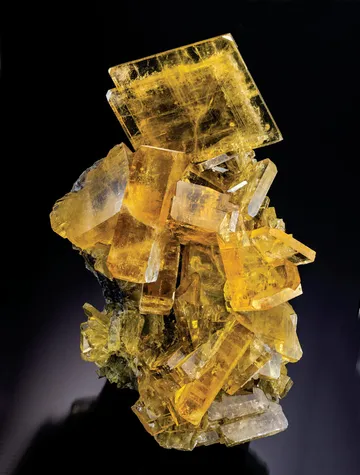
Meikle Mine, USA - Carlin Trend locality in Elko County, Nevada, famed for honey-yellow barite on calcite crystals from active cavities, prized by collectors.
Key facts
Meikle Mine is one of the rare localities where a world-class orebody and a world-class specimen occurrence occupy the same underground address. The mine lies in the Goldstrike area of the northern Carlin Trend in Elko County, Nevada, within the Bootstrap Mining District, and its economic identity is unmistakably that of a high-grade Carlin-type gold deposit. For collectors, however, Meikle is remembered for something visually improbable: hot, deep mine cavities lined with transparent yellow to amber barite and lustrous calcite, opened during active underground gold mining rather than by recreational collecting.
Geologically, Meikle is a structurally focused, sediment-hosted gold system developed in lower-plate Paleozoic carbonate rocks, especially Bootstrap limestone and related Roberts Mountains–Popovich stratigraphy, cut and disturbed by faults, breccias, and intrusive rocks. Its gold is mostly invisible, carried in fine-grained pyrite formed by sulfidation and replacement of iron-rich carbonate rocks. The collector minerals belong largely to a later cavity history: post-ore dissolution and collapse of carbonate produced open spaces, and those spaces were later cemented and lined by calcite and barite. That sequence explains the striking contrast between Meikle’s economic ore—dark, altered, pyritic, and microscopic in its gold—and its finest specimens, which can look like honey glass perched on pale calcite from a lit cavern.
Regional View
Country View
The best Meikle barites are instantly recognizable: lemon-yellow, honey-yellow, orange-gold, or amber crystals with bright glassy luster, ranging from sharp tabular plates to thicker blades and spear-like forms. Many sit on cream, tan, smoky, gray, or greenish calcite; others occur on friable limonitic or silicified matrix. Exceptional specimens combine transparency, saturated color, undamaged edges, and an airy arrangement of crystals rather than a crowded crust. The mine also produced distinctive calcites—dogtooth, “potato-chip,” blocky, bladed, twinned, and clear crystals—along with rarer sulfides and sulfosalts that appeal to systematic collectors.

Photo: Wikimedia Commons
What makes Meikle especially compelling is the controlled, industrial context of the finds. The important specimens did not come from a casual claim dump or an open collecting pit. They were recovered from an operating underground gold mine with heat, gas, unstable ground, production schedules, and safety constraints shaping every opportunity. Labels that record a mine level, stope, drift, or named cavern are therefore more than decorative provenance; they preserve the physical story of where the crystals were encountered in a complex underground ore system.

Photo: Wikimedia Commons
Search for specimens: View all specimens from Meikle Mine, USA
Meikle Mine is part of the Goldstrike mining complex on the northern Carlin Trend of northeastern Nevada, in the Bootstrap Mining District of Elko County. The locality is widely listed as Meikle Mine, Bootstrap Mining District, Goldstrike Mines, Elko County, Nevada, USA. Mindat places it at approximately 40° 59' 49" N, 116° 22' 45" W. In mining literature the deposit was formerly known as the Purple Vein, and it is situated north to northwest of the Betze-Post open-pit area within the broader Goldstrike system.
The deposit is a sediment-hosted, Carlin-type gold deposit. Its richest ores formed where permeable, reactive, iron-rich carbonate rocks were altered, fractured, and brecciated before being invaded by Eocene Carlin-type fluids. The key host setting is lower-plate carbonate stratigraphy associated with the Bootstrap limestone, Roberts Mountains Formation, and Popovich Formation, with the Roberts Mountains thrust and later fault systems forming part of the regional structural architecture. The ore-forming fluids were hot, acidic, H2S-rich, and capable of dissolving carbonate while adding gold-bearing pyrite. In the most favorable breccias, replacement and dissolution were so complete that pyrite and insoluble residues accumulated as very high-grade internal sediments.
Meikle’s orebody is not a simple vein. Technical descriptions divide the deposit into zones that include the Main Zone, East Zone, Meikle Extension, South Meikle, and Lamprophyre Zone. The Main Zone and related pipe-like zones parallel the Post Fault system and trend roughly northwest, while South Meikle and the Lamprophyre Zone include flatter components influenced by stratigraphy and intrusive contacts. Gold is concentrated in silicified and pyritized hydrothermal and collapse breccias, especially near Bootstrap limestone footwall rocks, with rhyodacite, dacite, monzonite, and lamprophyre intrusions contributing important structural and permeability contrasts. Typical alteration recorded for the mine includes silicification, argillization, pyritization, and dolomitization.
The famous specimen cavities belong to a later chapter than the gold ore itself. Geological work on the calcite-barite collapse breccias interpreted the barite and calcite event as post-ore and late Pliocene, around 2 million years old—far younger than the main Carlin gold mineralization. Oxidized descending waters mixed with reduced H2S-rich waters, producing sulfuric acid that dissolved carbonate and enlarged cavities. Later low-temperature fluids deposited calcite and barite in the open spaces. This is why collector specimens can line voids and caverns in an ore mine whose gold mineralization is otherwise microscopic.
Historically, the Purple Vein area had earlier mercury interest, and Meikle’s recorded ore assemblage includes cinnabar and metacinnabar along with gold-bearing pyrite and other sulfides. The gold discovery was made by drilling in 1989; the shaft was developed in 1994–1995; production began in September 1996 and reached full production in 1997. Older Barrick-era references describe Meikle as a major high-grade underground mine within Goldstrike. The modern operating context is Nevada Gold Mines, the Barrick-Newmont joint venture formed in 2019, with Barrick holding 61.5% and Newmont 38.5%. The Carlin Complex remains an active industrial mining operation, and Meikle is not a public collecting locality.
The best-known specimen recoveries began in the mid-1990s and became documented in the late 1990s. Early collecting by employees, contractors, and unauthorized parties was followed by controlled recovery work involving mine permission, safety support, and specialized access. The most important barite-producing interval was the upper part of the mine, especially around the 975 and 1075 levels, with additional finds on the 925, 1125, 1225, 1275, and other levels. The 975-level stope 3525 pocket produced transparent yellow to yellow-gold square tabular crystals to about 6 cm on friable limonitic matrix. The 1075-level cavern near the batch plant—the “George Bush cavern” in collector accounts—was lined with calcite and carried orange barite, commonly spear-shaped, with crystals reported to 20 cm. The 1125-level small cavern measured roughly 16 feet deep, 18 feet wide, and 5 feet high, with large thick tabular crystals lining the back and ribs but curiously absent from much of the floor. The 925-level stope 3675 produced the distinctive occurrence of yellow barite on quartz, while the 1225 level behind the mechanics bay yielded attractive rosette-like lemon-yellow barites.
Calcite pockets were encountered at several levels and in different habits. Before January 1999, collector accounts emphasize “potato-chip” calcite and cloudy to smoky dogtooth calcite. A large cave off the Griffin drift produced lime-green blocky and bladed calcite, some with dark tips. Gemmy calcite twins were found on the 1450 and 1650 levels in January 1999, and clear calcites were reported from a decline off the 1750 level in March 1999. Some voids lay directly in the path of mining and ramp development, so collecting depended on whether management and crews could safely allow access before ground support, backfilling, or production needs ended the opportunity.
Access today should be treated plainly: Meikle is an active or historically active underground mine within a major operating gold complex, not a collecting site. Modern specimens enter the market through old recoveries, mine-related provenance, dealer inventories, estate collections, and occasional pieces from older hoards. Any claim of recent casual collecting at Meikle should be viewed with caution unless supported by credible documentation from the mine operator or a verifiable recovery history.
Barite from Meikle is the locality’s signature collector mineral: transparent to translucent lemon-yellow, yellow-gold, honey, amber, and orange-gold BaSO4 in sharp tabular, thick tabular, bladed, and spear-shaped habits, commonly associated with calcite and locally with quartz or pyrite. The main collector production came from hot underground cavities in the upper mine, particularly the 975- to 1075-level interval, with famous pieces from the 975-level stope 3525 pocket, the 1075-level batch-plant cavern, the 1125-level small cavern, the 925-level stope 3675 quartz association, and the 1225-level mechanics-bay rosette occurrence. Crystals range from thumbnails and miniatures to cabinet plates, with individual crystals documented to several centimeters routinely and exceptional crystals around 20 cm from the 1075-level cavern. The best Meikle barites are separated from ordinary pieces by saturated golden color, high transparency, glassy luster, crisp undamaged edges, architectural spacing, and reliable level or stope provenance; heavily cleaved, bruised, dull, or crowded crusts are far less desirable.
Baryte—the same mineral species listed by the international spelling—is represented at Meikle by the classic golden tabular crystals that made the mine famous among late-20th-century American localities. Collector descriptions emphasize two principal habits: gemmy tablet-shaped crystals and flatter spear-shaped crystals, with colors from pale lemon through gray-yellow to honey-orange; specimens may occur as free-standing clusters on limonitic or silicified matrix, as yellow blades on calcite, or as unusual styles such as the delicate “sugar cookie” habit of paper-thin baryte squares over a fine calcite network. The most sought-after baryte pieces are those with unambiguous Meikle provenance and three-dimensional display quality, especially 1997–1999 material from named levels and stopes. Good baryte here is not merely yellow—it has a wet, glassy brightness and internal clarity that lets the crystal seem lit from within, while lesser pieces suffer from internal fracturing, contact marks from the vug wall, bruised edges, or friable matrix that has been over-trimmed or stabilized.
Calcite from Meikle is more varied and less famous than the barite, but it is essential to understanding the specimen pockets: the large solution-collapse cavities were commonly lined first and most abundantly with calcite, with barite appearing only in selected areas. Documented habits include sub-euhedral cavity linings, cloudy to smoky dogtooth crystals, thin “potato-chip” forms, lime-green blocky and bladed calcite from the Griffin drift area, gemmy twins from the 1450 and 1650 levels, and clear crystals from a 1750-level decline. Mindat records calcite crystals to 25 cm from the mine. The most collectible Meikle calcites are sharp, lustrous, isolated, transparent to translucent, or unusually colored—especially pale golden twins and lime-green blocky or bladed pieces—while ordinary material can be massive, contacted, cloudy, cleaved, or simply too common as cavity lining to compete with the barite associations.
Beyond barite and calcite, Meikle has a broader Carlin-type and post-ore mineral suite attractive to systematic collectors. Documented species include pyrite, marcasite, dolomite, quartz, sphalerite, stibnite, cinnabar, metacinnabar, goethite, gypsum, halotrichite, jarosite, galena, chalcopyrite, boulangerite, miargyrite, pyrargyrite, tetrahedrite-group minerals, tellurobismuthite, apatite, bassanite, brannerite, and englishite. Millerite is a notable rarity from Meikle, reported as fine metallic needles, sometimes with pyrite, and treated in a dedicated Rocks & Minerals collector note in 2003. A single pocket of pyrite-coated barite was reported from lower levels around 2000, with only about a dozen specimens to roughly 4 cm recovered. I found no verified evidence that Meikle is the type locality for a valid mineral species; its importance rests instead on world-class barite, important calcite, and a suite of unusual Carlin-related sulfides, sulfosalts, sulfates, and secondary minerals.
The principal authenticity issue for Meikle specimens is locality confidence, not a well-established tradition of outright manufactured fakes. Golden tabular barite from Cerro Warihuyn in Peru, Nevada’s Dee and Gold Quarry areas, Colorado, China, Morocco, and other sources can resemble Meikle in photographs, especially when cropped close. A trustworthy Meikle attribution is strongest when supported by an old label, a known dealer or collection history, or specific mine data such as 925, 975, 1075, 1125, 1225, 1275, 1450, 1650, or 1750 level; stope numbers such as 3525, 3475, or 3675; or wording such as Goldstrike, Bootstrap District, Griffin drift, South Meikle, batch plant cavern, or George Bush cavern.
Condition is the second major issue. Barite is heavy, cleavable, and easily bruised, and Meikle specimens were recovered from difficult hot cavities, often on friable limonitic matrix or delicate calcite. Examine crystal edges and corners under magnification for tiny percussion chips, bruising, cleaves, or repaired terminations. Inspect matrix joins and hidden contact points for glue, resin, or color-matched fill. Large plates deserve special scrutiny because natural matrix cracks, extraction breaks, and post-recovery stabilization can be hard to distinguish under normal show lighting.
Internal fracturing is particularly relevant at Meikle. Early museum and collector accounts note that the first larger crystals brought from the heated mine environment into cooler offices developed fractures, forcing staff to experiment with safer handling. That history makes truly clean, transparent crystals especially desirable. A crystal can still be authentic and attractive with internal veils, thermal cracks, or small contact marks, but pricing should reflect them.
Calcite should be checked for cleavage damage, bruised tips, and acid-cleaning effects. Sharp golden or clear twins and greenish blocky crystals are much less common than ordinary calcite-lined cavity fragments, and a calcite specimen with a strong Meikle label can be more interesting than a generic “gold mine calcite” with no level information. Mixed barite-calcite pieces are usually preferred when the two minerals are visually balanced rather than when the barite is lost in a thick crust of calcite.
Some Meikle material has been discussed by collectors as mildly radioactive “radian barite,” but that should not be assumed for ordinary Meikle barite. Uranium-bearing species such as brannerite are documented from the mine, and any unusually active specimen should be handled with the normal mineral-collector precautions: keep it dry, avoid generating dust, do not store it against sensitive photographic or electronic materials, and test with a meter if radioactivity is claimed as a selling point. For most Meikle barite and calcite specimens, the more practical hazards are weight, brittleness, cleavage, and matrix fragility.
Market availability is steady but uneven. Small and mid-size Meikle barites appear regularly because the late-1990s recoveries distributed a meaningful number of specimens into the trade. Fine cabinet pieces with saturated color, strong transparency, no repairs, and old labels are much scarcer. Museum-level plates, 1075-level spear-shaped crystals, well-documented 975-level stope 3525 material, large barite-on-calcite combinations, and rare habits such as pyrite-coated barite or barite on quartz should be treated as premium provenance pieces rather than routine Nevada barites.
The most memorable Meikle story begins not with a collector in the desert, but with miners cutting into hot darkness more than 1,000 feet underground. A Nevada State Museum account described the caverns as unlike familiar tourist caves such as Lehman Caves or Carlsbad Caverns; a Meikle employee likened them instead to the mine of the seven dwarfs in Disney’s Snow White. The comparison sounds fanciful until one imagines the scene: rounded masses covered in glittering calcite, transparent barite crystals flashing in mine light, and heat pouring from openings in the rock. One cavern was reportedly sealed because it was “belting out” 140-degree heat, worsening already difficult underground conditions. Another cavern was preserved as an illuminated exhibit area for limited business tours, so visitors could understand both the deposit and the working needs of the mine.
Barrick donated Meikle specimens to the Nevada State Museum, and the description reads almost like a confectioner’s inventory: lemon-yellow barite in thin and thicker square forms, small elongated prisms, stocky tabular clumps, and crystal surfaces with criss-cross reflective patterns. The most whimsical habit received the nickname “sugar cookie”—tiny paper-thin squares of barite encrusting a delicate calcite network. The museum account also records a practical lesson that only an underground mine could teach: larger crystals moved too quickly from the hot mine into cool offices developed disappointing fractures, so staff had to work out safer ways to bring them up.
The first documented collector visit in July 1997 had the feel of an underground expedition rather than a dig. The collectors descended in a cold cage wearing several layers, then began peeling those layers off as they moved through the drift and approached hotter working faces. At the 975 level, stope 3525, a pocket had opened in the lower right corner of the stope. It was lined with transparent yellow to yellow-gold square tabular barites to about 6 cm on friable limonitic matrix, and the pocket continued steeply downward to the right as far as the light would reach. It was beautiful but impossible to enter: the space was too tight, the heat too great, and sulfur dioxide gas present. The limonite was still hot to the touch, and nearby thermal steam escaped from another void.
On the same early tour, the party reached the 1075 level near the batch plant, away from the orebody. During construction of the plant—where concrete was mixed with waste rock to backfill mined-out stopes—a large cavern had been opened and preserved. Calcite lined the chamber, and in selected areas orange barite crystals reached about 20 cm, many in flat spear-shaped habits. Contractors had already collected some crystals during development; the remaining specimens demanded equipment and planning. That cavern became one of the reference points for Meikle collecting lore, the “batch plant cave” or “George Bush cavern.”
By early February 1998, the recovery effort had become formal enough that a contract was signed. Even then, specimens reached the market in fits and starts. A few pieces appeared at the February 1998 Tucson show after the mine superintendent provided samples from his office, but the work underground remained subordinate to production and safety. Some of the early 1075-level pockets came from stope 3475, the same apparent breccia-pipe structure seen above at the 975 level. Most were on friable limonite, though some later pieces came from hard black silicified limestone.
One January 1999 collecting attempt captures the frustration of Meikle perfectly. A date had been scheduled two months in advance to shoot a round in a known barite-producing area. When the collectors arrived on Monday, mining delays meant the holes had not yet been drilled. They worked calcite areas for several days while waiting. By Thursday the holes were ready, but the ground measured more than 164° F—too hot to load. A couple of hours later it had cooled to an average of 127° F, acceptable but too late to blast. The night crew loaded and shot the round, and the collectors returned Friday with the day shift. Mine crews installed support so the area could be entered safely, and collecting continued through Friday and part of Saturday. They planned to return Sunday, but an incident elsewhere at the mine prevented it; the area was later designated unsafe. The planning, labor, machinery, and anticipation vanished into the reality of underground mining.
The 1125-level cavern offered another kind of oddity. It was small—about 16 feet deep, 18 feet wide, and 5 feet high—but crystal-lined. Barites covered the back and ribs, yet the floor was mostly barren except where large crystals occurred locally. Underground crews provided ground support, power, and air so recovery could proceed. The crystals were large, thick, and tabular, and broken clear sections were good enough to yield sizable clean faceted stones.
Not all Meikle collecting happened standing upright. The 1225-level voids behind the mechanics bay produced lemon-yellow rosette-like barites, but the cavities were elevated, required ladder access, and were barely large enough to kneel in. The most comfortable collecting position was prone, with only the collector’s boots protruding into the drift. Another elevated void in the South Meikle Drift required a ten-foot ladder and already had wire mesh installed for wall support. To collect, the mesh had to be pulled back, pressing the collector awkwardly between the wire and the opening with restricted arm movement.
Calcite provided its own underground spectacle. A January 1999 void on the 1650 level was described as a “crystal cathedral,” with a second elevated crystalline calcite room nested inside the larger chamber. Mine-lamp reflections off countless calcite faces provided enough light for photographs, but there was almost no time: safety required the void to be filled with concrete. Collectors worked only as long as it took the concrete to dry, saved by the fact that the cavern was large enough to extend the drying period. The mental image is unforgettable—a collector sitting in an upper calcite sanctuary, suspended like a chandelier within a larger crystallized room, while backfill steadily reclaimed the space.