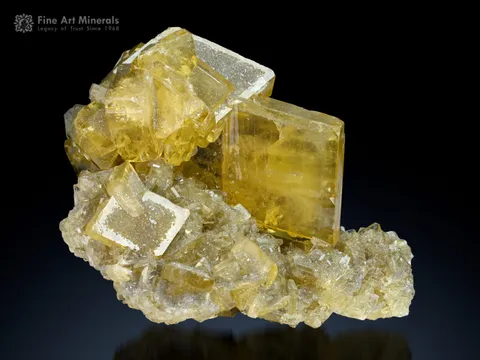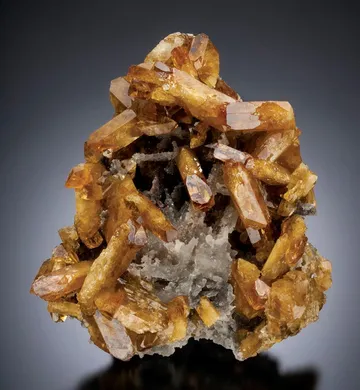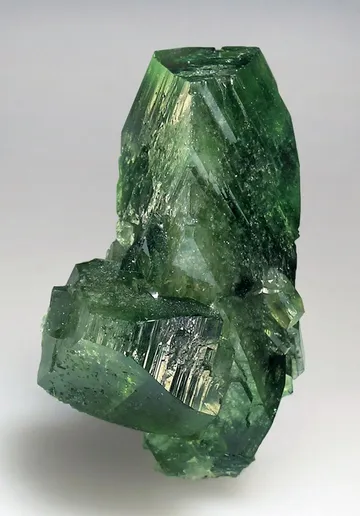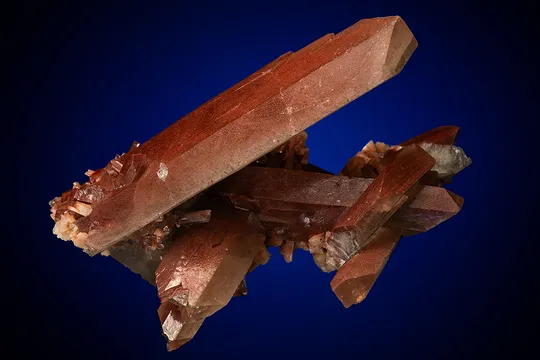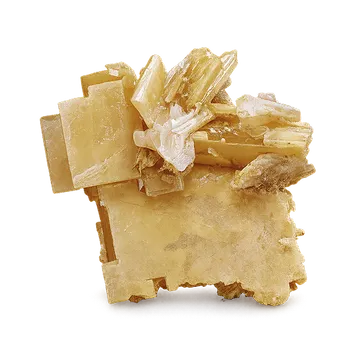
Meikle Mine barite - high-grade lemon-yellow to amber crystals with glassy faces from a Carlin-type system; prized for color, luster, and standout locality.
Key facts
Meikle Mine barite is one of the great modern American mineral-specimen stories: a high-grade underground gold mine on Nevada’s Carlin Trend that unexpectedly opened vugs and caverns lined with gemmy golden barite. The best specimens have a look that is instantly recognizable—transparent to translucent lemon-yellow, honey-gold, amber, or orange-gold crystals with bright glassy faces, often perched on cream, gray, or greenish calcite from hot underground voids.
What makes the locality special is not simply that the crystals are attractive; it is the combination of color, transparency, luster, crystal size, and geological drama. These are not ordinary vein barites casually pried from a roadside prospect. They formed in solution-collapse cavities deep in a major Carlin-type gold system, after the main gold event, and were recovered only because mine personnel and professional specimen collectors recognized their natural-history value during production mining.
The Meikle barites collectors most prize are stout tabular crystals, sharp square tablets, thick blades with chisel or serrated-looking terminations, and sculptural groups on calcite matrix. Fine examples have a strong internal glow: golden in reflected light, brighter and more transparent when backlit. Matrix specimens with contrasting calcite can be visually superb, but clean single crystals and crystal clusters are also important, especially where the faces are bright, the terminations sharp, and damage minimal.
Historically, the locality arrived fast. The Meikle deposit was discovered as a gold deposit in 1989, developed in the mid-1990s, and entered production in 1996. By the late 1990s, barite from the mine was already being treated as a world-class modern classic, with articles in The Mineralogical Record and Rocks & Minerals documenting the discovery and recovery of specimens. The locality’s best material therefore belongs to a short, well-defined window of specimen production, and most fine pieces on the market today are older recovered material moving from collections rather than fresh mine production.
Search for specimens: View all barite specimens from Meikle Mine, Nevada, USA
The Meikle Mine is part of the Goldstrike operations in northern Nevada, north of Carlin in Elko County. Mineral labels most often place it in the Bootstrap Mining District, Goldstrike Mines, Elko County, Nevada, though government mining records also associate the deposit with the Lynn district. The locality lies in the heart of the Carlin Trend, one of the most important gold belts in the world.
Meikle is a sediment-hosted, Carlin-type gold deposit. The gold ore is hosted in lower-plate Paleozoic sedimentary rocks, especially the Roberts Mountains and Popovich formations, with important control by faults, breccias, and intrusive rocks. The system is structurally complex: mineralization is associated with collapse and hydrothermal breccias, carbonate host rocks, monzonite porphyry, and multiple fault trends. In the collector’s eye, the important point is that the barite specimens came from open cavities and solution-collapse voids developed in this broader gold-deposit architecture.
The barite-and-calcite cavities represent a late post-ore event rather than the main gold-mineralizing event itself. Research on the deposit interprets the final hydrothermal episode as gold-poor, responsible for carbonate dissolution, collapse brecciation, and the growth of calcite and barite crystals in cavities. The barite-forming fluids were low-temperature, reduced, H2S-rich meteoric waters; the event was dated to the late Pliocene, roughly 2 million years ago, long after the Eocene Carlin gold event. That timing helps explain why the spectacular barite is a mineralogical treasure of the mine but not simply a showy expression of the original gold ore.
The mining history begins before the famous barites. The Purple Vein, an earlier name for the Meikle deposit, was known as a mercury prospect in the 1930s. Gold was discovered by drilling in 1989, and the deposit was developed underground in 1994–1995. Production began in late 1996 and reached full production in 1997. The mine was a major underground operation, with gold, silver, mercury, zinc, barite, and antimony recorded among its commodities or associated materials.
The barite pockets were encountered during active underground mining, not by recreational collecting. Professional recovery began after early recognition of the specimens by miners, contractors, and collectors in the mid-1990s. The best documented recovery work occurred in the late 1990s, when collectors worked with mine personnel to remove specimens from dangerous hot cavities without interfering with production or safety. Levels and workings mentioned in specimen literature and dealer records include the 925, 975, 1075, 1125, 1225, and 1275 levels, along with specific stopes such as 3525, 3475, and 3675.
Collecting access today should be understood plainly: this is not an open collecting locality. It is an industrial underground gold mine within a major operating mining complex. The classic specimens were recovered under controlled circumstances with mine permission, safety support, and professional access. Claims of casual self-collected modern Meikle barite should be treated cautiously unless backed by credible provenance.
Notable finds include the famous 975-level stope 3525 pocket of transparent yellow to yellow-gold square tabular crystals, barites with calcite from the 1075-level cavern near the batch plant, large thick tabular crystals from a small 1125-level cavern, yellow barite on quartz from the 925-level stope 3675, rosette-like lemon-yellow crystals from the 1225 level behind the mechanics bay, and later-market specimens labeled from the 1275 level and 4480 Ramp. The Nevada State Museum also displayed a suite of Meikle barites donated by Barrick, including lemon-yellow forms and the delicate “sugar cookie” style: paper-thin squares of barite encrusting calcite.
Meikle barite is typically golden: lemon-yellow, grayish yellow, honey yellow, yellow-gold, deep amber, or orange-gold. The finest crystals are transparent to translucent, with a bright vitreous luster and an unusually warm body color. Many pieces look better in hand than in photographs because the crystals transmit light through thick golden interiors while reflecting sharply from the faces.
The dominant habit is tabular. Classic crystals may be square, tablet-shaped, thick tabular, or bladed, and some show chisel-like or serrated-looking terminations. Matrix groups can combine stout barite tablets with drusy, bladed, or flattened calcite, producing the celebrated golden-on-cream contrast. Other specimens are essentially barite-only clusters or floaters with intersecting tabular crystals.
Size varies widely. Small cabinet and miniature specimens with crystals under a centimeter are common enough to be collectible, especially where they are sharp and gemmy. Fine individual crystals of several centimeters are well documented, and recovered pockets produced crystals reported to 6 cm, 20 cm, and, in some early descriptions, as much as 7 or 8 inches. Dealer and auction records show high-end cabinet pieces with dominant crystals over 5 cm and dramatic “rabbit ear” or double-terminated forms exceeding 8 cm.
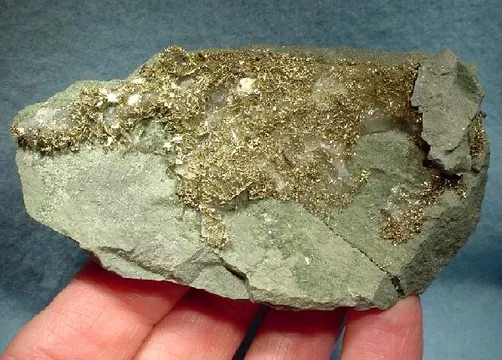
Associated minerals most relevant to the collector are calcite and, less commonly, quartz. Calcite occurs as cream, gray-yellow, silvery, greenish, or bladed to flattened rhombic matrix. Quartz-associated Meikle barite is more unusual; one documented occurrence from the 925 level at stope 3675 produced yellow barite crystals on quartz. The broader mine mineralogy includes pyrite, marcasite, sphalerite, stibnite, cinnabar, metacinnabar, realgar, orpiment, native sulfur, gypsum, halotrichite, jarosite, millerite, galena, and other species, but most barite specimens seen by collectors are either barite alone or barite with calcite.
The best specimens combine several qualities at once: saturated golden color, glassy luster, transparency, undamaged edges, sharp terminations, strong three-dimensional composition, and credible provenance. Matrix pieces are judged on both barite quality and composition—whether the barite is isolated, visible, and elevated above calcite rather than buried in a busy plate. Single crystals and floaters are judged more ruthlessly for edge wear, contact marks, internal clarity, and termination completeness.
Meikle specimens often have a deceptively simple beauty. They do not rely on exotic species associations or bizarre morphology; their appeal is the purity of yellow barite done exceptionally well. A top specimen should look “lit” from within, with bright faces, clean geometry, and enough thickness to show the honey color without becoming dull or opaque.
The main authenticity concern with Meikle barite is locality confidence. Many yellow and amber barites from Nevada, Colorado, Peru, China, Morocco, and other localities can look superficially similar in photographs. A strong Meikle attribution is helped by an old dealer label, mine-level or stope data, a connection to the late-1990s recovery period, or provenance through known dealers and collectors who handled the original material. Labels mentioning Meikle Mine, Goldstrike, Bootstrap District, Carlin Trend, or specific levels such as 975, 1075, 1125, 1225, 1275, or named stopes are especially valuable when credible.
No well-documented locality-wide problem of fake Meikle barite has become part of the collector literature, but repairs, stabilization, and restoration are always possible in a mineral with cleavage, heavy crystals, friable matrix, and a history of recovery from difficult underground pockets. Fine cabinet pieces should be examined under magnification for glued crystal contacts, restored edges, hidden matrix joins, or resin-supported friable limonite or calcite. Disclosure matters; a repaired specimen can still be desirable, but it should be priced and described honestly.
Condition is the usual battleground. Barite has perfect cleavage, and Meikle crystals commonly have exposed tabular edges and corners that chip easily. Look for bruising along crystal margins, tiny white nicks on terminations, cleaved-off corners, repaired blades, or stress fractures through transparent crystals. Some specimens show micro-damage that is acceptable for the locality, especially on older pocket pieces, but the price difference between “slight edge wear” and “pristine, glassy, gemmy, sharp” can be substantial.
Matrix can also be fragile. Some early pockets produced crystals on friable limonite, and calcite matrices may be delicate or contact-rich. Avoid ultrasonic cleaning and steam cleaning. A gentle air bulb, soft brush, or minimal room-temperature water cleaning is safer, and any wet cleaning should consider attached calcite, iron oxides, and old repairs.
Rarity is tiered. Modest miniatures and small cabinet pieces still appear on the market with some regularity, but top examples from the major late-1990s pockets are finite and increasingly collection-bound. Large, gemmy, undamaged matrix pieces with strong crystal architecture are scarce. High-end pieces from major old collections, museum-caliber plates, or specimens with specific mine-level provenance are much less common than the number of “Meikle Mine barite” listings might suggest.
As of the present market, Meikle barite remains available but is not abundant in fresh supply. Typical offerings include older dealer inventory, collection dispersals, and occasional thumbnails, miniatures, and small cabinet specimens. Prices range from modest sums for small or damaged pieces to hundreds or low thousands for good cabinet specimens, and substantially more for exceptional large, transparent, well-composed barite-on-calcite examples.
The best Meikle stories begin not with a collector’s pick but with an underground gold mine breathing heat.
A Nevada State Museum account from 1997 described the Meikle caverns as unlike ordinary limestone caves. A mine employee compared them to the seven dwarfs’ mine in Disney’s Snow White, and the comparison is easy to understand: clumped rounded forms covered with twinkling calcite and transparent barite, hidden more than 1,000 feet below the surface until mining cut into them. One large area was reportedly sealed off because it was belting out 140-degree heat, making an already hot mine still harder to ventilate. Another cavern was preserved as an illuminated exhibit area for limited tours, so visiting business associates could see the structure of the deposit and the practical realities of mining it.
The museum’s article also preserves one of the most charming bits of Meikle vocabulary: the “sugar cookie” habit. Barrick donated lemon-yellow barite specimens to the Nevada State Museum showing thin and thicker square forms, small elongated prisms, and stocky tabular clusters. The most unusual consisted of tiny paper-thin squares of barite encrusting delicate calcite, a formation compared to fancy confections. The same account notes a practical problem familiar to anyone who has handled hot-pocket minerals: Meikle staff had to experiment with how to bring large crystals safely from their heated underground environment into cool offices. The first ones developed disappointing fractures.
The Geoprime recovery accounts put the collector directly into the workings. In early July 1997, after finishing a chalcocite recovery project at the Flambeau Mine in Wisconsin, Casey and Jane Jones responded to an invitation to tour the Meikle Mine. Their first stop was the 975 level at stope 3525. A large pocket had been exposed in the lower corner of the stope, lined with transparent yellow to yellow-gold square tabular crystals up to 6 cm on friable limonite matrix. The cavity continued downward at a steep angle, with crystals visible as far as the light would reach, but the space was too tight, too hot, and too contaminated by sulfur dioxide gas to enter safely. They collected the edges while hot limonite warmed their hands, and nearby thermal steam escaped from another open void.
Another early stop was on the 1075 level near the batch plant, where waste rock and concrete were mixed for backfilling mined-out stopes. During development, a large cavern had been opened and preserved by Barrick. It was lined with calcite, and selected areas held orange barite crystals to 20 cm, many as flat spear-shaped forms. Some had already been collected by contractors; what remained required specialized recovery. Later, the collectors brought in equipment to remove what they safely could.
The practical side of specimen recovery at Meikle could be brutal. In the batch-plant cave, a small tunneling void led toward a deeper cavern. To reach barites in the accessible portion, the collectors used a diamond chainsaw. That meant carrying a 250-pound power pack into position close enough that hydraulic power and water supply would still work. The phrase “strong backs” appears in the recovery account for good reason: this was not romantic rockhounding but industrial work in a hot, restricted underground setting.
A January 1999 collecting trip shows how fragile even a carefully planned recovery could be. The crew had scheduled a blast for two months in a known barite-producing part of the 1075 level, stope 3475. When the collectors arrived on Monday, mining delays meant the holes had not been drilled. By Thursday the holes were drilled and intended to be loaded and shot between day and night shift, allowing night-shift collecting. Ground temperatures, however, were too high to load safely—more than 164°F. A couple of hours later the ground had cooled to an average of 127°F, but by then it was too late to blast. The round was loaded by the night crew, the collectors returned Friday after the blast, and mine crews performed ground-support work to make access possible. They dug Friday and part of Saturday, planned to return Sunday, and then an incident at the mine prevented further work that week. The area was later declared unsafe. Months of planning, mine labor, equipment, and collector effort could be erased by heat, safety, and timing.
Not all Meikle pockets were grand caverns. One small 1125-level cavern measured about 16 feet deep, 18 feet wide, and 5 feet high. Crystals lined the back and ribs, but were mostly absent from the floor except where large crystals occurred locally. Underground crews provided ground support, electrical support, and air support so the collectors could enter the void. The barites recovered there were large, thick, and tabular; broken clear sections even yielded clean faceted stones.
Some pockets demanded contortions rather than machinery. On the 1225 level behind the mechanics bay, fine lemon-yellow barites formed attractive rosettes in elevated voids. Reaching them required ladders, and the spaces were barely large enough to kneel in. The prone position was most comfortable; according to the account, sometimes only the collectors’ boots sticking out into the drift betrayed their presence. Another elevated void in the South Meikle Drift required a ten-foot ladder, and wire netting installed for wall support had to be pulled back during collecting. The collector was partly pressed between the wire and the opening, working with restricted arm movement, yet several good pieces and a large plate came out of that small upper chamber.
The Meikle story is a rare case where the romance of minerals and the realities of mining are inseparable. The specimens exist because an operating gold mine opened the ground, because dangerous pockets were noticed before they vanished into waste or backfill, and because mine personnel and specimen collectors found a way—sometimes only briefly—to save what could be saved.