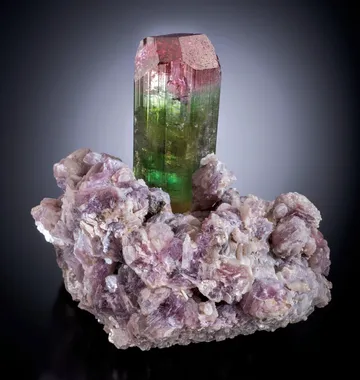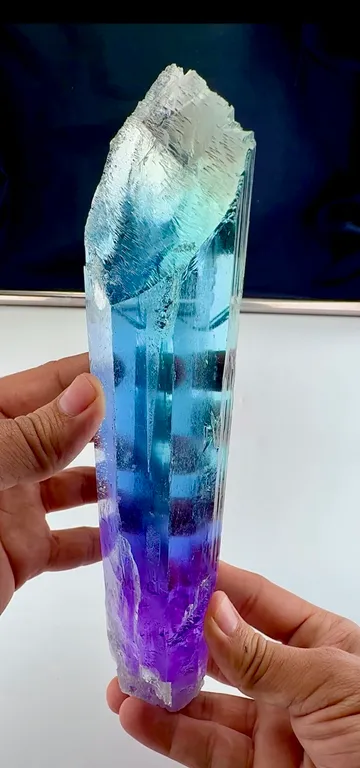
A collector's guide to Mawi pegmatite, Afghanistan: its geology, mining history and notable minerals, illustrated with the 269 specimens documented from this locality on EarthWonders.
Key facts
Mawi is one of the great names of the Nuristan rare-element pegmatites: a giant gem-bearing body in the Nilaw-Kolum pegmatite field, high in the southeastern spurs of the Hindu Kush, where a single locality has supplied collectors with enormous spodumene and kunzite crystals, bright elbaite, morganite, aquamarine, purple fluorapatite, tantalite-(Mn), stibiotantalite, pollucite, and the white feldspar architecture that makes Afghan pegmatite specimens instantly recognizable. The pegmatite lies in the Mawi valley, a short western branch of the Kolum valley, within a crystalline terrane of gneiss, schist, migmatite, gabbro-dioritic rocks, granites, and marble-bearing units. Its collector importance rests not just on attractive gem minerals, but on scale: Mawi is repeatedly described as a massive, zoned, lithium-cesium-tantalum style pegmatite, with a principal body on the order of 1.5 km long and as much as 40 m thick, and with gem-bearing pockets capable of yielding hundreds of kilograms to tons of spodumene.
Regional View
Country View
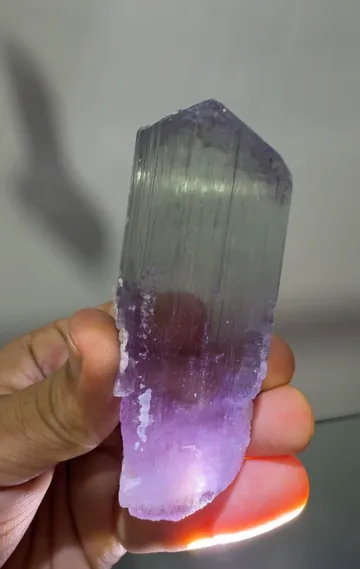
For collectors, Mawi’s visual language is a marriage of mass and delicacy. The locality has produced large, bladed to prismatic spodumene in pink, purple, yellow, green, blue, and colorless tones; some crystals are etched and sculptural, others retain fine glassy faces and sharp terminations. The very best kunzite specimens show a colored spodumene crystal perched against snow-white cleavelandite, quartz, mica, or pale feldspar, rather than simply lying loose as a detached crystal. Mawi elbaite is less overwhelmingly abundant in the literature than the great green tourmalines of Korgal or the polychrome crystals of Paprok, but Mawi’s own tourmalines include tricolored, colorless, blue-green, and pastel gem crystals, sometimes intimately associated with quartz, cleavelandite, lepidolite, morganite, and the rare yellow tantalate stibiotantalite.

Photo: Wikimedia Commons
Historically, Mawi entered modern mineralogical consciousness through Soviet geological work in the 1960s and 1970s, followed by the classic 1978 Mineralogical Record treatment of the pegmatites of Laghman/Nuristan by Jean-François Poullen and Pierre Bariand, and later the detailed 2017 Mineralogical Record review by Peter Lyckberg. Those works place Mawi among a tight cluster of famous deposits—Nilaw, Kolum/Kulam, Korgal, Pashagar, and nearby fields farther east—whose specimens passed through Kabul, Peshawar, Tucson, European collections, and major museums. Old labels may say “Laghman,” “Lagman,” or simply “Nuristan,” reflecting older administrative usage and the fact that “Nuristan” long referred to the region before the modern province was formed in 2001.
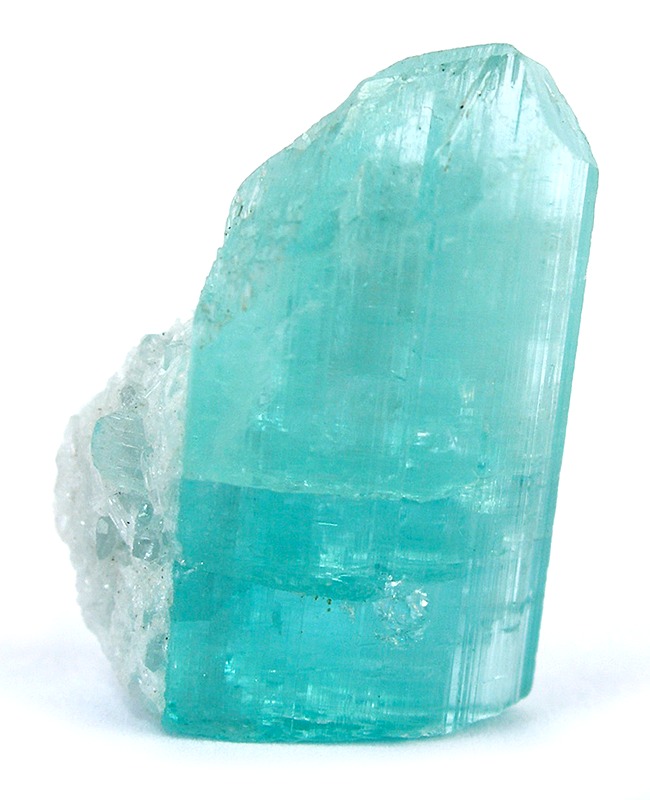
Photo: Wikimedia Commons
Search for specimens: View all specimens from Mawi pegmatite, Afghanistan
Mawi pegmatite is a gem-bearing rare-element pegmatite in the Nilaw-Kolum pegmatite field of Nuristan, northeastern Afghanistan. Mindat places the locality at about 35° 12' 6" N, 70° 20' 8" E and specifically notes that a USGS report used incorrect coordinates for the locality. Modern geospatial reporting places the main Mawi mine very close to those coordinates, with the Kolum workings slightly to the northeast. The mine area is roughly 2,000 m in elevation, not as high as some of the snow-season-limited Paprok workings, but still in extremely rugged country where roads, weather, security, and terrain all constrain access.
The deposit belongs to the larger Hindu Kush–Himalayan belt of young rare-element pegmatites generated during and after continental collision between India and Asia. In the Nuristan-Laghman region, pegmatites were emplaced along the margins and roof zones of Oligocene granites and into older metamorphic and mafic intrusive rocks. The most productive gem bodies in the Nilaw-Kolum-Mawi-Korgal group are not simple barren feldspar-quartz veins; they are internally zoned, lithium-rich pegmatites enriched in B, Li, Be, Cs, Ta, Nb, and Sn. Mawi’s most important associations belong to an LCT family in collector language, with spodumene, lepidolite, elbaite, pollucite, beryl, albite-cleavelandite, quartz, microcline, columbite-tantalite minerals, cassiterite, and accessory phosphates.
The broader Nilaw-Kolum-Mawi-Korgal field lies north of the village of Nuristan and near the Alingar, Kolum, and related valleys. Published descriptions distinguish the major deposits from west to east as Nilaw, Kolum/Kulam, and Mawi, with Korgal and Pashagar as related outlying localities. Mawi itself is in the Mawi valley, a western branch of Kolum valley. The pegmatite is described as a giant body approximately 1.5 km long and up to 40 m thick; older work also describes the principal vein as about 40 m thick and roughly 1,200 m long. These figures are not ornamental trivia: they explain why Mawi could yield both huge quantities of spodumene rough and large, display-worthy crystals.
The internal structure is classically zoned. At the wall-rock contact, early quartz and muscovite form a narrow border association, locally with large blue-green beryl. In the eastern part of the deposit, a biotite-microcline-quartz zone carries aquamarine and black tourmaline. A discontinuous zone of giant quartz and microcline follows, with beryl crystals in offshoots of the main vein. The principal collector-producing zone is quartz-spodumene, where local segregations may be several meters thick and massive spodumene crystals may be frozen in the pegmatite. Later albite-muscovite-quartz zones, including sugary albite and cleavelandite, carry lepidolite, multicolored tourmaline, and additional spodumene.
Gem pockets occur in the central and upper parts of the pegmatite system. Soviet core-drilling data cited in later literature placed gem-bearing cavities generally between about 11 and 20 m below the surface. Older gemological accounts describe gem tourmaline, spodumene, and beryl in cavities in the quartz-rich central portions of the pegmatites, commonly enclosed in soft powdered clay; when miners reach such a cavity, hand extraction rather than brute-force blasting is the only way to save crystals. At Mawi, pockets have been described as room-sized, large enough to produce mixed lots of loose crystals, large matrix specimens, and many kilograms of broken gem material.
Modern scientific attention began with Afghan and Soviet exploration. Large pegmatite fields at Mawi and Parun were identified during explorations in 1963–1964, and Soviet geologists undertook serious surveys of Mawi, Kolum/Kulam, and Nilaw beginning in 1971. Their work targeted lithium, cesium, rubidium, niobium, tantalum, and associated strategic minerals, but the teams also encountered gem pockets. Local men were employed for drilling, blasting, and mining during the Soviet period, and accounts from the field emphasize that the locals opened parts of the pegmatites but were not allowed access to the pockets and ore zones revealed during the most intense Soviet work in 1972–1973.
Recorded production gives Mawi its almost mythic status among spodumene localities. In July 1973, 420 kg of spodumene were extracted, followed by 176 kg in October-November of that year. A giant pocket opened in summer 1995 yielded about 1,800 kg of spodumene, including about 300 kg of faceting-grade material. Another Mawi pocket produced around 2 tons of kunzite rough, and many other pockets are reported to have yielded up to 500 kg. A 2009 pocket yielded 2 tons of kunzite rough, and a March 2010 find produced gemmy kunzite crystals weighing up to 18 kg, together with matrix pieces of roughly 5 kg showing kunzite with tourmaline and morganite beryl.
Specimen recovery has always been uneven. Poullen and Bariand observed large plates of quartz, microcline, and cleavelandite on the dumps at Mawi—essentially the matrix bases from which spodumene crystals had been removed by gem hunters. That explains why detached Mawi kunzites are far more common than undamaged matrix specimens, and why a fine attached crystal is so prized. The same seems to be true for beryl: loose crystals and broken-off bases are part of the locality’s history. On the other hand, the dumps and pockets also produced small tricolored and colorless tourmalines, spessartine embedded in pegmatite, large botryoidal muscovite masses, and rare accessory species that today receive more collector attention than they did when production was focused almost entirely on gem cutting.
Access today is not a recreational collecting proposition. Even after road improvements, the pegmatites themselves are not directly accessible by ordinary vehicle, and open reporting describes adits, white crystalline tailings, spoil piles, rebuilt buildings, and renewed or expanded mining activity visible in satellite imagery between 2019 and 2022. Current work appears to be local, informal to semi-organized, and tied to the regional gem trade rather than to public fee collecting or regulated tourist access. For collectors, Mawi is best approached through specimens with trustworthy old labels, documented dealer provenance, laboratory work for rare species, and a sober understanding that locality names in this part of Afghanistan have often been simplified, shifted, or confused in commerce.
Mawi spodumene is the locality’s signature mineral, occurring as large to enormous prismatic crystals in pink, purple, yellow triphane, green, blue, and colorless material, with documented frozen crystals in the quartz-spodumene zone reaching up to 2 m and collector-quality crystals commonly represented by loose individuals, etched crystals, and rarer matrix pieces on cleavelandite, quartz, mica, lepidolite, pollucite, tourmaline, or spessartine. Historic and modern accounts emphasize both quantity and quality: hundreds of kilograms were recorded in 1973, room-sized pockets yielded 1.8 to 2 tons in later finds, and individual gemmy crystals from 2010 reportedly weighed up to 18 kg. The best Mawi spodumene specimens are not merely large; they have transparency, strong color or interesting color change, intact terminations, minimal cleavage damage, and preferably a natural setting on white cleavelandite or quartz rather than a detached crystal with sawed, bruised, or reattached surfaces.
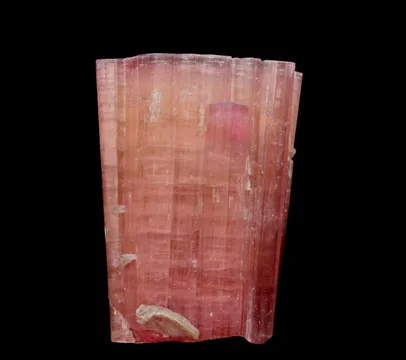
Mawi tourmaline is best known as elbaite-rich material from the late, highly evolved albite-muscovite-quartz and lepidolite-bearing zones, especially small tricolored crystals with pink, green, and colorless sections, colorless achroite, and pastel blue-green to green crystals associated with quartz, cleavelandite, lepidolite, morganite, spodumene, pollucite, and locally stibiotantalite. Older literature treats the small tricolored crystals as particularly characteristic of Mawi, while broader Nuristan gemological work records pencil-like tourmalines up to about 20 cm in the district and cuttable crystals to 15 cm long and 4 cm wide, though the finest intense green production is more strongly associated with Korgal. A good Mawi tourmaline has clear zoning, undamaged termination, bright glassy luster, and convincing locality support; ordinary pieces are small, abraded singles or fragments whose color alone is not enough to separate them from the flood of Afghan and Pakistan elbaite.
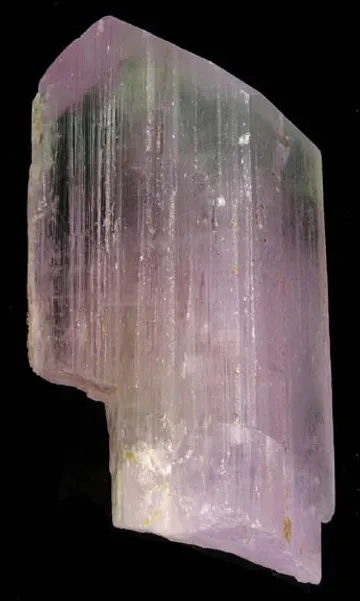
Mawi kunzite, the pink to lilac-purple variety of spodumene, ranges from pale rose and lavender crystals to stronger purple and color-zoned examples, with published accounts recording a sharp 50 cm crystal obtained by Pierre Bariand, Mawi production of 1,800 kg from a summer 1995 pocket, a further 2-ton pocket, and March 2010 crystals up to 18 kg. The classic habit is a flattened, striated clinoprism, commonly etched or naturally dissolved, and most production is loose because gem hunters removed crystals from pocket matrices of cleavelandite, quartz, microcline, muscovite, lepidolite, tourmaline, and morganite. The collector premium here belongs to sharp, transparent crystals with strong color viewed down the proper axis, intact or doubly terminated form, and especially those still aesthetically set on white cleavelandite; repaired cleavage breaks, faded color, bruised tips, and detached bases are common downgrades.
Collector labels from Mawi often use “apatite” for the locality’s purple phosphate crystals, but the documented species in modern locality lists is fluorapatite, occurring as deep purple to violet crystals in open vugs and on pegmatite matrix with quartz, muscovite, albite-cleavelandite, tourmaline, and feldspar. The best Mawi apatite/fluorapatite pieces are small but vivid, usually in the 5 mm to 2 cm range, with exceptional crystals reported to about 5 cm; they are most attractive when glassy, saturated, and perched rather than embedded. Because “apatite” is a group name in casual commerce, serious collectors should prefer pieces identified as fluorapatite when possible, and should value color, crystal sharpness, matrix contrast, and undamaged prism and pinacoid faces over size alone.
Quartz at Mawi is fundamental to the pegmatite architecture rather than a mere accessory: it forms part of the giant quartz-microcline zone, the quartz-spodumene productive zone, and the pocket matrices that carried spodumene, cleavelandite, morganite, elbaite, fluorapatite, tantalite-(Mn), and rare tantalates. Historic visitors saw large plates of quartz, microcline, and cleavelandite on the dumps, evidence that kunzite crystals had been broken away from the matrix; in the 1995 production, quartz specimens were reportedly so unwanted that some were discarded and even used in a large fireplace. Good Mawi quartz specimens today are those that preserve a locality-specific association—kunzite, tourmaline, morganite, purple fluorapatite, stibiotantalite, or sharp white cleavelandite—rather than isolated colorless quartz crystals with little diagnostic value.
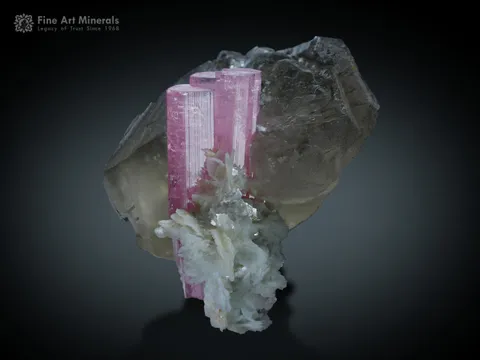
Elbaite from Mawi occurs as gemmy tourmaline in small to medium crystals, including tricolored pink-green-colorless examples, achroite, and blue-green to green crystals, with documented associations including quartz, albite-cleavelandite, lepidolite, morganite, spodumene/kunzite, pollucite, topaz, montmorillonite, and the remarkable lemon-yellow stibiotantalite pocket material. Published illustrated specimens from Mawi include elbaite crystals in the 4.9 to 14 cm range, and Wikimedia-documented material includes a 2.3 cm neon blue-green thumbnail. The best pieces combine clarity, color saturation, intact termination, and a natural feldspar-quartz matrix; lesser examples are damaged singles, detached pocket fragments, or broadly labeled “Afghanistan” tourmalines lacking the color style, association, or provenance needed to sustain a Mawi attribution.
Mawi fluorapatite is a choice accessory mineral, most admired as deep purple to violet crystals in open vugs, commonly small—5 mm to 2 cm—but exceptionally reported to about 5 cm, with a few crystals described as gemmy. Its Mawi associations include quartz, muscovite, albite-cleavelandite, tourmaline, and feldspar, and older dealer and museum-style specimen descriptions emphasize the contrast of purple crystals against pale pegmatite matrix. Fine pieces are scarce relative to kunzite and elbaite, and the collector distinction is straightforward: bright purple color, transparency, sharp form, and an undamaged mount on matrix are far more important than a large but dull or bruised crystal.
Albite at Mawi is both rock-forming and specimen-making: it occurs in late albite-muscovite-quartz zones, in sugary masses, and as the white feldspar matrix that frames kunzite, tourmaline, morganite, fluorapatite, tantalite-(Mn), and quartz. In collector practice, much of the attractive albite is the platy variety cleavelandite, but albite sensu lato also appears as massive to crystalline matrix in pocket plates and in the broken bases seen on old dumps. Good Mawi albite specimens are rarely bought for albite alone; they succeed when the feldspar is clean, fresh, lustrous, and compositionally useful as a bright stage for a colored Mawi mineral, especially pink spodumene or morganite, blue-green elbaite, or purple fluorapatite.
Cleavelandite, the bladed variety of albite, is the classic white matrix for Mawi specimens and one of the reasons the best pieces have such strong display contrast: pink kunzite, pastel morganite, blue-green elbaite, black to reddish tantalite-(Mn), and violet fluorapatite all show powerfully against thin, pearly feldspar blades. Poullen and Bariand observed cleavelandite-bearing plates on the Mawi dumps from which spodumene crystals had been removed, and later illustrated material confirms cleavelandite as a matrix for morganite and aquamarine as well. A good cleavelandite-bearing Mawi specimen has fresh, undamaged blades and original pocket relationships; too many pieces are simply broken feldspar bases with the valuable crystal removed.
Mawi morganite occurs as pink to peach beryl crystals, typically short-prismatic to somewhat tabular, associated with cleavelandite, quartz, smoky quartz, muscovite, elbaite, aquamarine, and locally kunzite or tantalum minerals. Published examples include Mawi morganite with cleavelandite and smoky quartz at 13.3 cm, a 12.8 cm morganite on cleavelandite, and an especially admired 7 cm transparent short-prismatic crystal standing on snow-white cleavelandite, with glossy prism faces and slightly frosted pyramid modifications. The best Mawi morganites are not merely pink beryl singles; they show transparency, complete form, pale feldspar contrast, and old, credible provenance, while ordinary pieces are detached, chipped, pale, or too generically labeled within the broad Afghan beryl trade.
Lepidolite at Mawi marks the highly evolved lithium-rich portions of the pegmatite, especially the late albite-muscovite-quartz zones where concentrations of lepidolite occur with multicolored tourmaline and spodumene. It is usually a matrix and paragenetic mineral rather than the principal collector target, appearing as lilac to pinkish micaceous aggregates with spodumene, elbaite, cleavelandite, quartz, and occasionally pollucite or rare tantalates. The best Mawi lepidolite specimens are those where the mica adds color, context, and contrast to an attached kunzite or tourmaline; isolated lepidolite masses are much less desirable unless unusually fresh, sculptural, or tied to a notable pocket assemblage.
Muscovite is present from the earliest border assemblage of quartz and muscovite at the pegmatite contact through later albite-muscovite-quartz zones, and it appears in matrix with spodumene, beryl, quartz, fluorapatite, and feldspar. The most memorable Mawi muscovite observation in the literature is not a cabinet specimen but two enormous botryoidal muscovite balls, each up to about 30 cm across, seen at the locality and judged essentially untransportable. Collectible muscovite from Mawi is therefore usually contextual: lustrous books, rosettes, or botryoidal masses that support or accompany kunzite, morganite, aquamarine, tourmaline, or purple fluorapatite are far more meaningful than ordinary mica plates lacking locality-specific association.
“Tantalite” on Mawi labels should be treated carefully, because the documented species is chiefly tantalite-(Mn), with older literature also using columbite-tantalite and manganotantalite language for the dark heavy oxides in the pegmatite. Mawi tantalite-(Mn) is known as black to reddish brown crystals, loose or on cleavelandite with quartz, generally in the 1 to 4 cm range, with an exceptional razor-sharp 8 cm crystal on cleavelandite held by the Mim Museum in Beirut. Good pieces are sharp, lustrous, well-seated on white cleavelandite, and preferably analyzed or from a reliable old collection; undiagnostic black blades or broken heavy fragments should not be accepted uncritically as “tantalite” without supporting evidence.
Aquamarine from Mawi is a documented but secondary prize compared with spodumene, morganite, and elbaite: older descriptions place aquamarine in the biotite-microcline-quartz zone with black tourmaline, especially in the eastern part of the deposit, and note that the lower section of Mawi once produced giant blue aquamarine beryl crystals frozen in matrix, now obscured by dumps from above. Published specimen examples include aquamarine on cleavelandite at 6.8 cm and a notable 4 cm Mawi aquamarine with a 2 cm octahedral fluorite perched on it, but the literature specifically says Mawi aquamarine was not generally found in large or fine freestanding crystals. The most desirable pieces are therefore association specimens—blue beryl with cleavelandite, morganite, quartz, muscovite, or fluorite—rather than isolated pale beryl fragments.
Other minerals documented from Mawi include beryl, cassiterite, columbite-(Fe), columbite-(Mn), microcline, montmorillonite, nanpingite, pollucite, schorl, spessartine, stibiotantalite, topaz, biotite, microlite, and fluorite. The most collector-relevant rarities are pollucite, which reflects localized cesium enrichment around cavities; stibiotantalite, famous from Mawi as small flattened yellow to lemon-yellow crystals, some loose and some associated with elbaite or quartz; spessartine, occurring as sharp orange crystals generally from a few millimeters to about 1.5 cm and in rare cases perched on yellow triphane; and the columbite-tantalite minerals and cassiterite that record the pegmatite’s rare-metal character. I found no verified source showing Mawi as the type locality for a valid mineral species; nanpingite is recorded from Mawi but was named for and described from the Nanping area of Fujian, China, not Afghanistan.
The first authenticity issue with Mawi is locality discipline. Specimens may be labeled “Mawi,” “Kolum,” “Kulam,” “Nilaw,” “Laghman,” “Lagman,” “Nuristan,” “Afghanistan,” or simply “Afghan pegmatite,” and those names are not always interchangeable. Older administrative labels can be legitimate, but vague labels should not be upgraded to Mawi without a credible chain of custody, diagnostic association, old dealer stock, museum-style documentation, or analytical work in the case of rarities. The broader Afghan-Pakistan pegmatite trade has long suffered from shifted or simplified localities; even country-of-origin errors are documented in the literature.
Spodumene condition is the central practical concern. Mawi produced huge quantities of kunzite and triphane, but spodumene has perfect cleavage, is internally stressed, and breaks easily during mining, transport, trimming, and handling. Detached crystals are common because pocket material was often removed for gem value rather than specimen preservation. Expect repaired crystals, reattached terminations, polished or sawn bases, bruised prism edges, and etched faces. Natural etching is not a flaw in itself and can be highly attractive, but damage masquerading as etching is not. On matrix, inspect the junction between spodumene and cleavelandite carefully for glue, fill, and fresh break surfaces.
Light sensitivity matters. Mawi is famous for green and blue spodumene material that can turn pink or purple after brief sunlight exposure; kunzite in general is also vulnerable to fading with prolonged strong light. Store important Mawi spodumene away from direct sun and intense display lighting, especially if the color is a key part of the specimen’s value. For faceted stones and crystals alike, color should be judged under consistent lighting and from multiple directions because spodumene pleochroism can make the same crystal look dramatically different along different axes.
Tourmaline is more durable than spodumene but still often repaired, especially slender pencils and tricolored crystals. Mawi elbaite thumbnails and miniatures can be superb, but isolated single crystals are difficult to distinguish from other Afghan localities without provenance. Colorless achroite, pastel blue-green crystals, and tricolored pink-green-colorless pieces fit the Mawi style, yet style alone is never proof. The finest Mawi tourmalines should have crisp terminations, no disguised side bruising, and ideally a natural association with quartz, cleavelandite, lepidolite, morganite, stibiotantalite, or spodumene.
Beryl at Mawi requires caution. Morganite is documented and collectible, but top examples are much rarer than loose kunzite. Aquamarine is documented but not usually in large freestanding crystals from Mawi, despite old accounts of giant blue crystals frozen in the lower section of the pegmatite. Claims of intense heliodor or very deep golden beryl from young Himalayan-system pegmatites deserve skepticism; published discussions specifically warn collectors about implausible color/locality stories in this regional trade. As always with beryl, check for filled fractures, polished terminations, and whether the specimen is a cut-stone candidate being represented as a natural crystal.
Purple fluorapatite from Mawi is a legitimate and attractive specialty, but it is brittle, soft compared with quartz and feldspar, and prone to edge bruising. Many commercial labels say simply “apatite”; a precise fluorapatite identification is preferable. Stibiotantalite and tantalite-(Mn) are highly desirable but should be bought with extra care. The yellow stibiotantalite pocket material from Mawi is distinctive and surprising, yet small rare-species crystals are exactly the kind of specimens for which analysis, provenance, and reputable dealer history matter. “Tantalite” labels should be narrowed to tantalite-(Mn) only where supported.
Market availability is split. Loose Mawi kunzite and spodumene remain available in the trade because the locality produced large quantities over decades, but superb, unrepaired, strongly colored, well-terminated crystals are far less common, and matrix specimens with natural attachment are genuinely scarcer. Mawi elbaite, morganite, aquamarine, purple fluorapatite, stibiotantalite, and tantalite-(Mn) are available only intermittently in fine quality. Current mining appears to continue in some form, but security, legality, local control, road access, and Afghan export realities make “field collecting” effectively irrelevant for ordinary collectors; the responsible route is the documented specimen market.
Before Mawi was a specimen label, it was a mountain problem. In 1977, the jeep road north from the Kabul-Jalalabad route ended far below the interesting pegmatites, after roughly 70 km from the fork and only a few kilometers beyond the village of Nuristan. From there, reaching the district meant a full day on foot through about 25 km of narrow gorges to the houses near Dahaneh-Pyar, then another full day over bad rocky trail toward Nilaw. To reach Mawi from Nilaw, one crossed the Koh-e-Sagoli range at about 3,000 m and descended into the short Mawi valley until the dumps finally appeared. The phrase “remote pegmatite” is too mild for this place; the locality was an expedition before it was a collecting locality.
The old accounts preserve a striking pre-mining image of the same landscape. In the forested mountains near the present-day Mawi and Nilaw mines, Afghan kings traditionally hunted brown bears and leopards. The king waited with his horse lower down in the Kolum valley while local men formed a human chain high on the mountain, driving any bears downhill toward him. Later accounts add cobras, scorpions, and the near disappearance of leopards after decades of warfare. The setting that produced pastel kunzite and morganite was never gentle country.
The Soviet period left its own hard-edged stories. In 1971, Soviet geologists began serious work at Mawi, Kolum/Kulam, and Nilaw, employing about 100 local men for core drilling, blasting, and mining while searching for lithium, cesium, rubidium, niobium, tantalum, and gem-bearing zones. Local accounts later told to Faisal Umar Shinwari recalled that during the intense 1972–1973 work, the Russian geologists did not allow the men who had helped open the pegmatites into the pockets or ore zones exposed by their labor. Yet the same locals remembered large quantities of “heavy minerals” and gem tourmaline being recovered. Years later, in a post-Soviet kunzite pocket, miners found a kunzite crystal pierced by a two-inch Soviet drill hole—a perfect physical symbol of science, secrecy, and gemstones colliding in the same pocket.
Pierre Bariand’s Mawi crystal is one of the great early Western collecting moments from the deposit. Bariand, curator at the Sorbonne in Paris, visited the field in 1976 and obtained from the giant Mawi pegmatite a sharp 50 cm kunzite crystal. The old Mineralogical Record photographs show Mawi spodumene and kunzite specimens in the Sorbonne collection, including large twinned and doubly terminated crystals. These pieces helped announce to Western collectors that Afghanistan was not just a source of lapis lazuli, emerald, and ruby, but a new pegmatite province capable of competing with the classic localities of Brazil, California, Madagascar, and Pakistan.
The most cinematic story is the 1995 pocket. That summer, a Mawi pocket produced 1,800 kg of spodumene, including about 300 kg of faceting-grade material. In the same season of value blindness, many quartz specimens were simply thrown onto the dumps because no one was buying quartz, and one large fireplace was built from discarded quartz specimens. It is a painful image for today’s collector: pocket quartz that might now be cherished as contextual Mawi material, sacrificed as building stone because all eyes were on kunzite.
The later pockets were no smaller in imagination. A 2009 Mawi pocket yielded about 2 tons of kunzite rough. In March 2010, another pocket produced gemmy kunzite crystals weighing up to 18 kg, together with 5 kg matrix specimens showing kunzite associated with tourmaline and morganite beryl. Those numbers explain why Mawi kunzite exists in both worlds: as serious mineral specimens and as gem rough sold by the kilogram. For the collector, the paradox is that immense production did not automatically preserve the best specimens; the more valuable the gem rough, the more likely crystals were removed, broken, or sorted for cutting before a specimen-minded dealer ever saw them.
One morganite story shows how specimens moved through the Afghan-Pakistan trade. Peter Lyckberg described what he considered perhaps the finest morganite from Mawi: a gemmy 7 cm short-prismatic pink crystal standing on edge on snow-white cleavelandite, with glossy transparent prism faces and slightly frosted pyramid faces modifying the prism edges. It was first bought by a consortium of Pakistani dealers. After ten years, one dealer bought out the others, and the specimen entered Lyckberg’s collection. That kind of shared ownership, negotiation, and delayed resolution is part of the specimen’s biography, just as real as its mineralogy.
The modern market has its own theater. Lyckberg wrote of world-class specimens being pursued within hours after a single photograph moved from one person to another, with dealers in America and Peshawar suddenly chasing the same object. His comparison was unforgettable: “throwing a rat into a snake pit.” At the source, entire pocket contents may be auctioned in lots before cleaning, with dozens or even hundreds of people participating; a lot might contain fine specimens, facet-grade gem rough, fragments, and cabochon material, and may cost up to several hundred thousand dollars. Mawi specimens on a collector’s shelf are serene. Their path out of the mountain was not.
Jean-François Poullen and Pierre Bariand, “Famous Mineral Localities: The Pegmatites of Laghman, Nuristan, Afghanistan,” The Mineralogical Record, 9(5), 301–308, 1978 — The classic locality article, reprinted by Pala International, with first-hand observations of Nilaw, Mawi, and Korgal geology, access, paragenesis, and specimens.
Peter Lyckberg, “Gem pegmatites of northeastern Afghanistan,” The Mineralogical Record, 48(5), 610–675, 2017 — The most detailed modern collector-oriented treatment of the Afghan pegmatite fields, with a substantial Mawi section, production stories, specimen figures, and a Mawi mineral table.
Gary W. Bowersox, “A Status Report on Gemstones from Afghanistan,” Gems & Gemology, Winter 1985 — Important early gemological overview of Nuristan tourmaline and spodumene, including Mawi and the Kolum district, pocket descriptions, mining conditions, and gem properties.
Peter G. Chirico and Katherine C. Malpeli, eds., “Summaries of Important Areas for Mineral Investment and Production Opportunities of Nonfuel Minerals in Afghanistan,” USGS Open-File Report 2011–1204 — USGS synthesis useful for the regional rare-metal pegmatite context, deposit types, and Afghan mineral-resource framework.
John Rakovan, “Apatite from Nuristan, Afghanistan,” in Apatite: The Great Pretender, 2013, pp. 96–97 — Cited in Mindat’s fluorapatite occurrence record for Mawi and relevant to the locality’s purple apatite/fluorapatite specimens.
Mindat reference record for Lyckberg, “Gem pegmatites of northeastern Afghanistan,” The Mineralogical Record, 48(5), 610–675 — Bibliographic record tying the 2017 article to Mindat’s Afghan pegmatite occurrence data.
Wikimedia Commons: “Spodumene-Albite-209981.jpg” — Documented photograph of an 8.6 x 7.7 x 6.7 cm Mawi kunzite on cleavelandite, ex Rolf Wein Collection, photographed by Rob Lavinsky.
Wikimedia Commons: “Elbaite-257481.jpg” — Documented photograph of a 2.3 x 1.7 x 1.0 cm blue-green elbaite crystal from Mawi, photographed by Rob Lavinsky.
Wikimedia Commons: “Strontiumapatite-d06-74a.jpg” — Documented photograph of a purple apatite/fluorapatite miniature from Mawi, photographed by Rob Lavinsky.
Mindat: Mawi pegmatite, Nilaw-Kolum pegmatite field, Nuristan, Afghanistan — Core locality page with coordinates, locality hierarchy, mineral list, photographs, and references.
Pala International: Pegmatites of Laghman, Nuristan, Afghanistan — Accessible reprint of the 1978 Poullen and Bariand classic, with geology, paragenesis, historic access notes, and early specimen photographs.
ResearchGate: Peter Lyckberg, “Gem pegmatites of northeastern Afghanistan” — Full article page for the 2017 Mineralogical Record Afghan pegmatites issue.
GIA: A Status Report on Gemstones from Afghanistan — Gemological overview of Afghanistan’s major gem materials, including Nuristan tourmaline and spodumene from the Kolum-Mawi district.
Tearline: Geospatial Analysis of Afghanistan Gemstone Production Under the Taliban — Satellite-imagery based discussion of recent Mawi and Kolum mining activity, buildings, roads, tailings, and production.
Mindat: Spodumene from Mawi pegmatite — Occurrence page recording Mawi spodumene colors, associations, and “very large crystals” note.
Mindat: Elbaite from Mawi pegmatite — Occurrence page for Mawi elbaite with associated-mineral data and photo gallery.
Mindat: Fluorapatite from Mawi pegmatite — Occurrence page for Mawi fluorapatite with associations and reference to Rakovan’s apatite treatment.
Mindat: Stibiotantalite from Mawi pegmatite — Occurrence page for one of Mawi’s most distinctive rare accessory species.
Wikimedia Commons: Minerals of Mawi pegmatite — Open image category with documented Mawi photographs of spodumene, elbaite, apatite/fluorapatite, quartz, and related specimens.