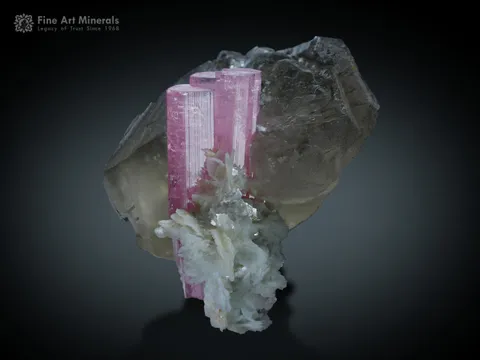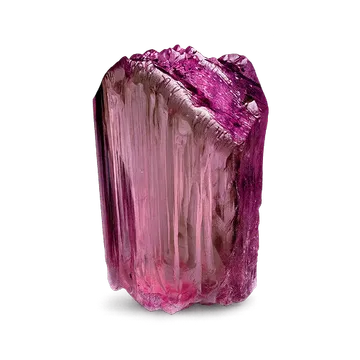
Kunzite — from Mawi Pegmatite, Nuristan: large, lustrous pink to purple spodumene crystals with strong pleochroism, color zoning, and high collecting value.
Key facts
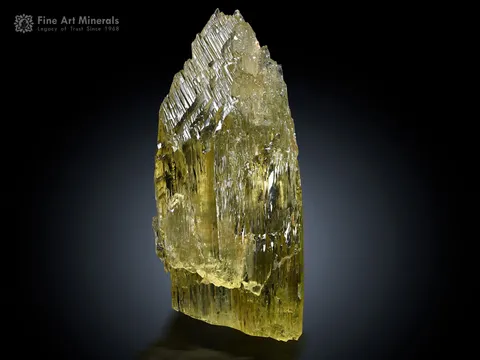
Kunzite from the Mawi Pegmatite is one of the modern standards by which Afghan spodumene is judged: large, lustrous, strongly striated crystals in pink, lilac, purple, and locally color-zoned tones, commonly with the most saturated color visible when looking down the length of the crystal. Mawi’s best pieces have the virtues collectors want in spodumene but rarely get all at once—size, transparency, sharp terminations, strong pleochroism, and enough sculptural form to stand as mineral specimens rather than simply cutting rough.

Photo: Wikimedia Commons
The locality belongs to the Nilaw-Kolum pegmatite field of Nuristan, in the high, rugged gem belt of eastern Afghanistan. Mawi is not an isolated pocket occurrence but part of a highly evolved rare-element pegmatite system rich in lithium, beryllium, cesium, boron, tantalum-niobium oxides, tin minerals, and gem silicates. The mineral list is exactly what one hopes for in a complex LCT-style pegmatite: spodumene and kunzite, elbaite, albite-cleavelandite, quartz, microcline, lepidolite, muscovite, beryl including aquamarine and morganite, pollucite, spessartine, topaz, fluorapatite, cassiterite, stibiotantalite, tantalite-(Mn), and columbite-group minerals.
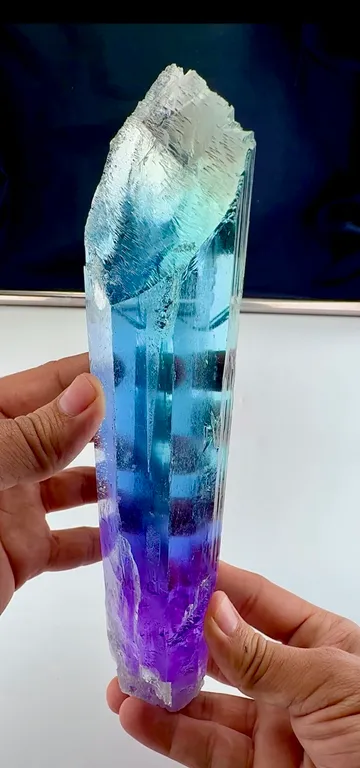
The visual character of Mawi kunzite is immediately recognizable. Fine crystals are usually tabular to bladed or prismatic, with lengthwise striations, glassy to waxy luster, and color that may look pale from the side but deepens dramatically through the c-axis. Historic descriptions from the Nuristan pegmatites note tabular gem spodumene crystals up to 45 cm long, and modern market examples from Mawi still include large cabinet specimens and multi-hundred-gram crystals. The finest examples are not simply “pink spodumene”; they are airy, architectural crystals with a delicate but electric internal color.

Photo: Pala International
Historically, Mawi became known to Western collectors through the Soviet geological work of the early 1970s and the classic 1978 Mineralogical Record article by Pierre Bariand and J. F. Poullen. That article placed Mawi beside Nilaw and Korgal as one of the great Nuristan pegmatite localities, and illustrated large Mawi spodumene, including a 20 cm kunzite crystal and a 15 cm twinned kunzite in the Sorbonne collection. Later gemological reporting in Gems & Gemology emphasized the remarkable production of the Kolum-Nuristan district, including more than 1,260 kg of gem-quality kunzite reported from 1973 to 1975 and an estimated annual production of about 2,000 kg of fine kunzite during the mid-1980s.
For collectors, the appeal is twofold. A fine Mawi kunzite can be a world-class spodumene crystal in its own right, with size and form that far exceed most classic California or Brazilian examples. But it can also be a pegmatite-suite specimen: kunzite with cleavelandite, quartz, elbaite, microlite-group minerals, or other pocket associates, tying it visibly to the complex chemistry of one of Afghanistan’s most important gem pegmatites.
Search for specimens: View all kunzite specimens from Mawi Pegmatite, Nuristan, Afghanistan
The Mawi Pegmatite lies in the Nilaw-Kolum pegmatite field of Nuristan, Afghanistan, in the Mawi valley, a small western branch of the Kolum valley. Mindat places the locality at approximately 35° 12' 6" N, 70° 20' 8" E, with the note that the USGS report used incorrect coordinates for the locality. Modern geospatial reporting places the main Mawi mine close to 35.201, 70.335, with Kolum workings to the northeast.
Geologically, Mawi is a gem-bearing rare-element pegmatite emplaced in the Nuristan-Laghman crystalline terrane. The country rocks of the broader district include gneisses, schists, quartzites, migmatites, gabbros, diorites, granites, and marble-bearing units. Bariand and Poullen described the Nilaw and Mawi pegmatites as veins of highly variable size, from narrow stringers to bodies tens of meters thick and from a few meters to several kilometers long. In the Nilaw intrusion, the pegmatites are especially important where they occur in gabbro-dioritic rocks, and some veins can be followed for kilometers.
Mawi’s pegmatite mineralogy marks it as highly evolved. The productive zones contain lithium minerals, boron minerals, beryllium minerals, cesium minerals, and tantalum-niobium-tin oxides. The pocket-forming environment produced gem spodumene, beryl, and tourmaline; the associated species recorded from Mawi include albite, aquamarine, morganite, cassiterite, columbite-series minerals, elbaite, fluorapatite, lepidolite, microcline, montmorillonite, muscovite, nanpingite, pollucite, quartz, spessartine, stibiotantalite, tantalite-(Mn), topaz, and tourmaline.
The locality was brought into scientific focus during the Soviet geological work of the early 1970s. Gem-bearing pegmatites at Nilaw, Suraj, Mawi, and Korgal were identified as major producers north of the village of Nuristan, and Soviet reports from the period became foundational references for later Western mineralogical and gemological articles. Bariand and Poullen visited Nilaw, Mawi, and Korgal in the 1970s and recorded the realities of access: jeep travel ended far below the deposits, followed by long foot travel through narrow gorges and rocky trails.
Mining at Mawi has always been shaped by terrain. Historical accounts describe the broader Nuristan gem mines as difficult to reach even in peacetime, with all final travel to the mines by foot. In the 1980s, about 500 miners were reported to work the Nuristan region daily, using large drills to penetrate hard pegmatite and then hand tools to remove crystals from clay-filled pockets. Gem-bearing zones were commonly encountered 11 to 20 m below the surface. The pockets themselves were described as soft, powdered-clay-filled cavities in quartz-rich zones, a setting that allowed many crystals to survive as sharp, complete floaters.
Modern satellite and ground-photo reporting indicates continuing work at Mawi. Recent geospatial analysis describes adits, white crystalline tailings, spoil piles, electrical wiring into mine openings, and a graded road reaching the Mawi mine by 2021. Between 2019 and 2021, imagery showed restored or new buildings, vehicles near the mine, and new tailings at both Mawi and toward Kolum, indicating renewed activity.
Notable finds at Mawi are dominated by spodumene, including kunzite, but the pegmatite is also famous for morganite, aquamarine, and tourmaline. Bariand and Poullen specifically singled out Mawi for very large spodumene crystals in green, blue, pink, yellow, and colorless varieties, as well as morganite, aquamarine, and tricolored tourmaline. Pala’s later field-photo notes described Mawi as one of Afghanistan’s largest pegmatites, famous for big spodumene pockets, fine tourmaline, aquamarine, and other pegmatite minerals.
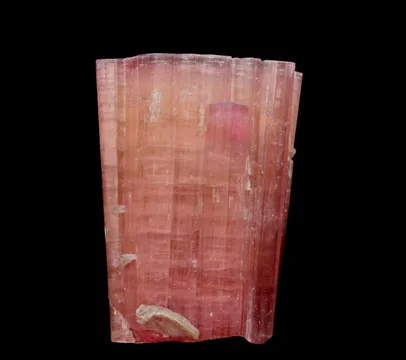
Mawi kunzite is spodumene, LiAlSi2O6, in the pink to lilac to purple color range. The crystals most prized by collectors are elongated, tabular, bladed, or prismatic, with strong vertical striations and large, flat faces. Terminations can be simple, chisel-like, stepped, etched, or complex; the most desirable pieces have sharp, undamaged terminations and enough transparency for the internal color to glow under transmitted light.
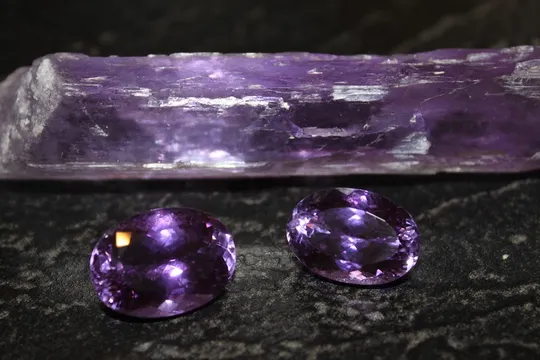
Color is one of the locality’s signatures. Mawi material ranges from pale pink and lilac to richer violet-purple, and some specimens show zoning into colorless, yellowish, bluish, or greenish zones. The color is strongly directional: a crystal that appears rather pale broadside may show a much deeper pink, lilac, or purple when viewed down the long axis. This pleochroic behavior is a critical quality factor for Mawi kunzite and explains why dealers and collectors often photograph the c-axis view separately.
Historic Nuristan descriptions record transparent gem spodumene in purple, pink, blue, green, and yellow, with crystals up to one meter long in the broader district. More conservative and locality-grounded accounts describe tabular gem spodumene up to 45 cm in the Kolum-Nuristan district and important Mawi crystals of 15 to 20 cm in the Sorbonne collection. In the current collector market, Mawi kunzites appear from miniatures around 4–6 cm to cabinet and large-cabinet crystals in the 10–24 cm range, with weights from a few dozen grams to more than two kilograms for exceptional pieces.
The associated minerals are an important part of the locality’s personality. Cleavelandite is one of the best companions, giving white, pearly albite blades against pink or lilac spodumene. Quartz and microcline are common pegmatite associates; elbaite may occur close to kunzite and, more rarely, on the same specimen; lepidolite and muscovite point to the lithium-rich pocket environment. Microlite-group minerals and tantalum-niobium oxides are especially interesting on Mawi specimens because they advertise the rare-element chemistry of the pegmatite rather than merely decorating the crystal.
Most collectible Mawi kunzite is valued as a crystal rather than a matrix specimen. Many pieces are complete or nearly complete floaters, sometimes re-healed at the base, reflecting pocket growth and later liberation from soft clay. Matrix pieces do exist, including kunzite with albite-cleavelandite or tourmaline, but clean, freestanding crystals remain the form most associated with the locality.
Quality grading should begin with form. A fine Mawi kunzite should have a recognizable crystal shape, clean edges, and a natural termination. Next comes color: stronger lilac-purple through the c-axis commands attention, especially where the color is not confined to a thin zone. Transparency and luster are the next tests; the best pieces are gemmy to translucent, with glassy or waxy faces. Finally, condition matters greatly because spodumene has perfect cleavage. Even superb crystals often show small cleaves, bruises, or repaired-looking internal planes, but major cleavages through the display face or tip sharply reduce desirability.
The main authenticity issue with Mawi kunzite is not a plague of locality-specific fakes but the broader problem of spodumene color and treatment. Kunzite color can be unstable: exposure to sunlight, ultraviolet light, or moderate heating may fade pink and purple tones, and irradiation can create or restore pink, purple, and sometimes greenish colors in spodumene. Older gemological reporting on Afghan spodumene noted that miners described blue-violet or green material changing to pink or purple after boiling and sunlight exposure, and laboratory fade tests showed pink color in Afghan spodumene could bleach with heat or direct sun. Collectors should therefore treat “natural color,” “unheated,” or “untreated” claims as meaningful only when they come from a trusted chain of custody or, for high-value pieces, laboratory documentation.
The second concern is naming. Afghan spodumene in blue, green, yellow, colorless, and purple tones is sometimes loosely sold as “kunzite,” but strictly speaking kunzite is the pink to lilac to purple variety. Yellow spodumene is better called triphane, and green spodumene is not automatically hiddenite; true hiddenite is chromium-colored green spodumene, a much more specific gemological identity. For Mawi specimens, a precise label should say “spodumene var. kunzite” when the dominant collector value is the pink-lilac-purple color.
Condition is the everyday challenge. Spodumene has perfect cleavage, so Mawi kunzite is vulnerable to flat breaks, bruised edges, cleaved bases, and stress cracks. Fine striated faces can be lustrous but still show small nicks along prism edges. Etching is natural and can be attractive, but heavy etching may reduce transparency and crispness. Repaired specimens are not unknown in large spodumene generally; collectors should inspect long crystals carefully under strong side light for glue lines, filled cleavages, and mismatched luster along breaks.
Color preservation deserves practical care. Display Mawi kunzite away from direct sunlight and intense UV. LED case lighting is preferable to hot halogen or sunlight-rich window display. The richest c-axis color is one reason these crystals are beloved, but that same color can be sensitive; a specimen should not be treated like a quartz or feldspar that can sit indefinitely in bright sun.
Market availability is better than for many classic pegmatite localities, but quality varies sharply. Small to medium Mawi crystals appear regularly in dealer inventories and auctions, including complete lilac floaters, striated tabular crystals, and pieces with cleavelandite or tourmaline. Large, deeply colored, sharply terminated, gemmy crystals are much less common and command strong prices, especially when they are undamaged and aesthetically complete. Recent public listings show small cabinet crystals in the low hundreds to low thousands of dollars, while large cabinet and exceptional crystals can be listed from several thousand dollars upward or offered on request.
For serious collectors, the best Mawi kunzite is not necessarily the largest. A 5 cm doubly terminated floater with saturated lilac c-axis color, clean faces, and no distracting cleaves can be far more desirable than a 20 cm pale blade with a broken tip. The sweet spot is a crystal that shows the Mawi look instantly: glassy striated faces, pale-to-rich pleochroic color, a natural termination, and the crisp geometry of a pocket-grown lithium pegmatite mineral.
The old approach to Mawi reads less like a collecting trip than a mountain expedition. In 1977, Bariand and Poullen described the end of the jeepable road as lying far below the interesting pegmatites. The road left the Kabul–Jalalabad route, ran north to Mehtar Lam, and ended several kilometers beyond the village of Nuristan, about 70 km after the fork, at a small newly built bridge over the Alingar River. From there, the mineral localities belonged to walkers. One full day on foot was needed to cover 25 km of narrow gorges between the bridge and a tiny cluster of houses near Dahaneh-Pyar, at the junction of the Kolum and Alingar rivers. Another full day was needed to reach Nilaw over 15 km of bad rocky trail.
Mawi lay beyond Nilaw, reached by crossing the Koh-e-Sagoli range at about 3,000 m and descending into the short Mawi valley until the dumps came into view. The path from Nilaw to Mawi was described as “relatively easy,” but that phrase belongs to people already accustomed to the Alingar gorges. In practical collecting terms, it meant that even in peacetime a visitor did not simply “go to Mawi.” He walked into Mawi.
The geology was equally dramatic. The principal vein at Mawi was later summarized as about 40 m thick and 1,200 m long, and Pala’s 2010 field photographs carried a blunt caption from their correspondent: the mountain was “not a normal mountain,” but a huge pegmatite vein. Another photograph was taken specifically to show the scale of the pegmatite against a human body. For collectors used to pegmatites as dikes glimpsed in a quarry wall, Mawi’s scale is the first surprise: this was not a small pocket seam, but a mountainous mass of feldspar, quartz, lithium minerals, and gem pockets.
The pocket environment was kinder to crystals than the surrounding country was to people. In the Nuristan pegmatites, gem tourmaline, spodumene, and beryl formed in cavities up to about 50 cm across in the central parts of complex pegmatite bodies. The crystals were often surrounded by soft, powdered clay in quartz-rich zones. When miners hit a pocket, the work changed from drilling hard pegmatite to delicately scraping clay with small tools. That contrast—violent entry, surgical recovery—is one reason Mawi produced so many complete, sharp crystals.
The old production numbers are astonishing. Rossovskiy and coauthors reported that between 1973 and 1975, more than 1,260 kg of gem-quality kunzite came from the Kolum district. By the mid-1980s, Gary Bowersox estimated about 2,000 kg of fine kunzite being mined each year in the Nuristan region. Those figures explain why Mawi and nearby Kolum became familiar names in the mineral trade, but they can mislead if read only as tonnage. Most spodumene from any large production is not fine collector material. The pieces collectors still fight over are the survivors: terminated, transparent, correctly colored crystals with minimal cleavage damage.
One of the most memorable accounts concerns color itself. Afghan miners told Bowersox that spodumene came from the ground blue-violet or green, and that leaving crystals in the sun for several days, often after boiling them in water, could turn the material into attractive purple or pink kunzite. Laboratory fade tests added the cautionary ending: heating fragments to 400°C for six hours bleached the pink color completely, and direct sunlight faded pieces from a single pink crystal to nearly colorless within several days, less than a week. Few mineral localities offer such a vivid reminder that a crystal’s beauty can be both natural and fragile.
The route to market was as severe as the route to the mine. In the 1980s, mined tourmaline and spodumene were carried by miners on foot over roughly 560–640 km of rough mountain terrain to reach Pakistan, through border areas reported to be dotted with land mines. From there, material moved into trading centers and eventually to cutting and collector markets in Pakistan and beyond. A Mawi kunzite in a modern display case may look serene, but its early commercial history runs through mountain passes, wartime necessity, and a trade network built on human backs.
Pala’s later Mawi field notes add a face to that history: Mr. Khoji, a miner from Gaamata village in the Mawi area, said to have worked there for forty years. In one photograph he stands as a working miner; in another caption he is “going to find some beautiful indicolite” at the Gaamata mine. The same page shows a crew of Gaamata miners and describes the area’s best indicolite. These notes were about tourmaline rather than kunzite, but they belong to the same pegmatite and the same mining culture: long familiarity with a giant vein, local knowledge of productive pockets, and decades of work in a place most collectors will only know through crystals.