Marquette County, USA: Michigan's classic iron-oxide locality, known for specular hematite, martite, goethite and jasper; historic mines and collecting appeal.
Key facts
Marquette County is the heart of Michigan’s classic iron country: a Lake Superior upland of folded Paleoproterozoic iron formation, jasper, chert, schist, and old mine dumps that has supplied both steel furnaces and mineral cabinets for nearly two centuries. For collectors, the essential name is the Marquette Iron Range, especially the Negaunee Iron Formation and associated Goodrich Quartzite, where sedimentary banded iron formation was metamorphosed, oxidized, leached, enriched, folded, mined, and finally weathered into an unusually varied suite of iron-oxide specimens. The county’s best-known pieces are not delicate pegmatite miniatures but muscular ore minerals: glittering silver-gray specular hematite, dense blue-black martite, lustrous black kidney ore, velvety and stalactitic goethite, red jasper banded with specularite, and the distinctive altered almandine dodecahedra long prized from the Michigamme and Champion-area mines.
Historically, this was the first great iron-producing district of the Lake Superior region. The 1844 compass deflections near Teal Lake, the Jackson Mine at Negaunee, the long haul to Marquette’s harbor, the Soo Canal, the rise of Cleveland-Cliffs, and later the Tilden taconite operation all belong to the same mineral story. The collector specimens preserve that industrial geology in hand-sized form: specular hematite plates that flash like mica but leave a red-brown streak, black botryoidal hematite with rounded “kidney” surfaces, goethite crusts that look varnished or velvet-black, and garnet forms partly or wholly replaced by chlorite, chamosite, magnetite-rich mixtures, or iron oxides.
Regional View
Country View
The county is also broader than the iron range alone. Pegmatites near Republic and Lake Michigamme add beryl, tourmaline, quartz, apatite, and accessory rare minerals; the Presque Isle and Yellow Dog peridotite-related occurrences add sulfides and ultramafic associations; and the Ishpeming greenstone-belt gold prospects contribute quartz-sulfide mineralization. Still, the best Marquette County mineral specimens are usually judged by iron-country standards: brightness of specularite, integrity of botryoidal surfaces, sharpness of martite or pseudomorph form, vivid red jasper contrast, and good old mine provenance.

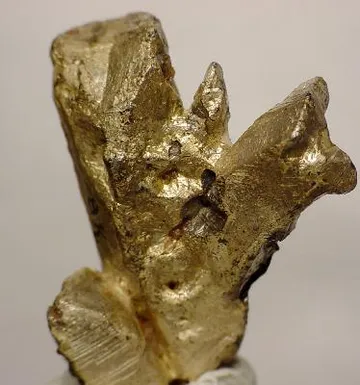
Photo: Wikimedia Commons

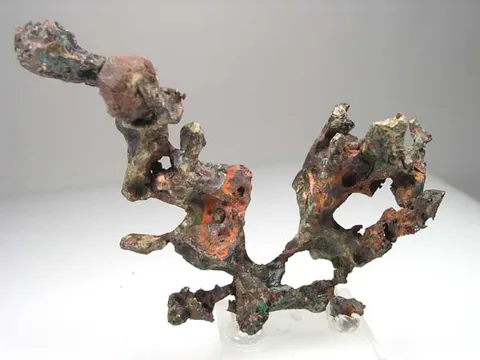
Photo: Wikimedia Commons
Search for specimens: View all specimens from Marquette County, USA
Marquette County’s classic mineral specimens come chiefly from the Marquette Iron Range, a belt of iron formation extending through the Negaunee-Ishpeming-Champion-Republic area. The principal host is the Negaunee Iron Formation of the Menominee Group, within the Marquette Range Supergroup. Its unaltered iron formation contains chert, magnetite, hematite, siderite, and iron silicates such as grunerite, minnesotaite, and stilpnomelane; local enrichment by replacement, oxidation, and leaching concentrated iron oxides and produced the soft and hard ores that gave the district its mineral character. In collector terms, the key distinction is between soft, porous, earthy hematite-goethite-limonitic ore and hard, dense magnetite-martite-hematite-specularite ore.
The ore bodies were not a single uniform blanket. At Cliffs Shaft, hard specular hematite ore was localized high in the Negaunee Iron Formation, close beneath Goodrich Quartzite, in the axial part of the Marquette synclinorium. Elsewhere, oxidation and silica removal made porous soft ores; groundwater movement and later weathering opened cavities for goethite, botryoidal hematite, barite, apatite, quartz, manganite, and other late minerals. Some ore was spectacularly textural rather than crystalline: “pencil ore,” “velvet ore,” “grape ore,” “kidney ore,” red earthy hematite, jaspery hematite breccias, and contorted jaspilite. The Goodrich Conglomerate ores south of Negaunee incorporated fragments derived from the Negaunee Iron Formation—jasper, chert, and hematite ore—then received secondary hematite and magnetite in pore spaces and replacements.
Mining began in the 1840s after the Teal Lake-area iron discoveries, with the Jackson Mining Company organized in 1845 and the Jackson Mine becoming the symbolic birthplace of Michigan iron mining. Early ore was smelted locally with charcoal, then, after the opening of the Soo Canal in 1855, shipped by Great Lakes vessel from Marquette. The district rapidly expanded through the Jackson, Cleveland, Lake Superior, Champion, Republic, Mather, Tracy, Cliffs Shaft, and many other operations. Iron Cliffs opened the Cliffs Shaft as the New Barnum in 1879, and the 1891 merger that formed Cleveland-Cliffs Iron Company tied much of the range’s later history to one operator. The older underground and open-pit mines supplied high-grade hematite and specularite; the modern era shifted to low-grade iron formation processed into pellets, most notably at Tilden, which began pellet production in 1974.
Today the operating industrial landscape is very different from the specimen-producing heyday. Michigan lists Tilden and Empire as the state’s permitted iron mines in Marquette County, but Empire has been indefinitely idled since 2016, while Tilden remains the major active iron-ore operation on the range. Tilden is an open-pit truck-and-shovel mine with concentrating and pelletizing facilities, and it is unusual among Cleveland-Cliffs’ U.S. iron operations in having hematite as the primary ore mineral, with martite, goethite, and siderite also important. Active mine property is not a collecting locality for casual visitors. Collectors should treat modern mine, railroad, and plant areas as restricted industrial sites and should collect only where access is explicitly public or permission is secured.
The old dumps and exposures are the traditional collector’s ground. The Champion-Beacon mine dumps are especially famous for specular hematite, martite, grunerite, garnet pseudomorphs, siderite, sericite, tourmaline, and quartz; older state collecting literature noted garnets over one inch in the Champion area and larger non-gem garnets at Michigamme. Jackson, Lake Superior, Athens, Lucy/McComber, National, Burt, Mather, Tracy, Cleveland, Section 16, Pendill, Dalliba, Republic, Salisbury, and other mines each added their own styles of hematite and goethite. Jasper Hill or Jasper Knob at Ishpeming remains the iconic outcrop for contorted jaspilite—red jasper bands folded with blue-black specular hematite—more a geologic monument than a specimen pocket, but central to understanding the look of Marquette material.
Marquette County almandine is valued less as a transparent gemstone than as a metamorphic and replacement specimen tied directly to the iron range: dodecahedral garnets in chlorite schist, mica schist, quartz, sulfide-quartz veins, and iron-formation contact zones, commonly red to brown when fresh and black, greenish, or dull when partly replaced by chlorite, chamosite, magnetite-rich material, or iron oxides. The finest documented county material includes Michigamme Mine dodecahedra to about 7.5 cm, partly altered in chlorite schist; Champion Mine almandine on the 32nd sublevel about 180 meters east of No. 7 shaft in a matrix of pyrrhotite, chalcopyrite, minor pyrite, and quartz; Beacon Mine pseudomorphs historically described as “aphrosiderite”; altered Washington Mine dodecahedra generally under 2 cm; glassy red Edwards Mine crystals to about 1.5 cm in mica schist; and olive fine-grained garnets with grunerite in contorted bands near the M-95 bridge south of Republic. A top Marquette almandine specimen has recognizable dodecahedral form, enough contrast against quartz, chlorite, mica, sulfide, or specularite to read as a crystal rather than an ore lump, and either retained reddish garnet substance or a sharp complete pseudomorph that records the original garnet with authority.
Hematite is the signature collector mineral of Marquette County, occurring as earthy red ore, compact blue-black ore, botryoidal kidney ore, grape ore, pencil ore, micaceous specularite, schistose “specular slaty ore,” martite after magnetite, and hematite pseudomorphs after pyrite. Champion produced excellent specularite and martite octahedra to about 1 cm in schistose specularite; Beacon yielded octahedral martite and specularite; Jackson is noted for specularite pockets or irregular lenses, martite, jasper, grape ore, red earthy hematite, and limonite; Cliffs Shaft produced blue-black martite bands alternating with red jasper, pencil ore, and pyrite-cube pseudomorphs to about 2.5 cm; Cleveland and Lucy/McComber produced hematite after cubic pyrite to around 3 cm; Republic produced excellent specularite and platy crystals to about 10 cm; and the Lake Superior and Mather mines supplied large botryoidal and kidney-ore styles. The best cabinet pieces show clean metallic sparkle or rounded black luster without excessive bruising, clear jaspilite contrast where present, and an old-mine label precise enough to distinguish Champion specularite, Jackson kidney ore, Republic plates, or Cliffs Shaft martite rather than merely “Michigan hematite.”
Marquette County goethite belongs to the oxidized soft-ore environment and is best known as black to brown botryoidal, reniform, stalactitic, velvety, drusy, lamellar, radial-bladed, and earthy material associated with hematite, limonite, martite, quartz, barite, manganite, pyrolusite, and altered iron formation. At the Jackson Mine it occurs in drusy vugs as lamellar crystals less than a centimeter long and as stalactitic limonite masses coated with radiating goethite blades over 2.5 cm; Lake Superior Mine material is botryoidal, stalactitic, and earthy; Athens has cavity goethite in hematite ore; Lucy/McComber produced velvety botryoidal masses; National produced excellent botryoidal specimens; Burt is noted for fine radiating masses; Mather yielded compact reniform masses of needle-like crystals; Section 16 near Ishpeming produced velvety botryoidal vug linings in hematite; and the Northampton and Dalliba mines near Lake Michigamme produced radial grape ore in stalactites, some described historically as coated with a smooth bright black varnish-like surface or velvety needle-goethite, with vugs containing goethite and quartz. Good pieces here are judged by undamaged rounded surfaces, silky or varnished luster, open vug architecture, and locality specificity, because much ordinary Marquette “limonite” is visually ambiguous without analysis or strong provenance.
Beyond these three, Marquette County has a deep and locally distinctive mineral list. Magnetite and martite are fundamental to the iron ores; grunerite, minnesotaite, stilpnomelane, chlorite, sericite, siderite, ankerite, quartz, jasper, and chert frame the iron-formation assemblage; and manganese-rich zones at Champion and Republic add jacobsite, pyroxmangite historically labeled “rhodonite,” kutnohorite, manganoan calcite, manganoan siderite, manganite, pyrolusite, and related black manganese oxides. The Champion Mine is notable for black tourmaline sprays in quartz veins and for manganiferous quartz veins cutting Negaunee Iron Formation; Beacon and Champion also yielded apatite, tourmaline, and sulfides. The Republic-area pegmatites and Lake Michigamme pegmatitic rocks add quartz, muscovite, beryl, apatite, topaz, tourmaline, and accessory rare minerals. The county is also important for rarer occurrences such as mackinawite as microscopic inclusions in cubanite from the Yellow Dog peridotite, reported as the first occurrence of mackinawite in Michigan, and seamanite at the Cambria-Jackson Mine, a rare manganese phosphoborate better known from its Iron County type locality.
The first authenticity issue with Marquette County specimens is locality precision. “Champion Mine” labels can be ambiguous because Michigan also has the famous Champion copper mine in Houghton County; Marquette County iron-range material should specify Champion, Champion Township, Marquette County, or Beacon/Champion iron mine where appropriate. “Marquette” alone is too broad for serious cataloging because Jackson, Champion, Republic, Michigamme, Cliffs Shaft, Cleveland, Lucy/McComber, Mather, National, and Tilden-area material can look quite different and have different historical significance.
The second issue is mineral naming. Much old brown or black iron oxide was labeled “limonite,” but limonite is a field term rather than a single species, and analyzed material is commonly goethite with variable hematite, lepidocrocite, amorphous iron oxides, and adsorbed water. Similarly, “aphrosiderite” on old garnet pseudomorph labels is an obsolete name for chlorite-group material, often used for altered almandine forms from the iron mines. Those specimens are still collectible and historically important, but they should be described as chlorite-group or chamosite after almandine, or as altered almandine, depending on evidence. Pink carbonate from the Lucy/McComber Mine area has also been called rhodochrosite in older circulation, but documented testing showed at least some of the pale pink finger-like cavity linings are manganoan calcite.
Condition matters strongly. Specular hematite is tough but messy; it sheds glittering metallic scales and red-brown to black dust, and attractive display faces are easily dulled by abrasion. Botryoidal hematite and goethite commonly show bruises, impact scars, cracks, or broken bubbles along high points. Goethite can be porous and may hold dirt or moisture in cavities; avoid aggressive wet cleaning unless the specimen is stable and fully dried afterward. Jaspery hematite slabs take polish beautifully, but crystallized specimens should not be treated as lapidary rough. Almandine and pseudomorphs after almandine are commonly altered, fractured, or embedded in massive schist; sharp, isolated dodecahedral form is far more important than transparency.
Fluorescence is not the main attraction of the locality. Iron oxides are generally non-fluorescent and opaque, and ultraviolet response is not a reliable field discriminator for the principal collectible species. Handling is more practical than optical: keep hematite and goethite away from pale, friable, or porous specimens because their dust stains; support heavy iron-ore pieces well in drawers; and label altered garnets carefully so future owners do not misrepresent pseudomorphs as fresh gem garnet.
Market availability is steady for common Champion specularite, jaspilite, and small hematite pieces, but strong old-locality specimens are not common. The best examples—sharp Michigamme garnet pseudomorphs, lustrous Jackson kidney ore, Republic platy specularite, pyrite-cube hematite pseudomorphs from Cleveland or Lucy, or well-provenanced goethite stalactites and grape ore—usually appear from old collections rather than current mining. Active operations are not a source for casual collecting, and many historic dumps have been reclaimed, overgrown, built over, or placed under changing ownership, so provenance from older collectors, museum exchanges, or well-documented field collecting is especially valuable.
On September 19, 1844, William Austin Burt’s survey party was working near Teal Lake when the compass needle began to misbehave. The disturbance was not a minor annoyance; it was the clue that led the surveyors toward iron-rich rock and into the first recorded discovery of the great Lake Superior iron deposits. Two days later, on September 21, six inches of snow reportedly fell, closing the season with the kind of Upper Peninsula punctuation that makes the episode feel less like a tidy discovery story and more like field geology at the edge of endurance. The rock that pulled at the compass would pull miners, capital, railroads, ships, and immigrants into Marquette County for the next century and a half.
The Jackson Mine began as an astonishingly simple proposition: a mountain of ore about 150 feet high. The earliest workers did not arrive with a modern pit fleet. They pried ore loose with bars and picks, then drilled by hand and blasted the iron formation. Early accounts of the first open pit describe fewer than a dozen men at the crude quarry. Some of those first miners came from Cornwall and brought double-jacking, a three-person method in which two men swung sledges while a third—sometimes a boy—held the drill steel. A collector holding a dense Jackson hematite today is holding the same material that was once broken loose by muscle, rhythm, and nerve before steam, electricity, and deep shafts transformed the district.
Getting ore to market was almost as difficult as finding it. Before reliable rail and harbor infrastructure, ore-laden wagons and sleighs had to slog roughly twelve miles to the lakeshore through mud, snow, and rough country. In 1852, Tower Jackson, working as a local agent for the Cleveland Iron Mining Company, sent the plea that the Iron Ore Heritage Trail still preserves in its signage: “We want a plank road!” The phrase is wonderfully plain, but it says everything about the district’s bottleneck. Marquette County had iron; what it lacked was a dependable path from mine to vessel.
The Jasper Knob dispute sounds almost comic until one remembers that a fortune lay in the outcrop. News of the “Mountain of Ore” drew rival companies to the same prize, and the Cleveland Mining Company and the Marquette Iron Company each sent men to occupy the ground while title was contested. Cabins were built and burned. Potatoes, parsnips, and carrots were planted and pulled. The struggle lasted seven years before the Marquette Iron Company secured the knob. Today Jasper Knob is loved for its folded jaspilite—red jasper bent through blue-black specular hematite—but its surface also records one of the range’s earliest battles between geology, law, and raw possession.
The ore docks turned mineral specimens into national infrastructure. In 1931, the great Lower Harbor ore dock at Marquette received its first load: 10,103 tons of iron ore from Ford Motor Company’s Blueberry Mine west of Ishpeming. The loading took 92 minutes. That figure is a fine corrective to the collector’s hand lens. In a case, Marquette hematite is a lustrous black mound or a silver micaceous plate; on the dock, it was a measured river of ore moving from railcar to ship pocket at industrial speed.
Among collectors, the Michigamme garnet pseudomorphs have their own folklore. Miners called the hard altered dodecahedra “black diamonds,” and the name makes sense the moment one sees a sharp, dark, twelve-sided crystal form in the hand. They were not diamonds, of course, and many were no longer fresh almandine throughout, but they were memorable enough that local entrepreneurs reportedly sold them to visitors and tourists, especially around the Michigamme railroad depot. The best survivors still have the charm of that nickname: black, geometric, tough, and unmistakably born of the iron range.
Modern field collectors have added their own nicknames. The Champion area has been called “Specular Acres” by collectors because the old mine dumps can glitter with micaceous hematite, while one field collector famously compared Marquette County to Michigan’s “Tsumeb” for its surprising breadth of mineral occurrences. The comparison is playful, not literal, but it captures what makes the county rewarding: one can go looking for garnet and come away with specularite, tourmaline, martite, siderite, jasper, or a puzzle that sends the specimen back under the scope.