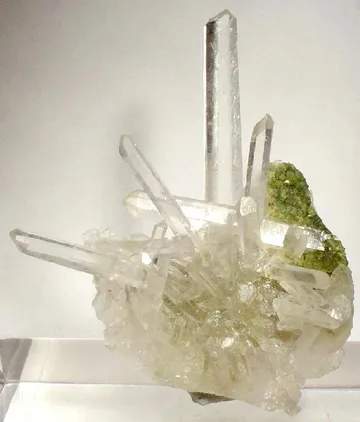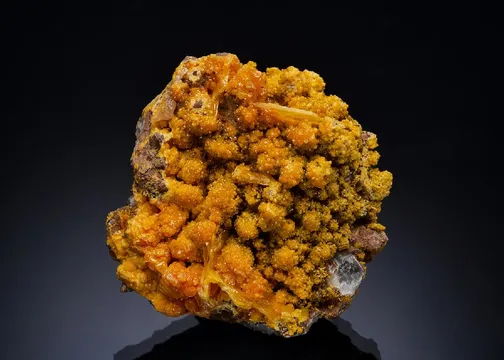
A collector's guide to Mammoth-Saint Anthony Mine, USA: its geology, mining history and notable minerals, illustrated with the 255 specimens documented from this locality on EarthWonders.
Key facts
The Mammoth-Saint Anthony Mine at Tiger, Arizona, is one of the classic oxidized base- and precious-metal vein localities of the American Southwest: a mine whose reputation among collectors rests not on a single spectacular species, but on the density, color, and scientific oddity of an entire secondary-mineral ecosystem. In the dry Basin and Range country southwest of the modern town of Mammoth, fault-controlled quartz veins cut older granitic and volcanic rocks, and sulfide ores rich in lead, zinc, copper, silver, gold, and molybdenum were later oxidized to remarkable depth. That oxidation produced the minerals that made “Tiger” a name collectors still say with a certain reverence: orange wulfenite, reticulated white cerussite, emerald dioptase, electric-blue diaboleite, leadhillite, caledonite, linarite, vanadinite, mimetite, willemite, malachite, and an extraordinary suite of rare lead-copper-chloride, sulfate, chromate, tungstate, and silicate species.
The best Mammoth-Saint Anthony specimens have a look unlike anything from the big Arizona copper camps. They are not simply “Arizona wulfenites” or “Arizona dioptases”; they are porous, vuggy, often heavily oxidized pieces in which orange plates, white reticulated lead carbonate, green copper silicate, blue lead-copper chlorides and sulfates, and pale quartz or barite matrix are stacked in improbable miniature landscapes. The mine is equally important to systematic collectors. Several minerals were first described from Tiger material, and many of the locality’s rarest pieces require a microscope to appreciate fully. A fine cabinet specimen may be an aesthetic mineral object; a good Tiger thumbnail can also be a small piece of mineralogical history.
Regional View
Country View
The mine complex has appeared under several closely related names in labels and literature: Mammoth Mine, St. Anthony Mine, Mammoth-Saint Anthony Mine, Collins Mine, Mohawk Mine, New Year Mine, Tiger property, and Mammoth Gold Mines Ltd. property. For collectors, those names matter because old labels may preserve which vein, shaft, or period a specimen came from. The Collins vein and Mohawk workings are especially important in the specimen history, and the old townsite of Tiger has become inseparable from the mine’s identity.

Photo: Rob Lavinsky / iRocks.com, Wikimedia Commons

Search for specimens: View all specimens from Mammoth-Saint Anthony Mine, USA
Mammoth-Saint Anthony is a polymetallic vein deposit in the Mammoth mining district of Pinal County, Arizona, about 5 km southwest of the town of Mammoth and roughly north-northeast of Tucson. The ore system is centered on major fault-controlled vein structures, particularly the Mammoth and Collins veins, where quartz-rich vein filling and brecciated zones cut Precambrian quartz monzonite or Oracle Granite and are closely associated with Tertiary rhyolite and volcanic rocks. Later oxidation was exceptionally deep, and in places the old workings were oxidized hundreds of feet below the surface, creating the environment for the mine’s celebrated secondary minerals.
The ore history and the specimen history are inseparable. The primary sulfide stage included galena, sphalerite, pyrite, and chalcopyrite, with gangue quartz, barite, fluorite, and hematite. Oxidation then produced the showy lead, zinc, and copper secondaries: cerussite, anglesite, hemimorphite, smithsonite, willemite, malachite, azurite, linarite, dioptase, chrysocolla, and diaboleite. A later vanadium-molybdenum event placed wulfenite and vanadinite over earlier assemblages, so the same specimen may carry evidence of several mineralizing episodes: quartz after galena, blue diaboleite or caledonite, white cerussite, green dioptase, orange wulfenite, and yellow mimetite or other late coatings.
The mining story begins with Frank Schultz, who located claims on the Collins vein in 1879, the Mohawk vein in 1881, and the Mammoth vein in 1882. Early work focused on gold, and the town of Mammoth developed to serve the ore treatment needs of the district. Ore was hauled first by 20-mule teams and later by aerial tramway. By the late 1880s the property was operating under Mammoth Gold Mines Ltd., and in the 1890s and early 1900s it passed through several companies and reorganizations. A major cave-in in 1901, reportedly extending from the 750-foot level to the surface, interrupted operations. Before 1914 the mine was essentially a gold producer, but World War I demand for molybdenum made the old wulfenite-bearing material commercially important, and tailings were reworked for molybdenum. Later operations recovered gold, silver, lead, zinc, copper, vanadium, molybdenum, and related commodities in several intermittent campaigns. The mine finally closed as a major operation in the early 1950s, with later limited work and reworking of material.
For collectors, the most important specimen-producing zones include the Collins vein, the Mohawk shaft area, and oxidized pockets and seams encountered during ore work. The famous wulfenite fracture described from the mine was a vertical opening hundreds of feet high but only inches wide, lined with orange-yellow crystals. Dioptase-rich material from the Mohawk shaft entered collecting history in unusually large quantity, including specimens recovered from mine handling equipment rather than carefully excavated pockets. Many old Tiger specimens were saved opportunistically during mining, which helps explain both their desirability and their condition problems: specimens may be brilliant and historically important, yet show edge wear, contacted crystals, or mining damage.
The mine and surrounding ground should be treated as private or controlled property, and the old underground workings are not a modern collecting destination. Published mining data describe the old workings as inaccessible, and the locality’s best specimens now circulate through old collections, museum holdings, dealer inventories, and occasional estate dispersals. Serious collectors should think of Mammoth-Saint Anthony as a classic historic market locality rather than a place to visit for casual collecting.
Wulfenite is the visual signature of Mammoth-Saint Anthony: orange, orange-yellow, honey, reddish-orange, and brownish tabular to bladed crystals, commonly thin and lustrous, scattered on vuggy quartz-rich matrix or laid over earlier cerussite, dioptase, willemite, fluorite, and mimetite-bearing assemblages. The most storied material includes orange-yellow crystals lining a long narrow fracture, and Collins vein specimens with bright blades over powdery yellow mimetite; individual crystals on good pieces may reach thumbnail to miniature scale, while historic large plates are highly prized. Fine Tiger wulfenite is separated from ordinary material by transparency, saturated orange color, intact blade edges, clean contrast with white cerussite or green dioptase, and convincing old provenance; many lesser pieces are attractive but chipped, crowded, or visually flat.
Cerussite from Mammoth-Saint Anthony occurs as colorless, white, beige, gray-white, and sometimes silky reticulated crystals, commonly in branching or V-twinned forms, and it is one of the great “architecture” minerals of the locality. Some crystals and clusters reach cabinet significance, including reticulated groups several centimeters across and individual twinned crystals to several centimeters, but many of the most desirable pieces are smaller combinations where cerussite forms a delicate white framework partly coated by emerald dioptase and accented by orange wulfenite. The best specimens preserve a three-dimensional open lattice without crushed or missing terminations; because old Tiger cerussite is fragile and dense, ordinary examples often show broken tips, contacted backs, or dull surface wear.
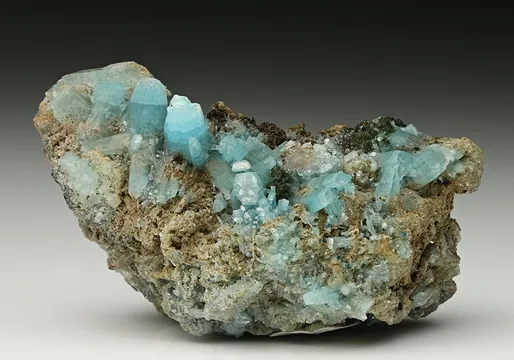
Dioptase at Tiger is famous for its emerald-green to deep bluish-green color in tiny prismatic crystals, drusy coatings, radial sprays, and spherical aggregates that sparkle against pale oxidized matrix. The Mohawk shaft material is legendary among collectors, and classic combinations show dioptase sprinkled over or preferentially coating reticulated cerussite, set with orange wulfenite, or associated with willemite, quartz, fluorite, and mimetite. Individual dioptase crystals are generally small, but superb specimens have saturated color, bright luster, and dense coverage; the most collectible pieces are those in which the green dioptase is not merely present, but visually composes the specimen with white cerussite and orange wulfenite in the unmistakable Tiger palette.
Leadhillite is one of the classic lead-carbonate-sulfate species that gives Mammoth-Saint Anthony its systematic importance, occurring as pale yellow, colorless, white, and locally bluish or ice-blue tabular to platy crystals in the oxidized lead zone. It is closely tied to the mine’s complex secondary paragenesis, especially the Collins vein and anomalous oxidation assemblages where it may appear with cerussite, diaboleite, caledonite, matlockite, phosgenite, wherryite, georgerobinsonite, bobmeyerite, and other rare species. Display-quality leadhillite from Tiger is much scarcer than wulfenite or cerussite; fine examples show sharp, glassy, undamaged plates with visible form and contrast, while ordinary material is more massive, embedded, or visible only as small pale areas among more colorful species.
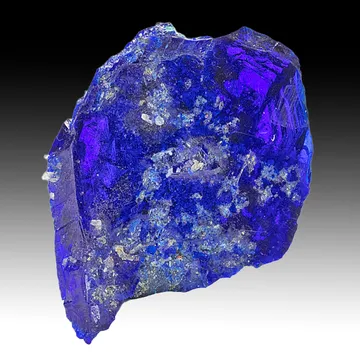
Diaboleite from Mammoth-Saint Anthony is a collector’s blue: sharp tetragonal tabular crystals and crystal aggregates in intense royal to electric blue, often tiny but visually powerful under magnification. It occurs in the oxidized lead-copper chloride assemblage with leadhillite, caledonite, cerussite, phosgenite, matlockite, wherryite, yedlinite, and quartz, and it is also part of several rare-species parageneses from the mine. Most crystals are millimetric or submillimetric, though historical pockets and rare aggregates produced more substantial visual specimens; the best pieces show isolated, lustrous, sharply outlined blue plates on contrasting pale matrix or in association with green caledonite and pale leadhillite rather than merely blue stains or indistinct grains.
Caledonite at Mammoth-Saint Anthony occurs as blue to blue-green prismatic or bladed crystals, often striated and typically associated with diaboleite, leadhillite, cerussite, wherryite, and other oxidized lead-copper species. It is one of the minerals that rewards a hand lens: on lesser specimens it may appear as small greenish-blue flecks among more dominant minerals, but on fine pieces it forms distinct, sharp, brightly colored crystals that hold their own beside the darker blue of diaboleite. The finest Tiger caledonite specimens are valued for crystal definition, clean color, and association in the rare lead-copper sulfate-carbonate assemblage; ordinary material tends to be microcrystalline, crowded, or confused with other blue-green copper secondaries.
Mimetite from Mammoth-Saint Anthony is a bright secondary lead arsenate that typically appears as orange, yellow-orange, canary-yellow, or golden crusts, sparkling microcrystals, rounded botryoidal aggregates, or small prismatic to tabular crystals on oxidized matrix, quartz, barite, wulfenite, and willemite-bearing vugs. Its most attractive role is as a color amplifier: powdery yellow mimetite beneath orange wulfenite blades, golden balls among dioptase and wulfenite, or yellow crusts that make a small Tiger specimen immediately recognizable. Good mimetite pieces are not judged by crystal size alone, but by freshness of color, coverage, and association with classic species; dull yellow coatings without visible structure are commoner and less desirable than lively, well-crystallized crusts tied to old labels or Collins vein provenance.
Azurite from Mammoth-Saint Anthony is a secondary copper mineral of the oxidized zone, occurring as deep-blue crystals, crusts, and aggregates, commonly in association with cerussite, malachite, brochantite, chrysocolla, and other lead-copper secondaries. It is not the locality’s dominant fame in the way wulfenite, cerussite, or dioptase are, but old Tiger azurite can be highly collectible when it appears in rich blue groups with white cerussite or as part of malachite-after-azurite and mixed oxidized assemblages. Good pieces show recognizable crystal form or saturated blue contrast and credible Tiger matrix; ordinary examples are small, earthy, or visually difficult to distinguish from blue copper staining without careful study.
Linarite from Mammoth-Saint Anthony is another vivid blue lead-copper species of the oxidized zone, generally seen as tiny prismatic, acicular, or bladed crystals and rich blue micro-aggregates rather than large display crystals. It belongs to the same chemically busy supergene environment that produced leadhillite, caledonite, diaboleite, cerussite, brochantite, and rare sulfate-chromate-silicate species, and it may occur as a strongly colored accent in vugs on pale matrix. The best Tiger linarite specimens have unmistakable deep azure color, bright luster, and visible crystal habit under magnification; ordinary material can be easy to overlook or misread as azurite unless the crystal form and associations are examined closely.
Willemite from Mammoth-Saint Anthony is part of the zinc-bearing supergene assemblage and occurs as colorless, white, grayish, or pale crystals and aggregates, including compact hexagonal-looking forms in association with wulfenite, dioptase, cerussite, quartz, fluorite, hemimorphite, and mimetite. It is rarely the loudest mineral in a Tiger specimen, but it can be a key locality cue on combination pieces, especially where pale willemite matrix carries green dioptase and orange wulfenite. Good willemite specimens show distinct crystal form and clear association rather than anonymous pale matrix; the most interesting examples are combination pieces where willemite provides structural contrast beneath the classic wulfenite-dioptase-cerussite assemblage.
Malachite from Mammoth-Saint Anthony occurs as green acicular groups, velvety coatings, crusts, and pseudomorphic or partial-replacement material in the oxidized copper assemblage, commonly with azurite, cerussite, brochantite, chrysocolla, and other secondary species. Its best role is in mixed Tiger specimens where green malachite adds texture and color around glassy cerussite or blue azurite; it is less often a standalone show mineral here than it is at some larger copper localities. Fine pieces show sharp fibrous sprays, rich green color, and stable surfaces, while ordinary specimens may be earthy, dusty, or subordinate to more collectible lead minerals.
Boleite from Mammoth-Saint Anthony is a dark-blue lead-silver-copper chloride occurring as small cubic crystals and aggregates in the oxidized lead halide assemblage, particularly important in association with bideauxite, leadhillite, matlockite, anglesite, cerussite, phosgenite, paralaurionite, and caledonite. The classic Tiger material includes boleite involved in replacement relationships with bideauxite near the base of the oxide zone in the Collins vein, making even very small crystals scientifically desirable. The best specimens show discrete, sharp, lustrous blue cubes on contrasting matrix or with associated rare species; ordinary examples may be tiny, embedded, or present only as blue specks requiring magnification and analytical caution.
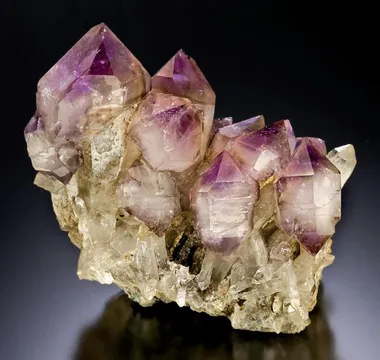
Quartz is the essential matrix and vein mineral at Mammoth-Saint Anthony, occurring as massive vein quartz, drusy coatings, vug linings, spongy silicified matrix, and minute crystals that in places replaced primary galena and provided a framework for later diaboleite, phosgenite, yedlinite, wulfenite, dioptase, and other secondaries. It is not collected from Tiger for quartz aesthetics alone, but the character of the quartz matters greatly: porous, pale, vuggy, or drusy quartz can present orange, green, blue, and white secondary minerals beautifully. Good Tiger quartz specimens are therefore judged by what the quartz hosts and how well it preserves the oxidized sequence, not by large crystal size.
Vanadinite from Mammoth-Saint Anthony belongs to the later vanadium-rich stage that also produced wulfenite, and it occurs as red, orange-red, brownish, or dark prismatic hexagonal crystals and subparallel groups on oxidized matrix. Though far less common on the market than Tiger wulfenite, it is important because the mine was a producer of vanadium minerals and because vanadinite helps define the late overprint on earlier lead-zinc-copper oxidation products. The best specimens show distinct lustrous prisms or compact groups with good color and association; ordinary pieces are small, dark, or visually overwhelmed by iron oxides and matrix.
Beyond these better-known species, Mammoth-Saint Anthony is especially prized for type-locality and rare minerals. The locality is documented for bideauxite, bobmeyerite, creaseyite, georgerobinsonite, macquartite, mammothite, murdochite, pinalite, wherryite, yedlinite, and evanichite, along with additional unusual species such as matlockite, phosgenite, paralaurionite, plumbonacrite, hydrocerussite, fornacite, mottramite, descloizite, hemimorphite, smithsonite, chrysocolla, brochantite, connellite, fluorite, barite, hematite, and others. Many of these are microminerals, but their scientific importance is disproportionate to their size: Tiger is one of the rare localities where a small vug can combine lead, copper, chlorine, fluorine, sulfur, chromium, tungsten, vanadium, arsenic, silicon, and carbonate chemistry in a single specimen.
Authentic Mammoth-Saint Anthony specimens are usually historic pieces, and provenance matters. Labels reading “Tiger,” “Mammoth Mine,” “St. Anthony,” “Collins,” “Mohawk,” or “Mammoth-St. Anthony” may all be legitimate, but they should be evaluated in context: species, matrix, associations, age of label, and comparison with known Tiger material. The classic combinations—orange wulfenite, white reticulated cerussite, emerald dioptase, blue diaboleite or caledonite, pale leadhillite, yellow mimetite, and vuggy quartz—are among the most recognizable. At the same time, Tiger’s mineralogy is so complex that misidentifications are common, especially among tiny yellow-orange chromates, molybdates, arsenates, and rare silicates.
No well-documented modern industry of fabricated Mammoth-Saint Anthony fakes is a standard warning in the literature, but mislabeling and over-identification are real concerns. Rare species should not be accepted on label alone unless the specimen has convincing documentation or analytical confirmation. Historical examples show why: bideauxite was originally present on specimens labeled as cerargyrite, georgerobinsonite was once treated visually as a more familiar orange mineral, and modern specimens carrying names such as macquartite, fornacite, wherryite, pinalite, bobmeyerite, or evanichite deserve careful verification. Even common species can be confused: linarite versus azurite, mimetite versus wulfenite, fornacite versus macquartite, and diaboleite versus other blue lead-copper chlorides are all realistic problems at this locality.
Condition is a major value factor. Tiger wulfenite is often thin and edge-chipped; cerussite lattices are easily broken; dioptase sprays can be rubbed; leadhillite and diaboleite crystals are commonly tiny and exposed on fragile matrix. Many specimens were recovered during active mining rather than modern specimen extraction, so a piece can be historically important while still showing bruising, broken crystals, or contacted backs. Evaluate the front carefully under magnification, but do not dismiss an old Tiger specimen solely because it has minor damage—truly intact old combinations are scarce.
Handling should be conservative. The assemblage contains lead minerals, copper minerals, arsenates, chromates, chlorides, and fine oxidized dust, so avoid inhaling dust, licking or wet-cleaning specimens, and using acids. Wash hands after handling and keep specimens away from children and food-preparation areas. Some rare lead halides and related species can be sensitive to light or environmental conditions; bideauxite, for example, has been documented as changing color with strong light exposure. Store rare-species pieces in stable, dry conditions, away from prolonged direct sunlight, and avoid unnecessary cleaning.
On the market, good Mammoth-Saint Anthony material is always desirable but unevenly available. Wulfenite and cerussite appear most often; dioptase combinations and old wulfenite-mimetite plates are scarcer; fine leadhillite, diaboleite, caledonite, linarite, vanadinite, boleite, and rare-species specimens are far less common and often remain in specialized collections. The strongest premiums go to pieces with attractive multi-species aesthetics, old labels, documented mine level or vein information, and minerals that are both visually identifiable and locality-distinctive.
The first Tiger story begins with Frank Schultz on a set of veins in the Black Hills country of Pinal County. In 1879 he located claims on the Collins vein, then added the Mohawk vein in 1881 and the Mammoth vein in 1882. The earliest workings were an open cut on the Collins vein, and mineral specimens from that period have survived with the old locality “Schultz gold mine” on their labels. That label is more than a name; it is a glimpse of the camp before it became Tiger, before the famous mineral assemblage was fully understood, when gold rather than wulfenite or rare lead-copper species was the object of the work.
The logistics were pure Arizona mining frontier. Ore was first moved by 20-mule teams, then later by an aerial tramway to the town of Mammoth, where the gold ore was milled. The mine was not a neat, continuous success story. In 1901 the workings caved from the 750-foot level to the surface, a disaster that, along with litigation, kept the mine from reopening for years. Yet that same violent, broken, oxidized vein system was exactly what later collectors would value: open space, shattered ore, and chemically reactive pockets where lead, copper, zinc, molybdenum, vanadium, chlorine, sulfate, carbonate, and silica could recombine into one of the richest secondary assemblages in Arizona.
One of the most repeated Tiger specimen stories is almost absurd in scale: a vertical fracture about 750 feet high, only 4 to 6 inches wide, lined with orange-yellow wulfenite crystals as large as 2 inches on an edge. It is the kind of occurrence collectors imagine but seldom see—a narrow wound in the orebody, tall as a high-rise building, glittering with thin orange molybdate plates. The geometry also explains why so much old wulfenite shows damage. A seam like that was a specimen treasure, but it was also part of an operating mine, and the crystals grew in a space too narrow for gentle collecting.
The Mohawk shaft gave the locality another legendary image. Emerald dioptase specimens reportedly came out in such abundance that Dick Jones collected 18 large boxes in a single afternoon from the conveyor belt. Not from a carefully prepared pocket wall, not from a museum excavation, but from the machinery of an active mine. That detail says everything about Tiger: specimen production was so rich that collector-quality material could appear in industrial flow, but its survival depended on whether someone was present, recognized what it was, and saved it before it was broken, milled, or dumped.
The rare-mineral stories are smaller in physical scale but just as vivid. Yedlinite was first noticed in 1967 by Neal Yedlin on material obtained from Schortmann’s Minerals of Easthampton, Massachusetts. The species turned out to be a red-violet, millimetric lead-chromium oxychloride, known from only a small number of crystals on old Mammoth Mine specimens. The described material seems to date from collections made around 1940–1941, meaning that a new mineral was hiding for decades in old cabinet material before careful micromount observation revealed it.
Georgerobinsonite has one of the best paper trails of any Tiger rarity. The specimen that yielded the new mineral carried the number M 117 in black ink on a white label. Researchers tried to trace that “M,” and Carl A. Francis of the Harvard Mineralogical Museum suggested that it stood for Dan Mayers, a Harvard mineralogy graduate student who had attended the University of Arizona College of Mines in 1943–1944 and made regular weekend trips to the Mammoth Mine to collect specimens. The holotype later passed through academic hands and ended up in the Royal Ontario Museum. A crystal less than 0.1 mm across thus connects a weekend-collecting student in wartime Arizona, Harvard, European systematic collections, and modern mineralogical research.
Bobmeyerite adds a modern collector’s chapter to the Tiger story. Robert “Bob” Owen Meyer acquired his first Mammoth-Saint Anthony specimen in 1978 and then spent thousands of hours studying material from the deposit. He noticed the unknown mineral on that very first specimen. It was submitted for identification in the late 1980s, recognized as a likely new species, but the thin needles made it too difficult to characterize at the time. Decades later, interest was revived by Bob Meyer, Joe Ruiz, and Brent Thorne, and new specimens finally allowed the mineral to be described. It is a perfect Tiger lesson: the mine may be closed, but its specimens are not finished speaking.