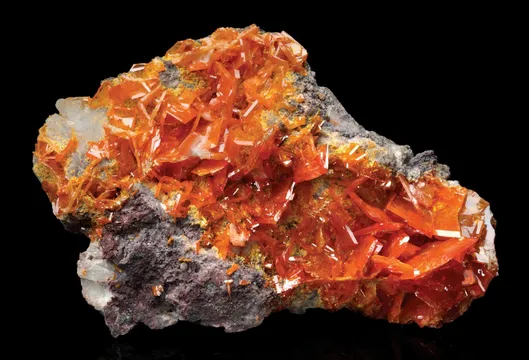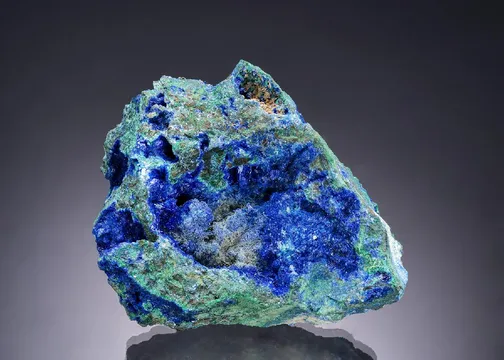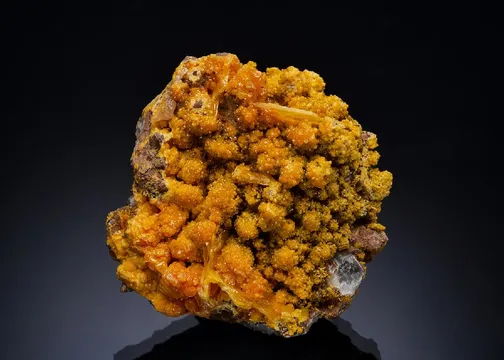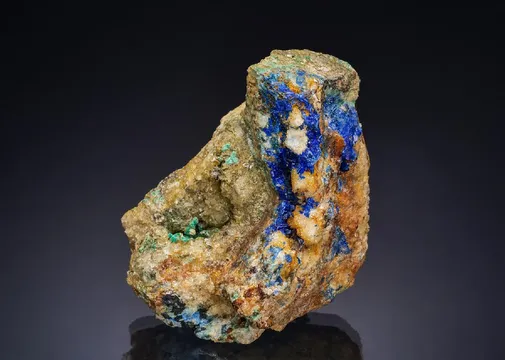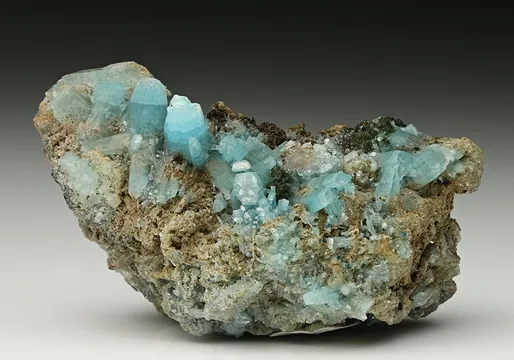
Mammoth-Saint Anthony Mine, Tiger, Arizona — noted locality for electric azure linarite blades; a premier secondary-lead ore assemblage prized by collectors.
Key facts
Linarite from the Mammoth-Saint Anthony Mine at Tiger, Arizona, belongs to the small fraternity of American mineral classics whose reputation rests on both color and locality. The species itself, PbCu(SO4)(OH)2, is a lead-copper sulfate of the oxidized zone, but at Tiger it becomes something more memorable: electric azure-blue blades and prisms from one of Arizona’s richest secondary lead-copper mineral environments. Good specimens are instantly recognizable to collectors—small, sharply formed, intensely blue crystals scattered through cavities or perched on pale lead minerals and darker galena-rich matrix.
The Mammoth-Saint Anthony Mine is not merely “a linarite locality.” It is one of the great specimen-producing mines of Arizona, famous for an extraordinary suite of secondary minerals including wulfenite, cerussite, caledonite, leadhillite, dioptase, diaboleite, malachite, azurite, and a long list of rare lead-copper species. In that crowded company, linarite stands out by color. The best examples show a saturated blue that can rival azurite, but with a different personality: sharper, more vitreous, often bladed or prismatic, and commonly set in small vugs where the blue crystals flash against white, gray, green, or earthy matrix.
The geological setting is a polymetallic vein system in the Mammoth Mining District, on the east slope of the Black Hills north-northeast of Tucson. Mineralization occurred in steep shear-zone veins with quartz, calcite, barite, and fluorite gangue, followed by deep oxidation that transformed primary lead, copper, zinc, and related sulfide ores into a spectacular oxidized-zone assemblage. At the Mammoth mine, oxidation was reported complete to the 700-foot level, with the 760-foot level still largely oxidized but retaining residual galena. That depth of oxidation is one of the reasons Tiger became so prolific for collector minerals: the mine exposed an unusually large vertical interval in which lead, copper, sulfate, carbonate, chloride, vanadate, molybdate, and chromate chemistry could repeatedly recombine.
Historically, the mine began as the Mammoth gold mine in the early 1880s, later becoming the Mammoth-St. Anthony operation and incorporating related workings such as the Collins, Mohawk, and New Year. It produced gold, lead, zinc, vanadium, molybdenum, copper, silver, tungsten, fluorite, and barite at various times. The mine’s mineralogical fame grew out of the same mining that made the district economically important: ore extraction opened fractures, stopes, and pockets that collectors and miners sometimes recognized as specimen ground, and sometimes lost to the mill.
For linarite collectors, Tiger material is most desirable when it shows sharp, undamaged crystals with rich, unfaded blue color, high luster, and recognizable associations. The most coveted pieces are not merely blue coatings; they show distinct crystals—bladed, tabular, or prismatic—standing in relief on matrix. Association matters. Linarite with cerussite, anglesite, caledonite, leadhillite, brochantite, beaverite-(Cu), dioptase, malachite, or remnant galena gives the specimen its Tiger context and makes it far more convincing than an isolated blue crust with a vague old label.
Search for specimens: View all linarite specimens from Mammoth-Saint Anthony Mine, USA
The Mammoth-Saint Anthony Mine is located at Tiger in the Mammoth Mining District, Pinal County, Arizona, on the east slope of the Black Hills, about 80 km north-northeast of Tucson. The locality has appeared under several names on old labels, including Mammoth-St. Anthony Mine, Mammoth Mine, St. Anthony Mine, Tiger property, and Mammoth Gold Mines Ltd. property. Specimen labels may also refer to the Collins, Mohawk, or New Year workings, which were part of the broader mine property and vein system.
The deposit is best understood as a polymetallic vein system. The principal veins occupy shear zones that trend roughly west-northwest and dip steeply. The gangue is brecciated country rock cemented and replaced by quartz and calcite, with barite and fluorite also present. Some quartz generations show comb structure and local amethystine color, while dense greenish-yellow quartz is associated with much of the gold. Wall-rock alteration includes chloritization and silicification, consistent with an epithermal vein environment.
The Mammoth orebody group, including the Mammoth, Mohawk, and New Year workings, has been described as one major vein system, the Mammoth vein. The Collins vein and Mammoth fault form important structural elements nearby. In the oxidized portion of the mine, the chemistry was ideal for secondary lead-copper minerals: galena, chalcopyrite, sphalerite, and other primary or residual sulfides supplied metals; sulfate-rich waters and carbonate, chloride, molybdate, vanadate, and chromate components produced the complex suite for which Tiger is famous.
Mining began after claims were located in 1879, with production starting in 1881. The Mammoth mine operated as the “Mammoth” until 1912, then later as Mammoth-St. Anthony. It was worked again during 1916–1919, when wartime demand made molybdenum and vanadium attractive, and again from 1935 to 1953. Ownership included Mammoth-St. Anthony Mining, Ltd. from 1935 to 1953 and Magma Copper Co. afterward. Gold-price increases in the 1930s revived work in the oxidized veins, and during the 1940s mining moved into deeper sulfide orebodies for lead and zinc below the 650 level of the Collins vein.
The scale of production was large for such a famous specimen locality. The camp’s output from 1881 through 1947 is recorded as 1,889,375 tons of ore yielding 397,201 ounces of gold, 983,918 ounces of silver, 3,456,121 pounds of copper, 74,730,289 pounds of lead, 48,272,654 pounds of zinc, 6,314,822 pounds of MoO3, and 2,540,842 pounds of V2O5. Earlier production from the Mammoth and Collins mines through 1901 alone exceeded 150,000 ounces of gold.
The workings ultimately reached a depth of about 1,125 feet. The old vertical shaft lay in what was once the town of Tiger, and the former townsite was later obliterated by activity connected with the nearby San Manuel mining complex. Later surface work used high-silica rock as smelter flux and attempted to recover residual gold, but the lead content complicated that effort. Today, the old underground workings are not casual collecting ground: the property is reported as private, old workings are inaccessible, and any visit requires permission from the land and mineral-rights holders as well as serious mine-safety awareness.
Notable finds from the broader mine include exceptional wulfenite, cerussite, caledonite, leadhillite, diaboleite, dioptase, and numerous rare or type-locality species. The mine is the type locality or co-type locality for several minerals, including bideauxite, macquartite, mammothite, murdochite, pinalite, and others recorded from the Tiger suite. Linarite sits among these as one of the classic blue species: not the rarest Tiger mineral, but one of the most visually compelling and one of the species that helps define the locality’s oxidized-zone character.
Mammoth-Saint Anthony linarite is valued for intense azure to deep-blue color and well-formed crystals. Documented habits include excellent euhedral crystals, ranging from small vug linings to much larger examples in old records. The most cited locality description notes crystals to 4 inches, or about 10 cm, which places Tiger among the notable large-crystal occurrences for the species. In today’s collector market, however, most available specimens show crystals in the millimeter range, commonly as sparkling blades, slender prisms, or tabular crystals scattered across matrix.
The classic look is a bright blue crystal spray or cluster in a small cavity, often on altered lead-rich matrix. Some specimens show isolated crystals; others present druses of many small blades. Fine examples should have strong vitreous to subadamantine luster, saturated color without dull alteration, and crystal faces that remain sharp under magnification. Because linarite is soft and brittle, even a small thumbnail-sized specimen with pristine crystals can be more desirable than a larger piece with bruised or abraded crystal edges.
Associated minerals are especially important at Tiger. Photo-based and published records document linarite with brochantite, anglesite, cerussite, leadhillite, caledonite, dioptase, malachite, quartz, chlorargyrite including bromian chlorargyrite, antlerite, paralaurionite, and atacamite. Beaverite-(Cu) is specifically recorded as golden-yellow shining scales around the bases of linarite crystals, a highly characteristic association when present. Caledonite adds a deeper blue-green lead-copper sulfate-carbonate note, while cerussite and anglesite provide pale contrast and confirm the oxidized lead environment.
The best Tiger linarites are not massive blue smears. They show discrete crystals with form and relief. Collectors should look for blades or prisms standing free from the matrix, ideally with visible terminations, strong luster, and the saturated blue color that distinguishes linarite from paler secondary copper sulfates. Blue color alone is not enough: azurite, caledonite, diaboleite, mammothite, and other Tiger blue minerals can appear in the same broad visual family, so habit, association, density, and analytical confirmation matter on higher-value specimens.
Typical cabinet and small-cabinet examples may have fields of crystals only a few millimeters long but cover enough matrix to make a vivid display piece. Dealer and auction descriptions of classic Mammoth-Saint Anthony linarite commonly emphasize “electric blue” bladed or prismatic crystals, with crystals around a few millimeters being quite respectable in attractive groups. A specimen with 3–4 mm sharp, lustrous linarite crystals richly covering matrix can be far more appealing than a larger but scattered or damaged occurrence.
Quality factors are straightforward but strict: color, crystal definition, luster, lack of damage, association, and label history. Provenance matters because old Tiger specimens have circulated through major American collections for decades, and a credible old label can help distinguish genuine classic material from a vague “Arizona linarite” attribution. Matrix also helps: pieces with galena-rich, quartz-carbonate, cerussite/anglesite-bearing, or caledonite-associated matrix read as Tiger more convincingly than anonymous blue crusts on featureless rock.
Linarite from Mammoth-Saint Anthony is a classic locality material, but not a common modern field-collecting mineral. The mine is historic, old underground workings are inaccessible, and the property is not an open public collecting site. Most specimens available to collectors today are from older collections, dispersed estate material, dealer inventories, and occasional auction offerings. Fine examples with sharp crystals and strong old provenance are increasingly difficult to replace.
No well-documented, locality-specific faking industry is known for Mammoth-Saint Anthony linarite, but several authenticity issues deserve attention. The first is misidentification. Linarite is famously confused with azurite, and Tiger’s blue mineral suite is unusually crowded: azurite, caledonite, diaboleite, mammothite, and other blue species may occur in the same broad collector category. Linarite’s habit, luster, lead-rich associations, and crystal form help, but important pieces should be confirmed by reliable provenance or analysis.
The second issue is overgeneralized locality labeling. “Tiger,” “Mammoth,” “Mammoth-St. Anthony,” “St. Anthony,” “Collins,” and “Mohawk” labels can all refer to related parts of the historic property, but they are not interchangeable in the strictest specimen-record sense. Old labels should be preserved, even when wording is archaic or inconsistent. A specimen with an old “Tiger, Arizona” label may be more historically useful than a modern label that has been over-normalized and stripped of its original context.
Condition is critical. Linarite has perfect cleavage, low hardness, and brittleness, so crystals bruise easily. Common condition problems include chipped terminations, rubbed edges on exposed blades, broken crystals in high points, and dulling from careless cleaning. Avoid aggressive cleaning. Linarite should not be subjected to acids, ammonia, bleach, detergents, or prolonged soaking. It is best handled as a delicate lead-copper sulfate specimen: keep it dry, dust gently, avoid ultrasonic cleaning, and store it where crystals cannot contact lids, padding, or neighboring specimens.
Because linarite is a lead-bearing mineral, collectors should use normal lead-mineral precautions. Do not grind, lick, or ingest dust; wash hands after handling; and keep specimens away from children and pets. These precautions are especially relevant for friable matrix or old crumbly vug material.
In the market, Mammoth-Saint Anthony linarite appears intermittently rather than abundantly. Small specimens with modest crystalization remain attainable when older collections are dispersed, but attractive small-cabinet pieces with vivid, sharp crystals are sought after by Arizona specialists, sulfate collectors, and collectors of classic American localities. Association pieces can command a premium, especially when linarite occurs with cerussite, caledonite, leadhillite, or rare Tiger species. Old collection provenance—particularly from miners, early dealers, or well-known Arizona collectors—adds considerable interest.
The story of Tiger is a reminder that specimen mining and ore mining have never been the same enterprise. Arizona Highways described the Mammoth-St. Anthony as the most famous of Arizona’s mineral occurrences, crediting it with more than 95 common, rare, exceptional, or unique species. One example from the mine’s specimen history is almost absurd in scale: a 750-foot vertical fracture, only 4 to 6 inches wide, lined with orange-yellow wulfenite crystals to 2 inches on an edge. It is the sort of pocket description that makes a collector stop reading and stare at the wall.
Another Tiger episode belongs to the Mohawk Shaft, where emerald-green dioptase appeared in such abundance that Dick Jones reportedly collected 18 large boxes of specimens in one afternoon from the conveyor belt alone. That detail captures the peculiar luck and frustration of great ore mines: for a moment, specimen minerals were plentiful enough to be gathered by the box from moving mine rock, yet their survival depended on whether someone with an eye for crystals happened to be present before the ore stream carried them away.
A later collecting thread runs through Jack Streeter and Rock H. Currier. Streeter, described as a traveling salesman, had the unusual opportunity to visit the Tiger mine in its earlier specimen-producing days and buy good pieces directly from miners. Currier later acquired Streeter’s best Tiger material in 1972 for $500. One hydrocerussite and linarite specimen from that exchange, a 2.8 x 1.6 x 1.2 inch piece with pyramidal white hydrocerussite crystals and associated linarite, sold at Heritage Auctions in 2019 for $25,000. Currier’s note on it was direct and collectorly: after 50 years of looking, he had not seen a better example of its kind. The linarite was not the dominant mineral in that lot, but its presence on a top Tiger specimen underscores how closely the blue sulfate belongs to the mine’s best oxidized-zone stories.