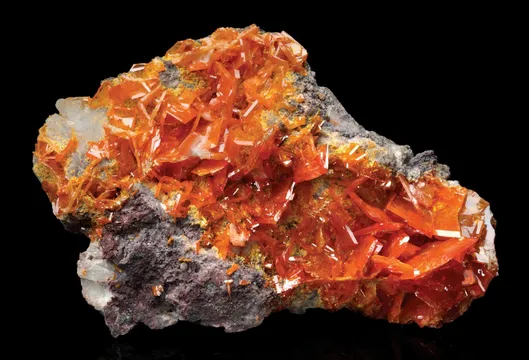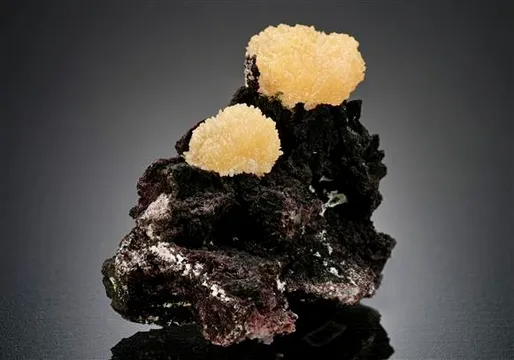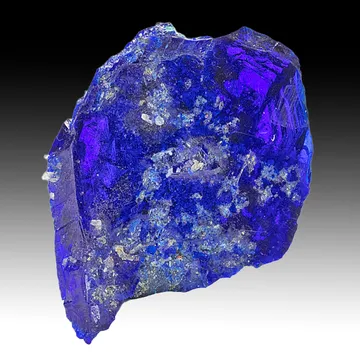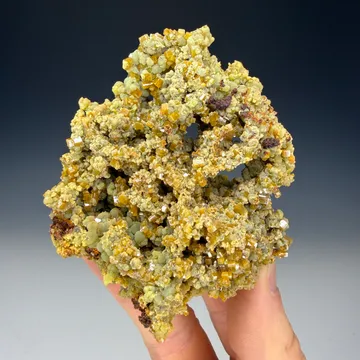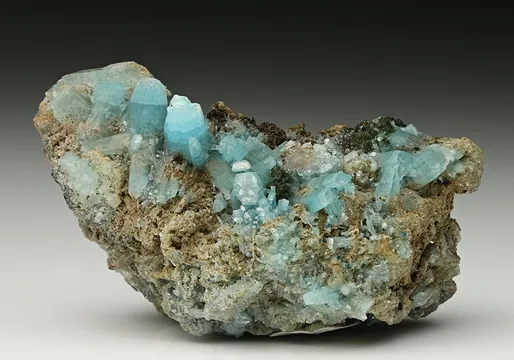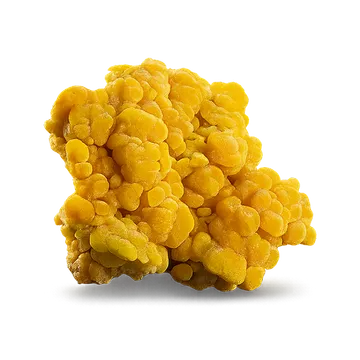
Mimetite from Mammoth-Saint Anthony Mine, Arizona: bright orange to canary-yellow crystals and crusts in oxidized vein context, prized by collectors.
Key facts
Mimetite from the Mammoth-Saint Anthony Mine is part of the broader legend of Tiger, Arizona: a vanished mining camp whose oxidized lead-zinc-gold veins yielded one of the most varied and collectible secondary-mineral assemblages in the United States. The mine is better known in general mineral circles for wulfenite, dioptase, cerussite, leadhillite, diaboleite and a remarkable suite of rare lead-copper-chloride, sulfate, chromate and silicate species, but its mimetite has a character all its own: bright orange to canary-yellow lead arsenate, commonly as sparkling crusts, botryoidal to rounded “campylite” aggregates, and small prismatic to tabular crystals spread over quartz, barite, oxidized matrix, wulfenite plates, or willemite-bearing vugs.

Photo: Wikimedia Commons
The appeal of the locality is visual before it is analytical. Tiger mimetite often reads as a golden-orange glow beneath or between the more architectural minerals of the mine: thin orange wulfenite blades, clear willemite rhombs, white quartz, greenish copper-bearing coatings, and iron-stained oxidized gangue. Fine examples are rarely single-species showpieces in the way a great Mexican or Namibian mimetite can be; they are locality specimens, full of context, chemistry and old Arizona mine character. The best pieces show strong color saturation, a clean contrast with associated species, and enough crystal definition to separate them from mere yellow powdery coatings.
Geologically, the mimetite belongs to the oxidized portion of a complex epithermal vein system on the east slope of the Black Hills near the former town of Tiger, in the Mammoth Mining District of Pinal County. The mine exploited Au, Ag, Pb, Zn, Cu, Mo, V, W, fluorite and barite, and the same oxidation that made the upper workings mineralogically spectacular also created the lead-arsenate environment in which mimetite formed. Collectors prize Mammoth-Saint Anthony mimetite because it anchors a specimen to one of Arizona’s classic old localities, especially when it occurs with wulfenite, willemite, dioptase, chrysocolla, barite, quartz, mixite or old labels from mid-20th-century collections.
Search for specimens: View all mimetite specimens from Mammoth-Saint Anthony Mine, Arizona, USA
The Mammoth-Saint Anthony Mine, also recorded as the Mammoth-St. Anthony Mine, Mammoth Mine, St. Anthony Mine, Tiger property and Mammoth Gold Mines Ltd. property, lies in the St. Anthony deposit at Tiger, in the Mammoth Mining District of Pinal County, Arizona. The locality is near Mammoth, Arizona, roughly 50 miles north-northeast of Tucson and about 21 miles south of Winkelman, on the east slope of the Black Hills. Its recorded coordinates place it near 32° 42′ 23″ N, 110° 40′ 59″ W.
The deposit is a vein system developed in shear zones. The veins strike generally west-northwest and dip steeply, with brecciated country rock cemented and replaced by quartz and calcite, plus barite and fluorite. Successive generations of quartz include comb-textured quartz and locally amethystine quartz; the older dense greenish-yellow quartz carried much of the gold. Chloritization and silicification of wall rock, together with the vein textures and mineralogy, point to epithermal deposition.
The Mammoth orebody group included the Mammoth, Mohawk and New Year workings and appears to have been part of a single major structure known as the Mammoth vein. The Mammoth fault, with a similar strike but steep opposite dip, reaches the surface near the Collins vein. The oxidized zone was exceptionally important for specimen mineralogy: oxidation in the Mammoth Mine is recorded as complete to the 700-foot level, and the 760-foot level was reported as largely oxidized except for residual bunches of galena. That deep oxidation profile explains why the mine produced such an unusually rich suite of secondary lead, copper, zinc, vanadium, molybdenum, arsenate, phosphate, chromate, chloride and sulfate species.
Mining history at Tiger begins with claims located in 1879 and production beginning in 1881 under the Mammoth name. The original Mammoth operation closed in 1912, then the property later became the Mammoth-St. Anthony operation and incorporated the Collins mine and vein. It was worked again from 1916 to 1919, then from 1935 to 1953. The Mammoth-St. Anthony Mining Ltd. controlled the property during the 1935–1953 period, after which it passed to Magma Copper Company.
Production was substantial before the locality became a mineral-collector classic. By the end of 1901, the Mammoth and Collins mines had yielded more than 150,000 ounces of gold valued at more than $3,000,000 in period dollars. Total camp production from 1881 through 1947 is recorded as 1,889,375 tons of ore yielding 397,201 ounces of gold, 983,918 ounces of silver, 3,456,121 pounds of copper, 74,730,289 pounds of lead, 48,272,654 pounds of zinc, 6,314,822 pounds of MoO3 and 2,540,842 pounds of V2O5. The camp revived during World War I for molybdenum and vanadium, closed again when prices fell in 1919, and revived once more after the 1933 rise in the gold price. By 1943, high prices and the demand for base metals led to development of sulfide orebodies below the 650 level of the Collins vein for galena and sphalerite.
The workings reached about 1,125 feet deep. The principal vertical shaft was once in the middle of the town of Tiger, a town that has since vanished. Later activity by operators of the nearby San Manuel mining complex removed or obscured much of what had been the town and mine landscape. Today the shaft is filled; the mine site and surrounding ground should be treated as private or controlled property unless explicit permission is obtained. For collectors, Mammoth-Saint Anthony mimetite is primarily a historic market locality, not a casual collecting destination.
Notable finds from Tiger include not only mimetite and wulfenite combinations, but a long roster of classic and rare species. The locality is the type locality or co-type locality for several minerals, including bideauxite, bobmeyerite, creaseyite, georgerobinsonite, macquartite, mammothite, murdochite, pinalite, wherryite and yedlinite. That list matters to mimetite collectors because it shows the same unusual oxidation chemistry that produced orange lead arsenate coatings also produced a scientifically famous mineral suite.
Mammoth-Saint Anthony mimetite is most characteristically bright orange, orange-yellow or canary-yellow. The classic descriptive habit is tiny prismatic to tabular crystals occurring as crusts and coatings. In collector specimens, these crusts may range from thin yellow druses on quartz or oxidized matrix to richer orange granular or botryoidal areas that visually compete with associated wulfenite. Some pieces are described as campylite, the rounded, barrel-like mimetite habit; in better examples from Tiger these rounded crystals may reach several millimeters and show a resinous to lustrous surface.
The most desirable Mammoth-Saint Anthony mimetite specimens are usually combinations. Wulfenite with mimetite is the signature pairing: orange to yellow-orange blades or “windowpanes” of wulfenite over, beside or partly embedded in yellow-orange mimetite. Fine old plates from the Collins vein can be large, with mimetite forming a powdery to crystalline yellow layer beneath bright wulfenite. Smaller cabinet and miniature pieces commonly show wulfenite crystals in the millimeter to centimeter range with mimetite as vivid botryoidal or crystalline accents.
Willemite is another important association. Some rich old Tiger specimens show orange to orange-brown rounded mimetite crystals lining vuggy matrix, accented by glassy colorless willemite crystals. This is one of the more refined Mammoth-Saint Anthony mimetite styles: less immediately architectural than wulfenite combinations, but prized for luster, crystal definition and old-time locality character. Willemite from the locality is recorded as small rhombs, barrel-shaped crystals and acicular forms, sometimes colorless to bluish and fluorescent creamy-yellow under shortwave ultraviolet light.
Quartz, barite and oxidized iron-rich matrix are common settings. Mixite is specifically recorded in association with wulfenite and mimetite on barite matrix, giving some specimens pale green radiating sprays or coatings against the orange-yellow arsenate. Chrysocolla may appear as pale blue-green material with mimetite and quartz. The broader Tiger assemblage can also include dioptase, cerussite, caledonite, leadhillite, vanadinite, pyromorphite, mottramite, creaseyite, descloizite and other secondary species, though not all are present on typical mimetite specimens.
Size expectations should be realistic. Mammoth-Saint Anthony mimetite is not generally a locality of giant freestanding mimetite crystals. The locality’s strength lies in rich coverage, color, association and historical significance. Many specimens show crystals or aggregates in the sub-millimeter to several-millimeter range. Crystals around 4 mm on a well-preserved, richly covered piece are already noteworthy. Cabinet-scale wulfenite-mimetite plates exist, but on those specimens the mimetite is commonly a crust, layer or aggregate rather than a forest of isolated large mimetite crystals.
Quality factors are locality-specific. Strong orange color is preferable to dull tan or chalky yellow. Sharpness matters: rounded campylite aggregates should still show luster and form, while crusts should sparkle under magnification rather than appear earthy. Association matters greatly; wulfenite, willemite, quartz, barite, chrysocolla or rare green secondary species can elevate an otherwise modest mimetite coating into a true Tiger specimen. Provenance also matters. Old labels, especially those indicating Tiger, Mammoth-St. Anthony, Mammoth Mine, Collins vein or 1950s–1960s collection history, add both confidence and collector appeal.
The main authenticity issue for Mammoth-Saint Anthony mimetite is not a well-documented wave of treated or artificial material from the locality; it is accurate species and locality attribution. Mimetite belongs to the apatite supergroup and is visually close to pyromorphite and vanadinite in some habits and colors. At Tiger, all three lead oxyanion species are recorded, and mixed or borderline material may require Raman spectroscopy, EDS or another analytical method if the exact species is important. A yellow-orange crust on an old Tiger wulfenite specimen may be mimetite, but labels should not be treated as analytical proof.
Misidentification is not merely theoretical. At least one photographed Tiger specimen was originally posted as macquartite and later corrected to mimetite after EDX work. The mine’s complex chemistry makes that kind of confusion understandable: yellow to orange lead-bearing microcrystals can represent several species, and the locality is famous precisely because so many rare lead-copper-chromate, arsenate, phosphate and sulfate minerals coexist in small vugs and crusts.
Condition should be assessed under magnification. Mimetite crusts can be friable, and rich wulfenite-mimetite combinations often have exposed blade tips or edges that chip easily. Powdery yellow mimetite layers may be partly abraded, especially on old plates that passed through multiple collections before modern mounting and storage standards. Orange botryoidal or campylite-style mimetite is generally more visually forgiving than thin drusy coatings, but broken high points and rubbed luster still matter.
Labels deserve attention. “Tiger,” “Mammoth Mine,” “Mammoth-St. Anthony,” “St. Anthony Mine,” “Collins vein,” and “Collins Mine” may all appear on old labels, sometimes inconsistently. A credible old label can be valuable, but the locality name alone is not enough: compare the matrix, associations and style. Classic Tiger wulfenite-mimetite pieces often show orange-yellow wulfenite blades, oxidized matrix, yellow to orange mimetite coatings, and sometimes dioptase, willemite or pale secondary lead minerals. Pieces that look more like Mexican Ojuela or Santa Eulalia material should be questioned if labeled Tiger without provenance.
Market availability is intermittent. Small wulfenite-mimetite specimens and modest mimetite crusts appear from time to time, often from old collections. Rich, well-preserved, colorful old-time combinations are much less common. Recent recorded offerings show a range from modest small specimens to stronger small-cabinet pieces in the several-hundred-dollar range, with especially rich old collection specimens carrying a premium. Pure mimetite-dominant Mammoth-Saint Anthony specimens are scarcer than wulfenite-dominant pieces with mimetite as an association.
The most evocative story at Tiger is the disappearance of the place itself. The Mammoth workings once included a vertical shaft in the middle of the town of Tiger. The town is gone now, and the shaft is filled, marked by four corner stakes of rebar at the bottom of a pit roughly 20 to 30 feet deep. The old scene is readable only in fragments: a cleft in the hill to the west where the Collins vein caved, and to the east the outline of the former Mohawk headframe against oxide ore leach heaps from the San Manuel operation.
There is a brutal elegance in the later fate of the mine rock. After the Mammoth-Saint Anthony mine had already made its name in gold, lead, zinc, vanadium, molybdenum and collector minerals, the high-silica rock was eyed for two uses at once: flux for a smelter and recovery of remaining gold. The plan ran into a practical metallurgical problem—the material carried too much lead—and the effort was abandoned. For collectors, that abandoned idea is a reminder that many specimens now valued as classics survived a long industrial history in which their hosts were repeatedly seen as ore, flux, waste or nuisance before they became cabinet minerals.
One old wulfenite-mimetite plate from the Collins Vein, 9th Level carries the kind of human paper trail collectors love. The specimen measures 18.2 x 9.5 x 3.1 cm and is described as a large, bright, bladed wulfenite piece on a layer of powdery yellow mimetite. It came with an Eugene Sensel label and a handwritten note indicating that it had been purchased in 1959 for $25—serious money for a rock at the time. The back of the Sensel label records that it had entered the Hauck collection by 1972. The specimen is not flawless; damage is acknowledged. But that hardly diminishes its importance. It is exactly the kind of old Tiger survivor that preserves the mine’s collector history as much as its mineralogy.
Another modern example shows how old labels can compress decades into a few square centimeters of paper. A Mammoth-Saint Anthony mimetite-willemite specimen from the Dennis Mullane Collection carried an older The Bradleys label with a November 1952 date. The piece was described as a vuggy matrix covered on all sides by highly lustrous orange to orange-brown rounded campylite crystals of mimetite, accented by glassy colorless willemite, with mimetite crystals reaching 4 mm. That date matters. November 1952 places the specimen near the end of the mine’s major working life, before the old locality became primarily a specimen-trade memory.
The mine also tells a scientific story of small things in crowded vugs. Tiger produced enough unusual chemistry that mineralogists returned to its specimens again and again: bideauxite, murdochite, wherryite, yedlinite, mammothite, bobmeyerite and georgerobinsonite among them. Against that backdrop, mimetite may seem familiar, but it is part of the same chemical theater. The bright orange arsenate crusts on a wulfenite plate are not merely decoration; they are one expression of a remarkably deep oxidation zone where lead, copper, zinc, arsenic, vanadium, molybdenum, chromium, chlorine, sulfur and silica were redistributed into a cabinet’s worth of rare secondary minerals.