Malmberget, Sweden — Kiruna-type ore locality famed for honey-gold calcite, fluorite, and stilbite in pocket environments; historic pockets attract collectors.
Key facts
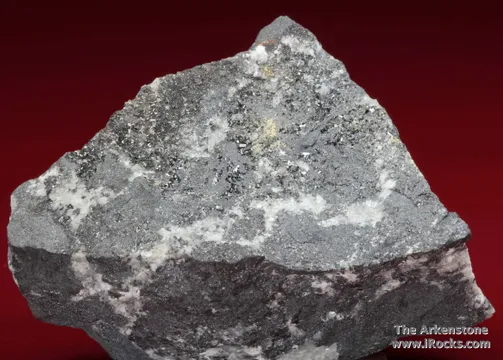
Malmberget is one of the rare ore mines whose specimen reputation rests not on the ore itself, but on what tectonics and late fluids did to a huge iron-oxide-apatite deposit after its main formation. The mine sits at Gällivare in northern Norrbotten, in the classic Fennoscandian iron province of northern Sweden, where Paleoproterozoic volcanic and volcano-sedimentary rocks host giant magnetite-apatite ores of the Kiruna type. At Malmberget those ores were not left as simple tabular masses. They were folded, faulted, metamorphosed, intruded by granitic and pegmatitic bodies, and opened along fractures and ore-wallrock contacts. Those open spaces became the collecting story: cavities lined with calcite, stilbite-stellerite, fluorite, hematite, pyrite, apatite, feldspar, amphibole, titanite, quartz, and skarn silicates.
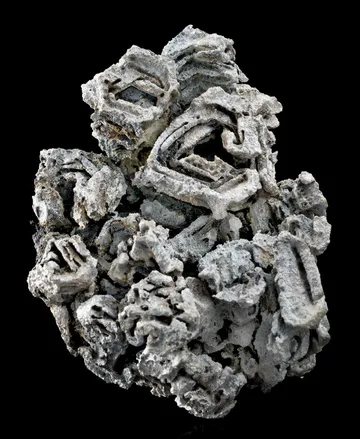
The great cabinet specimens from Malmberget have a very distinctive northern-European look. The best calcites are not merely yellow; they are honey-gold to orange-gold, glassy, lustrous, and sculptural, with modified scalenohedra and the celebrated “butterfly” twins standing on darker ore or breccia matrix. Stilbite-group specimens are more intimate but often elegant: warm yellow to orange-brown bow-ties, sprays, radial balls, and subparallel aggregates, sometimes making the visual bridge between black magnetite, green fluorite, white calcite, and pyroxene-amphibole matrix. Malmberget’s finest pieces are therefore not anonymous mine-run calcite or zeolite; they are specimens whose color, age, and pocket history are inseparable from one of Europe’s great iron mines.
Regional View
Country View

Photo: Rob Lavinsky, iRocks.com / Wikimedia Commons
Malmberget also matters because it is a collector locality with a documented modern history. Peter Lyckberg’s accounts of the mine, together with later studies of the deposit and zeolite-bearing fracture systems, give collectors unusually good context: named ore bodies, named pockets, dated late mineral assemblages, and named miners who physically saved specimens from active underground workings. The result is a locality whose best pieces have both mineralogical quality and a narrative provenance—1980s and 1990s pockets, often recovered under difficult underground conditions, with some material tied to the Baron, Parta, Fabian, Kapten, Välkomman, Koskullskulle, and other Malmberget ore zones.
Search for specimens: View all specimens from Malmberget, Sweden
Malmberget is an active underground iron mine at Gällivare, about 75 km southeast of Kiruna in Norrbotten County. The deposit belongs to the iron-oxide-apatite family and is commonly discussed with the Kiruna-type ores of northern Sweden. Its principal economic minerals are magnetite, with subordinate hematite in parts of the system, and fluorapatite as the characteristic phosphate component. The ores occur in a Paleoproterozoic succession of metavolcanic rocks ranging broadly from mafic to felsic compositions; modern work describes the mineralization as mainly hosted in dacitic to basaltic rocks within a deformed volcano-sedimentary and subvolcanic package.
Structurally, Malmberget is much more complex than the simple “ore mountain” name suggests. More than twenty historically named ore bodies or ore lenses are recognized across a mining field several kilometers in extent. Current technical descriptions group them into major zones such as the Western Field, Printzsköld-Alliansen, Dennewitz, Östergruvan-ViRi, Parta, and Fabian-Kapten. The Western Field and Printzsköld-Alliansen include folded ore zones, while the Eastern Field and Fabian-Kapten zones are more tabular and elongated down plunge. The mine has long included named bodies such as Välkomman, Baron, Johannes, Skåne, Josefina, Alliansen, Dennewitz, Hvitåfors, Koskullskulle, Kapten, ViRi, Parta, Fabian, and Printzsköld; older lists and collector labels may preserve still more historic mine or claim names.
The specimen-forming mineralization is tied to the deposit’s post-ore history. The ore and host rocks were intruded by dolerite, pegmatitic and aplitic dikes, and granitic bodies; the area was affected by amphibolite-facies metamorphism, deformation, potassium and sodium alteration, and later brittle fracturing. Those events produced open fissures and cavities along contacts between massive magnetite ore and wall rocks, where rheological contrast made fracturing especially effective. Low-temperature hydrothermal assemblages in these openings include calcite and stilbite-group minerals, with apatite, K-feldspar, biotite, hornblende, titanite, monazite, magnetite, hematite, pyrite, and related phases depending on the particular fracture generation and host.
Mining at Malmberget began historically at Illuvaara, later Gällivare Malmberg, in the eighteenth century, and the first railway shipment of ore was loaded in 1888. LKAB, founded in 1890, has operated Malmberget together with Kiirunavaara since the end of the nineteenth century. The mine is now a large, highly mechanized sublevel-caving operation with ore hauled through extensive underground infrastructure to processing plants at Gällivare/Malmberget. LKAB’s 2025 and 2026 public reporting places Malmberget among the company’s key assets, with continuing exploration at depth and renewed interest in apatite as a future source of phosphorus and rare earth elements. In June 2026, the Land and Environmental Court granted LKAB an environmental permit for continued and expanded operations in Malmberget, including processing facilities tied to apatite and critical-mineral recovery.
For collectors, access must be understood in active-mine terms. Malmberget is not a casual field-collecting locality. The important specimen recoveries came from underground work encountered during mining, and, in the classic period, from restricted recovery by miners working with permission and coordination. Lyckberg emphasized that most pockets were barren or collectible only in limited zones, and that the preservation of world-class pieces depended on miners recognizing cavities, reporting them, and carefully removing specimens before blasting, scaling, shotcreting, or production destroyed them. Modern collectors should assume no public collecting access to the mine and should treat any newly offered “Malmberget” specimen as a market specimen requiring provenance, not as material obtainable by visiting the locality.
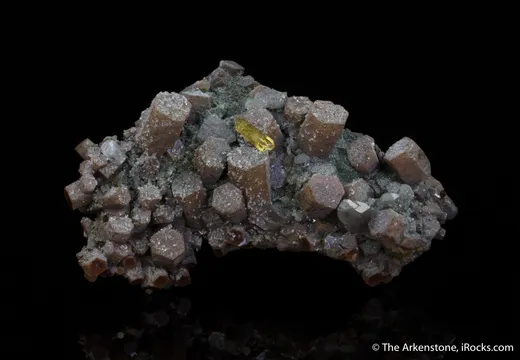
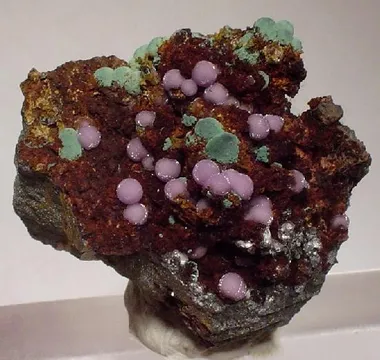
The most famous collector finds are the late-1980s golden calcite pockets and the 1982 fluorite-bearing cavities in the Baron area. The “Emerald Hole” and related pockets at the 450-meter level produced emerald-green fluorite with orange-brown stilbite-stellerite and associated calcite, while the Gem Pocket and Butterfly Twin Pocket produced the calcites that made Malmberget famous far beyond Scandinavia. Other pockets yielded stilbite-group coatings and balls, titanite, fluorapatite, hematite, pyrite, feldspar, and pyroxene-amphibole associations; but the great specimens are scarce because the productive cavities were few, discontinuous, and easily damaged by underground mining conditions.
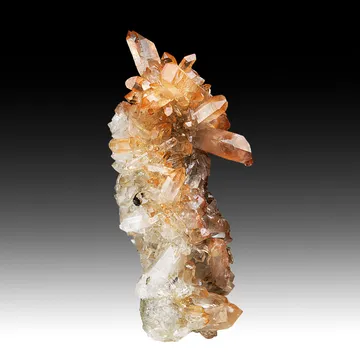
Malmberget calcite ranges from ordinary grey, white, and pale yellow mine-cavity crystals to some of the most coveted golden calcites in the European canon. The finest pieces came from the late-1980s Gem Pocket and Butterfly Twin Pocket, where transparent to translucent honey-gold and orange-gold modified scalenohedra, complex twins, and “butterfly” forms grew in fissure cavities associated with massive magnetite and hematite-bearing brecciated wall rock near the Parta-Baron mine area. Individual crystals are commonly a few centimeters, but documented pocket material includes crystals and twins far larger, with large scalenohedra in the 10–30 cm range and at least one butterfly twin exceeding 16 cm. The best collector pieces combine saturated color, glassy luster, translucence, undamaged terminations, sculptural isolation, and matrix; ordinary Malmberget calcite is much paler and more common, while elite specimens have the glowing, amber internal quality and precise morphology that make the locality unmistakable.
Malmberget “stilbite” should be read carefully by collectors, because much historic material is stilbite-subgroup material and at least some specimens are stellerite; fine visual specimens may require analysis to separate the two confidently. The classic Malmberget style is warm yellow, orange-yellow, brownish-yellow, or pale honey-colored crystals in bow-tie groups, radiating balls, crusts, and subparallel aggregates, commonly lining open fractures or sitting on dark mafic or magnetite-rich matrix, K-feldspar, calcite, pyrite, pyroxene, amphibole, or fluorite. Fine pieces are usually small-cabinet to cabinet in scale, with individual crystals often millimetric to about a centimeter, but the quality is in the freshness, color, luster, and undamaged sprays rather than size alone. The most desirable examples show bright, sharp, translucent bow-ties or radial balls in association, especially with emerald-green fluorite, golden calcite, pyrite, or dark ore matrix; dull crusts, bruised zeolite balls, and analytically uncertain “stellerite” labels are much more routine.
Beyond calcite and stilbite, Malmberget has a broad but very locality-specific suite: magnetite and hematite as the ore foundation; fluorapatite and monazite-(Ce) as phosphate and rare-earth carriers; emerald-green and blue fluorite from the Baron-area fluorite pockets; pyrite, chalcopyrite, bornite, molybdenite, native copper, cuprite, malachite, and azurite as minor sulfide and secondary copper minerals; titanite, quartz, K-feldspar, microcline, albite, biotite, muscovite, ferro-hornblende, diopside, hedenbergite, epidote, garnet-group minerals, scapolite, sillimanite, and andalusite as metamorphic, skarn, and vein minerals; plus zeolites and related species such as stellerite, chabazite, harmotome, and apophyllite-group material. Malmberget is not chiefly a type-locality mineral site; its importance is instead as a world-class specimen locality inside a major iron-oxide-apatite ore deposit, with notable rarities and scientifically useful late fracture minerals rather than a long roster of named type species.
Malmberget is a provenance-driven locality. The strongest labels name not only “Malmberget” or “Gällivare,” but, when known, a pocket, ore body, mine level, collector, or miner-associated provenance: Gem Pocket, Butterfly Twin Pocket, Emerald Hole Pocket, Baron orebody, Parta, Fabian, Kapten, Välkomman, Koskullskulle, and so on. Because the mine is active, inaccessible to ordinary collectors, and no longer producing classic specimen material in any regular market quantity, claims of recent self-collected specimens should be treated skeptically unless backed by a credible chain of custody.
The most specific treatment issue documented for Malmberget concerns some of the hexagonal “Mutterkalsitten” or “nuts calcite” style pieces shown and sold at the Kopparberg fair in 1989: several pieces were reportedly lacquered. Lacquer can make a calcite look wetter, glossier, or unnaturally even on frosted faces, and it may pool in recesses. On valuable golden calcites, collectors should also look carefully for repaired butterfly twins, reattached crystals, glued bases, cleaves at the tips, and bruising along edges. Many specimens were removed from hard underground rock in awkward cavities, then transported out of a heated mine into severe winter conditions; the survival of fine pieces is part of their romance, but condition is still the central market variable.
Mislabelling is most common around the stilbite-stellerite question. Older labels may say “stilbite,” “stellerite,” or simply “stilbite/stellerite,” and visual separation is not always reliable. For ordinary display specimens, a stilbite-subgroup label is often the safest conservative wording; for high-value single-species specimens, analysis is preferable. “Malmberget calcite” is also sometimes used too broadly in the market for any yellow Swedish calcite, but the true golden pocket material has a distinctive color, morphology, and documented 1988–1990 provenance that should be supported by label history.
Condition issues vary by species. Golden calcite is relatively soft and cleavable, so even tiny tip cleaves or edge rubs matter greatly. Stilbite-group crystals are more delicate still; radial balls and bow-tie aggregates can shed, bruise, or flatten at exposed edges. Fluorite octahedra from the Emerald Hole-style pockets are prized for color and association but should be checked for corner bruising and contact points. Specimens with amphibole, fibrous alteration products, or “asbestos” labels should be handled conservatively: keep them boxed, avoid abrasion, and do not trim or clean fibrous material dry.
Market availability is thin. Common small stilbite-group pieces and lesser pale calcites appear periodically, but elite golden calcites, matrix butterfly twins, and strong Emerald Hole fluorite associations are genuinely scarce and often move privately. A modest, undamaged golden calcite with credible provenance can be more significant than a larger but pale or repaired example. For Malmberget, “good for the locality” means more than species and size; it means color, pocket attribution, intact form, and an honest old label.
The best Malmberget stories begin not in a field with a hand lens, but underground, in a working iron mine where a pocket could disappear under shotcrete or a production blast before anyone understood what had been found. In 1982, the Baron orebody produced the fluorite story: the Emerald Hole Pocket at the 450-meter level, in the Snedbana tunnel adjoining Baron. Five fluorite-bearing pockets were crossed by the adit, and one meter-wide pocket in the tunnel roof rivaled the Christmas Tree Pocket. The association became a Malmberget classic—emerald-green fluorite octahedra on orange-brown stilbite-stellerite, sometimes with calcite—an unlikely jeweled seam inside a mine built to feed Europe’s steel industry.
Then came the golden calcites. In 1988, miner Kenneth Holmgren and Peter Lyckberg encountered intensely colored calcite in a fissure cavity associated with a side magnetite orebody near the main Parta orebody. The pocket was not a tidy crystal-lined geode waiting in daylight; it was a narrow underground opening in hard rock, partly accessible only because miners noticed what was in the muck and wall. The finest material from the Gem Pocket was clean, gemmy, and golden, with scalenohedral crystals so saturated that they looked almost unreal beside the black ore. Much of the find entered a small Scandinavian and European collector circle before the wider market understood how rare the style would become.
The Butterfly Twin Pocket was discovered because Holmgren remembered calcite splinters from an earlier blast on the upper level of the same ramp. That recollection mattered. He searched for the place again and found the pocket about 50 meters vertically above the Gem Pocket, high on a wall near the ceiling. The outer part had already been sprayed with shotcrete for ground control, and the entrance survived only because it was narrow and bent. Holmgren could peer roughly two meters in. What he saw were transparent golden crystals 10 to 30 cm long hanging from the roof in one corner, and, on the bottom, a knob of large gemmy golden scalenohedra.
When Holmgren called Lyckberg and described “10 cm flat calcite crystals looking like butterflies” sitting among the scalenohedra, the plan changed from collecting to rescue. Lyckberg instructed him to remove half a meter of rock below the pocket before trying to extract anything, because the best crystals were not loose souvenirs; they were on matrix, and the matrix was hard. After hours of work, Holmgren and the miners succeeded in removing three large specimens with several butterfly twins growing on golden calcite scalenohedra. Most of the large twins had grown on the bottom of the pocket, including on a half-meter ball-like mass that became the centerpiece of the find.
The greatest specimen, later known as the Lyckberg Calcite and called “storblocket” by the miners, was a roughly 45 x 45 x 35 cm ball-like aggregate covered in golden scalenohedra and carrying 12 gemmy golden butterfly twins up to about 12.5 cm wide. Lyckberg compared the effect to butterflies landing on a flowered meadow. The extraction was almost absurdly physical: the specimen was about 1.5 meters inside a narrow fissure, 5 meters up a vertical wall, with hard rock below it. When asked how he managed to lower it from the cavity, Holmgren’s answer was wonderfully plain: “When I reached the vertical wall I turned around and walked down the wall holding the specimen in my arms and put it into the back of the truck.”
The pocket still held lessons after the showpiece came out. Some larger crystals had broken off long before recovery and recrystallized over broken surfaces, evidence that the pocket had its own history before miners entered it. The largest butterfly twin recorded from the pocket reached more than 16 cm. A second smaller cavity at the back-left end of the Butterfly Twin Pocket yielded additional large twins, including one reported in the Natural History Museum in Vienna. Not everything was saved cleanly. Some loose twins and detached pieces were dispersed quickly, and Lyckberg spent years buying back fragments from around Scandinavia, trying to reunite crystals with their original matrix. Two missing butterfly twins were still noted as absent from their matrix in later accounts.
The atmosphere around the find quickly changed. Word of golden calcite moved through the mine and beyond it, bringing traffic from Sweden, Norway, Germany, the United States, and Japan. That excitement had a destructive side: inexperienced collectors and competing miners searched for extensions, and one miner, Roland Bäckström, was remembered for blasting rock “to smithereens.” Malmberget’s specimen history is therefore a story of timing and restraint. The same mining system that exposed the pockets could erase them instantly; the same rumor mill that celebrated the finds could scatter or damage them. That is why the best Malmberget labels matter: they are the paper trail of a few pockets saved from an industrial process much larger than mineral collecting.
Moore, Thomas P., and Peter Lyckberg. “Malmberget, Gällivare, Lapland, Sweden.” The Mineralogical Record, Vol. 56, No. 5, September–October 2025, pp. 533–604. The major modern English-language locality treatment for collectors, covering Malmberget’s specimen history and classic finds.
Lyckberg, Peter. “The Malmberget iron mine, Sweden—A world class mineral locality.” Norsk Bergverksmuseum Skrift, Vol. 33, 2006, pp. 75–87. A key collector-mineralogical account by the person most closely associated with documenting the classic late-twentieth-century pockets.
Lyckberg, Peter. “Die Goldenen Calcite von Malmberget, Schweden.” Mineralien-Welt, Vol. 7, No. 3, 1996. German-language account of the golden calcite discoveries.
“Golden Calcite from Malmberget.” Minerals Newspaper, Issue 3, Spirifer Minerals / Miner’s Lunchbox, 2011. A richly illustrated collector article recounting the Gem Pocket and Butterfly Twin Pocket discoveries.
Romer, Rolf L. “U-Pb systematics of stilbite-bearing low-temperature mineral assemblages from the Malmberget iron ore, northern Sweden.” Geochimica et Cosmochimica Acta, Vol. 60, No. 11, 1996, pp. 1951–1961. The crucial geochronological paper on Malmberget’s stilbite-bearing fracture assemblages.
Romer, Rolf L., and Alexander Rocholl. “Young mobilization of U in old U-rich hydrothermal zeolites from the Malmberget and Svappavara iron ores, northern Sweden.” Geochimica et Cosmochimica Acta, Vol. 68, No. 22, 2004, pp. 4705–4719. Follow-up isotopic work on stilbite from Malmberget and Svappavaara, important for understanding open-system behavior in zeolites.
Sarlus, Zmar, Ulf B. Andersson, Olof Martinsson, Tobias E. Bauer, Christina Wanhainen, Joel B. H. Andersson, and Martin J. Whitehouse. “Timing and origin of the host rocks to the Malmberget iron oxide-apatite deposit, Sweden.” Precambrian Research, Vol. 342, 2020, 105652. Modern geochronology and regional geological context for the Malmberget IOA deposit.
Lund, Cecilia. “Mineralogical, chemical and textural properties of the Malmberget iron deposit: a process mineralogical characterisation.” Luleå University of Technology, 2009. Process-mineralogical thesis focused on the ore, useful for understanding the deposit beyond display specimens.
Lund, Cecilia. “Mineralogical, chemical and textural characterisation of the Malmberget iron ore deposit for a geometallurgical model.” Luleå University of Technology, 2013. Detailed geometallurgical treatment of the ore bodies and mineral textures.
Geijer, Per. “Gällivare malmfält: geologisk beskrivning.” Sveriges Geologiska Undersökning, Serie Ca 22, 1930. The classic geological description underlying much later work on the Malmberget ore field.
Geijer, Per. “The iron ores of the Kiruna type: geographical distribution, geological characters, and origin.” Sveriges Geologiska Undersökning, Serie C 367, 1931. A foundational publication for the Kiruna-type framework in which Malmberget is usually discussed.
Flink, Gustaf. “Bidrag till Malmbergsgruvornas och Kirunavaaras mineralogi.” Lapplands mineralogi 7, 1924. Early mineralogical work cited in later Malmberget studies.
LKAB. “Malmberget Mine – Summary Technical Report,” effective 31 December 2024, published May 2025. Current technical reporting on geology, ore zones, resources, mining, and processing.
From Rock to Iron Ore Pellets in Gällivare/Malmberget — LKAB A concise official film showing the mine-to-pellet route at Gällivare/Malmberget, including underground extraction, sorting, enrichment, pelletising, and rail transport.
Press clips — LKAB Official LKAB editorial media clips, including underground driving and side-tipping trucks in the Malmberget mine.
The Home and the Cavity / Malmberget — Per Bifrost and Alexander Rynéus A 2013 Swedish documentary about the town, the mine, and the social reality of a community being dismantled for continued ore extraction.
1962 runt Malmberget — PowerTubeLive Digitized 8 mm footage of Malmberget in 1962, useful for historical atmosphere rather than mineralogical detail.
Kamrater, motståndaren är välorganiserad — Lena Ewert and Lasse Westman Documentary film record of the 1969–1970 wildcat miners’ strike involving Kiruna, Svappavaara, and Malmberget.
Mindat locality page: Malmberget, Gällivare, Norrbotten County, Sweden The central locality database page for mineral species, sublocalities, coordinates, photos, and references.
Mindat calcite occurrence: Malmberget Useful for calcite-specific associations, photo data, and sublocality links.
Mindat stilbite subgroup occurrence: Malmberget Useful for the stilbite-subgroup record and associated references.
Mindat stellerite occurrence: Malmberget Important for understanding the stilbite-stellerite identification issue at the locality.
Mindat photo gallery: Malmberget Broad visual reference for calcite, stilbite-group minerals, fluorite, ore minerals, and locality photographs.
Wikimedia Commons: Calcite-pb11b.jpg Openly licensed photograph of a classic golden Malmberget calcite.
The Mineralogical Record: Sep–Oct 2025, Vol. 56 No. 5, Malmberget! Publication page for the major modern collector article on Malmberget.
Peter Lyckberg, “The Malmberget iron mine, Sweden—A world class mineral locality” Reference entry for Lyckberg’s 2006 Kongsberg Mineralsymposium paper.
Romer 1996 abstract: U-Pb systematics of stilbite-bearing assemblages Abstract and bibliographic entry for the key geochronology paper on Malmberget’s low-temperature fracture minerals.
Romer and Rocholl 2004 PDF: hydrothermal zeolites from Malmberget and Svappavaara Full-text scientific paper on isotope behavior in old U-rich zeolites.
Sarlus et al. 2020: Timing and origin of the host rocks to the Malmberget IOA deposit Modern academic paper on host-rock ages and geological setting.
LKAB Malmberget Mine Summary Technical Report, 2024 Technical source for current ore-zone terminology, mineralization, resources, and mining context.
LKAB: Environmental permit for operations in Gällivare Current LKAB statement on the June 2026 environmental permit for continued and expanded Malmberget operations.
LKAB: Improved Mineral Resources, March 2026 Current company resource update placing Malmberget in the broader LKAB resource base.
UC Minerals: Malmberget stilbite specimen example Representative current-market example of small-cabinet Malmberget stilbite.
Minfind archive: Calcite from the Butterfly Twin Pocket Sold specimen archive useful for market provenance language and condition expectations.