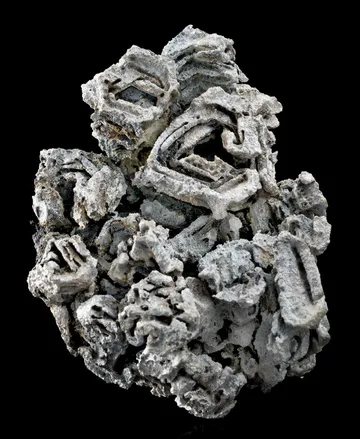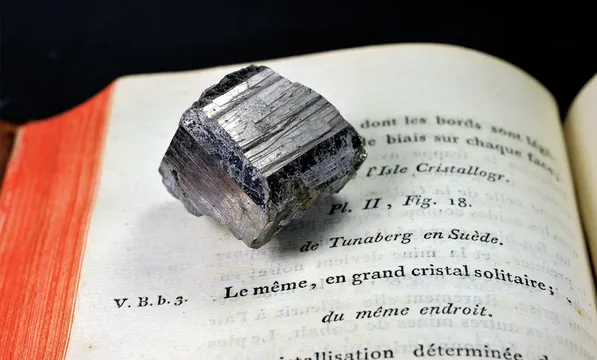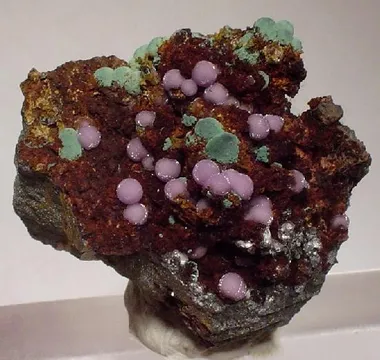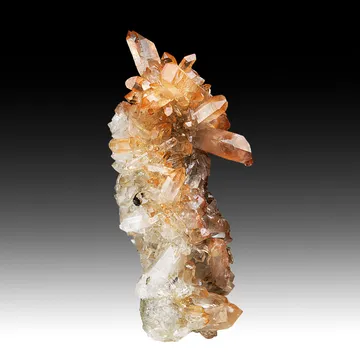
Filipstad, Sweden: historic locality anchored by Långban, yielding rare, scientifically important minerals and highly prized, information-rich specimens.
Key facts
Filipstad is not a single-mine collecting name so much as a mineralogical province in miniature: the western Bergslagen iron country of eastern Värmland, anchored by Långban, Nordmark, Jakobsberg, Persberg, Pajsberg and Harstigen. For collectors, the name matters above all because Långban, about 20 km north of the town of Filipstad, is one of the most astonishing mineral localities on Earth: a carbonate-hosted, metamorphosed Fe-Mn deposit where iron ore, manganese ore, dolomitic marble, skarn, fissures and late hydrothermal remobilization combined to generate an assemblage of unusual lead, manganese, barium, arsenic, antimony, beryllium, boron, tungsten and chlorine minerals unmatched in northern Europe.
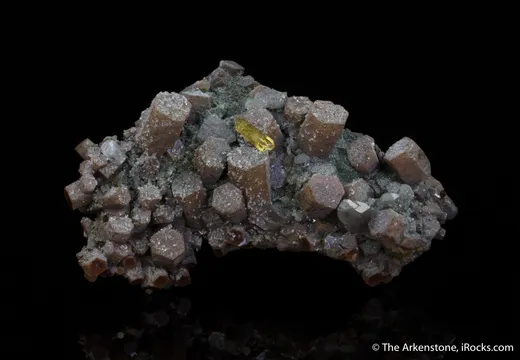
The best Filipstad specimens are not usually the simple, architectural cabinet pieces of an Alpine cleft or a Mississippi Valley district. They are more often dense, information-rich pieces: black hausmannite and braunite against white or cream carbonate; brown to orange richterite; dark metallic Långbanite; emerald-green magnussonite; pink allactite; lead-gray native lead; and minute but scientifically important arsenates, arsenites, oxides and lead silicates occupying seams, vugs, cleavage planes and skarn contacts. The aesthetic can be severe at first glance—black, gray, buff and white—but under magnification, fresh fracture, or ultraviolet light, many pieces reveal exactly why Långban material has been treasured by systematic collectors for more than a century.
Regional View
Country View
Filipstad’s collector identity rests on both specimen beauty and scientific priority. Långban alone has produced hundreds of mineral species and scores of type-locality minerals; the wider Filipstad mining district adds the historic skarn-ore fields of Nordmark, Jakobsberg and Persberg, where fissure minerals such as calcite and quartz occur with amphiboles, epidote, chlorite, sulfides and a suite of rarer species. The district is also historically deep: iron working in this landscape reaches back to the medieval and early modern Bergslagen tradition, while Långban’s documented continuous mining period ran from 1711 until closure in 1972.

Photo: Wikimedia Commons

Photo: Wikimedia Commons
Search for specimens: View all specimens from Filipstad, Sweden
The collector locality “Filipstad, Sweden” is best understood as the Filipstad part of western Bergslagen, Värmland County, Sweden. The district includes several historic ore fields, but the mineralogical center of gravity is Långban: a Fe-Mn-(Ba-As-Pb-Sb-W-Be-B) deposit hosted by Paleoproterozoic dolomitic marble and felsic metavolcanic rocks. Modern descriptions interpret Långban-type mineralization as originally syngenetic and submarine volcanic-hydrothermal, formed in a shallow marine, mainly felsic volcanic to subvolcanic back-arc setting around 1.90–1.88 Ga, then strongly modified by regional metamorphism and later brittle fracturing and fluid activity.
At Långban, the iron and manganese ores generally occurred together in the same ore bodies. The iron ore was dominated by quartz-bearing hematite, with coarser crystalline magnetite toward the margins of some ore bodies; dressed ore could reach roughly 60 percent iron. The manganese ore was less voluminous but economically decisive, composed chiefly of hausmannite and braunite. In larger manganese ore bodies, braunite commonly occupied the central part, with hausmannite forming an outer shell; the richest manganese ores reached about 40 percent manganese. This mineralogical zoning is central to the appearance of Långban specimens: massive black to steel-gray oxide ore, pale carbonate, and skarn minerals cut by late seams and fissures carrying some of the locality’s rarest species.
The broader Filipstad district adds important context. Nordmark, Jakobsberg and Persberg are classic iron-skarn and manganese-bearing ore districts within the same regional geological province. Jakobsberg, within the Nordmark mining district, is especially important to systematic collectors because it shares the Långban-type affinity and has yielded such historically significant species as jacobsite, plumboferrite and svabite as type-locality minerals. Persberg and Pajsberg-Harstigen add their own long mining histories and mineral lists, including iron ore, manganese, silica, silver, zinc and skarn-associated assemblages.
Mining at Långban likely began in some form by the mid-1500s, when a smelter was established to work local iron ore. The long documented phase began in 1711 and continued until the mine was closed in 1972. During the 1600s, bar-iron hammers were built near the smelter; in the 1700s, Storgruvan and Collegiegruvan became important workings; in the 1800s, mechanization, manganese-ore concentration and deeper shaft work transformed the field. Manganese became so valuable after the 1870s that iron ore was increasingly treated almost as a by-product. Dolomite quarrying began in the 1890s and became the final commercial activity after iron and manganese extraction ceased in the later 1950s. From then until 1972, the operation was essentially a dolomite producer.
Långban’s named mine features are part of its collecting vocabulary. Storgruvan, Collegiegruvan, Bjelkes schakt, Nya schaktet, Lokaschaktet, the Garden dump, the Lake dump, Pumphålet, and stopes such as Amerika, Bolivia, Abessinien and Canberra recur in specimen records and mineral descriptions. Some modern species have been recognized from old museum or dump material rather than newly mined rock; friisite, for example, was described from a museum specimen collected from the Canberra stope at 220 m depth and preserved in the Swedish Museum of Natural History.
Today the underground mines are closed and water-filled. Collecting is essentially dump collecting, not underground mining. Långban Mining Village is operated as a museum and cultural site, with the outdoor area visitable year-round and seasonal museum activities in summer. The museum’s Mineral LAB program has offered visitors the chance to borrow sledgehammers, goggles and gloves and search the old heaps by the lake, then examine finds afterward. Serious collectors should treat the site as a managed heritage and research landscape: obey posted restrictions, avoid fenced or reserved areas, do not disturb historic structures, and assume that significant rare-species identifications require analytical confirmation rather than hand-lens optimism.
The great finds from Filipstad are rarely “pockets” in the quartz-crystal sense. They are more often small paragenetic microenvironments: fracture fillings, vugs, altered skarn seams, late carbonate-rich openings, ore-carbonate contacts, and old dump blocks whose significance was only recognized decades later. That is why Långban remains alive mineralogically after closure. New species continue to be recognized from old samples, and seemingly dull black-and-white pieces can still hide a type mineral in grains measured in micrometers.
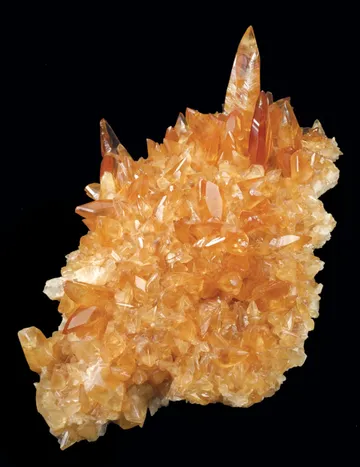
Calcite from the Filipstad district is most collectible when tied to Långban-style ore and skarn associations rather than as isolated carbonate crystals. At Långban it occurs in the carbonate host, in fissure and late-stage assemblages, and as a companion to hausmannite, hematite, magnetite, dolomite, diopside-schefferite, barytocalcite, richterite, allactite, swedenborgite, native lead, svabite, hedyphane and other characteristically Långban minerals. Specimens range from massive white to gray or cream carbonate matrix to distinct crystals and crystalline coatings; good pieces show either sharp, clean calcite contrasting with dark Fe-Mn oxide ore or strong shortwave ultraviolet response, commonly orange to red in manganese-bearing calcite. Ordinary pieces are abundant carbonate or ore fragments, while the desirable ones carry documented Långban associations, visible crystals, rare species in or on calcite, or a convincing old label from a named dump or stope.
Other documented Filipstad minerals are the reason the locality is legendary. Långban type-locality and classic species include richterite, hedyphane, berzeliite, swedenborgite, långbanite, filipstadite, magnussonite, melanotekite, kentrolite, barysilite, pinakiolite, pyroaurite polytypes, wermlandite, joesmithite, hyalotekite, akrochordite, eveite, allactite-associated rare arsenates, and many lead-manganese-antimony oxides and silicates. Recent work has added or clarified species such as vargite, skogbyite, igelströmite, manganoschafarzikite and friisite, reinforcing a pattern long familiar to Långban specialists: a specimen collected generations ago may still become scientifically new when examined with modern microanalytical methods. In the wider Filipstad district, Jakobsberg and Nordmark add jacobsite, svabite, plumboferrite, lindqvistite, katoptrite and related skarn-oxide assemblages, while Persberg and Pajsberg-Harstigen contribute additional iron-skarn and manganese-silicate material.
The chief authenticity issue for Filipstad specimens is locality precision. Old labels may read “Langban,” “Långban,” “Wermland,” “Vermland,” “Filipstad,” “Nordmark,” “Jakobsberg,” “Persberg,” or simply “Sweden,” and these labels are not interchangeable. A specimen sold as “Filipstad” may be correct in a broad municipal sense but still lose scientific and market value if the mine, dump or stope is unknown. For common calcite this may be acceptable; for rare Långban-type minerals it is a major problem.
Fakes and deliberate treatments are not the main concern for this locality. The more common hazard is over-identification. Many black Långban oxides look alike in hand specimen; hausmannite, braunite, jacobsite, magnetite-magnesioferrite-series material, filipstadite-group lookalikes and other dark phases may require polished section, X-ray diffraction, SEM-EDS, electron microprobe or Raman work. Likewise, tiny green, pink, yellow, brown or white grains in carbonate can be several different arsenates, arsenites, lead silicates or alteration products. A rare name on an old label is not proof.
Condition varies sharply. Calcite cleaves readily and bruised edges are common on old dump-collected pieces. Carbonate matrices can be friable, iron-manganese ore fragments may shed granular material, and some rare species occur as minute crusts that should not be scrubbed, acid cleaned or aggressively trimmed. Avoid acid testing anywhere near rare-species material; calcite and dolomite are part of the paragenesis, not mere matrix to remove. Use distilled water sparingly, soft brushes only, and keep labels with the specimen.
Fluorescence can be excellent, especially in calcite-bearing Långban pieces, but the response is specimen-specific. Orange to red shortwave responses are known in calcite, and dolomite may respond differently in the same piece. Because Långban specimens may contain arsenic-, antimony-, beryllium- and lead-bearing minerals, ultraviolet inspection is safer than chemical experimentation. Wash hands after handling dusty material, keep friable specimens boxed, and do not grind, saw or polish unknown rare-mineral pieces without appropriate dust control.
Market availability splits into three tiers. Calcite, dolomite, hausmannite-rich ore and mixed Långban matrix specimens appear with some regularity, especially from old European collections. Attractive classic combinations—braunite on richterite, native lead associations, allactite-magnussonite pieces, barytocalcite-bearing specimens, and old-time Långbanite—are much scarcer and increasingly label-dependent. True type-species material with analytical support, especially for modern microminerals known from only one or a few specimens, is rare, often museum-grade, and should be bought for provenance and documentation as much as for appearance.
The most memorable Långban story begins with animals, water, and a wooden solution to an underground problem. By 1787, miners at Storgruvan had built an inclined bridge from the surface down to a horse whim at just over 30 m depth. Before that arrangement, the work reportedly consumed about one horse every year in Storgruvan. After the bridge was installed, the horses could walk up and down daily, and their lives became markedly longer. It is a small detail, but it captures the preindustrial mine perfectly: not just ore and mineral names, but timber, hooves, pumping gear, wet darkness, and the practical ingenuity of a remote Bergslagen operation.
In 1808, Collegiegruvan changed the fate of the field. At the beginning of the 1800s, Långban’s mining situation was poor because the known ore was dwindling. Then Collegiegruvan yielded significant new ore, enough to rescue the operation. Two decades later, in 1828, 66 people were working at Storgruvan and Collegiegruvan. By the late 1810s, a rail road—unusual for its time—was carrying waste rock from Bjelkes schakt down to Långbanssjön. The landscape collectors see today as quiet dumps and museum ground was already becoming an engineered ore machine.
The water story is darker. In 1897, at 150 m depth, miners encountered a fault fissure that caused serious water problems for years. In 1907, when an exploratory drift was driven at 186 m depth, the deepest point of the mine at that time, a horizontal fissure was struck after 25 m, increasing inflow by roughly 50 percent. Then in July 1910, blasting in a drift from Bjelkes schakt on the 200 m level caused the water flow to increase drastically again. In only two months, the water level rose 58 m. Not until 1914, with electric power and modern centrifugal pumps, could the flooded mine finally be drained. That same year, machine drilling was introduced with an Atlas air compressor installed in the machine house at Lokaschaktet.
Fire repeatedly rewrote Långban’s surface works. A severe fire swept the mine field in 1918 and destroyed, among other things, both concentrating plants. Two years later, a new headframe with sorting house was completed at Nya schaktet, substantially the structure still associated with the shaft today. Then, in 1924, a new concentrating plant burned after only a few months in operation; by October it had already been replaced. For the collector standing beside the old buildings, these dates explain why Långban feels both ancient and industrially modern: its surviving forms are the product of centuries of rebuilding, not a single frozen mining moment.
The deepest reach of the mine came during the Second World War. In 1942, a blind shaft was begun from the Abessinien drift at 280 m down to the 369 m level. This became the deepest point in the mine, and it lay under Hyttsjön. The exploration did not find major new ore bodies, but the image is unforgettable: the mine pushing below the lake, through Fe-Mn carbonate country already famous to mineralogists, looking for commercial ore while unknowingly preserving the paragenetic riddles that later generations would solve in museums and laboratories.
The final chapter was quieter. By the second half of the 1950s, iron and manganese mining ended because the ore reserves were exhausted. Dolomite remained. Burned dolomite went chiefly to steelworks; unburned powdered dolomite also found uses, including as a soil improver valued for its magnesium content. At mid-year 1972, the mine closed after difficulties selling the dolomite. Underground, the workings flooded. Above ground, the dumps stayed behind—black, gray and pale heaps beside lakes and old buildings—and those heaps became the collector’s mine.