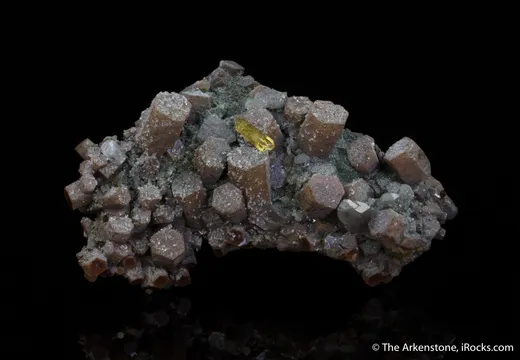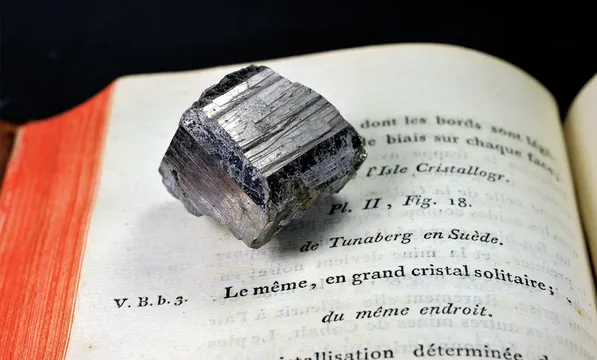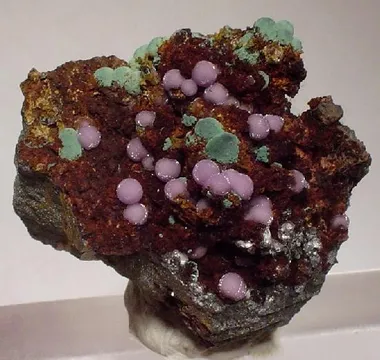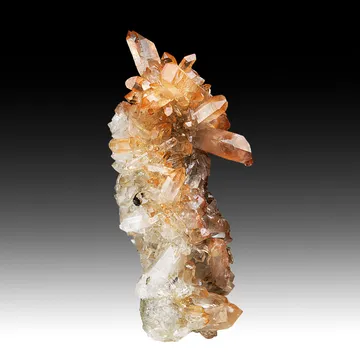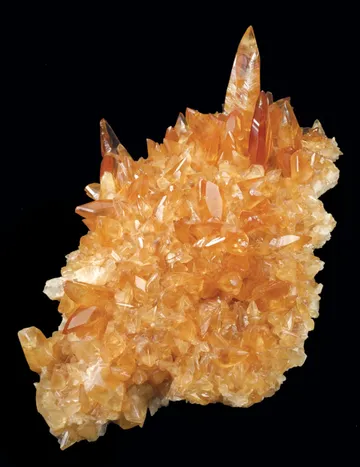
A collector's guide to Långban Mine, Sweden: its geology, mining history and notable minerals, illustrated with the 39 specimens documented from this locality on EarthWonders.
Key facts
Långban is one of the great names of systematic mineral collecting: a compact Swedish Fe-Mn deposit whose specimen record is vastly larger than its footprint. The mine lies in the Filipstad district of Värmland, in the western Bergslagen ore province, where Paleoproterozoic volcanic and carbonate rocks were metamorphosed, deformed, and later cut by chemically extraordinary fissures. To a collector, that geological history is not abstract; it is visible in hand specimens as black hausmannite and braunite ore, granular hematite and magnetite, white to grey dolomitic marble and calcite, pink rhodonite, green to brown amphiboles and pyroxenes, and a long parade of lead-, barium-, manganese-, arsenic-, antimony-, tungsten-, and beryllium-bearing rarities.
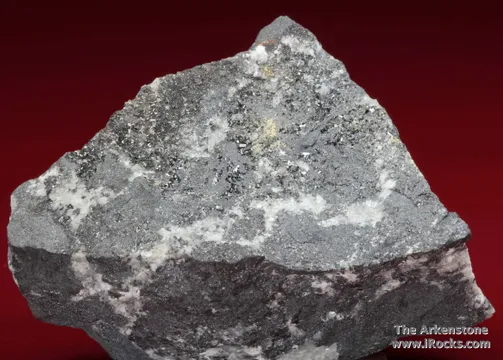
The mine’s fame rests on two overlapping reputations. First, Långban is a classic ore locality: it was worked for iron ore, manganese ore, and dolomite, with manganese eventually becoming the most valuable product. Second, and more important for collectors, it is a type-locality powerhouse. More than 300 valid minerals have been recorded from the mine in modern compilations, and dozens of mineral species were first described from Långban. The best specimens are rarely “pretty” in the usual gem-crystal sense; they are better described as dense, old-European, research-rich objects—lead sheets and herringbone forms on black manganese oxides, silky arsenates in calcite, pearly pyroaurite blades, massive black langbanite relieved by rose rhodonite, and tiny type-mineral crystals that may matter more under the microscope than across the room.
Regional View
Country View
The special collector character of Långban is inseparable from its late fissure assemblages. These mineralized cracks, especially in Mn-bearing dolomitic carbonate rocks and skarns, produced many of the deposit’s most exotic species. The suite includes arsenates, arsenites, oxychlorides, native metals, carbonates, oxides, silicates, and hydrated late-stage species formed during several mineralizing episodes after the main ore and skarn formation. The result is a locality where a modest black-and-white miniature can carry a mineralogical pedigree that would be impossible almost anywhere else.

Photo: Geological Survey of Sweden SGU / Wikimedia Commons


Search for specimens: View all specimens from Långban Mine, Sweden
Långban Mine lies between Hyttsjön and Långbanssjön, north of Filipstad, with the old mining village, furnace site, headframes, ore piles, and dumps still forming a coherent industrial landscape. Geologically, it is the name locality for a family of marble-hosted Fe-Mn-(Ba-As-Pb-Sb-W-Be-B) deposits in Bergslagen. The primary ore system formed in a shallow submarine, volcanic-hydrothermal setting about 1.9 billion years ago, then was recrystallized and reorganized during regional metamorphism and deformation. That long history created both the ordinary ore minerals and the extraordinary rare-mineral inventory.
The principal ores were iron and manganese. The iron ore was dominated by hematite and magnetite, while the manganese ore was built chiefly of hausmannite and braunite. In the richer manganese ore bodies, braunite commonly formed central portions of the ore, with hausmannite as an outer shell or associated zone. The best upgraded iron ore could run around 60 percent Fe, while the richest manganese ore reached roughly 40 percent Mn. Although iron mining began the economic story, manganese became the most valuable product after the 1870s, and iron ore was increasingly treated as a secondary product beside the manganese ore.
The host rocks and gangue are just as important to collectors as the ore minerals themselves. Dolomitic marble, calcite, barite, Mn-bearing carbonates, rhodonite, tephroite, diopside and related pyroxenes, amphiboles including richterite, phlogopite, and a variety of spinels and oxides provided reactive chemical reservoirs. Later fluids moved through fractures and small cavities, remobilizing lead, barium, arsenic, antimony, manganese, and other elements from the earlier ore and skarn. Many of the famous Långban specimens—native lead with hydrocerussite and pyrochroite, allactite-bearing fissure pieces, barite-calcite associations, and minute arsenate or arsenite rarities—belong to this late fissure environment rather than to the massive commercial ore.
Mining probably began in some form by the mid-1500s, when an ironworks was established at Långban to smelt the local ore. The historical record becomes clearer in the 1600s: two bar-iron hammers were established in connection with the furnace, and in 1667 the mining official Anders Malm referred to the “great ore streak” descending beneath Lake Långban. A long continuous mining period began in 1711, focused initially on Storgruvan, and continued until the final closure in 1972. Collegiegruvan, Bjelkes schakt, Nya schaktet, Lokaschaktet, Hindenburg and other named workings and dump areas appear in the mining and collecting record, and the mine eventually reached its deepest level through a blind shaft from the Abessinien drift down to the 369-meter level.
The 19th century brought both mechanization and the manganese era. A power transmission system to Storgruvan was completed in 1755; an unusually early rail road for waste rock from Bjelkes schakt to Långbanssjön was built in the late 1810s; experimental machine drilling was attempted in 1866; Nya schaktet was begun in the early 1870s and later became the principal shaft; manganese ore dressing began on a more rational footing in the mid-1870s; a manganese concentration plant was built in 1880; and in 1883 Sweden’s first iron-ore sorting plant was completed there. A Bessemer steel plant was built in 1873 but lasted only twelve years. Dolomite quarrying began in the early 1890s and ultimately outlived the Fe-Mn ore production.
The 20th-century mine was shaped by water, fires, and changing markets. A water-bearing fault fissure encountered at the 150-meter level in 1897 caused persistent difficulty. Further inflows were struck at the 186-meter level in 1907, and another serious increase came during blasting on the 200-meter level in July 1910. By 1914 electric power and modern centrifugal pumps had finally allowed the flooded mine to be pumped out, and machine drilling was introduced. The ore-dressing plants burned in 1918, a new headframe and sorting house at Nya schaktet were completed in 1920, and another fire destroyed a new concentration plant in 1924 before replacement was completed later that year. Iron and manganese mining ceased in the second half of the 1950s as workable ore ran out; dolomite alone was then mined until closure at mid-year in 1972.
For collectors today, Långban is no longer an underground collecting locality. The mine has been closed and flooded since the early 1970s, and serious scientific work on old underground assemblages depends heavily on museum and historical specimens. The surface, however, remains a living collecting and educational site under the Långban Mining Village. During the visitor season, the museum offers guided tours, a mineral exhibition, marked walks, and a Mineral LAB activity in which visitors can borrow a hammer, safety glasses, and gloves to search the old lakeside dumps. Serious collectors should check current local rules before hammering, work only where collecting is explicitly allowed, and remember that many important Långban minerals are microscopic and require analytical confirmation.
Important finds continue to come from old material as much as from fresh exposure. Langhofite, described in 2020, was found in a small vug in hematite-pyroxene skarn with calcite, barite, fluorapatite, mimetite, and minor sulfides; the discovery specimen was collected in 2000 from an old mine-waste dump close to Lake Långban, likely accumulated before 1900. Långbanshyttanite, approved in 2011, was discovered in material from the mine with calcite, Mn-bearing phlogopite, jacobsite-magnetite series spinels, antigorite, and trigonite. Skogbyite, described in the 2020s, shows that even after centuries of mining and collecting, Långban remains a source of new mineral species when old specimens and dump material are examined with modern methods.
Native lead is one of Långban’s signature collector species and one of the few localities where lead occurs in memorable crystallized form rather than as an obscure metallic speck. The classic pieces are heavy, dull to bright grey, and usually hosted by black hausmannite-bearing manganese ore, calcite, pyrochroite, hydrocerussite, and allactite; habits range from thick sheets and flattened masses to elongated crystals, ropes, herringbone growths, and the occasional sharp cuboctahedral crystal approaching a centimeter. Good specimens separate themselves from ordinary “lead-bearing rock” by having three-dimensional relief, recognizable crystal form, or clean metallic contrast against the black Mn-oxide matrix. The late fissure setting matters here: the lead belongs to low-temperature, Pb-Mn-As-Sb-rich fracture assemblages where native lead could precipitate with calcite, barite, allactite, and pyrochroite after earlier ore and skarn formation. Because the metal is soft, tarnishable, and easily bruised, old specimens with intact raised sheets, crisp crystal edges, and reliable Långban provenance command a premium.
Hausmannite at Långban is both an ore mineral and a specimen matrix, and that dual role defines its collecting appeal. In the manganese ores it occurs as black to brownish-black, dense, submetallic to adamantine material, commonly with braunite, calcite, dolomite, tephroite, rhodonite, magnetite-jacobsite series oxides, and native lead. The commercial manganese ore bodies commonly show braunite-rich cores with hausmannite forming outer zones, while specimen pieces may show granular, crystalline, or massive hausmannite as the dark architectural base for lead, berzeliite, allactite, magnussonite, hedyphane, and other Långban rarities. Standalone hausmannite crystals from Långban are generally not collected in the same “showy crystal” category as Kalahari hausmannites; the best Långban pieces are important because the hausmannite is rich, fresh, well crystallized for the locality, and intimately associated with the deposit’s rare Pb-Mn-As-Sb assemblage.
Pyroaurite is a type-locality mineral from Långban, named for its fire-golden, bronze to tan pearly appearance, and the best pieces are subtle rather than loud. At this mine it appears as pearly tan to brownish, platy or bladed crystals and scaly aggregates, commonly on calcite and associated with black pyrochroite and manganese-rich matrix; documented specimens include rich cabinet-size plates scattered with tan blades and small thumbnail pieces consisting of unusually large flat crystals for the species. Individual crystals are typically very small, so a good Långban pyroaurite specimen is judged by richness, luster, contrast on pale calcite, association with pyrochroite, and whether the platy crystals are distinct rather than rubbed into a dull coating. The mineral’s type-locality status also gives even modest material extra significance, especially when accompanied by an old label or a collection history.
Beyond lead, hausmannite, and pyroaurite, Långban is a systematic collector’s labyrinth. Type-locality and near-iconic Långban species include langbanite, berzeliite, allactite, barysilite, ekdemite, ganomalite, hedyphane, hyalotekite, kentrolite, magnetoplumbite, manganosite, melanotekite, nasonite, pinakiolite, pyrobelonite, quenselite, richterite, sarkinite, svabite, swedenborgite, tilasite, trigonite, wermlandite, wiklundite, langhofite, långbanshyttanite, and skogbyite, among many others. Some are handsome cabinet minerals; many are millimetric or microscopic; several require X-ray diffraction, spectroscopy, or electron-microprobe work for confidence. That is the essence of Långban collecting: the locality rewards the collector who values paragenesis, label history, and mineralogical verification as much as visible beauty.
The first authenticity issue with Långban is not usually outright fakery; it is provenance precision. Old labels may say “Langban,” “Långban,” “Långbanshyttan,” “Filipstad,” or simply “Sweden,” and the broader district also includes other famous Mn-Fe localities such as Jakobsberg, Pajsberg, Harstigen, Nordmark, and Tilas. Those localities can share broad mineralogical themes but are not interchangeable. For type-mineral and rarity collectors, the difference between “Långban Mine” and “Långban-type district” can be the difference between a type-locality specimen and a merely related specimen.
Analytical caution is essential. Many Långban rarities are visually ambiguous: black oxides, dark spinels, Mn silicates, arsenates, and lead silicates can resemble one another closely in hand specimen. Labels from reputable old collections are valuable, but modern confirmation by XRD, Raman spectroscopy, SEM-EDS, or microprobe is often the only responsible way to sell or catalogue rare species. This is especially true for tiny type minerals, hydrous arsenates, arsenites, Pb silicates, and mixed oxide phases.
Native lead from Långban deserves special handling. It is soft enough to scratch, smear, and bruise; raised sheets and ropes can be flattened by careless packing; and fresh metallic surfaces can dull with handling. Keep lead specimens dry, avoid rubbing or polishing them, and do not store them where they will contact hard quartz-rich pieces. As with all lead-bearing specimens—and especially Långban pieces containing arsenates or arsenites—wash hands after handling and keep them away from children, food-preparation areas, and abrasive dust generation.
Condition standards differ from those for showier crystal localities. A Långban lead specimen may be historically and mineralogically excellent while looking dark, lumpy, or “ugly” to a casual buyer. Conversely, a visually attractive Långban specimen without species confirmation may be worth less than its appearance suggests. Look for intact metallic form in lead, lustrous and well-defined blades in pyroaurite, fresh black crystalline hausmannite rather than altered massive ore, and old labels from named collections or dealers. Associations often matter more than the main species alone.
Hydrated and low-temperature minerals from the late fissure assemblages should be kept in a stable, dry display environment. Pyroaurite plates and similar soft hydrous phases can be delicate, easily abraded, and difficult to clean. Calcite-rich pieces may fluoresce, and some Långban specimens are collected by ultraviolet enthusiasts, but fluorescence is species- and assemblage-dependent and should not be used as a substitute for identification.
Market availability is paradoxical. Långban specimens are always present somewhere in the collector market because the mine was famous for generations and many old collections have been dispersed. Truly good pieces, however—especially sharp native lead, rich type-locality pyroaurite, attractive langbanite-rhodonite combinations, classic old-label rarities, and analytically confirmed type minerals—are scarce. The best purchases are usually made from dealers who understand systematic mineralogy and can explain not only the species name but the association, label history, and level of confirmation.
In Långban the most memorable stories are not only about minerals but about the mechanical struggle to reach them. In 1787, Storgruvan was equipped with an inclined bridge running from the surface down to a horse gin more than 30 meters below. That odd-sounding improvement had a brutal practical purpose: horses could now walk in and out of the mine each day. Before the bridge, the mine consumed about one horse a year. Afterward, the animals’ working lives increased dramatically. It is a vivid reminder that the old specimens from Långban came out of a pre-industrial landscape of shafts, waterwheels, wooden power transmissions, ore sorting, and animal labor—not from the tidy museum village visitors see today.
The mine’s long fight with water reads like a slow-motion disaster. In 1897, miners encountered a water-bearing fault fissure at the 150-meter level, and the problem haunted operations for years. In 1907, an exploratory drift was driven at the 186-meter level, then the deepest point of the mine. After 25 meters of advance, the drift cut a horizontal fissure and the total inflow to the field increased by about 50 percent. The pumps were already under pressure when, in July 1910, blasting from Bjelkes schakt on the 200-meter level triggered another drastic increase. Within only two months, the water in the mine rose 58 meters. Not until 1914, with electric power and modern centrifugal pumps, could the flooded mine finally be drained again.
Fire struck with similar force. In 1918 a severe blaze swept the mining field and destroyed both concentration plants. Two years later, a new headframe and sorting house at Nya schaktet were completed, creating much of the installation that still gives the site its preserved industrial profile. Then, in 1924, a new concentration plant burned after only a few months in operation. By October of that year yet another replacement plant was complete. Långban’s mineral specimens may sit quietly in drawers now, but the place that produced them was repeatedly rebuilt under economic pressure, ore exhaustion, floods, and fire.
One of the most satisfying modern Långban stories is the discovery of langhofite. The type specimen did not come from a dramatic new underground pocket; it came from old dump material near Lake Långban, likely waste accumulated before 1900 and collected in 2000. In that neglected rock, a small vug in hematite-pyroxene skarn held colorless to white elongated crystals with calcite, barite, fluorapatite, mimetite, and tiny sulfides. The mineral was later named for Jörgen Langhof, a curator at the Swedish Museum of Natural History, former director of Långban’s Mining Museum from 1998 to 2001, and a long-time investigator of the mine’s mineral wealth. It is the perfect Långban episode: a new species, a museum connection, a dump specimen, and a century-old rock still yielding secrets.
Dan Holtstam and Jörgen Langhof, eds., Långban: The Mines, Their Minerals, Geology and Explorers. Raster Förlag / Swedish Museum of Natural History, Stockholm, 1999. A major monograph on the mine, its geology, mineral inventory, history, and collectors. ResearchGate record
Paul B. Moore, “Mineralogy and chemistry of Långban-type deposits in Bergslagen, Sweden.” The Mineralogical Record, 1, 154–172, 1970. A foundational modern treatment of the Långban-type deposits and their unusual mineral chemistry.
Erik Jonsson and Curt Broman, “Fluid inclusions in late-stage Pb-Mn-As-Sb mineral assemblages in the Långban deposit, Bergslagen, Sweden.” The Canadian Mineralogist, 40, 47–65, 2002. Essential for understanding the low-temperature fissure assemblages that produced native lead and many exotic Långban species. DOI
Dan Holtstam and Joakim Mansfeld, “Origin of a carbonate-hosted Fe-Mn-(Ba-As-Pb-Sb-W) deposit of Långban-type in Central Sweden.” Mineralium Deposita, 36, 641–657, 2001. A key genetic paper on Långban-type deposits and their volcanic-hydrothermal, marble-hosted character. ResearchGate record
Dan Holtstam, Fernando Cámara, and Andreas Karlsson, “Langhofite, Pb2(OH)[WO4(OH)], a new mineral from Långban, Sweden.” Mineralogical Magazine, 84, 381–389, 2020. Describes the type specimen, paragenesis, and crystal structure of langhofite from old Långban dump material. Cambridge Core
N. V. Chukanov, I. V. Pekov, E. Jonsson, N. V. Zubkova, Y. E. Filinchuk, D. I. Belakovskiy, and D. Yu. Pushcharovsky, “Långbanshyttanite, a new low-temperature arsenate mineral with a novel structure from Långban, Sweden.” European Journal of Mineralogy, 23, 675–681, 2011. Type description of långbanshyttanite, with holotype material in the Fersman Mineralogical Museum and Swedish Museum of Natural History. EPA HERO record
Frank C. Hawthorne and coauthors, “Wiklundite, ideally Pb2(Mn2+,Zn)3(Fe3+,Mn2+)2(Mn2+,Mg)19(As3+O3)2[(Si,As5+)O4]6(OH)18Cl6, a new mineral from Långban, Filipstad, Värmland, Sweden: description and crystal structure.” A modern description of another highly complex Långban lead-manganese arsenite-silicate. PDF
“Skogbyite, Zr(Mg2Mn43+)SiO12.” American Mineralogist, New Mineral Names, 109, 799–802, 2024. Notes skogbyite as a new Zr-Mg-Mn silicate from Långban and summarizes the mine’s modern standing as a locality with more than 300 valid minerals and 78 type-locality minerals. PDF
Jörgen Langhof, Dan Holtstam, Luca Bindi, Andreas Karlsson, and Erik Jonsson, “Introducing the akrochordite mineral group, with the new mineral vargite from the Långban Mn-Fe deposit, Filipstad, Värmland, Sweden.” A recent addition to the continuing mineralogical record of the mine. PDF
Mindat: Långban Mine, Långban Ore District, Filipstad, Värmland County, Sweden — The central online mineral-species and photo database for the locality.
SGU: The mines of Långban — Concise official overview from the Geological Survey of Sweden emphasizing Långban’s mineral diversity and geological importance.
Värmlands Museum: Mining in Långban — Detailed Swedish-language history of the mine’s workings, ore, water problems, fires, and closure.
Värmlands Museum: Långbans Gruvby — Current visitor information for the mining village, exhibitions, activities, and seasonal access.
Värmlands Museum: Activities & Program — Practical information on guided tours, marked walks, and the Mineral LAB collecting activity on old dump material.
Värmlands Museum: About Långban Mining Village — English-language visitor overview of the preserved mining village and its setting.
Wikimedia Commons: Minerals of Långban — Useful open-image gallery showing native lead, pyroaurite, langbanite, melanotekite, pinakiolite, and other Långban minerals.
Jonsson & Broman 2002: Fluid inclusions in late-stage Pb-Mn-As-Sb mineral assemblages — The key technical paper for the late fissure assemblages central to many collector specimens.
Holtstam, Cámara & Karlsson 2020: Langhofite from Långban — Open-access type description of a modern Långban species from old dump material.
MSA Collector’s Corner: Minerals from Långban, Sweden — Historical mineral list showing many of the classic Långban species recognized in older collecting literature.