Majuba Placers, USA - Nevada placer field known for bright native gold nuggets and crisp crystal thumbnails, plus rare copper-arsenate minerals from Majuba Hil…
Key facts
Majuba Placers is one of those Nevada names that means different, but closely related, things to different collectors. To gold collectors it evokes the Rye Patch–Majuba placer field: a dry, shallow, alluvial-fan deposit east and southeast of Majuba Hill, west of Rye Patch Reservoir, famous for bright native gold nuggets and unusually crisp crystalline thumbnails. To secondary-copper collectors it also points a few miles up into the same Antelope district, to Majuba Hill Mine, where oxidized copper-tin-silver mineralization in rhyolitic intrusive breccias produced one of the classic American suites of copper arsenates: deep blue clinoclase, green olivenite, cornwallite, strashimirite, chalcophyllite, arthurite, metazeunerite, and the type-locality minerals parnauite and goudeyite.
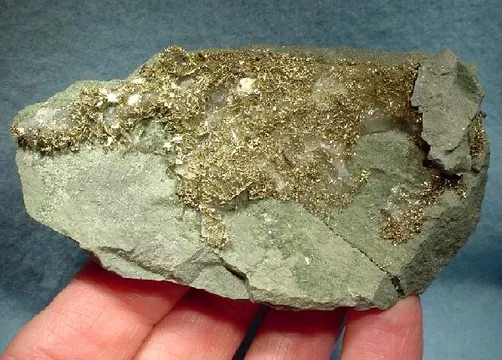
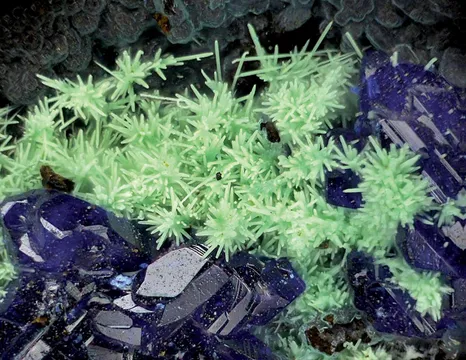
The placer gold is not the waterworn, anonymous yellow of many western camps. The best Majuba/Rye Patch pieces retain their history as crystals: flattened octahedra, hoppered cubes, skeletal ribs, spinel-twinned forms, curved leaves, fluted edges, and compressed crystal aggregates with a rich buttery luster. Much of it was found by drywashing and, later, by metal detecting across shallow pediment gravels where there is little overburden. The copper-arsenate specimens from Majuba Hill are the aesthetic counterpoint: tiny but intense, with electric blue to indigo clinoclase and bright green secondary species perched on limonite-stained rhyolite, quartz, and altered breccia.
Historically, the two collecting traditions grew from different mining stories. The placers were discovered in 1938 and worked most actively from 1938 to 1941, while the Majuba Hill hard-rock workings began with copper and tin discoveries in the early 1900s and expanded through the upper, middle, and lower adits. Together they make Majuba a compact lesson in Nevada mineralization: a porphyry-style intrusive center with base-metal, tin, gold, silver, molybdenum, and uranium geochemistry on the hill, shedding or neighbored by shallow placer gold on the alluvial fans below.
Regional View
Country View

Photo: Wikimedia Commons

Photo: Wikimedia Commons
Search for specimens: View all specimens from Majuba Placers, USA
The Majuba placer field lies in north-central Pershing County, Nevada, in the Antelope mining district near Majuba Mountain and west of Rye Patch Reservoir. The strict placer locality is an alluvial-fan deposit on the east flank of the Antelope Range, in and around T. 32 N., R. 32 E. Historic descriptions place the principal placer ground east and southeast of Majuba Hill, with U.S. Bureau of Mines placer-claim concentrations including the Majuba claim in section 8, Rio Grande, Delta, and Valley View ground in section 20, and Delta, Valley View, Dice, and Owens Circle ground in section 30. Mindat places the Majuba placer locality at about 40° 39' 4" N, 118° 24' 3" W, while the broader Majuba Placers geographic feature lies slightly farther southeast at about 40° 37' 5" N, 118° 24' 32" W.
The placer deposit is a shallow Placer Au-PGE–model occurrence in Holocene alluvium, with gold close to the surface and little overburden. The gold occurs in irregular concentrations across several square miles of pediment and fan gravels rather than as a continuous pay streak. This is why the district became so attractive to drywashers and, later, nugget shooters: the bedrock and older gravel surfaces are shallow enough that coarse pieces can be detected, but the distribution is erratic enough that barren ground may lie immediately beside a productive patch. The strict Majuba placer mineral list is simple—native gold is the recorded exploited mineral—but the form of that gold is unusually important to collectors.
The source of the placer gold has never been settled. Contemporary and later reports noted that the major bedrock deposits in the Majuba Hill area are principally silver, lead, tin, and copper, although some gold is associated with the base-metal system. One plausible explanation is erosion from small, shallow epithermal or intrusive-related gold-bearing structures in or near the placer field, because many nuggets show limited transport and preserve crystalline forms. Older regional descriptions also noted gold veins in the Scossa area to the northwest, in steeply dipping metamorphosed sedimentary rocks that could produce placer accumulations, but the direct connection to the Majuba placer gold was not demonstrated.
Majuba Hill Mine, the hard-rock locality tied to the district’s famous clinoclase and rare copper arsenates, is several miles west-northwest of the placer field on Majuba Mountain. There the geology is markedly different: a complex intrusive center of rhyolite porphyry, porphyritic rhyolite, quartz-feldspar porphyry, dikes, and breccia bodies intruding Triassic metasedimentary rocks of the Auld Lang Syne Group, with later Jurassic, Cretaceous, Eocene, Oligocene, and Miocene intrusive and volcanic events recognized in modern mapping. Ore and specimen mineralization are concentrated in breccia bodies, faults, fractures, and altered porous zones, especially where silicification, sericitization, tourmalinization, and later oxidation created open, reactive spaces.
The historic Majuba Hill workings include lower, middle, and upper adits developed by Mason Valley Mines Company after the property was leased in 1914. High-grade copper and minor tin were produced from oxidized ore in the early 1900s, with most known historic production coming from the middle adit. The Copper Stope in the middle adit is central to the mineral-collector story: it and nearby crosscuts and stopes produced the classic secondary copper arsenates, including clinoclase and the later-described type minerals parnauite and goudeyite. Freeport Sulfur Company explored the property for tin in 1941–1942, and J. O. Greenan and G. W. Kerr shipped copper and tin ores between 1942 and 1954. Modern exploration since the 1970s has treated Majuba Hill as a copper-silver-gold porphyry or intrusive-related system, with a large database of drilling and renewed corporate exploration activity.
The placer mining history begins later. The Majuba placers were reportedly discovered by C. E. Dice in July 1938 and were most intensively worked from 1938 through 1941. Records summarized from USGS and Nevada Bureau of Mines work cite more than 100 ounces of gold per year during that short active period and about 606 ounces of gold produced by the district from 1938 to 1941. Drywashing was practical because of the arid climate, shallow gravels, and limited overburden, and old dry-sluice equipment remains part of the district’s physical memory.
Collecting access today must be approached conservatively. The placer field includes BLM-administered land, unpatented placer claims, and nearby private or controlled lands, while the Majuba Hill hard-rock property has a modern exploration tenure, private parcels, patented claims, and federal lode claims under corporate control. The Rye Patch area is popular with detectorists, but it is also heavily claimed in places. Anyone contemplating field collecting should check current BLM MLRS claim status, Pershing County records, land ownership, and posted conditions before going; do not assume that “BLM land” means open collecting, and do not enter the Majuba Hill workings or project lands without explicit permission from the controlling party.
Majuba placer gold is prized because it is not merely coarse but characterful: fine specimens show rich yellow color, bright luster, and preserved or partly compressed crystal forms, including hoppered cubes, octahedra, skeletal ribs, spinel twins, curved leaves, and fluted nuggets with bits of quartz still attached in some examples. Documented specimen sizes span small thumbnails around 1.0 to 2.1 cm, with recorded weights of a few grams, while exceptional pieces include a 3.8 x 1.8 x 1.8 cm spinel-twinned crystal described from the placers. The best Majuba gold retains crisp internal ribs and recognizable crystal architecture despite alluvial modification; ordinary pieces are smoother, more rounded, less sculptural nuggets with less visible crystalline texture.
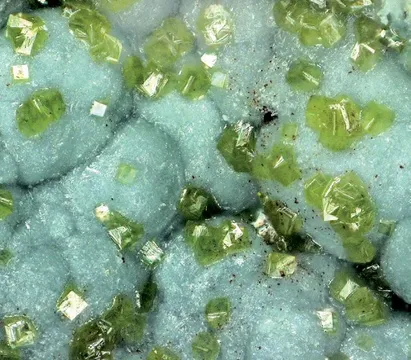
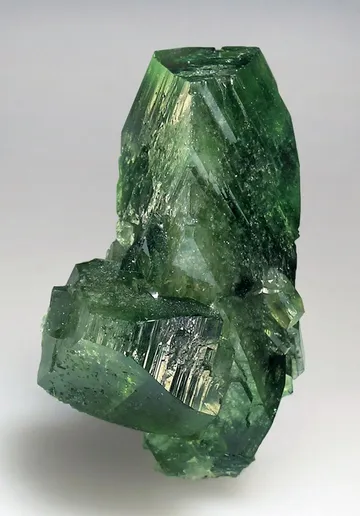
Clinoclase associated with the Majuba name comes from the oxidized Majuba Hill Mine workings rather than from the alluvial gold gravels themselves, and the finest pieces are among the district’s signature copper arsenate specimens: deep teal-blue to dark indigo, lustrous, monoclinic crystal aggregates, drusy clusters, botryoidal “beetle ore” surfaces, and small prismatic crystals on limonite-stained, altered matrix. The Copper Stope and nearby middle-adit workings are especially important, with associated cornubite, cornwallite, strashimirite, goudeyite, chalcophyllite, chrysocolla, brochantite, and other secondary copper minerals. Most crystals are millimetric, but rich cabinet-quality plates and miniatures can be visually powerful; superior specimens combine saturated blue color, sparkle, intact crystal crusts, and contrasting green arsenates or tabular chalcophyllite.
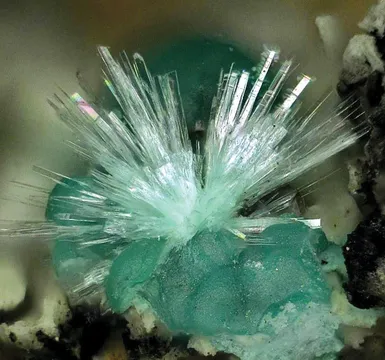
Beyond gold and clinoclase, the Majuba district is exceptional for its secondary copper-arsenate suite. Majuba Hill Mine is the type locality for parnauite, Cu9(AsO4)2(SO4)(OH)10·7H2O, and goudeyite, Cu6Al(AsO4)3(OH)8·3H2O, both described from the middle adit. Parnauite occurs as pale-blue fans and rosettes of lath-like crystals, green scales and crusts, and drusy coatings; goudeyite forms yellow-green hairlike crystals and fracture coatings. Important associated species documented from the mine include olivenite, cornwallite, cornubite, strashimirite, arthurite, scorodite, pharmacosiderite, metazeunerite, chalcophyllite, chalcanthite, chrysocolla, malachite, azurite, brochantite, cuprite, native copper, chalcocite, digenite, chalcopyrite, arsenopyrite, pyrite, cassiterite, fluorite, molybdenite, torbernite, and zeunerite. The strict placer locality is mineralogically far simpler, with native gold the verified collectible species, but the broader Majuba collecting name owes much of its fame to the hard-rock mine’s copper-arsenate diversity.
Majuba gold should be judged first as natural gold, then as Majuba gold. The most desirable pieces are bright, undamaged crystalline nuggets with clear skeletal, hoppered, cubic, octahedral, or spinel-twinned structure; weight alone is not the main value driver here. Rounded nuggets from the same area can be attractive, but without crystal form they are less distinctive. A good label should specify Majuba placer, Rye Patch/Majuba, Antelope district, Pershing County, Nevada; pieces vaguely labeled “Rye Patch” may still be correct, but precise section, claim, or find information adds interest when credible.
There is a documented fraud concern involving Rye Patch/Majuba-type alluvial gold being mounted onto quartz crystals and offered as “crystalline gold on quartz.” The problem is geological as much as aesthetic: much of the Majuba placer gold is alluvial or eluvial in character, and if rounded or placer-textured gold appears unnaturally attached to unrelated quartz, the association deserves skepticism. Collectors should inspect contact points under magnification for glue, solder, pressure marks, or implausible matrix relationships. Natural quartz attachments do occur on some Majuba nuggets, but they should look integral rather than staged.
Clinoclase from Majuba Hill presents a different set of concerns. Because the mine produced many blue-green copper arsenates, old labels are not always reliable. One documented dealer example from the Kay Robertson Collection was sold with a caution that the piece came labeled as Majuba Hill clinoclase but did not resemble typical rich electric-blue Majuba clinoclase in color or habit. Similar confusion can involve cornwallite, cornubite, strashimirite, olivenite, chrysocolla, and mixed copper arsenate crusts. For significant specimens, especially costly blue-green crusts or rare-species labels such as parnauite and goudeyite, analytical confirmation or trusted provenance is valuable.
Condition issues are predictable for both halves of the locality. Gold nuggets may show natural abrasion, flattening, or compression from transport and compaction, which is acceptable and often part of the Majuba look; fresh tool scars, polishing, or cleaned-out cavities are less desirable. Majuba Hill secondary minerals are commonly small, brittle, and fracture-hosted, so edge damage, rubbing on exposed crusts, and powdery limonite matrix loss are common. Many species are arsenates or copper salts and should be handled thoughtfully: avoid licking, sanding, ultrasonic cleaning, acid cleaning, or prolonged soaking. Chalcanthite and other soluble copper sulfate efflorescences, when present, are humidity-sensitive and should be kept dry. Uranium-bearing species such as metazeunerite, torbernite, and zeunerite are documented from the mine, generally in small amounts, so specimens with those labels should be stored and handled according to standard radioactive-mineral practice.
Market availability is split. Majuba/Rye Patch gold continues to appear through natural-gold dealers, detectorists, and older collections, but well-crystallized thumbnails with strong form are scarce and command premiums over ordinary gram-weight nuggets. Majuba Hill clinoclase is available more often than the rare type-locality species, yet truly rich, aesthetic, undamaged plates with saturated blue color are not common and can be expensive. Parnauite and goudeyite are usually micromount or small-cabinet collector species, often valued for locality significance and provenance as much as visual impact.
The Majuba story begins with a single piece of black tin-stone float on the flank of Majuba Mountain. In 1907, A. J. McCauly of Imlay located the Majuba Hill Mine after cassiterite-bearing float drew attention to the hill. What followed was not a gold rush but a strange Nevada copper-tin mine: Mason Valley Mines Company leased the property in 1914, drove more than 1,800 meters of workings through lower, middle, and upper adits, and found that most of the ore worth shipping came from the middle adit. Tin was discovered underground in 1917 during copper exploration, an unusual twist for Nevada, and a few cars of high-grade ore were still shipped by McCauly in 1928 after the first major mining period had ended.
The collector’s Majuba Hill was born deeper inside that industrial story, in the oxidized stopes and fractures around the middle adit. The Copper Stope became a small underground museum of arsenate chemistry: olivenite, clinoclase, cornwallite, strashimirite, scorodite, pharmacosiderite, arthurite, metazeunerite, chalcanthite, chrysocolla, and rarer species formed along fractures down to roughly the middle-adit level. When William S. Wise described parnauite and goudeyite in 1978, the type material was tiny—only a few hundred milligrams of parnauite and a few tens of milligrams of goudeyite—but the discovery fixed Majuba Hill permanently in systematic mineralogy. Parnauite honored John L. “Jack” Parnau of Sunnyvale, California, the collector who first found it; goudeyite honored Hatfield Goudey of San Mateo, a mining geologist, collector, and dealer in microscopic specimens. Both men had spent decades adding quietly to the knowledge of the deposit before their names entered the literature.
The placer story has a different tone: open sky, shallow gravel, dry washers, and the alluvial fans west of Rye Patch Reservoir. The discovery is credited to C. E. Dice in July 1938. The timing mattered: the area had already been known for base-metal and tin deposits, but the shallow placer gold gave the district a new identity. From 1938 through 1941 the placers were worked most heavily, yielding more than 100 ounces a year during that brief period. The old reports emphasized practical details—a gold deposit close to the surface, little overburden, and drywashing methods suited to the desert. That explains the haunting object still photographed in the field: an abandoned dry-sluice machine standing in the Majuba placer area, a relic of the short, intense push to win coarse gold from a dry Nevada fan.
Later detectorists gave Majuba/Rye Patch gold its modern collector reputation. The best pieces are small enough to sit in a thumbnail box but sculptural enough to stop a room: hoppered cubes, compressed octahedra, skeletal ribs, and curved spinel twins with bright yellow luster. One published gallery specimen measures 3.8 x 1.8 x 1.8 cm and is described as an unusually large spinel-twinned gold crystal for the deposit, while another 1.7 x 1.1 x 0.7 cm nugget weighs 27.99 carats, just over 5.5 grams, and shows fluting, indentation, a small quartz inclusion, and a layered base. The best Majuba gold looks as if it traveled just far enough to be sculpted, but not far enough to lose the crystal it once was.