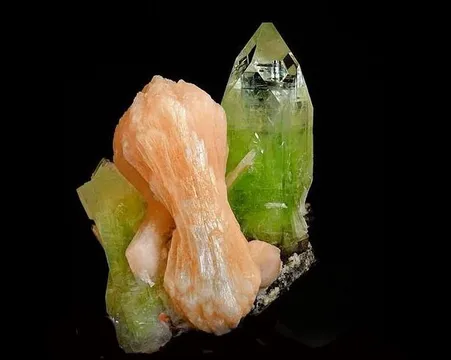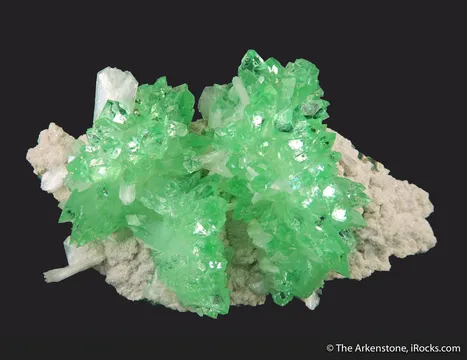
Mahodari quarry, India, a Deccan Trap locality famed for botryoidal fluorite spheres in quartz, yellow to yellow-green translucent balls; prized by collectors.
Key facts
Mahodari quarry, near Sinnar in Maharashtra’s Nashik District, is one of the great oddities of the Deccan Trap collecting province: a basalt aggregate quarry whose most celebrated specimens are not the expected zeolite sprays, but smooth spheroidal fluorites seated in quartz-lined vugs. The quarry lies in the western Deccan flood-basalt terrain, where gas cavities, fractures, and flow-top voids in tholeiitic lava flows were later mineralized by low-temperature fluids. In most Maharashtra quarries the collector’s eye goes first to apophyllite, stilbite, heulandite, scolecite, calcite, and chalcedony; at Mahodari it goes to the “egg-yolk” fluorites — translucent yellow to yellow-green hemispheres and balls, sometimes rusty orange or hematite-red, glowing through their satin skins from nests of drusy quartz, chalcedony, amethyst, and calcite.
Regional View
Country View
The locality’s importance is partly aesthetic and partly mineralogical. Fluorite is common worldwide, but Mahodari’s dominant collector habit is not the usual cube, octahedron, or stepped combination form. Its best pieces are botryoidal, nearly spherical, or hemispherical masses of fluorite, with a soft waxy-to-satin surface and enough translucency that the balls light up when backlit. A fine example has a complete, unabraded dome or sphere; strong contrast against white, gray, or amethystine quartz; and enough matrix to show that the fluorite formed naturally in a basalt cavity rather than as an isolated nodule.

Photo: Wikimedia Commons

Photo: Wikimedia Commons
Historically, Mahodari entered serious international collections through the late 1990s and early 2000s Indian specimen trade, then became fixed in the collector literature through the broader recognition of Deccan Trap minerals. Its name appears in several spellings — Mahodari, Mohadari, Mahadari, and Mahodri — and older labels may say simply “Nasik” or “Nashik.” That label history is not trivial: the Mahodari look is so distinctive that collectors often recognize the locality at a glance, yet exact quarry provenance within the Nashik quarry belt has not always been recorded with modern precision.
Search for specimens: View all specimens from Mahodari quarry, India
Mahodari quarry is in Sinnar taluka, Nashik District, Nashik Division, Maharashtra, west of the Nashik–Pune highway corridor and roughly 27 km from Nashik. It belongs to the larger Nashik system of basalt quarries, a district-scale specimen field in which quarrying for construction aggregate exposes mineralized cavities in the Deccan Trap lavas. The quarry has also appeared on labels as Sinnar quarry, Mahadari quarry, Mohadari quarry, and Mahodri quarry, and the older district spelling “Nasik” remains common on specimen tags.
This is not an ore deposit in the vein-mining sense. The worked rock is basalt, and the listed commodity is aggregate. The specimen minerals occupy open spaces in the volcanic rock: vesicles, amygdales, vugs, fractures, and quartz-lined geodes. The broader Deccan mineralizing model is a multistage cavity system. Early clay and silica-rich linings formed after lava cooling; later burial and circulating fluids deposited zeolites, calcite, and chalcedony; still later hydrothermal episodes produced additional calcite, powellite, apophyllite, and related secondary minerals in some cavities. Mahodari’s fluorite fits into this secondary-cavity world, but in a style that is exceptional for a trap-rock locality.
The productive “ore bodies,” in collector terms, are the cavity zones. Some are thin linings of quartz or chalcedony with small fluorite balls perched on the druse; others are more three-dimensional geodes with calcite crystals, amethystine quartz, or opal coatings. The classic Mahodari fluorite is commonly described from quartz geodes in trap basalt. Yellow and yellow-green are the standard colors, but the most dramatic rarities are hematite-influenced red to rusty orange fluorite spheres. Large, complete balls around 2 to 3 cm are already very desirable; exceptional specimens documented from the locality reach about 5 cm across and command a different level of collector attention.
Mahodari’s specimen production was a by-product of aggregate quarrying, not a purpose-built mineral-specimen mine. Finds were therefore episodic. A bench could produce little of interest, then a blast or fresh quarry face could reveal a pocket of quartz-lined cavities with fluorite, calcite, and associated secondary minerals. Fine pieces from the late 1990s to early 2000s remain the benchmark: complete yellow fluorite balls on quartz; red fluorite on calcite in quartz-lined basalt vugs; and rarer combinations with amethyst.
Collecting access should be treated as private industrial-quarry access. Published map resources caution that locality coordinates are for reference and that no site should be visited without permission from land or mineral-rights holders and proper safety awareness. For most collectors, Mahodari is not a casual field-collecting destination; the practical route is through old collections, established dealers, and carefully documented specimens.
Mahodari fluorite is the mineral that made the quarry famous: translucent yellow, yellow-green, amber, light brown, rusty orange, or hematite-red botryoids, balls, and hemispheres sitting on quartz, chalcedony, calcite, opal-coated matrix, or amethystine quartz. Fine examples commonly show single rounded domes around 1.5–3 cm across, while exceptional spheres reported from classic pieces approach 5 cm; the best have an unbroken satin surface, a warm internal glow when backlit, and a balanced nest of sparkling quartz rather than a crowded or sawn-looking matrix. Red fluorite is much scarcer than yellow and owes its desirability to hematite tinting, especially when the ball is perched on calcite in a quartz-lined geode. Ordinary pieces have incomplete, bruised, dull, or crowded fluorite; great Mahodari fluorite looks almost sculptural, like a natural egg yolk held in a crystalline cup.
Quartz at Mahodari is the architectural mineral of the fluorite specimens, lining basalt cavities as drusy colorless to white crystal crusts, chalcedonic bands, gray-blue microcrystalline coatings, and locally amethystine interiors. It forms the sparkling beds into which the fluorite balls are nested, and in some pieces it also records earlier cavity growth as chalcedony walls or casts after dissolved earlier minerals. The most attractive quartz specimens from Mahodari are not simply quartz plates; they are quartz-lined geodes or three-dimensional cavity sections carrying well-placed fluorite, calcite, amethyst, or opal. Collectors should value clean, undamaged crystal sparkle, intact basalt-rimmed vug form, and natural contrast with the fluorite over sheer size alone.
Mahodari calcite occurs as a companion mineral in the quartz-lined cavities, ranging from yellowish crystals supporting fluorite balls to more sculptural dogtooth and terminated groups in basalt geodes. The most memorable pieces use calcite as a pedestal: a translucent fluorite sphere perched on a pale yellow or brownish calcite crystal inside a quartz or amethyst-lined cavity. Calcite also appears in association records with heulandite subgroup minerals, stilbite-Ca, hematite, and quartz varieties. The best calcite-bearing specimens are those where the calcite is undamaged and compositionally necessary — lifting the fluorite into view or adding a second crystal habit — rather than merely forming broken background material.
Amethyst from Mahodari is best known as a rarer quartz variety in combination with the quarry’s spheroidal fluorite, not as large standalone amethyst crystals. It lines basalt geodes and cavity walls as pale to richer purple quartz points, sometimes with chalcedony bands and white microcrystalline quartz growths. The coveted combination is a yellow, amber, or creamy fluorite ball centered in, or perched on, a nest of purple amethystine quartz; pieces with strong purple color, a complete fluorite sphere or hemisphere, and a natural 360-degree presentation are substantially more selective than common white-quartz examples. Labels for amethyst-bearing material deserve extra scrutiny because similar-looking Indian spherical fluorites have also been discussed from other areas, but confirmed Mahodari examples are a classic rare combination.
Other documented Mahodari minerals include fluorapophyllite-(K) and broader apophyllite-group material, celadonite, epistilbite, goethite, goosecreekite, gypsum including selenite, gyrolite, hematite, heulandite-subgroup minerals, opal, powellite, scolecite, stilbite-Ca and the stilbite subgroup, and yugawaralite; laumontite, mordenite, and okenite have been listed with uncertainty in some records. Mahodari is not an accepted type locality for a mineral species in the standard records, but it is an important Indian occurrence for rarer Deccan Trap species such as goosecreekite, powellite, and yugawaralite. Mozartite has appeared historically in connection with the locality but is treated as an erroneous literature entry, a useful reminder that unusual Mahodari labels should be checked against current species records.
Mahodari specimens are visually distinctive, but mislabeling is still a real concern. Older labels may use Nasik rather than Nashik, may abbreviate the source to “Nasik quarry,” or may spell the locality as Mohadari, Mahadari, or Mahodri. Those variations can be legitimate historical label forms, but they can also blur the distinction between Mahodari and other Nashik-area quarries. The strongest provenance is a label chain or published/dealer record that names Mahodari or Sinnar specifically.
The most common authenticity issue is not outright fakery but confusion with other Indian botryoidal or spherical cavity minerals. Some gyrolite, thomsonite, okenite, or zeolite specimens from Maharashtra and Madhya Pradesh can fool a casual buyer at a glance. Mahodari fluorite should test as fluorite, not as a zeolite: it is CaF2, harder and denser than most associated zeolites, and commonly sits on microcrystalline quartz, chalcedony, calcite, or amethyst rather than the soft okenite “cottonball” matrix more typical of some other Deccan localities. Rounded fluorite from Mahodari may look almost artificial because of its egg-like form, so locality comparison and basic mineral testing are worthwhile on expensive pieces.
Condition is critical. The satin surfaces show scuffs, pressure marks, and flat bruises readily, especially on prominent domes. Broken basalt rims, chipped quartz druse, and repaired geode sections are also common risks. A naturally flat back is not automatically a defect, but it should be distinguished from aggressive trimming that has removed context. On high-end pieces, examine the contact between fluorite, calcite, and quartz for glue, fills, or suspiciously fresh fractures.
Fluorescence is variable. Some Mahodari fluorite and opal-coated pieces have been reported as fluorescent under long-wave and/or short-wave ultraviolet light, while other specimens show only minor response. Use UV as a supplementary observation, not as a locality proof. Avoid acid cleaning on calcite-bearing specimens, and be cautious with water or ultrasonic cleaning where soft zeolites, opal coatings, clay-filled basalt, or fragile drusy quartz are present.
Market availability is better than for many single-pocket oddities but far worse than for ordinary Indian zeolites. Small yellow fluorite-on-quartz examples continue to circulate; choice complete balls, red hematite-tinted fluorites, amethyst combinations, and sculptural calcite-in-geode pieces are much more selective. Recent public auction records show that top Mahodari fluorites can cross from attractive collector specimens into major-cabinet and institutional-level pricing when size, color, completeness, and presentation all align.
One of Mahodari’s enduring stories is the label trail itself. A single specimen in a modern collection was documented with three older labels, each pointing to the same quarry but each spelling it differently: “Mohadari Quarry, Nasik, India,” “Mahodri Quarry, Nasik, India,” and “Mahodari, Sinnar, Nashik District, Maharashtra, India.” That is exactly the kind of provenance puzzle serious collectors recognize from Indian Deccan Trap material. The specimen itself was a classic: a buff-yellow hemispherical fluorite resting in a cradle of clear quartz backed by basalt. Its paper history captured the transition from broad old trade labels to more precise modern locality language.
Another Mahodari story is the persistent question that follows the best fluorites: why here, and why like this? Dealers, collectors, and curators have handled fluorite from thousands of localities, yet Mahodari’s smooth spheroids remain immediately recognizable. They are not ordinary cubes rounded by wear, and they are not quartz-coated zeolite balls. They formed in basalt cavities, in a province better known for zeolites, and they look less like conventional fluorite crystals than like translucent drops that froze on the wall of a geode. Collectors have repeatedly described them as “egg yolks,” and the nickname has stuck because it is visually exact.
A major public benchmark arrived with a large red fluorite with hematite on calcite from Mahodari, sold by Heritage Auctions on May 16, 2026 for $87,500. The specimen measured 18.7 x 12.2 x 6.0 cm and carried several textbook fluorite botryoids up to about 3.5 cm in diameter, set atop terminated calcite within a quartz-lined vug. The description noted that only a very small percentage of Mahodari fluorites are hematite-red, and fewer still combine that color with such size and aesthetics. That sale did more than set a price point; it confirmed what advanced collectors already knew, that the finest Mahodari pieces are not curiosities but world-class fluorite specimens.
The amethyst combinations tell a quieter but equally compelling story. A specimen from the Marty Zinn collection, photographed by Rob Lavinsky and preserved on Wikimedia Commons, shows a small basalt geode lined with amethyst and gray chalcedony, holding a calcite crystal on which a pale fluorite sphere formed. Other documented examples place yellow or amber fluorite balls in purple amethyst nests. The contrast is the attraction: not a large amethyst geode, not a large fluorite cube, but a tiny geological theater in which several stages of cavity filling are visible at once.