A collector's guide to Lowell (Eden Mills), USA: its geology, mining history and notable minerals, illustrated with the 38 specimens documented from this locality on EarthWonders.
Key facts
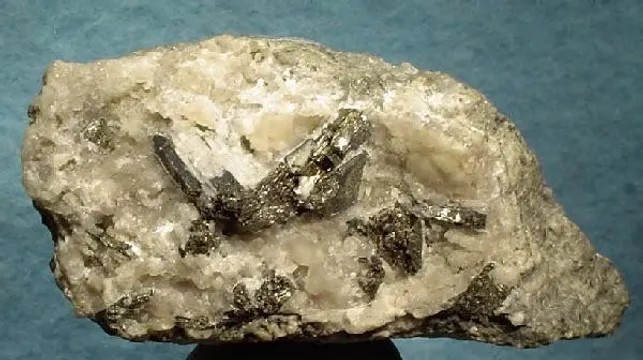
Lowell (Eden Mills) is the collector’s name for the Belvidere Mountain quarries of northern Vermont, a large chrysotile-asbestos mining district straddling the towns of Lowell in Orleans County and Eden in Lamoille County. The historic labels are famously messy—“Eden Mills,” “Lowell quarry,” “Ruberoid mine,” “VAG mine,” “Vermont Asbestos Group mine,” and “Belvidere Mountain quarries” all appear in collections—but the specimens most collectors mean are the classic calc-silicate and rodingite minerals exposed during asbestos quarrying on Belvidere Mountain.
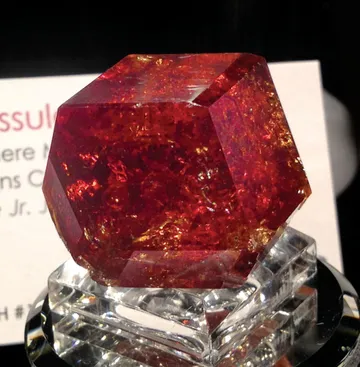
The locality matters far beyond its asbestos history. It is one of the great American grossular localities: orange to reddish-brown, lustrous, transparent to translucent dodecahedral grossular crystals, commonly perched on gray-green to pale green diopside, with accessory vesuvianite, epidote, clinozoisite, calcite, and serpentine minerals. The best pieces have a look that is instantly recognizable—warm cinnamon-orange garnets sparkling against cool green pyroxene, often in compact thumbnails and miniatures rather than grand cabinet plates. A truly fine Lowell/Eden Mills grossular is not merely “a Vermont garnet”; it is a signature New England specimen.
Geologically, the specimens come from a serpentinized ultramafic body within the northern Appalachian ophiolite belt. The mine’s commercial ore was chrysotile developed in fractured dunite and peridotite altered to serpentinite, but the collector minerals formed in calcium-rich blocks and rodingitic zones caught within and adjacent to the ultramafic mass. That odd marriage—serpentine asbestos ore plus metasomatized calcium-rich inclusions—gave collectors the combination of grossular, diopside, vesuvianite, clinozoisite, epidote, zoisite, titanite, fluorapatite, graphite, and rarer chromium-bearing species.
Regional View
Country View
The mine’s fame among collectors was built during active quarrying, when blasting and stripping continually exposed fresh pockets, cavities, and calcite-sealed zones. Many significant pieces entered private collections through local and regional collectors, and a number of important examples passed through the hands of Bob Whitmore, Clement Mason, Ken Hollman, Bill Pinch, and other New England specialists. By the time the asbestos operation finally closed in 1993, Lowell/Eden Mills had become a classic closed locality: the good material was already finite, the best finds were in old collections, and the mine site itself had become a hazardous, restricted industrial landscape rather than a field-collecting destination.

Photo: Wikimedia Commons

Photo: Wikimedia Commons
Search for specimens: View all specimens from Lowell (Eden Mills), USA
The collecting locality is the Belvidere Mountain quarry complex, historically worked for chrysotile asbestos in a serpentinized ultramafic body on the Eden–Lowell line in northern Vermont. The principal quarry names are the Eden quarry, the Lowell quarry, and the C-area quarry. The Eden quarry lies on the southeast side of Belvidere Mountain; the Lowell and C-area workings were the later, larger producers on the Lowell side. Older mineral labels may use “Eden Mills” because that village was the familiar approach point and nearest named settlement to many collectors, but the locality is not a village occurrence in the ordinary sense—it is the quarry system on Belvidere Mountain.
The deposit is an asbestos-bearing serpentinite developed from dunite and peridotite. In the commercial ore zones, chrysotile formed in fractures during serpentinization of ultramafic rock; antigorite, lizardite, brucite, magnetite, chromite, talc, magnesite, dolomite, calcite, and related alteration minerals belong to that ultramafic-serpentine assemblage. The collector silicates for which the locality is famous are tied to calcium-rich metasomatic rocks: rodingite and metamorphosed carbonate or calcareous blocks within the ultramafic complex. These zones produced grossular, diopside, vesuvianite, clinozoisite, epidote, zoisite, titanite, fluorapatite, graphite, and related species. Late hydrothermal activity added cavity-fill minerals such as albite, prehnite, stilbite-group zeolites, artinite, and some calcite and clinozoisite, while copper- and nickel-bearing late fluids account for sulfides and unusual species such as heazlewoodite, bornite, chalcopyrite, chalcocite, pyrite, and gersdorffite reported from the district.
The ore history begins with late nineteenth-century prospecting and early twentieth-century open-cut asbestos work on Belvidere Mountain. Judge Melvin E. Tucker of Hyde Park is credited in the literature with a significant 1899 asbestos discovery on the east side of the mountain; other early discoveries on the Eden side followed quickly. Several companies explored or worked the ground in the early years, including the Tucker Asbestos Company, New England Asbestos Mining and Milling Company, United States Asbestos Company, National Mining and Development Company, and Lamoille Asbestos Company. Early attempts were intermittent and difficult, but commercial production became more substantial in the 1930s when Vermont Asbestos Corporation and then Ruberoid developed the operation. Ruberoid later became associated with GAF, and in 1975 the mine was sold to employees, who operated it as the Vermont Asbestos Group until closure in 1993.
By the late 1950s and 1960s the Lowell and C-area quarries were operating as major open-pit asbestos producers. Bureau of Mines data for the Ruberoid operation described roughly 3,500 tons of ore processed per three-shift day and about 40,000 tons of chrysotile fiber annually, representing nearly all U.S. asbestos-fiber production at that time. The quarries produced low-percentage chrysotile ore by blasting, hauling, crushing, drying, and milling, but collectors benefited from the same large-scale rock exposure. Fresh quarry faces and calcite-filled cavities revealed the pockets that supplied the celebrated grossular-diopside specimens.
Specimen production was uneven. The largest quarry levels at the north end of the excavations, especially in the Lowell quarry area, produced much of the known collector material, though exceptional pieces also came from the southern quarry area in Eden. Old-time finds include calcite-encased crystals freed by preparation, compact vugs of orange grossular on diopside, pale to green diopside crystal groups, vesuvianite and epidote associations, and rarer pseudomorphs of grossular after epidote. A number of the best examples were self-collected during the mine’s operating years, and their old labels—sometimes vague, sometimes contradictory—are now part of the locality’s charm and its authentication challenge.
Collecting access today should be regarded as closed. The former Vermont Asbestos Group mine is a hazardous asbestos site with restricted access, eroding tailings, contaminated waste rock, and ongoing environmental concerns affecting the Hutchins Brook, Burgess Branch, Lamoille River, and Missisquoi River watersheds. Serious collectors should acquire Lowell/Eden Mills material through old collections, reputable dealers, documented estate dispersals, and well-labeled institutional deaccessions, not through unauthorized field entry.
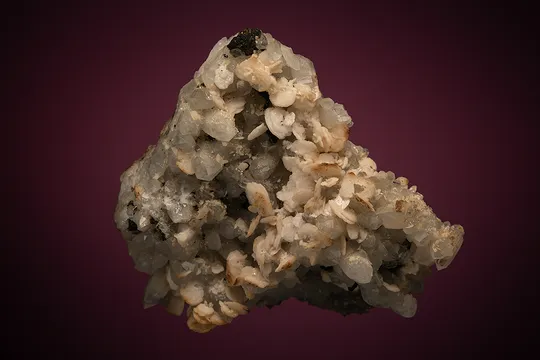
Grossular is the defining collector mineral of Lowell/Eden Mills, occurring as lustrous dodecahedra and modified dodecahedra in the classic hessonite color range: straw, honey, cinnamon-orange, burnt orange, reddish brown, and locally green to chromium-bearing green. Most showy crystals are small, commonly a few millimeters across, but verified specimens include crystals around 5–8 mm, 1 cm crystals, and exceptional larger crystals reported up to roughly 1.8 cm on notable old pieces. The most desirable specimens place gemmy orange grossular crystals on contrasting pale to gray-green diopside, especially when the garnets sit proud, are complete, glassy, and damage-free; lesser pieces may be rich but dull, crowded, chipped, embedded in calcite, or visually lost in granular rodingite. Scientific study of Eden Mills grossular has also made the locality important beyond aesthetics: nearly end-member orange grossular from rodingite cavities was used in work on optically anisotropic garnet, sector twinning, growth steps, hydrous components, and subtle departures from expected cubic optical behavior.
“Garnet” on Lowell/Eden Mills labels usually means grossular unless a more specific species has been confirmed, but the locality’s garnet story is broader: grossular var. hessonite is the classic, green chromium-bearing grossular and reported uvarovite reflect the chromium-rich ultramafic setting, and almandine is also listed from the Belvidere Mountain quarries. The collector-grade garnets are chiefly the calcium garnets formed in rodingitic and calcareous blocks, with dodecahedral orange grossular crystals on diopside forming the market standard. Good pieces are separated from ordinary ones by sharp faces, transparency, warm saturated color, isolation of the crystals, strong contrast against diopside or calcite, and reliable old provenance; vague “Eden Mills garnet” specimens that are massive, abraded, or unanalysed green microcrystalline material deserve more caution, particularly where uvarovite, chrome-bearing grossular, and green grossular have been used inconsistently on labels.
Diopside at Lowell/Eden Mills is not just a matrix mineral; it is the visual foil that makes the best garnets sing. It occurs as pale green, gray-green, brownish-green, colorless to whitish, and locally bright chromium-bearing green crystals, commonly prismatic and sometimes translucent to glassy. Many classic specimens show orange grossular perched on diopside crystals, but diopside-only pieces and diopside with epidote, vesuvianite, calcite, or grossular are also known. Crystals of a few millimeters are common on combination pieces; attractive miniature groups, fan-like aggregates, and larger individual crystals around 2 cm have been documented from old collections and are large for the locality. The best diopside specimens show clean prismatic form, intact terminations, translucency, strong green color or elegant pale glassiness, and, when present, well-positioned grossular accents; ordinary pieces are more massive, contacted, calcite-coated, or hard to distinguish visually from vesuvianite without crystallographic or analytical support.
Other documented minerals from the Belvidere Mountain quarries include vesuvianite, clinozoisite, epidote, zoisite, titanite, fluorapatite, calcite, dolomite, prehnite, albite, stilbite-group minerals, quartz, clinochlore, chamosite, phlogopite, muscovite, tremolite, actinolite, anthophyllite, edenite, pargasite, antigorite, chrysotile, lizardite, brucite, magnetite, chromite, magnesiochromite, forsterite, talc, magnesite, artinite, hydrotalcite, pyroaurite, heazlewoodite, bornite, chalcopyrite, chalcocite, pyrite, native copper, malachite, rutile, zircon, graphite, allanite-(Ce), axinite-(Fe), xonotlite, and others. The most important rarities for collectors include green chromium-related garnets, chromium-bearing diopside, fine clinozoisite, vesuvianite and epidote crystal specimens, and the distinctive grossular-after-epidote pseudomorphs that are much scarcer than the standard orange grossular on diopside.
The first collector issue is locality nomenclature. “Eden Mills” is the traditional collector name, but many specimens actually came from quarry areas on the Lowell side of Belvidere Mountain; “Lowell quarry,” “Eden quarry,” “C-area,” “Ruberoid,” “VAG mine,” and “Belvidere Mountain quarries” can all be legitimate depending on the specimen’s original label. The safest modern label is “Belvidere Mountain quarries, Lowell & Eden, Orleans & Lamoille Counties, Vermont, USA,” with “Eden Mills” retained in parentheses if it appears on an old label or if the market context requires it.
Mislabelling is common in three predictable ways. First, orange “garnet” should usually be grossular var. hessonite, not a generic almandine-style Vermont garnet. Second, green garnet from this ultramafic environment may be grossular, chrome-bearing grossular, or uvarovite, and visual identification alone is not enough for confident species-level labels on small green crystals. Third, diopside, vesuvianite, epidote, and clinozoisite can be confused on busy calc-silicate specimens, especially where crystals are pale, partly coated, broken, or overgrown. One specific label problem seen on market specimens is the description of some grossular pseudomorphs as “after diopside” when the form and documented pocket history indicate grossular after epidote, with later diopside grown on the replacement.
No robust pattern of manufactured fakes or routine treatments is documented for Lowell/Eden Mills grossular, but preparation matters. Some important pieces were originally locked in calcite and later exposed by trimming, mechanical preparation, or acid removal of calcite. Such preparation is normal for the locality, but over-etched surfaces, loosened crystals, dull acid-burned luster, and hidden repaired contacts should be checked carefully. The best grossular crystals are glassy and crisp; tiny chips on exposed dodecahedral corners are common and materially affect value because most crystals are small enough that a single bruised edge is conspicuous under magnification.
Health and handling considerations are unusually important here. The locality is an asbestos mine, and specimens may carry chrysotile, fibrous serpentine, amphibole asbestos, or dusty tailings matrix. Display-quality grossular-diopside specimens on tight crystalline matrix are generally stable when handled sensibly, but friable serpentine, loose fibrous coatings, sawed tailings pieces, or any dusty asbestos-bearing material should not be abraded, air-blasted, cut, ground, brushed aggressively, or cleaned dry. Store suspect fibrous specimens in closed boxes, avoid producing dust, and keep labels that warn future owners of possible asbestos content.
Market availability is limited but steady because old New England collections continue to disperse. Small thumbnails with one sharp orange grossular on diopside appear occasionally; rich miniatures with multiple clean, bright crystals are scarcer; large, damage-free, aesthetic cabinet specimens are genuinely rare. Provenance to known collectors such as Bob Whitmore, Clement Mason, Ken Hollman, Bill Pinch, Harvard-associated material, or documented old dealer labels adds weight, especially where the specimen has the classic color contrast and sharp dodecahedral habit. The finest examples compete less as “regional minerals” than as top-tier American garnet specimens.
The old approach to the quarries had drama before a collector ever opened a box of specimens. Sue Hadden’s 1996 description begins with the road north in Vermont: just beyond the Eden Mills general store, a narrow paved road follows the left fork, climbs gently for about 3.5 miles toward Lowell, passes farmland and a beaver pond, and then the quarries come suddenly into view. The effect, in her telling, was a short intake of breath: rural Vermont interrupted by the gray amphitheater of open-pit asbestos workings cut into 3,353-foot Belvidere Mountain. That contrast—pasture, pond, wooded ridges, then a raw industrial mountain—has always been part of the locality’s atmosphere.
The commercial story starts with the stubbornness of early prospectors. Judge Melvin E. Tucker of Hyde Park, a man with lumber interests in the region, undertook serious prospecting and found asbestos on the east side of Belvidere Mountain on November 9, 1899. Working as the Tucker Asbestos Company, he opened prospects in 1900 that developed into the Lowell quarry. Around the same time, B. B. Black found asbestos on the southeast side of the mountain, where the New England Mining and Milling Company developed what became the Eden quarry. These were open cuts on steep serpentinite outcrops, and the early companies were chasing different fiber habits: the Tucker ground in Lowell was richer in cross-fiber asbestos, while the Eden-side prospects were dominated more by slip-fiber asbestos.
One of the most evocative mining images from the district is not a garnet at all but an aerial tramway. A vintage photograph from about 1946 shows a cabled system carrying containers of asbestos ore from a developing quarry on the Lowell side of Belvidere Mountain to a mill on the Eden side. Before Ruberoid built a newer mill closer to the Lowell quarry, the operation literally slung its ore across the mountain landscape. For collectors, that old tramway helps explain the mixed locality labels: the rock, the mills, the roads, the workforce, and the specimens crossed the Eden–Lowell boundary long before careful mineral labels tried to pin them down.
The Bob Whitmore story is one every serious collector of Lowell/Eden Mills material should know. One small-cabinet grossular-and-diopside specimen, later photographed and widely circulated, had been self-collected by Whitmore in 1978. For roughly thirty years it remained in his collection with the crystals not fully exposed from overlying calcite. Once acquired and properly prepared, the piece revealed robust, complete crystals of a habit that Whitmore and later observers considered exceptional. Whitmore reportedly thought it should have gone into the celebrated American Mineral Treasures display but had simply been missed. That is the kind of locality this was: important specimens could sit half-hidden in calcite for decades, their quality dependent on the collector’s eye, patience, and restraint.
Another memorable specimen shows the locality’s stranger side: a 7.4 x 7.1 x 4.2 cm cluster in which grossular completely replaced a former epidote crystal group, including a doubly terminated crystal about 7 cm long, with later diopside crystals grown on the replacement. It was encased in calcite and dissolved out by collector Ken Hollman. That sequence—epidote first, grossular replacement, later diopside, then calcite sealing and eventual preparation—reads almost like a mineralogical palimpsest. It also explains why quick labels can fail here. A casual glance might call such a specimen grossular on diopside; a better reading sees a much more complex replacement history.
The mine’s final human chapters are less romantic. At its height the operation ran around the clock and was remembered locally as the place with good wages and steady work. Howard Manosh, the last operator and current owner associated with the Vermont Asbestos Group, recalled that the mine employed 325 people and ran 364 days a year; “The only day they closed it was Christmas day.” In 1975, when outside ownership no longer wanted to carry the costs of changing safety requirements, employees bought the mine and kept it alive as the Vermont Asbestos Group. That employee ownership is part of the locality’s identity just as much as the garnets are.
After the 1993 closure, the mine became a public environmental problem. More than 250 people packed the Eden Elementary School gym at a 2009 meeting about the asbestos site, with state and federal officials facing residents who distrusted both the science and the proposed remedies. Leslie White, one of the local voices, cut through the tension with the phrase, “something’s wrong here.” Another story from the cleanup era began with a photograph of a brook trout lying on a bed of glittering tailings; wetlands ecologist Shannon Morrison remembered first wondering whether it was “a mafia warning” because the image was so bizarre. When regulators visited the downstream wetland, they found asbestos-laden sediment so pervasive that one official remembered fibers hanging from trees. For collectors, these episodes are a sobering reminder that the same industrial excavation that revealed world-class grossular also left a landscape that should not be treated as a collecting playground.