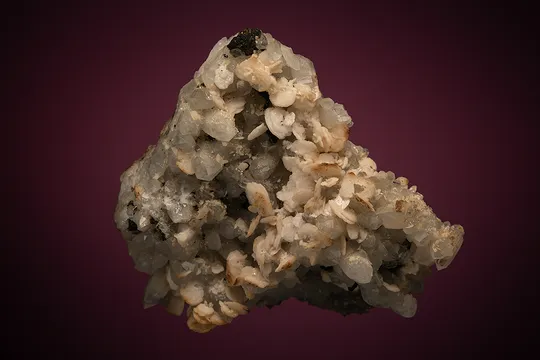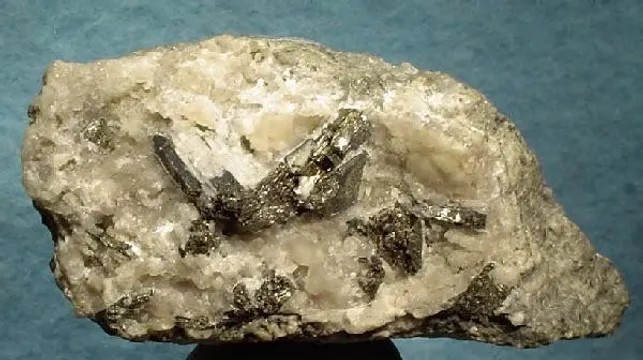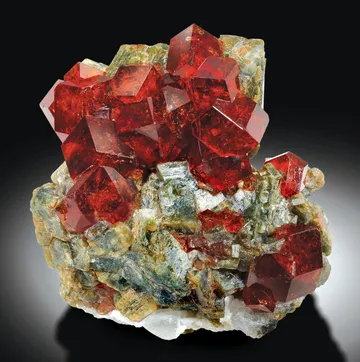
Belvidere Mountain Quarries, USA — famed for orange grossular in rodingite pockets with diopside and vesuvianite; a classic Vermont locality for collectors.
Key facts
Belvidere Mountain is one of the great paradoxes in American mineral collecting: an asbestos mine whose industrial importance came from chrysotile in serpentinized ultramafic rock, but whose enduring collector fame rests on small, jewel-like calc-silicate pockets in rodingite. The quarries lie on the Eden–Lowell line in northern Vermont, in an ultramafic body of the northern Appalachian ophiolite belt. Within and along the serpentinite, altered mafic blocks and contact zones produced rodingite assemblages dominated by grossular, diopside, vesuvianite, clinozoisite-epidote minerals, calcite, and related species. Those pockets made Belvidere a classic U.S. locality, especially for orange to reddish-brown grossular garnets perched on gray-green diopside or green vesuvianite.
The best Belvidere specimens have a distinctive look that serious collectors recognize immediately: sharp dodecahedral grossular, often cinnamon-orange to burnt orange, with a wet glassy luster and flashes of internal fire, set against pale green, olive, gray-green, or whitish bladed diopside and vesuvianite. Good pieces are rarely large by international cabinet standards, but they are intensely sculptural; a single 5–10 mm garnet, if undamaged and perfectly placed on contrasting rodingite matrix, can be a first-rate thumbnail. Larger plates with many bright grossulars, or pseudomorphic clusters preserving epidote-like forms, are among the locality’s most admired specimens.
Regional View
Country View
Historically the quarries were also among the defining industrial-mineral sites of Vermont. Chrysotile asbestos was known from Belvidere Mountain by the early nineteenth century, but large-scale open-pit production developed in the twentieth century, especially under Ruberoid, GAF, and later Vermont Asbestos Group. For a time the Eden–Lowell operation was the dominant American source of chrysotile. Mineral collectors, however, remember the mine less for its ore than for the garnets and associated calc-silicates saved from blasted quarry rock, old waste piles, pockets, and the collections of miners, superintendents, and visiting collectors who knew where the rodingite seams appeared.
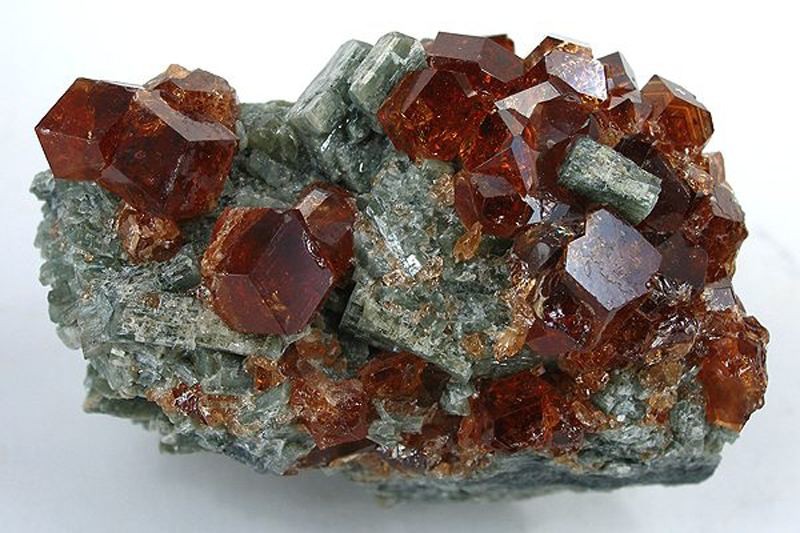
Photo: Wikimedia Commons / Robert M. Lavinsky

Search for specimens: View all specimens from Belvidere Mountain Quarries, USA
Belvidere Mountain Quarries is the collector name for the quarry complex historically known under several mine names, including the Vermont Asbestos Group Mine, VAG Mine, Lowell Mine, Ruberoid Asbestos Mine, and the often-used but technically imprecise “Eden Mills” locality name. The site straddles the towns of Lowell in Orleans County and Eden in Lamoille County. Older labels may say Eden Mills because that village is the last community on the traditional approach road, not because “Eden Mills Quarry” was a formal quarry name.
Geologically, the quarries expose a serpentinized ultramafic complex consisting chiefly of dunite and peridotite altered to serpentinite, with associated talc-carbonate rock, steatite, magnetite, chromite, brucite, carbonate, and chrysotile veins. The surrounding country rocks are metamorphosed sedimentary and volcanic units of the northern Green Mountains, including schist, gneiss, quartzite, and amphibolite. The asbestos ore was the fibrous chrysotile that formed in fractures and shear surfaces during serpentinization. The specimen-producing zones were not the asbestos seams themselves, but rodingite and contact rocks where calcium-rich metasomatism created garnet, diopside, vesuvianite, clinozoisite, epidote, titanite, calcite, and related minerals.
The quarry complex is usually described in terms of three main working areas: the Eden quarry on the southeast side of Belvidere Mountain, the Lowell quarry near the mine and mill area on the eastern side, and the C-Area quarry south to southwest of the Lowell workings. The older Gallagher pit, an early source of asbestos production, was later absorbed into the expanding Lowell quarry area. The Lowell and C-Area workings yielded much of the high-grade chrysotile ore, while rodingite seams and pockets in and around the serpentinite contacts supplied the famous collector specimens.
The ultramafic body is not a simple homogeneous block. It is a folded, lens-like mass with relatively fresh dunite and peridotite in central portions, zones of massive serpentinite, and schistose serpentinite concentrated along margins and shear zones. Small pods and lenses occur near the margins of the larger bodies. This structure is important for collectors because the best calc-silicate pockets developed where altered mafic or carbonate-rich material interacted with the serpentinite system, particularly along fractured and sheared zones and near contacts with amphibolite. Rodingite vugs at Belvidere are reported to have reached several inches across, and even small cavities could carry bright garnet on diopside, vesuvianite, calcite, or clinozoisite.
Asbestos was recognized on Belvidere Mountain long before modern quarrying. Commercial-scale efforts began around the turn of the twentieth century, with companies such as Lowell Lumber & Asbestos and New England Asbestos Mining and Milling developing prospects. The Eden quarry opened early, and the Lowell workings expanded later; by the 1930s and 1940s the operation had become a major national industrial site. Ruberoid acquired the mine in 1936 and developed the first truly modern, large-scale open-pit asbestos operation there. Ruberoid later became part of GAF, and after GAF moved toward closure in the 1970s, employees organized Vermont Asbestos Group and kept the mine alive for roughly two more decades.
By the late 1950s the operation was processing roughly 3,500 tons of ore per three-shift day and producing about 40,000 tons of chrysotile fiber annually, accounting for nearly all domestic U.S. asbestos fiber production at that time. Later production figures and regulatory records describe a large mill, a substantial annual fiber output, and a mine that remained economically important to northern Vermont into the late twentieth century. Active mining ceased around the early 1990s, and the mine closed as a major industrial operation in 1993, leaving behind large open pits, mill remains, waste rock, and asbestos-bearing tailings.
The finest specimen finds came during the long working life of the quarries, when miners, superintendents, and visiting collectors could see fresh rodingite seams exposed by blasting. Important old-time pieces are associated with names such as Clement Mason, Ken Hollman, Bob Whitmore, Ed David, Marty Zinn, Dick Jones, and other New England collectors whose specimens later passed into museum and private collections. A portion of Mason’s collection went to the Harvard Mineralogical Museum in the 1980s and helped expand the documented mineral list for the locality. Bob Whitmore’s self-collected Belvidere specimens, particularly from late twentieth-century collecting, are especially respected for their aesthetics and provenance.
Collecting access has changed completely. Belvidere Mountain is not a modern fee-dig or casual rockhounding locality. The mine is a closed asbestos site with environmental and health concerns, and collectors should treat the quarry complex as closed unless they have explicit, current, lawful permission from the property owner and relevant authorities. Old stock specimens are therefore the normal way to acquire Belvidere material. For serious collectors, labels, provenance, and the distinction between true Belvidere Mountain material and loosely labeled “Eden Mills” pieces matter greatly.
Grossular is the signature collector mineral of Belvidere Mountain and the reason the locality is known far beyond New England. The classic crystals are sharp dodecahedra, commonly 3–10 mm and exceptionally larger, with reported individual crystals up to about 2 cm and occasional larger-than-normal examples exceeding that; the most prized color is transparent to gemmy cinnamon, orange, reddish orange, or reddish brown, though pale green to apple-green chromian grossular is also known and has sometimes been mislabeled as uvarovite. Belvidere grossular occurs in rodingite pockets and seams with gray-green to whitish diopside, green vesuvianite, calcite, clinozoisite-epidote minerals, dolomite, prehnite, and minor accessory species. Fine pieces are judged by luster, transparency, undamaged dodecahedral form, strong orange internal glow, and isolation on contrasting matrix; ordinary pieces tend to be darker, more crowded, partly contacted, or embedded in massive rodingite without the crisp three-dimensional presentation that makes the locality’s best thumbnails and miniatures so desirable.
Diopside at Belvidere is both a collector mineral in its own right and the classic stage on which the garnets sit. It occurs as pale to gray-green, olive-green, whitish, and locally bright chromium-bearing green prismatic or bladed crystals, commonly in parallel-growth groups and intergrown fans lining rodingite openings. Good diopside specimens show clean terminations, open bladed architecture, and contrast with orange grossular or green vesuvianite; the best combination pieces may have a single gem dodecahedral garnet perched on lustrous diopside blades, while less desirable examples are massive, bruised, or so mossy with small garnets that the crystal form is lost. Chromium-bearing diopside is a notable Belvidere variant, especially where small vivid green crystals appear with chrome-rich garnet in the VAG quarry material, but most market specimens are valued for the pale green to gray-green bladed matrix associated with grossular.
On Belvidere labels, “garnet” nearly always refers to the calcium-garnet suite for which the quarries are famous: grossular, hessonite-colored grossular, and green chromian grossular from rodingite rather than the common almandine of regional schists. The collector form is overwhelmingly dodecahedral, from tiny microcrystals to sharp crystals around a centimeter and, rarely, larger; colors range from honey, straw, cinnamon, peach-orange, reddish brown, and green. The finest garnet specimens from Belvidere are not merely rich plates but sharply composed combinations, with transparent orange dodecahedra standing proud on diopside, vesuvianite, calcite, or replaced epidote forms. Generic “garnet” labels should be handled cautiously: attractive orange material is usually grossular or hessonite-variety grossular, while old “uvarovite” labels for green garnet require analytical caution and are more safely treated as chromian grossular unless verified.
Vesuvianite is one of the key rodingite minerals at Belvidere and forms green to yellow-green crystals and crystalline matrix with grossular, diopside, calcite, talc, clinochlore, and serpentinite. In the best specimens it gives the locality’s orange garnets a cool green, lustrous ground, producing the classic Belvidere color contrast: gemmy burnt-orange grossular scattered over green vesuvianite or mixed with diopside. Vesuvianite-only pieces are less common on the market than grossular combinations, but well-crystallized, bright, undamaged examples are important New England classics in their own right. Good pieces show visible crystal faces, fresh green color, and aesthetic association with garnet; ordinary examples are granular, massive, or so subordinate that vesuvianite is merely the matrix name on a grossular specimen.
Hessonite from Belvidere is best understood as the cinnamon to reddish-orange variety of grossular that gave the locality much of its specimen fame. It occurs as sharp, lustrous dodecahedral crystals in rodingite, typically a few millimeters to around a centimeter on good thumbnails and miniatures, with exceptional reported crystals larger. The classic association is hessonite on gray-green to olive diopside, sometimes with vesuvianite or calcite, and the most desirable pieces have transparent orange crystals that stand out individually rather than merging into dark, crowded crusts. High-end Belvidere hessonite is about proportion and placement: a clean garnet centered on bladed diopside, a pair of perfect crystals on a small matrix, or a bright plate where every crystal is undamaged and catches light. Dark brown, chipped, or heavily contacted crystals are much more common than the fiery, glassy pieces that made the old “Eden Mills” name famous.
Epidote and epidote-group minerals at Belvidere occur in the rodingite assemblage with grossular, diopside, calcite, chlorite-group minerals, and related calc-silicates, but the locality is especially notable for pieces in which grossular preserves former epidote crystal forms. Some of the most memorable Belvidere specimens are pseudomorphic clusters: blocky to prismatic, three-dimensional forms of former epidote partly or completely replaced by grossular, with later diopside crystals grown on the surface or between the replaced crystals. Documented examples include small-cabinet pieces several centimeters across and clusters preserving long, doubly terminated epidote-like forms. The best epidote-related specimens are valued for recognizable crystal morphology, complete terminations, later diopside accents, and the unusual replacement story; plain massive epidote or dark, broken pseudomorphs are far less appealing.
Belvidere’s full mineral list is much broader than the display minerals above. Documented species include antigorite, chrysotile, lizardite, clinochrysotile, clinozoisite, zoisite, prehnite, xonotlite, titanite, fluorapatite, albite, microcline, phlogopite, clinochlore, leuchtenbergite, talc, brucite, magnetite, chromite, magnesiochromite, ilmenite, rutile, graphite, heazlewoodite, pyrite, chalcopyrite, bornite, chalcocite, native copper, malachite, artinite, pyroaurite, hydrotalcite, magnesite, dolomite, siderite, calcite, quartz, and several amphiboles. Clinozoisite is an especially important Belvidere species, with striated green to yellow-green crystals known from the rodingite vugs. Heazlewoodite, pyroaurite, xonotlite, ferro-axinite, aragonite, native copper, and the amphibole suite are of special interest to systematic collectors. Despite the tempting name, edenite is not named for Eden, Vermont, and no accepted mineral species is generally treated as having Belvidere Mountain as its type locality; the locality’s mineralogical importance rests instead on outstanding examples of established species and on its value as a well-studied serpentinite-rodingite system.
The most common authenticity issue for Belvidere specimens is locality labeling rather than outright fakery. Old labels may read “Eden Mills,” “Lowell,” “Ruberoid Mine,” “VAG Mine,” “Vermont Asbestos Group,” or “Belvidere Mountain.” These can all refer to the same broad quarry complex, but better labels specify Belvidere Mountain Quarries, Lowell & Eden, Orleans & Lamoille counties, Vermont. Be wary of labels that imply a formal “Eden Mills Quarry,” and be aware that the exact quarry—Eden, Lowell, C-Area, or old Gallagher area—is often unknown unless the piece has excellent provenance.
Green garnets require special caution. Old “uvarovite” labels are part of the locality’s history, but many green Belvidere garnets are better regarded as chromian grossular unless chemically confirmed. Likewise, “hessonite” is a variety name for the orange to cinnamon grossular, not a separate species. Generic “garnet” labels on orange Belvidere pieces should usually be read as grossular unless a different garnet species has been analyzed.
Condition is a major value driver. Belvidere garnets are often small but sharply exposed, so even tiny cleaves on the front crystal can be obvious. Look carefully for chipped dodecahedral faces, contacted edge crystals, broken diopside blades, repaired matrix, and acid-cleaning residues in calcite-bearing pockets. Some specimens were legitimately prepared by dissolving enclosing calcite to expose the rodingite crystals; this is not automatically a defect, but over-etched or chalky pieces lose much of the snap that collectors want. The best pieces have undamaged, transparent garnets standing proud of the matrix with visible separation between crystals.
Handling considerations are real because this is an asbestos mine locality. Many Belvidere display specimens are compact calc-silicate pieces and are not friable asbestos ore, but labels and matrices should be examined with care. Avoid trimming, sawing, grinding, air-abrasion, or ultrasonic cleaning of serpentinite-rich or fibrous material. Store any specimen with visible chrysotile or fibrous amphibole in a closed box, do not blow dust from it, and avoid handling friable matrix over living or work spaces. For cabinet specimens, a clear acrylic perky box or sealed display mount is often wise.
Market availability is finite but not vanishing. Belvidere grossular on diopside or vesuvianite appears regularly enough from old collections, dealer inventories, and auctions, but truly fine pieces—sharp, gemmy, orange, damage-free, and well composed—are much scarcer than casual listings suggest. Provenance to recognized New England collectors or older mine-era collections adds real value. Good thumbnails are often more satisfying than mediocre cabinet specimens because the locality’s strength is crystal quality and composition rather than sheer size.
In the old mining days, Belvidere Mountain was not just a mineral locality; it was the economic engine of Eden and Lowell. At night, when the mine was running hard, the open pits, conveyors, crushers, and mill lights made the mountain look industrially alive. Howard Manosh, who later became president of Vermont Asbestos Group, remembered that “the place was lit up like a city.” For local families, the mine was steady work in a rural corner of northern Vermont where steady work was not easy to find. Former residents remembered fathers, uncles, neighbors, and immigrants from Canada tied to the operation, and by the 1970s it employed hundreds of people in a region where a job at the mine could support a household.
The most extraordinary turn in the mine’s history came when the workers themselves tried to save it. In the mid-1970s, as asbestos regulation tightened and GAF prepared to shut the operation, miners organized Vermont Asbestos Group and bought the mine. The purchase has been described as one of the notable employee-owned industrial efforts of its kind in the United States. They were not saving a hobby locality; they were trying to preserve the largest employer in the area. Millions of dollars were raised, much of it needed for dust-control and environmental equipment, and the mine continued operating long after many outside observers would have expected it to close.
The collector side of the story has its own cast of characters. Clement Mason, a quarry superintendent and guide for visiting groups, became central to the locality’s mineral history. For years, visiting students and collectors could see the mine and then be invited to Mason’s Hyde Park home to look at specimens. His collection was important enough that part of it was acquired by the Harvard Mineralogical Museum in 1985. Study of that material helped add species such as aragonite, ferro-axinite, and xonotlite to the Belvidere list, a reminder that the scientific record of a locality often depends on the habits of observant field people who saved unusual pieces instead of tossing them onto a dump.
Belvidere’s post-mining story is darker. In 2009, more than 250 people packed the Eden Elementary School gym for a public meeting about the abandoned mine. The mine had closed in 1993, but questions about asbestos-bearing tailings, waterways, wetlands, health studies, and cleanup had not gone away. Residents filled the folding chairs and lined the walls while state and federal officials stood at the front of the room. The atmosphere was raw. Some people were angry that agencies had taken so long to act; others feared that agency attention itself would stigmatize their towns. One resident cut through the room’s tension with a line that became emblematic of the meeting: “Something’s wrong here.”
One of the strangest catalysts for renewed attention was a brook trout. Around 2004, a Vermont wetlands ecologist received a package containing an eight-by-ten photo of a brook trout lying in sparkly asbestos tailings. At first the image seemed almost like a threat, but the note that accompanied it came from a nearby landowner pleading for help. Tailings were washing from the mine and smothering wetlands. When officials visited, they described a “lunar landscape,” with so much material in the wetland that the ecological damage was impossible to ignore. That image—a trout in a bed of mine waste—became one of the sharpest symbols of Belvidere’s transformation from productive quarry to environmental problem.
In 2010 another unusual chapter opened when Hannah McHardy, a 24-year-old Sterling College graduate, studied whether fungi already present at the site might help break down asbestos fibers. On a tour with her adviser Charlotte Rosendahl and Howard Manosh, McHardy handled greenish-gray rock that peeled apart to reveal asbestos fibers. The idea was not casual speculation: she was looking at bioremediation, and similar experiments had been underway at a chrysotile mine in Italy. Manosh, who had every reason to care about the cost and outcome of cleanup, put $10,000 of his own money toward continuing the research. His reaction was characteristically understated: “I think it’s neat.”
For mineral collectors, these stories add weight to even the smallest specimen. A 1 cm orange garnet on diopside is not merely a pretty New England thumbnail; it came from a mountain that supplied industrial asbestos, employed whole families, created world-class calc-silicate pockets, and then became one of Vermont’s most complicated environmental legacies. The best Belvidere pieces carry all of that history in miniature: beauty crystallized in the seams of a hazardous industrial landscape.