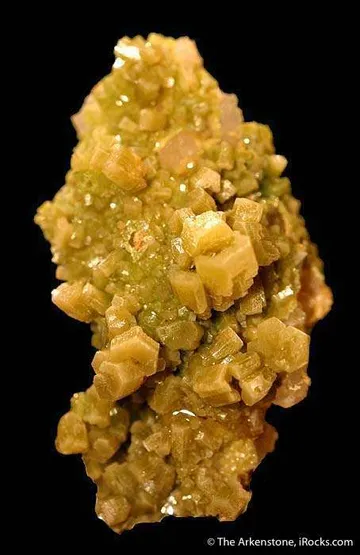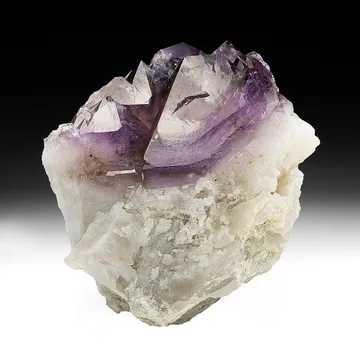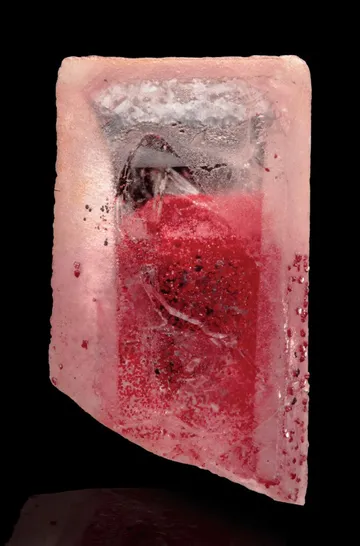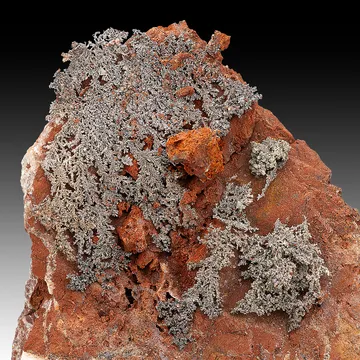
A collector's guide to Las Cruces Mine, Spain: its geology, mining history and notable minerals, illustrated with the 136 specimens documented from this locality on EarthWonders.
Key facts
Las Cruces is the modern Spanish copper locality that forced collectors to rethink what a new Iberian Pyrite Belt mine could produce. It is not an old open adit in the Huelva hills but a blind, high-grade volcanogenic massive sulphide deposit hidden beneath the Neogene–Quaternary cover of the Guadalquivir Basin, about 20 kilometres northwest of Seville. That sedimentary cover is central to the locality’s importance: it helped preserve an unusually complete supergene profile, with a gossan, a spectacular copper-enriched cementation zone, and primary polymetallic sulphides below. For mining, the star was chalcocite-rich secondary copper ore; for collectors, the revelation was sharp, metallic copper-sulphide crystallization from a contemporary open-pit operation.
The finest Las Cruces specimens have a distinctive look. Chalcocite forms lustrous, steel-gray to black, flattened cyclic twins, commonly with a hexagonal outline, scattered or drused over dark sulphide matrix. Many are accompanied by sparkling pyrite microcrystals, white calcite coatings, and, in the late finds from Phase 6 at the 130–135 level, dark gray to lustrous antimony-bearing Tennantite-(Fe). A separate late suite produced bornite pseudomorphs after chalcocite, retaining the same angular twin morphology but with bronze to blue iridescence. The best pieces combine sharp twinning, clean metallic luster, clear contrast against calcite or pyrite, and enough size to read immediately without magnification.
Regional View
Country View
Scientifically, Las Cruces is as interesting as it is collectible. Studies of the deposit describe a primary Iberian Pyrite Belt VMS system overprinted by supergene copper enrichment and then by unusual late carbonate–sulphide mineralization involving galena, silver sulphides, gold, and microbial processes in the deep subsurface. This is why the locality appears in both mineral-collector literature and ore-deposit research: it is simultaneously a source of elegant cabinet specimens and a natural laboratory for preserved weathering profiles, groundwater–rock interaction, and the deep biosphere.
Search for specimens: View all specimens from Las Cruces Mine, Spain
Las Cruces lies in Seville Province, Andalusia, within the municipalities of Gerena, Guillena, Salteras, and with facilities associated with La Algaba. Geologically it belongs to the Iberian Pyrite Belt, one of the great volcanogenic massive sulphide provinces of the world, but it is unusual in being concealed beneath the sedimentary fill of the Guadalquivir Basin. The orebody does not crop out; exploration was guided to a covered target, and the deposit was discovered in May 1994 by Riomin Exploraciones after drilling a gravity anomaly under Tertiary ground. Its cover, commonly described in the literature as roughly 100 to 150 metres of sandstone and calcareous mudstone or about 150 metres of marls, protected the weathering profile from erosion and gave Las Cruces its exceptional mineralogical character.
The deposit is a VMS system with primary massive sulphides and stockwork mineralization, overlain by a copper-rich secondary sulphide cementation zone and a gossan. Published descriptions of the primary ore emphasize pyrite as the dominant phase, with sphalerite, galena, chalcopyrite, tetrahedrite–tennantite, arsenopyrite, and subordinate Bi- and Pb-bearing sulfosalts. The early mine exploited the secondary copper sulphide zone, where chalcocite-group minerals replace and overprint the primary sulphide body. In collector terms, that is the critical zone: the specimen suite is not just “copper ore” but a tight paragenesis of chalcocite, djurleite, digenite, bornite, covellite, pyrite, calcite, and Tennantite-(Fe), with later rarities documented from the gossan and precious-metal assemblage.
Commercial development moved through several corporate hands. The project was advanced after discovery by Rio Tinto interests, then acquired by MK Gold in 1999. Inmet Mining took a majority position in 2005 and built the mine and hydrometallurgical plant, and First Quantum Minerals acquired Inmet in 2013. The open-pit operation began producing copper cathode in 2009. The principal open-pit copper phase wound down in 2021, followed by tailings reprocessing through 2023; Cobre Las Cruces states that the open-pit facility operated from 2009 to 2023 and produced very high-purity refined copper, with average annual output around 70,000 tonnes during its operating life.
As of September 2026, Las Cruces has entered a new ownership and redevelopment stage. On June 3, 2026, Cobre Las Cruces announced that Global Panduro S.L.U., controlled by Resource Capital Funds, had acquired 100% of the company from First Quantum Minerals. The immediate industrial focus is the PMR, or Polymetallurgical Refinery Project: an underground mine and refinery intended to treat polymetallic primary sulphide ore and produce copper, zinc, lead, and silver. The concession modification for that four-metal, underground/PMR phase was granted in June 2021, environmental permits were granted in June 2021, and the water concession was granted in March 2023. For collectors, that change matters because the famous open-pit specimen windows are no longer active collecting situations; the classic Las Cruces chalcocites are finite products of earlier mining exposures, especially the 2011-era finds and the final Phase 6 material of 2019–2020.
The best-documented specimen find for the collector market is the late Phase 6 suite, repeatedly labelled by dealers as coming from levels 130–135 at about 175 metres depth, with collection dates around September–November 2019 and January 2020. These pieces reached the international market through Spanish dealers and were quickly recognized in show reports and specialist mineral publications. The Phase 6 material produced lustrous flattened chalcocite twins on pyrite-rich matrix, chalcocite with calcite and pyrite, Sb-rich Tennantite-(Fe) with chalcocite and iridescent pyrite, and bornite pseudomorphs after chalcocite. Earlier material, around 2011, includes chalcocite with calcite and rare djurleite specimens; some of these are important because the copper-sulphide identities were confirmed analytically rather than assumed from appearance.
Collecting access today should be considered closed. Las Cruces is an active industrial mining and metallurgical complex with private land, permits, safety controls, and ongoing redevelopment plans. The locality is not a casual collecting site, and the open pit that produced the best-known crystallized material is no longer an accessible specimen source. Any legitimate collector specimen should have a clear chain of custody from the mine-production years, preferably with a dealer, collection, or analytical label noting Las Cruces, Gerena-Guillena-Salteras, Seville, Andalusia, Spain, and, for the late suite, Phase 6, levels 130–135, approximately 175 metres.
Chalcocite is the defining collector mineral of Las Cruces, occurring as bright metallic gray to black crystals, most characteristically flattened cyclic twins with hexagonal outlines and crisp, sharply profiled edges; published and dealer-described specimens range from thumbnail groups with individual crystals of only a few millimetres to cabinet pieces with main crystals reported around 2.4 x 0.7 cm and exceptional chalcocite-covered matrix specimens over 10 cm across. The classic associations are pyrite microcrystals, calcite coatings, Sb-rich Tennantite-(Fe), and, in some late material, bornite after chalcocite; the best pieces came from the late open-pit finds, especially Phase 6, levels 130–135, around the 175 metre level, in 2019–2020, while earlier 2011-era material established the locality as more than a mining curiosity. Good Las Cruces chalcocite is judged by sharp twin geometry, uninterrupted metallic luster, visible individual crystals rather than merely dark crusts, clean contrast with white calcite or iridescent pyrite, and reliable analytical support because the locality also produced visually similar djurleite, digenite, and bornite pseudomorphs.
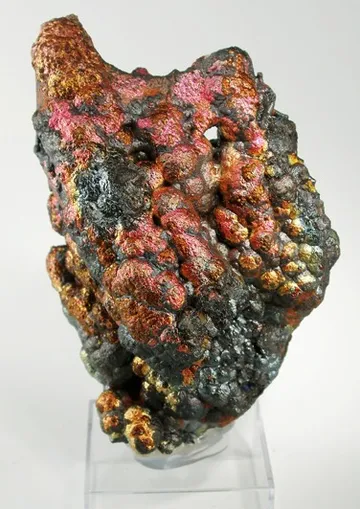
Pyrite at Las Cruces is both an ore-forming mineral and a specimen companion, and its collector expression is notably different from the large cubic Spanish pyrites of Navajún or Ambasaguas: here it appears as massive sulphide matrix, glittering microcrystalline coatings, iridescent botryoidal or polycrystalline growths, and crowded aggregates described as highly polycrystalline octahedral crystals. In the best specimen associations, pyrite forms dark to brassy, sometimes blue, red, mauve, or purple-iridescent microcrystal fields beneath or around flattened chalcocite twins and Sb-rich Tennantite-(Fe), especially in the 2019–2020 Phase 6 material. Strong Las Cruces pyrite pieces are those in which the pyrite is not just anonymous matrix but contributes color, sparkle, and texture: lustrous octahedral aggregates with twinned chalcocite, vivid iridescent coatings framing sharp chalcocite, or pyrite-rich bases that make the copper-sulphide twins stand proud and readable.
Calcite from Las Cruces is chiefly valued as a contrasting gangue and late coating mineral on copper sulphide specimens rather than as isolated calcite cabinet material. It occurs as small white crystal coatings and drusy crusts on dark sulphide matrix, commonly with chalcocite, pyrite, djurleite, and bornite pseudomorphs after chalcocite; specimen descriptions repeatedly note that Las Cruces calcite can fluoresce under both longwave and shortwave ultraviolet light, with some pieces described as very fluorescent and phosphorescent under shortwave UV. Fine calcite-bearing Las Cruces specimens use the calcite to frame the ore minerals: the white crystals should be clean, not chalky or bruised, and should enhance the metallic gray chalcocite or blue-bronze bornite without obscuring sharp faces; in this locality, calcite is often the visual difference between a dark sulphide mass and a display-quality copper-sulphide specimen.
The Tennantite recorded from the collector suite is Tennantite-(Fe), commonly described in market and analytical labels as Sb-rich or antimony-bearing Tennantite-(Fe), and it is one of the key minerals of the late Las Cruces assemblage. It occurs as lustrous dark gray tetrahedral crystals, groups with dominant tetrahedral faces and minor forms, parallel-growth clusters, coatings on chalcocite, and in some cases globular lustrous growths associated with iridescent pyrite and twinned chalcocite. The best Tennantite-(Fe) specimens are from the same final Phase 6, levels 130–135, approximately 175 metre suite of 2019–2020; desirable pieces show obvious tetrahedral form or unusual crystallographic habit, bright luster, and clear association with chalcocite or pyrite, while ordinary pieces can look like dark, analytical-only sulphide crusts unless the crystals are cleanly developed and well labelled.
Beyond the four featured species, Las Cruces is important for a compact but unusually rich suite of copper, lead, silver, mercury, and arsenic minerals. Mindat’s documented valid mineral list includes anglesite, bornite, cerussite, chalcopyrite, covellite, digenite, djurleite, galena, harmotome, luzonite, metacinnabar, native silver, pearceite, proustite, siderite, and xanthoconite, in addition to calcite, chalcocite, pyrite, and Tennantite-(Fe). Djurleite is especially notable, with analysed, pale gray, wedge-shaped to isometric crystals regarded as exceptional for the species. The gossan and precious-metal assemblage add another layer of interest: published work describes carbonates, iron sulphides, galena, stibnite, Pb-Sb sulfosalts, Ag-Hg-Sb sulphides and sulfosalts, Ag-Au-Hg amalgams, and Bi-Pb sulphides and sulfosalts, with gold and silver enriched toward the lower part of the weathering profile. For serious collectors, Las Cruces is therefore not a single-species locality but a well-constrained modern paragenesis where analytical labels matter.
The principal authenticity issue at Las Cruces is not a flood of documented artificial fakes; it is accurate identification within a visually similar copper-sulphide suite. Chalcocite, djurleite, digenite, bornite after chalcocite, and dark Tennantite-(Fe) can be difficult to separate by eye, especially where crystals are small, altered, or partially replaced. The best commercial descriptions from reputable dealers repeatedly state that specimens were analysed, and that is especially valuable for pieces sold as djurleite, Sb-rich Tennantite-(Fe), or bornite pseudomorphs after chalcocite. A specimen labelled simply “black copper sulphide, Las Cruces” may be attractive, but the more precise the species claim, the more important analysis becomes.
Locality labels deserve similar scrutiny. A good label should specify Las Cruces Mine or Cobre Las Cruces, Gerena-Guillena-Salteras, Seville, Andalusia, Spain. For late material, Phase 6, levels 130–135, around 175 metres, and dates such as September–November 2019 or January 2020 are meaningful details. Be alert for confusion with Las Cruces, New Mexico, or with generic Spanish “Las Cruces” labels that omit Seville or Andalusia. The specimen style is distinctive, but a strong label remains important because many dark sulphide specimens become anonymous quickly once separated from their mine paperwork.
Condition is usually about edges, coatings, and stability of appearance. Flattened chalcocite twins can have bright, sharp faces but thin projecting rims; damaged edges reduce the appeal immediately because the crystal geometry is the point of the locality. Calcite coatings can be bruised, etched, or dusty, and they may trap fine handling dirt. Iridescent pyrite and bornite surfaces are visually sensitive: repeated handling, rubbing, or aggressive cleaning can dull the very colors that make the specimens attractive. Avoid acids, ultrasonic cleaning, and strong chemical treatments; for most pieces, air-blowing with a hand bulb and careful storage are safer than intervention.
Calcite-bearing Las Cruces specimens can be worth checking under ultraviolet light. Dealer descriptions record calcite fluorescence under both longwave and shortwave UV, with some calcite noted as strongly fluorescent and phosphorescent under shortwave. That fluorescence is a bonus rather than the core value, but it can help document a piece and make a sulphide specimen more engaging in display. Because Las Cruces specimens may contain arsenic-bearing Tennantite-(Fe), lead minerals, mercury-bearing phases, and silver sulfosalts in the broader assemblage, handle broken or friable material sensibly: do not make dust, do not lick or soak specimens, wash hands after handling, and keep small chips away from children and food surfaces.
Market availability is finite but real. The important chalcocites appeared in quantity during the 2019–2020 late open-pit finds, and numerous small cabinet, miniature, and thumbnail specimens entered the trade. Better pieces with large, sharp, bright chalcocite twins, attractive calcite contrast, iridescent pyrite, or convincing bornite pseudomorphs are much less common than ordinary dark matrix pieces. Tennantite-(Fe) and djurleite are scarcer and should carry stronger documentation. Since the open pit is closed and the operation is moving toward underground redevelopment and refinery work, collectors should treat the classic specimen suite as a closed chapter rather than an ongoing supply stream.
Las Cruces began as a hidden target. In May 1994, Riomin Exploraciones drilled a gravity anomaly beneath the flat Tertiary ground of the Guadalquivir valley and hit a blind orebody where there was no old mine dump, no oxidized hill, and no obvious collector’s landmark at the surface. That concealment explains much of the locality’s later fame. The marls that made discovery difficult also protected the deposit: instead of the gossan and enrichment zone being stripped away by erosion, Las Cruces retained an unusually complete weathering profile. The result was a modern open pit cut down through a geological archive that most Iberian Pyrite Belt deposits had lost long before collectors arrived.
The specimen story reached its climax near the end of open-pit mining. Dealer labels and show reports repeatedly identify the memorable late suite as Phase 6, levels 130–135, about 175 metres down, with collection dates in late 2019 and January 2020. From those benches came the sharp, flattened chalcocite twins that made Las Cruces a serious entry in the modern chalcocite canon: bright black to steel-gray plates with hexagonal outlines, some arranged in druses on unaltered pyrite matrix, others sprinkled with white calcite or edged by iridescent pyrite. The same late window produced Sb-rich Tennantite-(Fe) crystals and the first collector-quality bornite pseudomorphs after chalcocite from the locality, retaining the chalcocite twin form but wearing bornite’s metallic blue, bronze, and violet skin. By the time these specimens reached Tucson and European show circuits, the best examples already had the aura of a last chance.
The final blast in the open pit had the rhythm of ceremony. Cobre Las Cruces marked blast number 1,827 on August 28, 2020 with the countdown “5, 4, 3, 2, 1… fuego!!” The company described it as the last blast in the Las Cruces open pit, closing fourteen years of excavation that had begun in 2006. For specimen collectors, that date gives a hard edge to the labels. The famous 2019–2020 chalcocites were not early, casual mine finds; they were recovered from the closing phase of a large industrial operation as the pit approached the end of its specimen-producing life.
The strangest Las Cruces story is microscopic. Researchers studying the late carbonate–sulphide rocks found galena in forms interpreted as possible bacteriomorphs: worm-like structures on the order of 10 microns long, tied to anaerobic microbial processes in a sealed subsurface environment. Their mass-balance estimates were startling: about 3.1 x 10^9 moles of reduced sulphur, 10^10 moles of CO2, approximately 1.19 million tonnes of carbonates, 114,000 tonnes of galena, 638 tonnes of silver sulphides, and 6.5 tonnes of gold attributed to this late mineralizing system. It is a rare mine where a cabinet chalcocite specimen and a discussion of deep microbial life belong in the same locality file, but Las Cruces is exactly that: a specimen source with a hidden biological chapter written in sulphides.
Menor-Salván, César; Carrasco, Iván; and García, Gonzalo (2010), “Los minerales del grupo de la Calcosina en la mina ‘Las Cruces’, Gerena (Sevilla),” Acopios 1:95–116 — The key collector-mineralogy paper for the chalcocite-group suite, documenting the copper sulphides that made Las Cruces famous among specimen collectors.
Menor-Salván, César (2011), “Minerales de plata de la mina ‘Las Cruces’, Gerena (Sevilla),” Acopios 2:59–69 — Important for the silver-bearing minerals and the analytical approach to Las Cruces micro-assemblages.
Capitán, M. A.; Nieto, J. M.; Sáez, R.; and Almodóvar, G. R. (2004), “Mineralogía del Gossan del yacimiento de ‘Las Cruces’ (Sevilla),” Macla 2:21–22 — Early published work on the gossan mineralogy, cited in Spanish mineralogical discussions of the locality.
Yesares, L.; Sáez, R.; Nieto, J. M.; de Almodóvar, G. R.; and Cooper, S. (2014), “Supergene enrichment of precious metals by natural amalgamation in the Las Cruces weathering profile (Iberian Pyrite Belt, SW Spain),” Ore Geology Reviews 58:14–26 — A central paper on Au-Ag-Hg enrichment and the precious-metal mineralization at the base of the weathering profile.
Tornos, F.; Velasco, F.; Menor-Salván, C.; Delgado, A.; Slack, J. F.; and Escobar, J. M. (2014), “Formation of recent Pb-Ag-Au mineralization by potential sub-surface microbial activity,” Nature Communications 5, Article 4600 — The landmark deep-biosphere paper linking late carbonate–sulphide mineralization to potential microbial processes.
Yesares, L.; Sáez, R.; Nieto, J. M.; de Almodóvar, G. R.; Gómez, C.; and Escobar, J. M. (2015), “The Las Cruces deposit, Iberian Pyrite Belt, Spain,” Ore Geology Reviews 66:25–46 — The principal modern synthesis of the deposit’s geology, structure, geochemistry, mineralogy, and supergene evolution.
Tornos, F.; Velasco, F.; and Slack, J. F. (2017), “The high-grade Las Cruces copper deposit, Spain: a product of secondary enrichment in an evolving basin,” Economic Geology 112:541–572 — A major ore-deposit study placing Las Cruces within the evolution of a sediment-covered basin and its high-grade copper enrichment.
Cameron, A.; Stone, R.; and Gómez Domínguez, C. (2024), “Cobre Las Cruces: Polymetallic Primary Sulphide Project,” NI 43-101 Technical Report, effective September 30, 2023 — The detailed technical report for the underground polymetallic and PMR redevelopment project.
Fabre Minerals, Reference Specimens: Las Cruces Mine chalcocite, Tennantite-(Fe), pyrite, djurleite, and bornite after chalcocite entries — A valuable market-record source for specimen sizes, habits, associations, find levels, and analysed late-suite material.
Mindat, Las Cruces Mine, Gerena, Seville, Andalusia, Spain — The most convenient consolidated locality page for coordinates, mineral list, references, and photo-linked species records.
“Proyecto PMR” — Cobre Las Cruces — Official video introducing the Polymetallurgical Refinery concept and the post-open-pit future of the mine.
“Ultima voladura en la corta minera de Las Cruces (vídeo)” — Cobre Las Cruces — Company post and embedded video marking the final open-pit blast, number 1,827, on August 28, 2020.
Mindat: Las Cruces Mine, Gerena, Seville, Andalusia, Spain — Best single starting point for the verified mineral list, coordinates, references, and photo records.
Cobre Las Cruces: Who We Are — Official company overview of the site, operating period, hydrometallurgical plant, and copper production history.
Cobre Las Cruces: PMR Project — Official description of the underground polymetallic and refinery redevelopment.
Cobre Las Cruces: Global Panduro acquisition announcement, June 3, 2026 — Current ownership and redevelopment context as of 2026.
NI 43-101 Technical Report: Cobre Las Cruces Polymetallic Primary Sulphide Project — Detailed technical source for geology, resources, concessions, mining method, and PMR planning.
Nature Communications: Formation of recent Pb-Ag-Au mineralization by potential sub-surface microbial activity — Essential paper on the unusual microbial and late sulphide-carbonate system at Las Cruces.
Ore Geology Reviews: The Las Cruces deposit, Iberian Pyrite Belt, Spain — Comprehensive technical study of the deposit and its preserved supergene profile.
University Complutense record: El Gossan de Las Cruces — Useful thesis record summarizing gossan mineralogy, precious-metal enrichment, and genetic interpretation.
MTI Acopios 1, 2010 — Host page for the foundational Spanish article on chalcocite-group minerals from Las Cruces.
MTI Blog: Acopios contribution announcement — Contemporary note recognizing the Las Cruces copper-sulphide suite as an important Iberian mineralogical find.
Fabre Minerals: Spanish Reference Specimens, Las Cruces entries — Detailed specimen descriptions for analysed chalcocite, Tennantite-(Fe), pyrite, djurleite, and bornite-after-chalcocite pieces.
Mineralogical Record: What’s New in the Mineral World, Report 56 — Market and show-report context for the 2020 Las Cruces chalcocite specimens.
Weinrich Minerals: Chalcocite with Pyrite, Tennantite-Fe, Calcite — Example of a documented Phase 6, level 130–135 collector specimen from the 2020 suite.
Museo Virtual de Mineralogía, Universidad de Huelva: Calcosina from Las Cruces — Museum database entry illustrating the locality’s chalcocite in calcite matrix.
ICOG Tierra y Tecnología: La Mina de Las Cruces, una ventana a la biosfera profunda — Accessible Spanish-language article connecting Las Cruces geology with the deep biosphere research.