A collector's guide to Resuperferolitica Mine, Spain: its geology, mining history and notable minerals, illustrated with the 31 specimens documented from this locality on EarthWonders.
Key facts
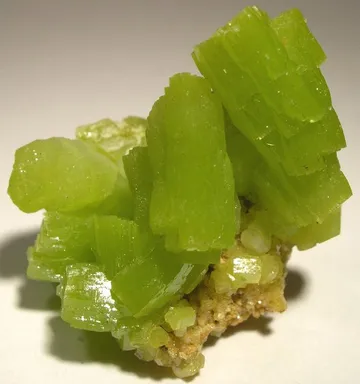
Resuperferolitica is a small name with an outsized place in modern Spanish mineral collecting. The mine is part of the Minas Viejas group north of Santa Eufemia, in Córdoba’s Los Pedroches district, where old argentiferous galena workings cut the northern fringe of a classic Variscan metallogenic province. Geologically, the setting is the lead-silver vein belt developed around the Los Pedroches batholith and its Paleozoic country rocks: a district of ancient galena, later carbonate-lead ore, and, in one extraordinarily collectible episode, pyromorphite. For specimen collectors the mine is not important because it yielded a long species list; it matters because a localized 1995 find produced unmistakable Spanish pyromorphites—honey-yellow, yellow-brown, greenish tan to olive-green hexagonal crystals, commonly on quartzose or ferruginous matrix, sometimes as airy druses of doubly terminated prisms and sometimes as tighter cavern linings with hoppery terminations and parallel growth.
Regional View
Country View
The finest pieces have a look that separates them immediately from the brighter apple-green Córdoba pyromorphites of San Andrés at Espiel. Resuperferolitica tends toward warmer, more mineralized colors—mellow yellow, tobacco-brown, ocher-honey, and muted greenish brown—with a slightly old-world austerity that suits the mine’s history. Good examples show crisp hexagonal prisms rather than mere crusts, visible terminations rather than rounded aggregates, and enough open space in the vug to let the crystal architecture read cleanly. On the best miniatures and small cabinets, the crystals rise from the matrix like a miniature thicket, lustrous but not garish, with a characteristic Spanish personality that serious pyromorphite collectors recognize at a glance.

Photo: Ivar Leidus, Wikimedia Commons
Search for specimens: View all specimens from Resuperferolitica Mine, Spain
Resuperferolitica lies in the Minas Viejas mining area at Cerro de la Canaleja, about 5 km north of Santa Eufemia in the Los Pedroches comarca of northern Córdoba. The mine belongs to an old lead-silver district rather than to a modern, continuously producing specimen locality. The broader Los Pedroches-Alcudia metallogenic zone contains numerous Pb-Zn and Pb-Ag vein mineralizations associated with the Variscan intrusive history of the Los Pedroches batholith and its surrounding Paleozoic rocks. In the Santa Eufemia sector the worked material was argentiferous galena and its oxidized derivatives, with later attention paid to lead-silver carbonates.
The Resuperferolitica concession is described in the collecting literature as covering old workings on a Pb-Ag vein system about 1,600 m long, including three veins. The pyromorphite occurrence that made the locality famous was not a broad, mine-wide phenomenon; it was a sharply localized secondary-mineral pocket zone on the wall of an already emptied vein. That geological detail is important for collectors because it explains both the consistency and the scarcity of the classic material. The pyromorphite was a late oxidized-zone mineral, formed where lead from primary galena and phosphate-bearing fluids met under weathering conditions, lining cavities rather than building large massive ore.
The mines at Santa Eufemia have a long history. Ancient surface workings in the area are repeatedly connected with Roman-period lead extraction, and modern sources describe Minas Viejas as an old argentiferous-galena mining landscape with shafts, drainage workings, galleries, masonry structures, ruined installations, washing remains, and collapsed ground. Modern exploitation began in the nineteenth century; a concession called Resuperferolítica was requested in 1866, and the modern mining phase is associated with the arrival in 1869 of the Portuguese company recorded in Spanish sources as the Companhia de Minas e Fundição do Chumbo de Santa Eufemia e Outros. One historical account places the mine at the center of Córdoba’s lead output around 1870, when Resuperferolitica is said to have produced 2,800 tonnes of lead. By 1876, official mining statistics still listed La Resuperferolítica and San Francisco at Santa Eufemia among the lead concessions being worked constantly, though the same report also notes the cost and uncertainty of deeper exploration as the known ore body became less dependable. By 1881, official statistics recorded the closure of San Francisco and Resuperferolítica while other lead mines in the region took over production.
The district’s later history was more about residual value than fresh ore. Minas Viejas reached its strongest activity in the middle of the nineteenth century, and mining is described as ending with the lead crisis of 1912. Between 1973 and 1977, the dumps were reworked by flotation, producing a lead concentrate notable for very high silver content, reported at about 2,500 grams per tonne. That late dump treatment helps explain why the site was already disturbed and why the later specimen find was a chance rediscovery in old ground rather than a by-product of active underground mining.
The collecting event that defines the locality came in April 1995. A small group of mineralogists working the old Resuperferolítica concession opened a very restricted zone in the southern wall of the exhausted vein and found cavities coated with pyromorphite. In a matter of weeks, numerous specimens—some accounts say thousands—entered Spanish and international collections. Labels reading “04/1995” are especially meaningful for this locality, because they tie a specimen to the classic pocket episode rather than to later field picking or older, less distinctive Santa Eufemia material. The mine is not an active collecting locality today in any practical commercial sense. The area contains old shafts, collapsed workings and ruined structures, and any field visit would require permission, current safety assessment, and respect for archaeological and mining-heritage restrictions.
Pyromorphite from Resuperferolitica is the reason collectors know the mine: crystals are typically hexagonal prisms in honey-yellow, yellow-brown, brownish green, greenish tan, and less commonly stronger olive to yellow-green tones, occurring as druses, cavity linings, and matrix groups from the 1995 pocket zone on the Resuperferolítica claim at Cerro de la Canaleja. Documented examples range from thumbnails and miniatures with main crystals of a few millimeters to cabinet pieces around 7 cm across and larger plates over 10 cm, with individual crystals commonly reported up to about 0.7–1 cm and Mineralogical Record index notes recording crystals to 1.5 cm. The most desirable pieces have sharp prism faces, good luster, undamaged terminations, visible doubly terminated crystals, hopper-shaped terminations or strong parallel growth, and the characteristic brownish-green or honey-brown color that distinguishes the 1995 geode material; ordinary examples are denser, duller, more crust-like, or too massive to show the elegant open vug habit that made the find a Spanish classic.
The documented species list for Resuperferolitica is short: aragonite, cerussite, dolomite, goethite, pyromorphite, and quartz. None is recorded as a type-locality mineral for the mine. Cerussite is the most relevant accessory for pyromorphite collectors, reported as small white flattened crystals on some pieces, while quartz and ferruginous goethitic material form much of the matrix context. Dolomite and aragonite belong to the carbonate gangue and oxidation assemblage rather than to the headline specimen suite. The locality’s mineralogical importance is therefore narrow but very strong: it is not a many-species rarity mine, but one of the defining modern Spanish localities for collectible pyromorphite.
The main authenticity issue is not outright fakery but locality precision. Specimens may be labelled simply “Santa Eufemia,” “Minas Viejas,” “Cerro de la Canaleja,” “Resuperferolítica claim,” or “Resuperferolitica Mine,” and all can refer to the same collecting district depending on the label’s age and source. At the same time, Córdoba also produced the famous San Andrés/Espiel pyromorphites, which are visually and historically distinct. Resuperferolitica labels should not be casually upgraded to San Andrés, and San Andrés material should not be folded back into Resuperferolitica merely because both are Córdoba pyromorphites. The classic Resuperferolitica material is typically warmer brownish yellow to greenish tan, with elongated or cavernous hexagonal crystals from the 1995 pocket episode; very bright apple-green, highly lustrous Córdoba pyromorphite deserves closer scrutiny for possible San Andrés origin.
Published dealer and reference archives do not identify a known systematic fake or treatment problem for Resuperferolitica pyromorphite. Condition, however, is a real grading issue. The crystals are often small, exposed, and crowded, so tiny bruises on terminations can be easy to miss. Hoppery terminations and parallel-growth prisms should be examined under magnification so natural growth features are not confused with damage, and so broken tips are not excused as “hopper growth.” Matrix can be brittle, especially on thin plates from cavity linings; avoid ultrasonic cleaning and aggressive scrubbing. Because the suite includes lead minerals—pyromorphite and cerussite—normal lead-mineral handling discipline applies: wash hands after handling, keep dust out of the workspace, and never use acid cleaning casually on mixed carbonate and phosphate material.
Fluorescence is a useful bonus but not a universal buying criterion. Some Resuperferolitica pyromorphites show yellow fluorescence under shortwave and midwave ultraviolet light, and dealer descriptions also mention minor longwave and shortwave response on certain pieces. The response varies enough that a non-fluorescent or weakly fluorescent specimen should not be rejected solely on that basis, while a good UV response can add interest when the daylight aesthetics are already strong.
Market availability is steady but finite. The 1995 find was large enough that specimens still circulate, yet it was localized enough that excellent, undamaged, well-labelled examples are not endlessly replaceable. Recent dealer and auction records show modest thumbnails and miniatures appearing at accessible prices, while better miniatures, old-collection pieces, greener examples, and cabinet specimens with provenance bring stronger premiums. The best labels are those tying the specimen to the 1995 Resuperferolítica find, especially with collection history or old Spanish dealer provenance.
The story of Resuperferolitica is a pocket story, but it begins like a mining history compressed into a hillside. The old workings north of Santa Eufemia had already been worked, forgotten, revisited, and reworked long before collectors arrived with specimen boxes. Roman lead workings left their trace in the district; nineteenth-century miners reopened the ground for argentiferous galena; official mining statistics tracked the boom-and-bust fortunes of the concession; and in the 1970s even the dumps were treated by flotation because the remaining lead concentrate still carried enough silver to matter.
Then came April 1995. The famous pocket was not found in a fresh commercial mine. It was found in the southern wall of an already emptied vein on the Resuperferolítica concession. Collectors working old lead ground opened a small zone and found cavities carpeted with pyromorphite unlike the material previously known from the district: hexagonal prisms in honey, brown, and muted greenish tones, with enough definition and abundance to transform a local curiosity into an international classic. The specimens moved fast. Within weeks, pieces were in public and private collections far beyond Córdoba, and the notation “04/1995” became a kind of passport—proof that a specimen belonged to the event that made the locality.
One anecdote from the dealer literature gives the find a wonderfully human edge. Jordi Fabre recorded a notably green Resuperferolitica pyromorphite that he had bought at the 1994 Munich show from German collectors, a year before the main 1995 discovery. They had been in the right place, or close to it, but the great pocket came later and to others. Fabre’s verdict on the episode was brief and perfect: “C’est la vie.” It is the sort of collecting story every field collector understands—the ground gives hints, timing decides the rest.