A collector's guide to Lake George area, USA: its geology, mining history and notable minerals, illustrated with the 78 specimens documented from this locality on EarthWonders.
Key facts
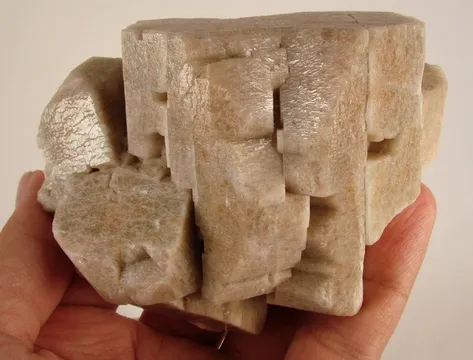
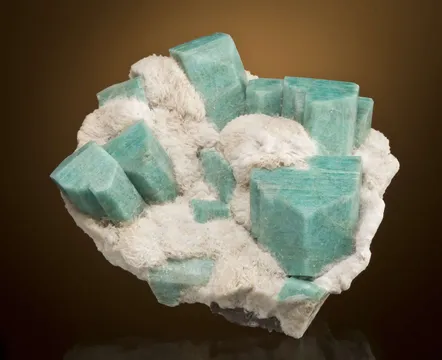
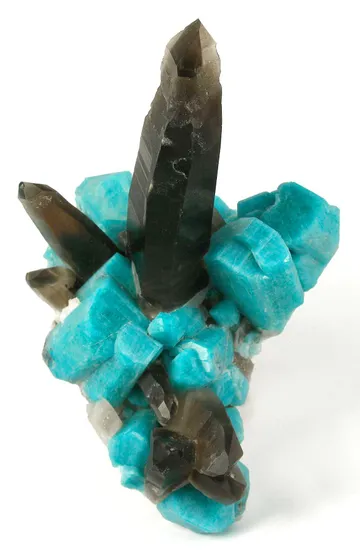
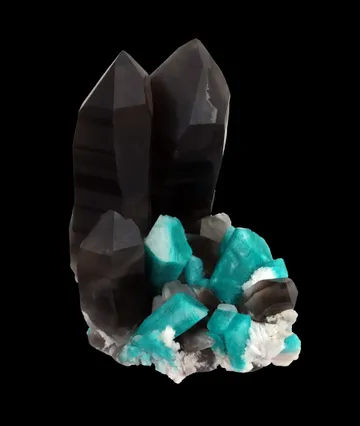
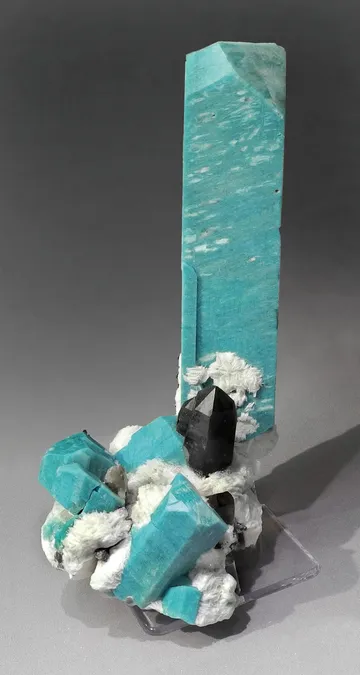
The Lake George area of central Colorado is one of the defining feldspar-and-quartz specimen districts of North America. Around Lake George, Florissant, Crystal Peak, Crystal Creek, Badger Flats, and the adjoining Teller–Park county line country, late-stage pegmatites in the Mesoproterozoic Pikes Peak batholith opened into miarolitic cavities—true crystal pockets—where microcline, amazonite, smoky quartz, albite, fluorite, topaz, goethite, hematite, and a surprising suite of Be-, Nb-, Y-, F-, and rare-earth minerals grew freely into open space. For collectors, the district’s signature is instantly recognizable: robins-egg to deep blue-green amazonite plates, often broken and naturally reassembled by careful preparation, contrasted with glossy root-beer to black smoky quartz and bright white cleavelandite.
The geological setting is as important as the beauty. The Lake George intrusive center lies on the western flank of the Pikes Peak batholith, a large anorogenic granite province a little over a billion years old. In the productive Crystal Peak–Smoky Hawk trend and nearby claims, small pegmatite lenses, dikes, and pockets occur in fractured pink granite and related rocks of the Lake George ring complex. These are not conventional metal mines with long ore shoots; the great “ore body” for collectors is the pocket itself—sometimes only a few centimeters high, sometimes large enough to work like a crawlspace, and commonly collapsed, clay-filled, iron-stained, and crossed by roots or fractures.
Historically, Lake George is a locality where ordinary rockhounding, specimen mining, and museum-caliber discovery overlap. Collecting began in the nineteenth century, when Crystal Peak and the “Lake George diggings” were already attracting prospectors, tourists, and commercial specimen men. Later, named claims and pockets—Gem Mines, Yucca Hill, the Key Hole Pocket, Two Point’s Tree Root Pocket, the Godsend claim’s Holy Moses pockets, and the modern Smoky Hawk trend—gave the district a documentary richness uncommon among American pegmatite localities. The best specimens are not merely “amazonite and smoky quartz”; they are compositions: blocky feldspar steps, dark prismatic quartz spears, snow-white albite rosettes, occasional fluorite cubes, iron-oxide pseudomorphs, and, in rare cases, accessory columbite, phenakite, topaz, cassiterite, bertrandite, milarite, xenotime, monazite, zircon, and genthelvite.
Regional View
Country View
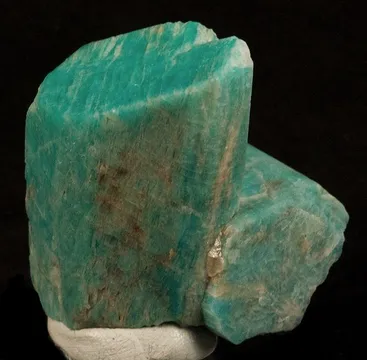
A good Lake George specimen has a particular geometry. The amazonite is normally blocky, stepped, or plate-forming microcline, often with subtle gridlike cleavage and twinning; the smoky quartz is prismatic and sharply terminated, sometimes tabular or tapered; the albite is white, bladed, and cleavelandite-like; and the entire piece has a contrast that looks almost designed. The district’s finest material can be startlingly saturated—deep blue-green feldspar beside nearly black quartz—while average material may be pale green, buff, pinkish, iron-stained, or dominated by broken singles rather than coherent groups.

Photo: Wikimedia Commons

Photo: Wikimedia Commons
Search for specimens: View all specimens from Lake George area, USA
The collector’s Lake George area is best understood as the Crystal Peak–Lake George pegmatite district on and near the western side of the Pikes Peak batholith, chiefly in Park and Teller Counties, Colorado. The productive specimen ground lies north of U.S. Highway 24 between Lake George and Florissant, around Crystal Peak, Crystal Creek, Yucca Hill, the Smoky Hawk trend, and related claims; the broader Lake George–Badger Flats area also includes Be-F greisen and pegmatitic mineralization northwest and west of Lake George. The region is underlain by Pikes Peak Granite and by the Lake George intrusive center, where potassic granitic rocks and sodic ring-dike rocks are arranged in a roughly circular intrusive complex. Most classic amazonite-smoky quartz pockets occur in miarolitic pegmatites cutting the granite, rather than in the sodic syenitic rocks themselves.
The pocket-bearing bodies are usually small pegmatite dikes, lenses, and seams. At the Two Point mine, productive lenses were described as biconvex graphic-granite bodies with thin open cavities sandwiched between hard graphic granite layers; many lenses had no vug at all. The pegmatites can pinch from pencil-thin seams to thicker feldspar-quartz lenses within a few meters, then die out again. Productive pockets often occur where pegmatites intersect fractures, joints, or fault-like structures. In the Smoky Hawk trend, many important pockets formed where pegmatites changed direction or stepped along fracture systems, rather than along simple linear dikes. That structural control explains why one part of a claim may yield repeated pockets while similar-looking granite nearby produces little.
Mineralogically, the district is dominated by microcline and quartz, with amazonite being the blue-green variety of microcline and smoky quartz the dark variety of quartz. Albite, particularly white bladed cleavelandite, is a major aesthetic associate. Fluorite, goethite, hematite, biotite or zinnwaldite-like mica, topaz, zircon, cassiterite, columbite-group minerals, phenakite, bertrandite, milarite, monazite, xenotime, bastnäsite, rutile, and genthelvite occur as scarcer accessories. In the Badger Flats–Boomer mine sector, the mineralization shifts toward greisen-style Be-F deposits with beryl, bertrandite, euclase, phenakite, fluorite, topaz, cassiterite, scheelite, wolframite, and sulfides, a separate but geologically related expression of volatile-rich late-stage Pikes Peak batholith fluids.
The collecting history begins in the nineteenth century. Crystal Peak was known for smoky quartz, topaz, and green microcline by the 1860s and 1870s, and the Foote Mineral Company is recorded among the early commercial parties mining and marketing material from the Crystal Peak area. In the late nineteenth century and into the early twentieth, Albert Whitmore and the old Gem Mines helped bring Colorado amazonite to international attention; specimens from the old No. 8 claim of the Gem Mines were exhibited at the Chicago World’s Fair era and helped establish the blue-green feldspar as a serious cabinet mineral rather than a curiosity.
Twentieth-century collecting became a patchwork of hand-dug prospects, private property, patented and unpatented claims, and occasional commercial ventures. The Clarence Coil claims around Yucca Hill produced notable deep blue-green amazonite in the 1970s, some with smoky quartz. The 10 Percenter claim yielded the celebrated Key Hole Pocket in 1985, a cavity reportedly large enough, when emptied, to drive a small car into; it produced hundreds of amazonite specimens, including large plates with white albite balls. The Two Point claim, originally named by John O. Buckner in 1956, was mined by Collectors Edge Minerals under lease in 1996–1997, producing the Tree Root Pocket, one of the benchmark finds in the district. The Godsend claim, staked by Richard Fretterd in 2001 in the Crystal Creek area, produced the Holy Moses pocket group in 2002, notable especially for very large smoky quartz and pale blue fluorite.
Modern production is inseparable from the Smoky Hawk trend and the Dorris family’s work under Glacier Peak Mining and Pinnacle 5 Minerals. The Smoky Hawk claim was filed in 1998 after years of prospecting, with mechanized exploration beginning around 2000 and mining after permitting in 2003. The trend has produced hundreds of pockets and a series of named finds including Legacy, Majestic, Smithsonian, Lucky Monday, Chuck’s, Dragon’s Mouth, and Icon. The Icon Pocket, found in 2012, produced the Smoky Hawk King, a large amazonite, smoky quartz, and cleavelandite plate now associated with the Denver Museum of Nature & Science.
Access today is constrained. Much of the best Crystal Peak–Lake George ground is private property, patented ground, or active unpatented mining claims within Pike National Forest; claim boundaries can be hard to see in timbered, rugged terrain, and permission is essential. Organized club trips, fee digs, and invited claim visits are the realistic route for many collectors. Casual surface hunting in unclaimed national forest land can still yield bits of quartz, feldspar, pale microcline, and occasional small crystals, but the world-class amazonite-smoky quartz pockets that define the locality overwhelmingly come from claimed ground, deep mechanized work, or carefully managed private digs. Any old excavation should be treated as a safety hazard and as someone’s possible claim or reclaimed mine disturbance unless verified otherwise.
Lake George amazonite is microcline at its most collectible: blocky, stepped, blue-green to deep teal crystals from miarolitic pegmatite pockets, commonly associated with smoky quartz, albite cleavelandite, goethite or hematite pseudomorphs, and occasional fluorite or rare accessory minerals. The best pieces from the district have saturated color, sharp forms, and a balanced contrast with dark smoky quartz; lesser pieces are pale green, buff, iron-stained, single-crystal fragments, or feldspar plates without an aesthetic quartz association. Historic production ranges from centimeter-size thumbnails to large cabinet plates, with exceptional pockets producing amazonite crystals several inches across and plates that required extensive collecting, cleaning, and repair. White caps and white stripes, produced by pale microcline overgrowths or zones on the amazonite, are especially prized in Smoky Hawk material, while Tree Root Pocket specimens are admired for their deep blue-green color and classic association with glossy smoky quartz and white albite.
Microcline in the Lake George area ranges from ordinary pink, buff, cream, or pale green feldspar to the blue-green amazonite variety that made the district famous, and the distinction matters: not every Lake George microcline is amazonite, and many pockets carry common microcline with smoky quartz but little gem color. At Two Point, pocket microcline was recorded in colors from pink and light green through medium green to dark blue-green, with the dark blue-green crystals being the desirable amazonite grade; at the Godsend claim, buff to cream microcline crystals to about 3.8 cm were noted, some feldspars showing red short-wave fluorescence. Good microcline specimens from the area show sharp blocky forms, attractive twinning and stepped growth, clean surfaces, and a strong pocket association with quartz, albite, or fluorite; ordinary pieces are massive feldspar, etched or decomposed blocks, or pale crystals lacking composition.
Quartz is the structural and visual partner of Lake George feldspar pockets, appearing as milky quartz cores, clear to gray crystals, smoky crystals, and pocket-wall growths intergrown with microcline and albite. In some pockets, massive or milky quartz forms barriers or cores that miners must break through before reaching better open cavities; in others, quartz is present as sharp prismatic crystals growing with feldspar plates. The Godsend claim produced some of the largest documented quartz crystals from the district, including giant smoky quartz individuals more than a meter long, while more typical collectible quartz ranges from small clear or gray points to cabinet-size clusters. For non-smoky quartz here, collectors look for transparency, complete terminations, pocket context, and association with feldspar, fluorite, or cleavelandite rather than simple massive white vein quartz.
Smoky quartz is the dark counterpoint that gives Lake George amazonite its drama, ranging from medium root-beer brown through deep smoky gray to nearly black, with crystals commonly prismatic, glossy, gemmy at the edges, and sharply terminated. The best smoky quartz specimens are not just dark; they are well placed, rising cleanly from blue-green amazonite or white cleavelandite, with no bruised terminations and no awkward imbalance between feldspar and quartz. Tree Root Pocket smoky quartz reached about 17 cm in length, though average crystals were smaller, while the Smoky Hawk trend is noted for very dark to black satin-luster quartz and a tendency toward tapered terminations on some crystals. Single smoky quartz crystals from Lake George can be handsome, but the market prizes combination pieces most strongly, especially when the quartz is transparent enough to show depth yet dark enough to create the classic Colorado contrast.
Fluorite from the Lake George area is less abundant than microcline and quartz but highly desirable when it appears as sharp cubes in pegmatite pockets, especially pale blue, greenish, purple-edged, or gemmy crystals associated with smoky quartz, microcline, amazonite, albite, goethite, and hematite. The Godsend claim produced pale blue cubic groups, some showing darker purple edges, and modern Smoky Hawk and Crystal Peak material includes small but aesthetic fluorite as a macro accessory in NYF-type pegmatites. Lake George fluorite also turns up in broader Be-F and greisen-style settings around Badger Flats, where the mineralogy is less about amazonite display pieces and more about fluorine-rich hydrothermal alteration. The best specimens for collectors show isolated, lustrous cubes in clear association with Lake George pegmatite minerals; ordinary examples are tiny, bruised, included, or buried in iron oxides without good crystal definition.
Barite is an uncommon but documented part of the broader Lake George–Crystal Peak mineral story, occurring as a rare pocket mineral in the Crystal Peak area and as a more familiar Park County collectible in the Hartsel–Tarryall country near Lake George. In the pegmatite context it is not a bulk commodity mineral but a late, unusual accessory that turns up sporadically among fluorine- and barium-bearing rare-mineral assemblages; reported pocket examples are far scarcer than amazonite, smoky quartz, albite, or fluorite. In the nearby Hartsel area, barite is known for blue to pale bladed or tabular crystals and crystal masses, a separate but regionally important Park County occurrence often encountered by Colorado collectors traveling the same Lake George–Hartsel collecting circuit. The most desirable Lake George-area barites are sharp, lustrous, and visibly crystallized rather than chalky masses, with credible locality detail being especially important because “Park County barite” and “Lake George-area pegmatite barite” can easily be confused in the trade.
Beyond the headline species, the Lake George area has a rich suite of rare and accessory minerals. Albite as cleavelandite is central to the finest combinations, often providing the white rosettes and blades that brighten amazonite-smoky plates. Goethite and hematite occur as coatings, crusts, spherical aggregates, and pseudomorphs after carbonate minerals such as siderite or calcite; some lustrous black rhombohedral clusters are labeled hematite, though pseudomorphic origins are often part of the discussion. Topaz, phenakite, cassiterite, columbite-(Fe), zircon including cyrtolite-like material, bertrandite, milarite, monazite, xenotime, bastnäsite, rutile, Nb-rich rutile, anatase, ilmenite, genthelvite, fluorapatite, galena, and manganese oxides such as cryptomelane-rich mixtures have all been documented from Crystal Peak–Smoky Hawk style pegmatite work. The broader Pikes Peak batholith contains several type-locality minerals, but the Lake George area itself is valued more for its classic NYF pegmatite assemblage and rare-pocket mineral diversity than for a single famous type species.
The main authenticity issue with Lake George specimens is not synthetic material but disclosure: exact locality, pocket, repair, and restoration matter. Many great pockets collapsed naturally before discovery, and many collectible plates were recovered as broken, clay-packed puzzles. The Tree Root Pocket is the classic example: a large proportion of the best specimens required repair, and Collector’s Edge documented pieces carefully, with catalog numbers and repair labels. Properly done repairs are accepted in this locality when disclosed; undisclosed reconstruction, glued crystal replacements, or vague “Lake George” labels on composite-looking plates should be treated with caution.
The second issue is locality precision. “Lake George,” “Crystal Peak,” “Florissant,” “Smoky Hawk,” “Teller County,” and “Park County” are often used loosely in the market. A specimen from the Smoky Hawk claim, Two Point, Yucca Hill, Godsend, 10 Percenter, Badger Flats, Hartsel, or an undisclosed private claim may all circulate under a broad Lake George-area label. For high-value amazonite-smoky quartz combinations, provenance to a claim, pocket, miner, old collection, or publication materially affects value.
Condition is critical. Amazonite cleaves and chips readily, smoky quartz terminations bruise, and pocket-wall plates commonly show edge breakage where they were removed. Iron-oxide staining is normal and may hide both beauty and damage. Brightly cleaned pieces can be spectacular, but over-cleaning may leave etched feldspar faces, dull quartz, or artificially “scrubbed” surfaces. White caps and white stripes on Smoky Hawk amazonite are natural and prized when genuine, but should be inspected as part of the crystal growth rather than as paint, filler, or glued-on pale feldspar.
Fluorite from the area is softer and more cleavable than the quartz-feldspar matrix and should be protected from impact. Albite rosettes are fragile. Goethite and hematite pseudomorphs can shed fine iron oxide if roughly handled. Some feldspars from the Godsend claim and related Pikes Peak batholith pockets have been reported to fluoresce red under short-wave ultraviolet light, an interesting diagnostic and display feature but not a universal property of Lake George microcline.
Market availability is uneven. Small amazonite crystals, single smoky quartz crystals, and modest feldspar-quartz plates appear regularly. Fine combination pieces with strong blue-green color, sharp undamaged smoky quartz, good albite, balanced composition, and credible pocket provenance are much less common and command strong prices. Specimens from named modern pockets such as Majestic, Legacy, Smithsonian, Lucky Monday, Icon, and related Smoky Hawk discoveries are especially sought after, as are documented Tree Root Pocket pieces and older Yucca Hill or Gem Mines material.
The great Lake George pockets are remembered because they read like field stories rather than production statistics. At the Two Point mine in June 1997, Collectors Edge Minerals had already spent three summers exploring, trenching, and opening pits when the crew noticed a few pieces of deep blue-green “color” on the dump of an older dig. That clue led to a pegmatite only about 2 meters below the surface beside a large tree. The pocket that followed was not a roomy crystal cave but a collapsed, clay-filled sandwich only about 16 to 20 cm high in places, with hard graphic granite above and below. A tree root had grown down along the pegmatite and through the pocket, levering apart the plates over time. The name Tree Root Pocket was literal.
At first the Tree Root Pocket looked discouraging. Single amazonite crystals came out damaged. Then small groups with quartz appeared, and by the end of the first day four superb specimens had been recovered. For about eight days the pocket produced a daily contest among the crew: could today’s piece beat yesterday’s? The cavity eventually measured more than 2 meters long, about 1.7 meters deep, and roughly kidney-shaped, yet never opened into a tall comfortable chamber. Every useful void had filled with iron-stained clay. The collapsed ceiling plates had dropped onto floor plates, making an amazonite-and-clay sandwich that had to be disassembled carefully.
The real work began after mining. In Golden, Colorado, the contents of the Tree Root Pocket were washed, sorted, matched, and reconstructed. Hundreds of pieces had to be compared. It took weeks of concentration to find fits, and about half of the final cataloged fine specimens were repaired, usually with only one repair. The reward was color: deep blue-green amazonite penetrating through the crystals, gemmy smoky quartz from medium to deep root-beer brown, white albite balls to about 4 cm, and even rare cassiterite crystals on two pieces. The pocket ultimately produced more than 100 cataloged amazonite-smoky quartz groups plus hundreds of singles and smaller groups.
The Godsend claim story has a different mood: fire, exposure, and giant quartz. Richard Fretterd staked the claim in 2001 in the Crystal Creek area west of Crystal Peak. In February 2002 he followed an east-west pegmatite dike where it met a half-meter-thick quartz vein, dug down about a meter, opened a pocket, and then broke through a milky quartz barrier into another large cavity. By September 6, 2002, six closely spaced pockets had been opened and named the Holy Moses group. That same year, the Hayman Fire burned more than 138,000 acres in the region, stripping vegetation from the surface and making resistant pegmatite ribs and graphic granite exposures far easier to see. In that exposed landscape, the claim produced some enormous smoky quartz: one crystal measured 1.295 m long and weighed 156.49 kg, while the heaviest smoky quartz crystal attached to a microcline plate weighed 199.1 kg and was about 1.218 m long. Pale blue fluorite cubes with darker purple edges added a completely different note to the same pocket system.
The Smoky Hawk stories are family stories as much as mining stories. On June 27, 2005, Joe Dorris, his son Tim, excavator operator Robert Quist, Leonard Himes, and Isaias Casanova were working a 35-foot face when a pegmatite appeared on the far right. It widened to about a foot thick, and about 8 feet along its length and 6 feet below the surface, rusty red areas appeared with smoky quartz—one of those signs Lake George diggers recognize immediately. At the left edge of the face, another old dig bottomed into a thick pegmatite with rusty pocket indications. By the end of the day they had two promising pockets about 20 feet apart. They packed the cavities with newspapers, buried them, and went into Lake George for dinner, where iced tea and lemonade tasted memorable after a warm day on the mountain.
The left-hand pocket, 05-057, soon began yielding big crystals: smoky quartz to 8 inches, amazonite to 4 inches, and groups with large cleavelandite blades. On July 2, Joe’s son Scott, on leave after his Air Force commissioning, joined the dig. The family was working several pockets, some nearly 30 feet deep under a hard granite cap, when Scott appeared above the cut and called for help pulling out a plate. Joe thought he was joking. At the pocket, Tim was half inside a small cave-like cavity about four feet wide and four feet high, clearing a ceiling plate that had fallen face down. Scott and Tim pried it out, lifted it like “unsheathing a saber,” turned it over, and saw a monster smoky quartz rising from a huge amazonite plate. Work stopped. Losing a day’s excavator rent no longer mattered.
That piece became the Legend. It carried big amazonites, dark smoky quartz, white caps and stripes, cleavelandite, and goethite pseudomorphs. The family worked until about 8:30 that evening, filling 22 flats and crates from pocket 05-056, then buried the remaining pocket for the night. Someone had been watching. Overnight the pocket was dug up and the remaining specimens were taken. Even so, the two Legacy pockets produced a remarkable haul: 05-057 filled 24 flats and packing crates, 05-056 filled 22, and the largest smoky quartz crystals were about 12 inches long by 4.5 inches in diameter. The Legend itself required prolonged preparation; cleaning and restoration ran from about March 2006 into September 2007. It later debuted at the Denver show, and the Martin Zinn family ultimately purchased it and donated it to the Colorado School of Mines Geology Museum, where it remains one of the great white-cap and white-stripe Lake George combinations.
The Icon Pocket of 2012 pushed the modern story still farther. The Dorris family uncovered a pegmatite on the Smoky Hawk claim at the end of June, and excavation continued into July while High Noon Productions filmed for the television series Prospectors. The largest cavity was kite-shaped, about six feet wide and eight and a half feet long, and produced roughly a ton of amazonite and smoky quartz crystals. From that collapsed abundance, a plate nearly three feet by two feet was assembled: the Smoky Hawk King. It became one of the largest high-quality amazonite-smoky quartz combination specimens ever recovered in Colorado and entered the Denver Museum of Nature & Science collection.
D. E. Kile and D. D. Eberl, “Crystal growth mechanisms in miarolitic cavities in the Lake George ring complex and vicinity, Colorado,” American Mineralogist, 1999 — Key scientific paper on crystal-size distributions and growth mechanisms in Lake George miarolitic pegmatites.
R. A. Wobus and R. S. Anderson, “Petrology of the Precambrian intrusive center at Lake George, southern Front Range, Colorado,” Journal of Research of the U.S. Geological Survey, vol. 6, no. 1, 1978 — Foundational geology of the Lake George intrusive center and its ring-complex rocks.
C. C. Hawley, “Geology and beryllium deposits of the Lake George (or Badger Flats) beryllium area, Park and Jefferson Counties, Colorado,” U.S. Geological Survey Professional Paper 608-A, 1969 — Classic USGS treatment of the Be-F greisen and beryllium mineralization northwest of Lake George.
Steven Wade Veatch, Reinhard A. Wobus, and Richard W. Fretterd, “The Godsend claim: a preliminary report, Lake George pegmatite district, Teller County, Colorado,” 24th New Mexico Mineral Symposium, 2003 — Describes the Godsend claim, Holy Moses pockets, large smoky quartz, fluorite, and geology of the Crystal Creek area.
Joseph Dorris, “Amazomite and Smoky Quartz Mining on the Smoky Hawk Claim, Teller County, Colorado,” 36th New Mexico Mineral Symposium, 2015 — Primary account of Smoky Hawk mining, the Smoky Hawk trend, major pockets, and the Smoky Hawk King.
Joseph Dorris, “Amazonite and Smoky Quartz Pegmatites of the Smoky Hawk Trend, Teller County, Colorado,” Second Eugene E. Foord Pegmatite Symposium abstract volume, 2016 — Technical summary of Smoky Hawk pegmatite structure, NYF classification, pocket frequency, and production.
Mark Ivan Jacobson, Brad Meese, Thomas Cheatham, and Joseph Dorris, “Crystal Peak: Lesser known mineral finds,” 42nd New Mexico Mineral Symposium, 2022 — Valuable compilation of rare species from Crystal Peak–Smoky Hawk style pockets.
Peter J. Modreski and Jack Thompson, “The Lesser-Known Minerals of the Pikes Peak Batholith,” 35th New Mexico Mineral Symposium, 2014 — Broad context for Lake George within the Pikes Peak batholith and its miarolitic, NYF, Be-F, and rare-earth mineral assemblages.
Barbara L. Muntyan and John R. Muntyan, “Minerals of the Pikes Peak Granite,” Mineralogical Record, vol. 16, no. 3, 1985, pp. 217–230 — Classic Mineralogical Record article cited in later summaries of the Pikes Peak batholith’s mineralogy.
Edwin B. Eckel, Minerals of Colorado, updated and revised edition, Fulcrum Publishing, 1997 — Standard reference for Colorado mineral localities, including Lake George, Crystal Peak, Badger Flats, and related Park–Teller County occurrences.
Amazonite & Smoky Quartz from New Crystal Hunters: Smoky Hawk — bluecapproductions — Short video shot at the Smoky Hawk Mine showing amazonite and smoky quartz specimens from the New Crystal Hunters filming.
Prospectors television series overview — Broadcast-media context for the Dorris family’s Smoky Hawk work and Lake George-area amazonite-smoky quartz collecting as presented to a general audience.
Mindat: Lake George, Park County, Colorado, USA — Broad locality page and photo gateway for Lake George-area minerals.
Mindat: Lake George area, Pikes Peak batholith, Teller County, Colorado, USA — Useful Teller County regional locality page for the Lake George–Pikes Peak batholith context.
Mindat: Lake George ring complex, Pikes Peak batholith, Teller County, Colorado, USA — Geological locality page for the ring complex and associated mineral records.
Mindat: Lake George (Badger Flats) Area, Park County, Colorado, USA — Mineral list and locality framework for the Badger Flats–Lake George area.
Collectors Edge: Two Point Amazonite Mine, Teller County, Colorado — Detailed mining history, geology, and Tree Root Pocket account.
Pinnacle 5 Minerals: Summer 2005 – Story of the Legend and the Legacy Pocket — First-person Dorris family account of the Legacy pockets and the Legend specimen.
Colorado Geological Survey: Gemstones — Amazonite — State geological survey overview of Colorado amazonite, Pikes Peak Granite, and collecting-access cautions.
U.S. Geological Survey: Crystal growth mechanisms in miarolitic cavities in the Lake George ring complex and vicinity, Colorado — Scientific abstract for the Kile and Eberl study of Lake George pocket crystal growth.
New Mexico Mineral Symposium: The Godsend claim — Source for the Godsend claim, Holy Moses pockets, large smoky quartz, and fluorite.
New Mexico Mineral Symposium: Amazomite and Smoky Quartz Mining on the Smoky Hawk Claim — Source for the Smoky Hawk trend, major pockets, production history, and the Smoky Hawk King.
ResearchGate: Crystal Peak: Lesser known mineral finds — Rare-mineral compilation for Crystal Peak and Smoky Hawk specimens.
Colorado Mineral Society Field Trips — Current-style example of organized club collecting access in Colorado, including Lake George and Hartsel trips when scheduled.
Lake George Gem & Mineral Club Field Trips — Local club trip listings and access route for collectors seeking legal, organized field opportunities.