






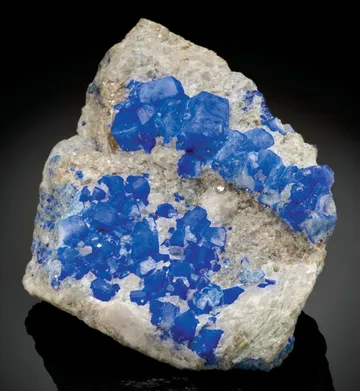
Kokcha Valley, Afghanistan — lapis lazuli locality with Sar-e-Sang workings yielding royal-blue crystals and associated minerals prized by collectors.
Key facts
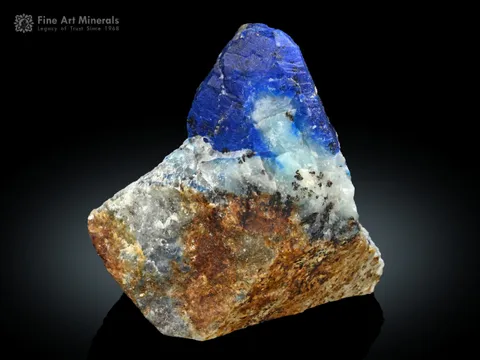
Kokcha Valley is one of the great names in mineral collecting because it is not merely a locality; it is the classical landscape of lapis lazuli. The specimen-producing heart of the district is Sar-e-Sang, especially the Ladjuar Medam lapis workings and nearby occurrences in the high Hindu Kush of Badakhshan. Here, deep-blue sodalite-group minerals occur in marble and calc-silicate skarn, with calcite, dolomite, diopside, forsterite, scapolite, phlogopite, pyrite, afghanite, sodalite, hackmanite, haüyne, and related feldspathoids forming an assemblage unlike any other collector locality. The best specimens have a startling contrast: royal-blue to midnight-blue crystals or crystal aggregates standing out from snow-white marble or calcite, dusted or veined with bright brassy pyrite.
Historically, Kokcha Valley is the archetypal source of lapis lazuli for the ancient world. Sar-e-Sang material moved outward by caravan routes toward Mesopotamia, Egypt, Persia, Central Asia, China, and later Europe, where the stone became ornament, seal, inlay, pigment, and royal object. In specimen terms, the locality matters for a different but related reason: it is one of the few places where lapis-associated minerals occur as collectible crystals rather than simply as blue ornamental rock. Fine lazurite, gemmy sodalite and hackmanite, hexagonal afghanite, richterite, marialite, phlogopite, diopside, and unusual fluorescent associations place Kokcha Valley squarely in the front rank of world feldspathoid localities.
Regional View
Country View
The geological setting is as dramatic as the specimens. The lapis bodies occupy high-grade metamorphic rocks of the South Badakhshan block, especially calcite- and dolomite-rich marbles, calciphyres, and skarn-like horizons associated with granitoid and mafic intrusions. The blue bodies occur as lenses, layers, and vein-like masses within pale marble on steep ground east of the Kokcha River. The classic collector aesthetic—blue crystals embedded in white marble with pyrite—records that environment directly: sodium-, sulfur-, chlorine-, and carbonate-rich fluids reacting with impure carbonate rocks under high-grade metamorphic to metasomatic conditions.

Photo: Wikimedia Commons

Photo: Wikimedia Commons
Search for specimens: View all specimens from Kokcha Valley, Afghanistan
Kokcha Valley specimens on the collector market most commonly trace to the Sar-e-Sang lapis district in Kuran wa Munjan, Badakhshan, with labels variously reading Kokcha Valley, Koksha Valley, Sar-e-Sang, Sar-i Sang, Ladjuar Medam, Lajur Madan, Dar-e-Zu, Pitwak/Pitawak, or simply Badakhshan. Ladjuar Medam is not a single adit name in the narrow modern sense; it is often used generically for the “blue mine” or lapis-lazuli mine complex. For collectors, locality precision matters because Sar-e-Sang proper, Dar-e-Zu, Pitwak, Jungaluk, unnamed gem sodalite occurrences, and richterite-bearing zones can yield quite different specimen styles.
The deposit is a metamorphic-metasomatic lapis lazuli occurrence hosted by marble and calc-silicate rocks. The Sar-e-Sang complex includes gneiss, cipolin marble, skarn, crystalline schist, amphibolite, leucocratic granite veins, pyroxenite, and hornblendite. The principal lapis-bearing horizons occur in a gray skarn band within thick pale marbles. Published descriptions record skarn beds and lenses commonly around 1 to 2 meters thick, locally thicker, with lateral continuity commonly in the tens of meters and, more rarely, several hundred meters. Lapis lazuli itself forms lenses, vein-like bodies, and layers in calcite- and dolomite-marble, with diopside skarn and forsterite-bearing calciphyre as key associated rock types.
The mineralizing system is chemically distinctive. Lapis formation required aluminum-rich protoliths, carbonate rocks, sodium- and chlorine-bearing fluids, and abundant sulfur. Calcite and dolomite are intimately intergrown with silicates such as diopside, scapolite, forsterite, and phlogopite; pyrite is a persistent companion of the blue material. The best ornamental lapis is the familiar nearly uniform deep blue with only small, bright pyrite specks and little visible calcite, but the best mineral specimens are different: they preserve crystal form, sharp color contrast, readable associations, and intact matrix.
Mining at Sar-e-Sang is ancient and seasonal. The high camp is near the Kokcha River, and the mine workings are high above the valley floor on steep terrain that has traditionally limited access to summer and early autumn. Older mining used fire-setting: wood fires heated the tunnel face, water or natural cooling shocked the rock, and the fractured marble was then broken and cobbed. Later, dynamite replaced fire-setting, but access, transport, altitude, winter weather, and security remained defining constraints. In the early 1980s, published gemological work reported annual production before the Soviet occupation at roughly one ton of lapis lazuli, with only a small proportion of the finest, fissure-free deep-blue material suitable for jewelry.
Specimen recovery is inseparable from lapis mining. Blue masses lacking ornamental quality, marble with crystal pockets, and pieces thrown to dumps have yielded some of the finest crystallized material. Classic lazurite crystals were sought in pale cipolin and calcite-rich matrix rather than in the most massive gem rough. Published accounts note crystals reaching about 5 cm, including a celebrated Pierre Bariand-collected crystal from 1964. More recent collector production brought unusual sodalite and hackmanite, including dodecahedral crystals and gem-quality transparent to translucent material, as well as afghanite, richterite, marialite, and other fluorescent or sodalite-group associations.
Access today is not a normal mineral-collecting proposition. The district is remote, high, politically sensitive, and historically tied to informal, licensed, semi-legal, and illegal mining networks. Since the 2010s, multiple investigations have described lapis mining in Badakhshan as entangled with armed groups, local strongmen, smuggling, and state-capacity problems. Since 2021, the wider Afghan mining sector has operated under Taliban rule, and open reporting on the exact mine-by-mine situation is limited. For collectors outside Afghanistan, ethical provenance and date of extraction are therefore not minor label details; they are central parts of evaluating any recently mined Sar-e-Sang lapis, sodalite, hackmanite, or associated mineral specimen.
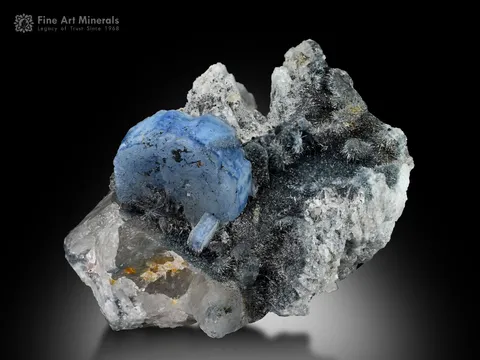
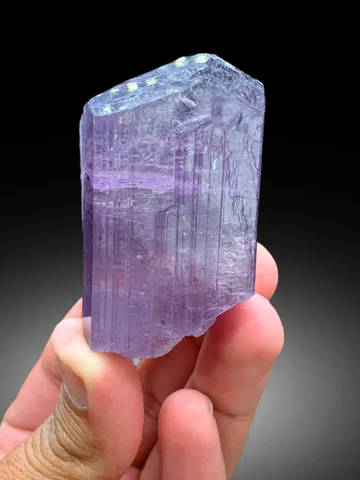
Kokcha Valley sodalite is among the locality’s most important modern specimen minerals, especially from Sar-e-Sang-area occurrences associated with the lapis-bearing marbles and related sodalite-group zones. The crystals are typically dodecahedral, from crude to sharp, and may range from colorless, gray, yellowish, greenish, lilac, lavender, purple, teal-blue, or darker tones depending on composition, inclusions, irradiation history, and light exposure. Mindat records dodecahedra to about 6 cm for the region, with some of the largest and best crystals from here around 5 cm; collector material also appears as massive to brecciated sodalite in marble, calcite, or mixed feldspathoid matrix. Fine Kokcha sodalite is judged by crystal form, translucency, saturation, lack of bruising, strong longwave orange-yellow fluorescence where applicable, and clear separation from massive lapis-like blue rock; ordinary pieces are cloudy broken masses or ambiguous blue feldspathoid fragments without diagnostic form or optical behavior.
Hackmanite from Kokcha Valley is a tenebrescent variety of sodalite and is one of the locality’s great fluorescent-mineral attractions. Sar-e-Sang-area material occurs as crude to sharp dodecahedra, trapezohedrally modified crystals, translucent to transparent gem rough, and crystalline aggregates in calcite, marble, richterite-bearing, or mixed sodalite-group matrix. Colors may appear creamy white, clear, gray, greenish, lilac, lavender, purple, or violet, with exposure to ultraviolet light commonly intensifying pink-to-purple color and longwave UV producing yellow-orange, orange, pink, or white fluorescence; some Afghan gem samples studied by GIA were unusually transparent and included faceted stones up to several carats, while trade reports noted clean cut stones said to reach 18 ct. Top specimens combine visible crystals, strong repeatable tenebrescence, bright fluorescence and phosphorescence, and a clean, undamaged matrix association; lower-grade examples may still glow strongly but are massive, fractured, heavily included, oiled, or visually indistinct without UV.
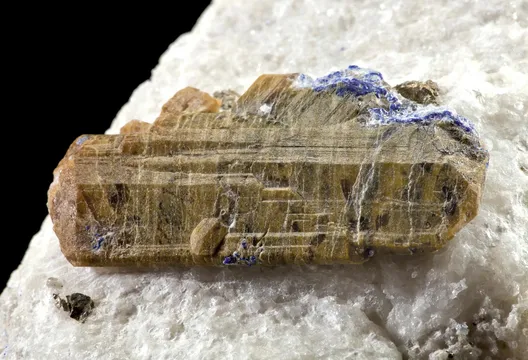
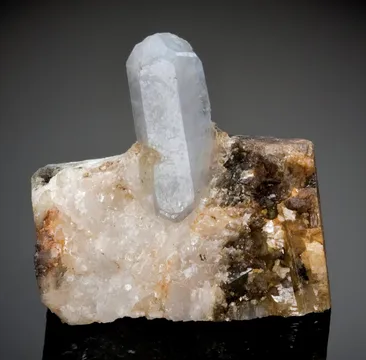
Afghanite is the signature type-locality mineral of Sar-e-Sang, first described from the lapis-lazuli mine area by Pierre Bariand, Fabien Cesbron, and Roger Giraud in 1968 and named for Afghanistan. In Kokcha Valley specimens it commonly forms hexagonal prismatic crystals, sometimes terminated or doubly terminated, in colorless, white, blue-gray, pale blue, or saturated blue tones, with orange to yellow-orange longwave fluorescence reported for the locality. It occurs with lazurite, sodalite, nepheline, phlogopite, olivine/forsterite, diopside, calcite, and pyrite, and may be seen perched on white marble, embedded in calcite, or associated with pyrite-speckled blue lapis matrix. Fine afghanite from here is all about clean hexagonal form, strong blue color, readable termination, matrix contrast, and undamaged crystal faces; ordinary pieces are broken or massive blue feldspathoid fragments that require analysis or strong provenance to separate confidently from sodalite-group material.
Kokcha Valley lazurite is the classic blue mineral of Sar-e-Sang lapis, occurring in ultramarine to midnight-blue masses, grains, crystals, and crystal aggregates in calcite-marble with brassy pyrite, phlogopite, diopside, scapolite, and forsterite. Well-formed crystals are rare compared with massive lapis but can be exceptional: published accounts describe rhombic dodecahedra, modified by cube and octahedral forms, reaching about 5 cm, and museum- and dealer-circulated specimens show equant royal-blue crystals on white marble with minor pyrite. The best collector pieces are not simply the darkest lapis; they are specimens in which the blue mineral has identifiable crystal form, a natural marble matrix, clean bright color, little bruising, and attractive pyrite accent without overwhelming the blue. Massive lapis with abundant white calcite veins may be historically interesting, but in specimen terms it does not compete with sharp blue crystals rising from white calcite or marble.
Calcite at Kokcha Valley is both a species and the stage on which the locality’s best blue minerals perform. Much of the collector calcite is white to colorless marble or coarse calcite matrix enclosing lazurite, sodalite, hackmanite, afghanite, pyrite, phlogopite, marialite, richterite, or diopside, rather than freestanding calcite crystals collected for calcite’s own form. In the lapis zones, calcite and dolomite are intimately associated with the blue feldspathoids and calc-silicate minerals, and calcite-rich marginal zones are part of the geometry of the larger lapis lenses. Good Kokcha calcite specimens are therefore judged by association: white, stable matrix that frames blue crystals sharply, lacks excessive iron staining or blast damage, and preserves the natural contact between calcite-marble and blue mineral. UV collectors should also check calcite-rich specimens carefully, because fluorescent sodalite, hackmanite, marialite, afghanite, and related minerals can be present in or on what first appears to be plain white matrix.
Diopside is a major geological indicator at Kokcha Valley and a modest but important collector species in its own right. In the Sar-e-Sang deposit it occurs in calc-silicate skarn, forsterite-bearing calciphyre, and lapis-bearing carbonate assemblages, commonly with calcite, dolomite, scapolite or marialite, phlogopite, lazurite, sodalite, afghanite, and pyrite. Specimen material from the Pitwak Mine and nearby Sar-e-Sang occurrences is reported as crude greenish-white prisms, while lapis-zone diopside may also appear as pale to pine-green grains or masses in white calcite with grossular or other calc-silicate minerals. Fine diopside from this district is scarce as a stand-alone display mineral; its value is strongest when it helps tell the skarn story beside blue feldspathoids, or when individual crystals are recognizable, undamaged, and placed in a clean matrix association. Ordinary pieces are small, blocky, pale pyroxene masses of interest mainly to locality specialists.
Beyond the headline minerals, Kokcha Valley has produced a remarkable sodalite-group and calc-silicate suite. Documented species include haüyne, nosean, nepheline, marialite, richterite, fluoro-richterite, potassic-fluoro-richterite, phlogopite, forsterite, chondrodite, hydroxylclinohumite, grossular, titanite, apatite, albite, K-feldspar, quartz, dolomite, anhydrite, gypsum, magnetite, molybdenite, pyrite, pyrrhotite, wurtzite, native sulfur, colusite, uraninite, and members of the thorianite-uraninite series. Afghanite is the essential type-locality species for collectors, while lazurite, even amid modern classification complexities in the sodalite group, remains the locality’s defining historical mineral. Particularly desirable specialist pieces include fluorescent sodalite-hackmanite associations, blue or color-zoned haüyne/lazurite group material, richterite with sodalite and uraninite, marialite prisms or pseudomorphs in calcite, and matrix specimens preserving the transition from white carbonate host to blue feldspathoid mineralization.
The first collector issue is nomenclature. “Lapis lazuli” is a rock name, not a single mineral species, and Sar-e-Sang labels may blur lazurite, haüyne, sodalite, nosean, afghanite, and other sodalite-group minerals. A blue specimen with pyrite in white marble is often sold as lazurite or lapis, while a paler fluorescent dodecahedron may be sodalite or hackmanite. Hackmanite should show noticeable tenebrescence; if the color change is absent or extremely weak, “sodalite” is the safer name even when sulfur is detected. For high-value crystals, especially afghanite, sodalite-group rarities, and transparent gem material, analytical confirmation by Raman, XRD, EDS, or a reputable lab is worth the cost.
Lapis lazuli from Afghanistan is widely treated and imitated. Dyed low-grade lapis, dyed calcite-rich material, waxed or resin-impregnated lapis, glass, plastic, and Gilson-type imitation lapis all occur in the broader gem trade. Specimen collectors should be especially cautious with unnaturally uniform blue masses, blue color bleeding into cracks or white calcite, lack of natural pyrite behavior, suspiciously glossy surfaces, or carved and polished material represented as natural specimen grade. In natural Sar-e-Sang lapis, pyrite is common, but the best gem rough has only small bright flecks; large or excessive pyrite and obvious white calcite reduce ornamental value even when they may enhance the geological look of a specimen.
Hackmanite and transparent sodalite from Afghanistan may be clarity enhanced. GIA’s study of Afghan hackmanite/sodalite documented oiled rough and cut stones, with Afghan samples showing spectral evidence consistent with clarity enhancement. On collector specimens, oiling may make fractures less obvious, increase apparent transparency, or leave whitish material in cracks. Recutting or cleaning can reopen the visual appearance of fractures, so avoid aggressive solvents or heat unless you are deliberately testing or conserving a low-value piece.
Condition can be unforgiving. Lazurite and sodalite-group minerals are not hard enough for rough handling, and cleavage or incipient cracks may be present. Many crystals were freed from very hard marble by blasting, cobbing, or hand trimming, so bruised edges, contacted backs, rehealed fractures, and missing terminations are common. The best pieces retain a natural marble seat rather than a sawed, polished, dyed, or glued appearance. With afghanite, look closely for broken prisms, etched faces, and chips along terminations; with lazurite, check whether the apparent “crystal” is a true crystal form or a broken blue mass emerging from calcite.
Fluorescence is a major part of the locality’s appeal. Afghan hackmanite and sodalite can respond strongly under longwave UV and may phosphoresce after shortwave exposure; tenebrescent colors can change over minutes, hours, days, or longer depending on the specimen and lighting history. Store display pieces out of strong, prolonged sunlight if you want to preserve a chosen color state, and document photographs with the lighting condition: natural light before UV, during LW/SW UV, immediately after UV, and after fading. Some specimens from richterite-bearing zones include uraninite or thorianite-uraninite series grains; these are generally small, but radioactive inclusions should be treated with normal radioactive-mineral discipline: do not grind or saw them, wash hands after handling friable material, avoid loose dust, and store with sensible spacing and labeling.
Market availability is uneven. Massive lapis and lapis carvings are common, but fine natural crystallized lazurite, matrix afghanite, sharp gemmy sodalite, and dramatic hackmanite are much scarcer. Older collection pieces with pre-2010 or pre-2021 provenance may command a premium not only for quality but for ethical clarity. Modern material still appears on the market, especially fluorescent sodalite/hackmanite and lapis, but current mining and export chains from Badakhshan require careful questioning. For serious collecting, ask for the most specific locality possible, the approximate acquisition date, whether the piece has been treated, whether species were analytically confirmed, and whether the seller can document a chain of custody.
The old travelers knew Kokcha Valley first as a place you had to survive before you could admire it. The road south from Fayzabad narrowed through mud-walled villages and rough mountain country; beyond Hazrat-Said the last approach traditionally became a pack-animal route into the Kokcha gorge. Published accounts describe the Sar-e-Sang camp on the right bank of the Kokcha near the Sar-e-Sang stream, with mine workings high above it between roughly 2,700 and 3,400 meters. Blocks of lapis came down the mountain on men’s backs, then moved onward by donkey toward Hazrat-Said and the long road to Kabul.
Marco Polo did not visit the mines himself, but his report fixed the place in the Western imagination: a mountain where the finest azure in the world was found, appearing in veins like silver streaks. Centuries later, British Army Lieutenant John Wood reached the lapis mines during his 1836–1838 journey toward the source of the Oxus. His warning has become the sentence collectors repeat whenever Sar-e-Sang is mentioned: “If you do not wish to die, avoid the Valley of Kokcha.” It sounds melodramatic until one reads the practical details—narrow defiles, high cliff workings, winter snow, summer heat, freezing nights, wolves and wild hogs, and a valley sometimes described as only a few hundred meters wide beneath 6,000-meter peaks.
The mines themselves preserved a physical memory of antiquity. The entrance to the main workings was reached by a steep footpath ending at a tiny platform, about two meters by two meters, before a cavern blackened by smoke. That soot was not incidental. Before explosives became common, miners used the fire-set method: they built great fires at the working face, then fractured the heated rock by cooling and shock. The method consumed wood in a barren high mountain country and eventually gave way to dynamite, but the smoke traces were still visible in the mine described by twentieth-century geologists.
Pierre Bariand’s 1964 collecting at Sar-e-Sang is one of the great mineralogical moments of the locality. Collectors had long known lapis as a blue ornamental stone, but Bariand and colleagues were searching for crystallized material and studying the deposit as mineralogists. A famous 5 cm lazurite crystal, a well-formed dodecahedron embedded in calcite, came from that work and entered the Faculty of Sciences collection at the Sorbonne. It is the kind of specimen that changed how collectors looked at the locality: not merely as a lapis quarry, but as a source of crystallized blue feldspathoids.
Afghanite’s story is even more specific. A specimen collected from the Sar-e-Sang region by Pierre Bariand led to the 1968 description of a new cancrinite-group mineral by Bariand, Fabien Cesbron, and Roger Giraud. The name “afghanite” tied the species permanently to the country of discovery. Later finds would show the mineral in more dramatic specimen form—blue to blue-gray hexagonal prisms on marble or calcite, sometimes with lazurite and pyrite—but the species’ identity began with the lapis mines, where unusual feldspathoids hid in a matrix that most of the world valued simply as blue stone.
Modern field reporting from the valley carries a harder edge. In 2007, Al Jazeera’s James Bays described a journey of more than twelve hours from the nearest town over roads that were hardly roads, then a descent into the Kocha/Kokcha valley to a mining settlement built for hundreds of men. Inside the shafts, miners worked by gas lamps, without safety equipment, and returned after dynamite blasts once the dust had settled. One miner, Mohammed Habid, said he had worked every day for five months and had found nothing; he planned to stay two more months because his family needed the money. For specimen collectors accustomed to clean labels and velvet-lined flats, that single detail is worth remembering whenever a blue Afghan stone changes hands.
The political life of the mines has been just as turbulent as the geology is ancient. Reports from the 1980s noted that the mines lay outside Soviet control during parts of the occupation, and later accounts described lapis revenues passing through mujahidin, local commanders, smuggling networks, political interests, and insurgent taxation. Global Witness later called Badakhshan lapis a conflict mineral, describing the struggle over the mines as a “business war.” That phrase is grimly apt: the same blue material that filled royal tombs and Renaissance paint boxes also became a resource fought over in a remote mountain district where formal oversight has repeatedly been weak or absent.

_(29807269083).jpg)