Deo Darrah, Afghanistan — remote pegmatite locality famed for blue beryl in compact, architectural crystals; prized for rarity, color, and appearance.
Key facts
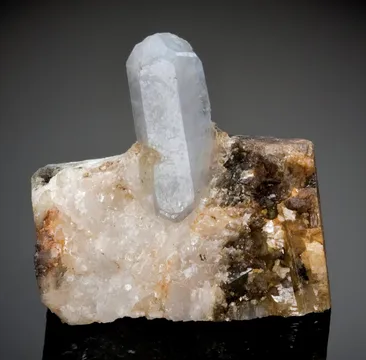
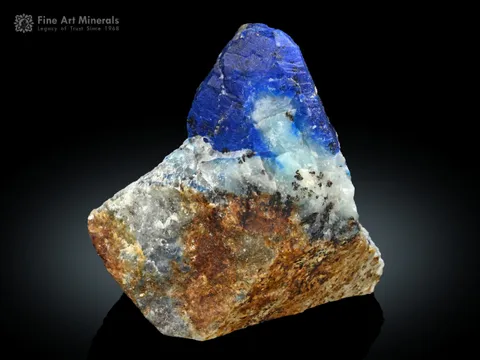
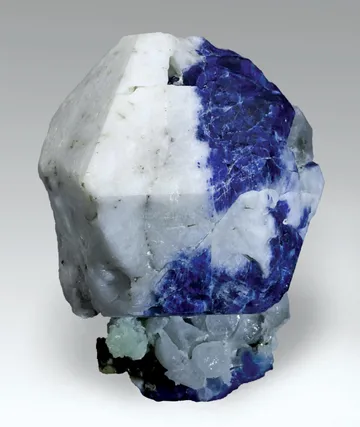
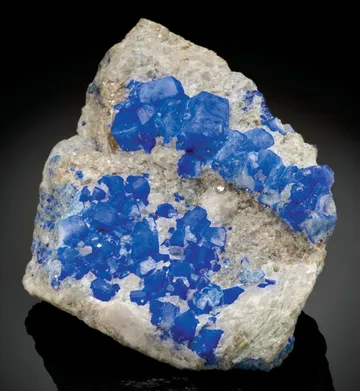
Deo Darrah is one of those Afghan pegmatite localities whose reputation rests on a very small suite of unmistakable specimens rather than on long production or a broad species list. In collector language it is the source of the strange blue, flattened beryl that first moved through the market under the alluring names “vorobyevite” and “rosterite,” then settled—after better chemical work—into the more cautious but still fascinating identity of alkali-rich blue beryl or low-alkali aquamarine-like beryl. The crystals are not the long, six-sided aquamarine prisms that make Nuristan and Kunar famous. Deo Darrah’s signature habit is compressed and architectural: stacked, tabular hexagons, rosettes, sheaves, and small parallel groups, commonly with a saturated blue core, paler or whitish margins, and a subtle fibrous or cat’s-eye sheen on the basal faces.
The setting is the high, remote Hindu Kush of Badakhshan, in the Kuran Wa Munjan–Khash border area as used on many specimen labels. The mineralization is pegmatitic, with the beryl occurring in a suite that includes quartz, feldspar, mica, and tourmaline—especially pink to blue or dark tourmaline on the better matrix pieces. Historically the place was known first as a tourmaline mine; only later did the odd blue beryl make it a modern collector locality. The finest specimens are not big by the standards of Afghan aquamarine, but they are visually singular: rich blue plates perched on white feldspar or clear quartz, sometimes accompanied by pink elbaite prisms, forming miniature and small-cabinet pieces with a look that is instantly separable from any normal pegmatite beryl.
Regional View
Country View
The scientific importance of Deo Darrah lies in that mismatch between appearance and chemistry. Early dealer and collector labels leaned on cesium-beryl names because the crystals looked like the old tabular alkali beryls of Russia, Elba, and Madagascar. Later work showed that at least some of the Afghan material is not meaningfully cesium-rich in the way those names imply; iron accounts for the blue color, and sodium, calcium, and other trace-element patterns may help explain the unusual growth. That history makes Deo Darrah a useful cautionary locality: beautiful, rare, and real—but best appreciated with a precise label.

Photo: Géry Parent / Wikimedia Commons
Search for specimens: View all specimens from Deo Darrah, Afghanistan
Deo Darrah is a pegmatite locality in Badakhshan’s high mountain country, treated on specimen labels and mineral databases as a mine in the Kuran Wa Munjan District area, though some government and trade references place the tourmaline operation in Kash District. The coordinates published for the locality are broad estimates rather than a surveyed collecting point, and that uncertainty is typical of many Afghan gem-pegmatite localities: production moves through miners, brokers, Peshawar dealers, and international shows long before exact mine maps become public.
The deposit is best understood as a rare-element granitic pegmatite occurrence, not as a conventional ore body. The collectible minerals come from pockets and vugs within pegmatite, where late-stage fluids concentrated Be, B, Li, Na, Fe, and other incompatible elements. The core assemblage documented from Deo Darrah and its Diba-Darra sublocality is simple but telling: beryl, elbaite or tourmaline-group minerals, quartz, feldspar, lepidolite or lithium mica, and hambergite. The presence of beryl plus tourmaline plus mica is exactly the kind of mineralogical pairing one expects in fractionated pegmatites, but the flattened, zoned beryl habit is the locality’s special fingerprint.
The best-known beryl pocket material entered the specimen world around 2012–2014. Early labels were confused, with some material reportedly passed first as coming from Pakistan or Gilgit before the Deo Darrah, Badakhshan locality became accepted. Dealer accounts from that period describe a limited pocket or a small number of pockets rather than steady mine production. Later specimens continued to appear sporadically, but the locality has never behaved like a constant commercial source. The result is a market profile familiar to advanced collectors: periodic small offerings, many old labels using obsolete varietal names, and strong demand for pieces with clean blue color, intact hexagonal plates, and meaningful matrix.
Mining history at Deo Darrah begins with tourmaline. U.S. mineral-industry summaries listed tourmaline from Deo Darrah as a recognized semiprecious gemstone operation in the mid-2010s, but without a named operating company or stated annual capacity. That is consistent with much Afghan gem mining: small-scale, seasonal, artisanal, and difficult to document from outside the trade. The locality’s rugged altitude and winter access problems make year-round work unrealistic; accounts tied to the 2012 beryl find refer to a short summer mining season of roughly three months.
Collecting access today should be regarded as closed to ordinary field collecting. This is not a roadside locality or a club collecting site; it is a remote Afghan mine area requiring legal permission, local arrangements, security awareness, and export compliance. Most collector specimens reach the market through Afghan and Pakistani dealers rather than through collector field trips. For buyers, the practical “access” question is therefore provenance and labeling: whether a piece is genuinely Deo Darrah material, whether the label overstates the chemistry as “vorobyevite” or “cesium beryl,” and whether associated minerals are correctly identified.
The notable finds are the tabular blue beryl pockets and the associated tourmaline-bearing matrix specimens. Top pieces show multiple flattened hexagonal beryl crystals, often only millimeters to a few centimeters across, but arranged with strong sculpture. Some crystals have bowed or concave centers, sandwich-like zoning, white fibrous-looking basal layers, or a satiny eye effect when rotated in light. Matrix examples with quartz, feldspar, mica, and pink tourmaline are more desirable than loose single plates, and large, undamaged clusters with saturated blue color are genuinely scarce.
Beryl is the defining collector mineral of Deo Darrah, but it appears here in an unusual form: blue to blue-gray tabular hexagons with a strongly shortened c-axis, commonly arranged as stacks, rosettes, parallel clusters, or sheaf-like sprays on quartz, feldspar, and mica. Individual crystals range from tiny 3–7 mm accents on matrix to plates and clusters several centimeters across, with some small-cabinet specimens built almost entirely of intergrown beryl crystals. The best pieces have saturated blue cores, lighter or whitish outer zones, sharp lustrous faces, translucent interiors, and undamaged basal surfaces that may show fibrous texture or a cat’s-eye-like sheen. Ordinary pieces are paler, more granular, heavily contacted, or visually flat; top Deo Darrah beryl has both the locality’s odd growth habit and enough color contrast to make the science visible at arm’s length. Older labels may say “vorobyevite,” “rosterite,” or “cesium-rich beryl,” but the most defensible modern labels are beryl, alkali-rich beryl, or aquamarine/blue beryl depending on the analysis and the conservatism of the collection.
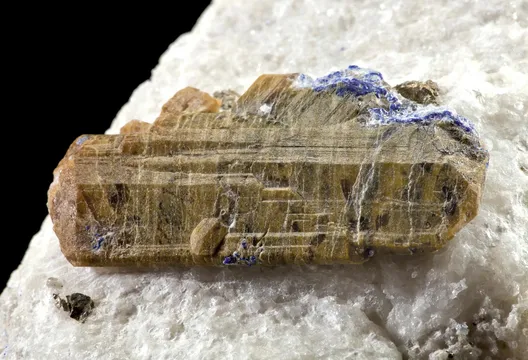
Tourmaline is historically central to Deo Darrah because the locality was known as an old tourmaline mine before the blue beryl became famous. Specimen associations show two collector-relevant expressions: dark blue to blue-gray or dark acicular tourmaline with alkali-rich beryl, and small pink to gemmy pink elbaite prisms with beryl on quartz matrix. The Diba-Darra sublocality has documented elbaite, and some beryl specimens carry pink tourmaline accents at the base or between quartz crystals, giving the otherwise blue-white pegmatite pieces a valuable color contrast. Deo Darrah tourmaline is not broadly marketed as large, freestanding gem crystals in the way Paprok or Pech tourmaline is; its best role for collectors is as an association mineral that confirms the pegmatite setting and elevates beryl specimens. Good examples are clean, distinct prisms or sprays that are visibly attached and not merely scattered needles; ordinary examples are dark, indistinct, or too fine-grained to identify confidently without magnification or analysis.
Other minerals documented from Deo Darrah and Diba-Darra include quartz, feldspar-group minerals, lepidolite or lithium mica, hambergite, and rhodochrosite. Hambergite is the most notable rarity in that list: Diba-Darra has been reported to produce strongly etched crystals reaching very large sizes, and its presence fits the Be-B-rich chemistry of a differentiated pegmatite. Quartz and feldspar are important less as stand-alone species than as the matrix that gives Deo Darrah beryl its best display; lepidolite and mica aggregates help place the blue beryl in the same late-stage pegmatite environment as the tourmaline.
The principal authenticity issue with Deo Darrah specimens is not an epidemic of artificial fakes, but nomenclature. Many labels from the first wave of material say “vorobyevite,” “rosterite,” “cesium beryl,” or “alkali cesium-rich beryl.” Those names should be treated cautiously. Modern analytical discussions show that at least some Deo Darrah blue beryl contains too little cesium to justify a cesium-rich varietal claim, and the International Mineralogical Association does not treat “vorobyevite” or “rosterite” as formal species names. A conservative, collection-grade label should read beryl, blue beryl, alkali-rich beryl, or aquamarine-like beryl, with the old trade name retained only in quotation marks if it is part of the specimen’s history.
Provenance mislabeling is also real. Early material was reportedly described as Pakistani or Gilgit before the Deo Darrah attribution stabilized, and some Afghan mineral labels use overlapping district names—Kuran Wa Munjan, Khash, Kash, Badakhshan—without precision. A Deo Darrah beryl should have the locality’s distinctive morphology: flattened hexagonal plates, often blue-centered and pale-edged, commonly with quartz, feldspar, mica, and tourmaline. A normal prismatic aquamarine crystal, a marble-hosted green diopside, or a typical Afghan gem tourmaline should not be accepted as Deo Darrah simply because the province name says Badakhshan.
Condition matters sharply because the crystals are broad and thin. Edge bruising, contacted basal faces, broken plate corners, and granular overgrowths can greatly reduce desirability. The best pieces show crisp hexagonal outlines, intact stacked edges, and no obvious repairs. Because some crystals are translucent rather than fully transparent, luster and zoning often matter more than gem clarity. Matrix examples should be checked for glued beryl plates or reattached tourmaline; the geometry of the pocket growth is unusual enough that convincing attachment can usually be evaluated under magnification.
Fluorescence should be used as an observation, not a primary identification test. Some reported Deo Darrah beryl samples are inert under long-wave and short-wave ultraviolet, while at least one documented specimen of light-blue alkali beryl with fluorapatite showed strong short-wave fluorescence and greenish phosphorescence in the beryl, with the fluorapatite fluorescing yellow. Associated apatite, if present, can dominate the UV response. For serious labeling, chemistry and morphology are more reliable than fluorescence.
Market availability is limited but not extinct. Small loose crystals, thumbnails, and modest miniatures appear periodically, while fine matrix pieces with blue beryl and pink tourmaline or quartz are much scarcer. Prices vary widely because buyers are paying for a combination of rarity, oddity, and aesthetics rather than for size alone. A small but sharp, saturated, well-composed Deo Darrah beryl can be more important than a larger pale mass with damaged plate edges.
The Deo Darrah beryl story begins with confusion—the productive kind that makes collectors argue, test, relabel, and look again. When the flattened blue crystals first appeared around 2012, they did not look like normal Afghan aquamarine. They looked like something older and stranger: tabular beryl varieties known under names such as “vorobyevite” and “rosterite,” names attached historically to alkali- and cesium-bearing beryls from places such as Russia, Elba, and Madagascar. The crystals had bowed centers, layered edges, and a sandwich-like zoning that seemed to invite a rare-name label. Some early material was even said to be from Pakistan or Gilgit before the locality was corrected to Deo Darrah in Badakhshan.
The debate quickly moved from show tables to laboratories. Dealer accounts describe the whole lot from the early pocket being sent to Dr. Federico Pezzotta in Milan for analysis, precisely because the habit was so abnormal. Early interpretations emphasized alkalis and speculated that unusual chemistry might be responsible for the compressed growth. Later discussion became more careful: Pezzotta’s correspondence was reported as finding notable sodium and calcium in crystal rims but no meaningful cesium, and subsequent analysis by Anatoly Kasatkin was described as finding cesium below detection limits in the tested material. In collector terms, the glamorous name lost ground to the less romantic but more accurate one: alkali-rich blue beryl.
A second memorable detail is the mine itself. The 2012 pocket was said to have been mined during the summer season, with altitude and access limiting work to roughly three months. A further attempt in 2014 reportedly failed to produce more of the same material. That short window explains the locality’s market rhythm. Deo Darrah beryl did not pour into the trade as an ongoing aquamarine product; it arrived in pulses, and many of the pieces collectors still chase today trace their desirability to those first small runs of strange blue plates.
The show circuit amplified the mystery. At Munich in 2014, dealers displayed sky-blue beryls from Deo Darrah with “interesting crystal growth,” and reports noted that additional analytical work was planned. By the time the material reached broader collector awareness, labels had already accumulated a small stratigraphy of names: Pakistan, Gilgit, Afghanistan, Badakhshan, Deo Darrah, vorobyevite, rosterite, cesium beryl, alkali beryl, aquamarine. Few localities provide such a compact lesson in why a beautiful label is not the same thing as a correct one.
There is also a charmingly intimate collector-scale episode from the identification forums. A collector examining a specimen with needle-like crystals beside the blue beryl wondered whether the association was really tourmaline. Experienced voices leaned toward tourmaline, and when the piece arrived he described the beryl as “weird, in thin hexagonal plates,” with acicular tourmaline that looked under the loupe like a darker version of the beryl color. That is exactly how many Deo Darrah specimens reward close study: not with huge cabinet drama, but with little optical and textural surprises that become more interesting the longer the piece is handled.
Yang Hu and Ren Lu (2018), “Unusual ‘Vorobyevite’ Beryl from Afghanistan,” Gems & Gemology, Fall 2018, Sixth International Gemological Symposium poster abstracts, p. 319 — The key gemological discussion of the Afghan tabular blue beryl, including RI, SG, inclusions, LA-ICP-MS chemistry, iron-related blue color, and the conclusion that the sample belongs to beryl rather than a cesium-beryl variety.
Mindat occurrence record for alkali-beryl from Deo Darrah — Summarizes the post-2015 analytical position: tabular blue beryl with a shortened c-axis, originally described as vorobyevite but better treated as alkali-containing beryl after cesium-rich interpretations were challenged.
Mindat locality page for Deo Darrah, Kuran Wa Munjan District, Badakhshan, Afghanistan — The principal locality database entry, with the mineral list, “old tourmaline mine” note, approximate coordinates, and references to the beryl-labeling debate.
Mindat locality page for Diba-Darra, Deo Darrah — Documents the Diba-Darra sublocality, including elbaite, hambergite, feldspar-group minerals, lepidolite, and tourmaline, with reference to Weerth and Weiß.
Weerth, A. and Weiß, S. (2016), “Neues aus der Grenzregion Pakistan/Afghanistan,” Lapis, Vol. 41, No. 10, pp. 30–39 — German-language article cited for Diba-Darra elbaite, hambergite, feldspar, lepidolite, and tourmaline, and for chemical observations on tabular aquamarine-like beryl from the Kuran/Wamunjan area.
De Ascenção Guedes, Roger; Lebocey, Julien; Bayle, Louis-Dominique (2014), “Munich 2014!”, Le Règne Minéral, Vol. 20, No. 120, pp. 41–53 — Show-report publication tied by Mindat to beryl and hambergite occurrences from Deo Darrah.
“Les béryls bleus alcalins de Deo Darrah, Afghanistan,” Le Règne Minéral, No. 147, June 2019, pp. 38–39 — A short French article devoted specifically to the blue alkali beryls of Deo Darrah.
Carnegie Museum of Natural History, “New Mineral Acquisitions” — Notes Carnegie specimen CM33875, a 4.4 cm blue alkali beryl from the Deo Darrah mine, selected for display in the museum’s systematic silicate collection.
mim Museum specimen discussion, Beryl on Feldspar, MIM number 2209 — Records a Deo Darrah beryl-on-feldspar specimen measuring 7 x 6 x 6 cm, with a 1.5 cm main crystal and “wheat sheaf” blue crystal habit.
EarthWonders specimen record, Beryl from Deo Darrah — Records a published Mineralogical Record figure label for tabular blue beryl crystals to 5 cm from the Deo Darrah mine near Patta Guzar village, Badakhshan.
Mindat: Deo Darrah, Kuran Wa Munjan District, Badakhshan, Afghanistan — Best starting point for the locality hierarchy, mineral list, and the evolving beryl nomenclature.
Mindat: Alkali-beryl from Deo Darrah — Focused occurrence page for the blue tabular alkali-rich beryl and its analytical history.
Mindat: Diba-Darra, Deo Darrah — Useful for the sublocality’s elbaite, hambergite, lepidolite, feldspar, and tourmaline documentation.
GIA: “Unusual ‘Vorobyevite’ Beryl from Afghanistan” — Essential gemological and chemical reference for understanding why the old “vorobyevite/rosterite” labels are problematic.
Wikimedia Commons: Alkali beryl from Deo Darrah — Freely licensed photograph showing the locality’s characteristic blue tabular beryl habit.
Le Comptoir Géologique: Alkali-beryl from Deo Darrah, Afghanistan — Accessible overview of the locality’s geological context, crystal morphology, and naming history.
USGS: Mine and mineral occurrences of Afghanistan, Open-File Report 2002-110 — Broad official inventory of Afghan mines, deposits, and pegmatite fields for regional context.
USGS: Local-area-enhanced satellite-image mosaics of the Tourmaline mineral district in Afghanistan — Official remote-sensing resource for the Afghan tourmaline mineral district.
USGS 2015 Minerals Yearbook: Afghanistan — Includes Deo Darrah as a tourmaline gemstone operation and discusses broader Afghan gemstone-mining issues.
Fluorescent Mineral Society FMDB: Alkali-Beryl, Apatite, on Feldspar from Deo Darrah — Useful UV-response record for a Deo Darrah alkali-beryl specimen with fluorapatite.
Kristalle: Munich Show Report 2014 — Contemporary show-report view of early Deo Darrah blue beryl on the European market.