






Scapolite from Badakhshan, Afghanistan: lilac to violet prismatic crystals from Kokcha Valley–Sar-e-Sang, notable for fluorescence and tenebrescence, highly pr…
Key facts
Badakhshan scapolite belongs to the same extraordinary mineral province that made Sar-e-Sang a name every lapis, lazurite, afghanite, sodalite, and fluorescent-mineral collector knows. The best-known collector specimens are not anonymous “Afghan scapolite” in the broad bazaar sense, but marialite-rich scapolite from the Kokcha Valley–Sar-e-Sang area of Kuran wa Munjan District, especially the Pitwak Mine, Sar-e-Sang River occurrences, Ladjuar Madan/Lajuar Madan area, and nearby meta-evaporite material. This is a locality where a normally understated rock-forming mineral can become gemmy, prismatic, purple to lilac, fluorescent, tenebrescent, or even replaced by blue orthoclase or lazurite-group material while keeping the unmistakable scapolite form.
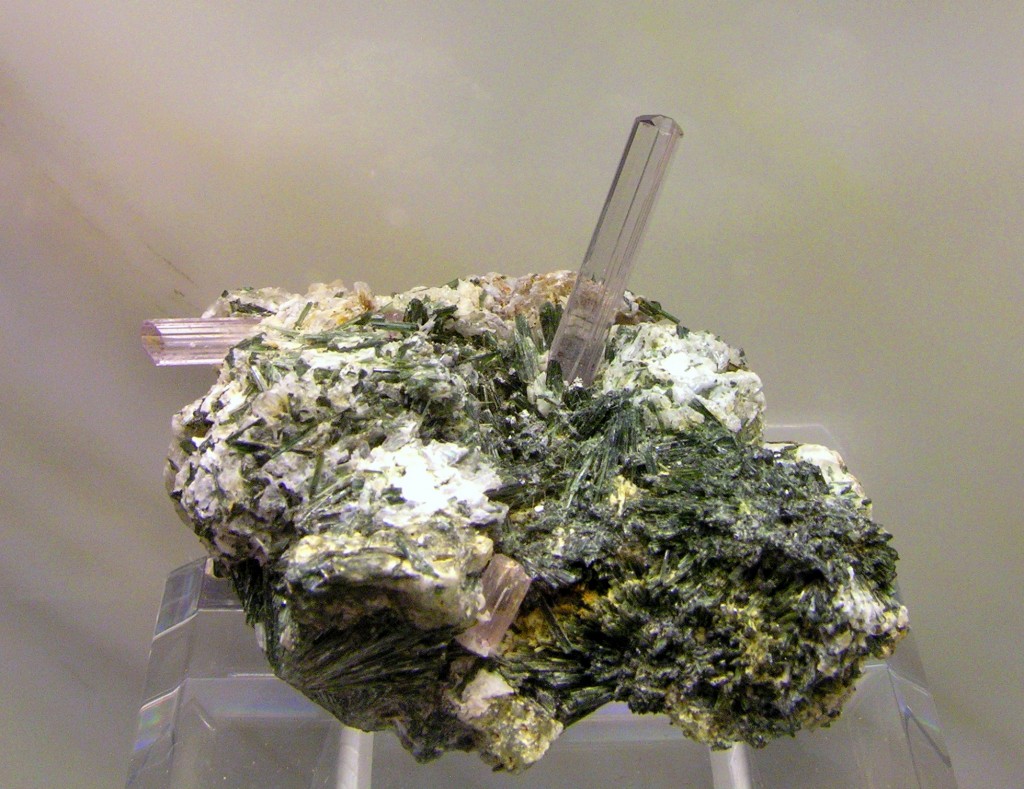
Photo: Marco Tomei / Wikimedia Commons
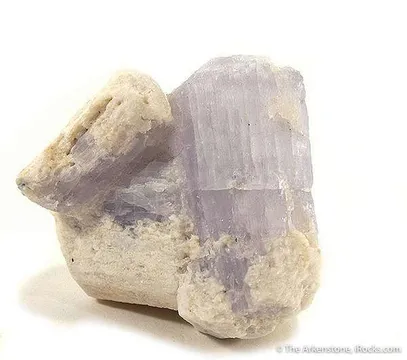
The visual appeal is immediate: slender tetragonal prisms, commonly striated lengthwise, rising from pale calcite, marble, feldspar, gypsum, or mixed calc-silicate matrix. Many pieces show a subdued but elegant lilac-pink to violet body color rather than the bright yellow, honey, or gray scapolites familiar from other gem localities. The finest crystals combine transparency, sharp terminations, glassy luster, and a delicate color that reads as lavender in daylight and can become surprisingly alive under ultraviolet light.
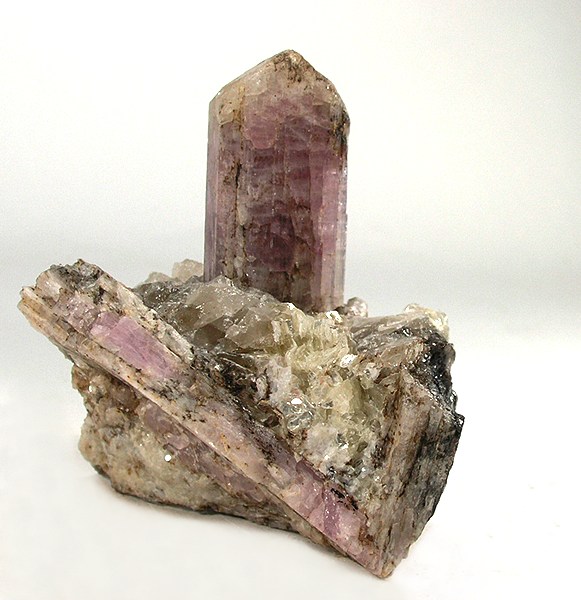
Photo: Rob Lavinsky, iRocks.com / Wikimedia Commons
Geologically, the appeal is deeper than color. Sar-e-Sang is a metamorphic and metasomatic system developed in ancient carbonate, evaporitic, pelitic, and mafic rocks of the Badakhshan block. Lapis lazuli bodies occur in calcite- and dolomite-marble with diopside skarn and forsterite-bearing calciphyre, and scapolite is one of the key halogen-bearing minerals recording the role of chlorine-rich, sulfur-bearing, carbonate-bearing fluids in the system. In other words, these crystals are not simply a peripheral curiosity of the lapis mines; they are one of the minerals that help explain why this small, difficult mountain district produced so many unusual sodium-, calcium-, chlorine-, sulfur-, and carbonate-bearing species.
For collectors, Badakhshan scapolite divides into several overlapping categories. There are purple to pink gem crystals on matrix; colorless to gray gem rough and cat’s-eye material; fluorescent marialite specimens that glow yellow, orange-yellow, or red depending on composition and wavelength; tenebrescent material that changes from near colorless to blue after ultraviolet exposure; and pseudomorphs or partial replacements in which orthoclase, lazurite, or uncertain blue phases preserve the original scapolite habit. The best pieces are judged not only by size and color, but by how much of this complicated Sar-e-Sang story they preserve in one specimen.
Search for specimens: View all scapolite specimens from Badakhshan, Afghanistan
The collector label “Badakhshan scapolite” usually points to the Kokcha Valley mineral district of northeastern Afghanistan, with Sar-e-Sang as the central name and Pitwak, Ladjuar Madan/Lajuar Madan, Dar-e-Zu, Sar-e-Sang River, and nearby unnamed meta-evaporite occurrences appearing on more specific labels. The spelling is variable in the literature and trade: Sar-e-Sang, Sar-i Sang, Sare Sang, Sary Sang, Kokcha, Koksha, Lajuar Madan, and Ladjuar Medam all occur. Good labels should be preserved, because the locality names record subtly different mineral environments within the same broader district.
The deposit type is best understood as a high-grade metamorphic and metasomatic lapis-lazuli/skarn/marble system, locally influenced by evaporitic components. Lapis bodies occur as lenses and layers in calcite- and dolomite-marble, with diopside skarn and forsterite-bearing calc-silicate rocks. Scapolite is especially at home in these halogen-rich calc-silicate assemblages, where it appears with minerals such as calcite, dolomite, diopside, phlogopite, forsterite, amphibole, apatite, titanite, gypsum, anhydrite, pyrite, lazurite, sodalite-group minerals, afghanite, haüyne, and orthoclase. The presence of anhydrite and gypsum, and the interpretation of some occurrences as remnants of ancient evaporitic beds or gypsum diapirs, is important for collectors because some marialite crystals occur in soft gypsum or show broken, rehealed, dissolved, or partially digested textures.
Mining history at Sar-e-Sang is overwhelmingly tied to lapis lazuli. The district has been worked since prehistoric antiquity and is one of the classic bridge localities between mineralogy, gemology, archaeology, and art history. Scapolite was long a background mineral in the lapis deposit descriptions, noted as part of the calcite-dolomite-silicate assemblage. It came into sharper collector focus through gem and mineral trade material from the early 2000s onward: tenebrescent colorless scapolite shown at Tucson in 2004, gem and cat’s-eye rough from the Lajuar Madan area obtained in 2015 and examined in 2016, and later specimen lots of purple marialite and fluorescent crystals from Pitwak and adjacent Sar-e-Sang occurrences.
The mining environment is remote and seasonal. Classic descriptions place the camp on the right bank of the Kokcha River around 2,500 meters elevation, with mine workings higher on the slopes, roughly 2,700 to 3,400 meters. Access historically depended on rough mountain routes, horses, donkeys, foot travel, and a narrow trail along the Kokcha gorge; the working season was constrained by climate and could be limited to only a few summer and autumn months. Blocks of lapis were brought down by hand and by pack animal, and old mining methods included fire-setting to fracture hard rock before modern use of explosives.
Collector access should be treated as closed in any practical sense for foreign collectors. These are active or historically worked mines in a remote mountain region with legal, security, land-rights, and safety issues. Specimens reach collectors through Afghan and Pakistani trade channels, European and North American dealers, auction houses, and older collections. For a serious collection, the best “field access” is documentation: keep original dealer labels, note whether a specimen is from Pitwak, Sar-e-Sang River, Lajuar/Ladjuar Madan, Dar-e-Zu, or an unnamed meta-evaporite occurrence, and do not collapse all material into a vague “Afghanistan” label.
Badakhshan scapolite is most often represented by marialite-rich scapolite, ideally Na4Al3Si9O24Cl, although gemological testing of some material has shown intermediate composition between marialite and meionite. In the collector-specimen literature and on Mindat, marialite is the confirmed scapolite species for important Sar-e-Sang material, while some older or trade identifications as meionite have been corrected or are treated cautiously. The safest language for an untested specimen is “scapolite group, probably marialite” unless Raman, PXRD, microprobe, or other analytical data are available.
The crystal habit is one of the locality’s great strengths. Crystals are typically tetragonal prisms with pyramidal terminations and pinacoid faces. Many show strong vertical striations, beveled edges, and elongated prismatic forms. Matrix specimens can have isolated crystals perched on marble, calcite, feldspar-rich matrix, gypsum, or calc-silicate material, or clusters of many small parallel to subparallel crystals. Fine single crystals may be stout and blocky, while the purple material often forms slender, transparent to translucent prisms.
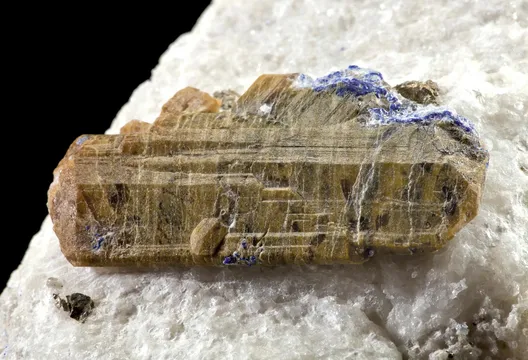
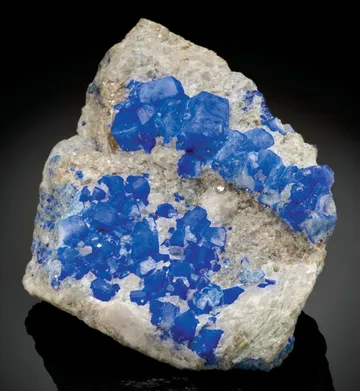
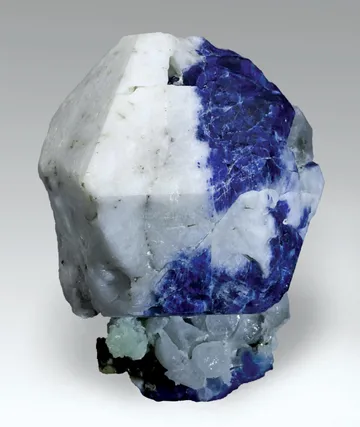
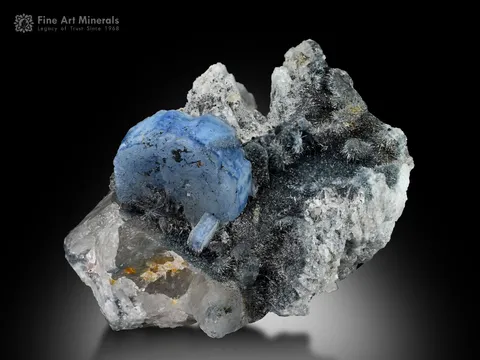
Colors range from colorless, white, and gray through pale lilac, pinkish purple, and deeper violet. Some specimens associated with alteration or replacement are pale blue to wedgewood blue, but those should not automatically be assumed to be blue scapolite: documented Sar-e-Sang material includes orthoclase pseudomorphs after marialite and blue replacements or coatings whose chromophore or mineral identity has required careful testing. This is one reason Badakhshan scapolite is especially interesting but also especially easy to mislabel.
Size varies by occurrence and specimen style. Many attractive matrix specimens show crystals from a few millimeters to around 1–3 cm. Documented collector pieces include 2.5 cm violet crystals on matrix, a 4.5 cm terminated purplish-pink crystal on scapolite matrix, and larger marialite crystals around 5 cm in gypsum or marble. Exceptional recorded pieces include a 7 cm crystal frozen in calcite and a marialite-on-afghanite specimen more than 12 cm tall in the Rob Woodside collection. In gem material, documented faceted and cabochon examples are small but significant: individual stones below a few carats may show transparency, gray coloration from inclusions, and in some cabochons a sharp cat’s-eye.
Fluorescence is a major collecting feature. Reported responses include bright yellow under long-wave ultraviolet in surviving marialite, yellow to orange-yellow fluorescence in some specimens, red short-wave fluorescence in purple scapolite, and complex multi-mineral responses when gypsum, calcite, sodalite, gonnardite, or other associated minerals are present. Tenebrescent pieces can change from near colorless to blue after ultraviolet exposure and fade back in light, sometimes within seconds. The phenomenon is part of the appeal, but it also creates a testing and treatment problem for collectors because irradiation can strengthen tenebrescence in some near-colorless scapolite without greatly changing its normal daylight appearance.
Associated minerals can be just as diagnostic as the scapolite itself. White calcite or marble gives the classic pale matrix; green to olive diopside produces strong color contrast; phlogopite contributes bronze to brown plates; gypsum and anhydrite point toward the evaporitic side of the district; pyrite and lazurite tie the specimen to the lapis system; orthoclase can replace or coat marialite; and afghanite, sodalite, haüyne, and gonnardite may appear in the broader Sar-e-Sang suite. A specimen with crisp purple scapolite, green diopside, and pale marble is visually different from a fluorescent marialite crystal in gypsum, and both are different again from a blue pseudomorph after scapolite.
Quality is governed by sharpness, integrity, color, luster, and documentation. For a daylight display specimen, collectors favor well-terminated, undamaged, transparent to translucent lilac or purple prisms on contrasting matrix. For a systematic collection, a verified marialite with analytical support or a specimen tied to Pitwak, Sar-e-Sang River, or a named Sar-e-Sang sublocality is more desirable than an attractive but vague “Afghanistan scapolite.” For a fluorescent collection, the quality factors shift toward strong long-wave yellow fluorescence, clear short-wave response, tenebrescence, phosphorescence, and a matrix that contributes rather than confuses the display.
Badakhshan scapolite is not a locality for casual identifications. Colorless material from the district has been sold or represented as zoisite; tenebrescent material was initially thought to be hackmanite; purple crystals may be traded simply as scapolite, marialite, wernerite, or even confused with sodalite-group minerals; and blue pseudomorphs after scapolite have been attributed in different contexts to lazurite, sodalite, haüyne, afghanite, orthoclase, or trace-element coloration. “Wernerite” is an obsolete trade/mineralogical term and should not be used as a final species name on a modern label.
The most important authenticity issue is not a flood of outright synthetic fakes, but a tangle of natural alteration, misidentification, and treatment ambiguity. Raman spectroscopy, PXRD, EDS/EDXRF, or microprobe data may be needed to distinguish marialite from other scapolite compositions and to separate scapolite from visually similar feldspathoids or pseudomorphs. If a specimen is sold as “meionite from Sar-e-Sang,” it deserves special scrutiny because important Sar-e-Sang entries have treated marialite as the confirmed scapolite species and corrected some meionite interpretations.
Treatment is particularly relevant for tenebrescent and near-colorless material. GIA examined Pitwak scapolite fragments in which half had reportedly been irradiated; the treated and untreated groups looked similar in normal light, but irradiation strengthened the tenebrescent blue response after ultraviolet exposure. That means a dramatic blue photochromic response is not by itself proof of treatment, and normal daylight appearance may not reveal the history. The prudent collector asks whether irradiation is known, suspected, or undisclosed, especially for colorless to pale material marketed for tenebrescence. For purple daylight specimens, ask the seller directly about treatment history and retain written disclosure.
Condition issues are common and should be judged with locality context. Scapolite has moderate hardness and imperfect to distinct cleavage, and elongated prisms can show chipped terminations, bruised edges, etched faces, and cleavage cracks. Matrix can be soft if gypsum is present, friable if altered, or sawn on the base from extraction and trimming. Some crystals from gypsum-bearing material show broken and rehealed ends or partial dissolution; these may be natural features of the occurrence rather than damage from handling, but they should still affect price and be described accurately.
Fluorescence can help evaluate a piece but can also mislead. Surviving marialite in altered crystals may fluoresce bright yellow under long-wave UV, while orthoclase replacement may not fluoresce. A crystal that keeps scapolite shape but lacks scapolite fluorescence may be a pseudomorph rather than intact marialite. Conversely, a complex matrix with sodalite, gypsum, calcite, or other fluorescent species can produce an impressive UV display that is not solely attributable to scapolite. A good fluorescent-mineral label should specify wavelength and response: long-wave, mid-wave, short-wave, tenebrescent color, phosphorescence, and whether the response is from the scapolite or the matrix.
Market availability is limited but active. Thumbnail and miniature purple marialite specimens appear periodically through specialist dealers and auctions; cabinet pieces and exceptional crystals are much less common. Recent offerings show that the material continues to move through the market, but the best pieces sell quickly and older collection examples with Rob Woodside, Herb Obodda, Dudley Blauwet, or established dealer provenance can command a premium. For most collectors, the sweet spot is a sharp 1–3 cm lilac to purple terminated crystal on contrasting white matrix with honest locality detail and no evasive treatment language.
The old Sar-e-Sang route reads like a mineralogical expedition from another century because it was one. Jean Wyart, Pierre Bariand, and Jean Filippi described journeys undertaken in 1964, 1967, and 1971 in search of homogeneous lapis material and a better understanding of the deposit. One route from Kabul ran by jeep from Charikar up the Panjshir Valley to Dasht-i-Rawat for about 160 km, then continued another 135 km on foot or by horse over Anjuman Pass. The alternative was longer: roughly 750 km from Kabul before the final approach, followed by a 40 km climb along the narrow, rough trail through the Kokcha gorges. These routes were practical only from June to November.
At the mine, the camp stood near the Kokcha River at about 2,500 meters elevation, while the workings rose higher on the mountain between roughly 2,700 and 3,400 meters. The miners worked hard rock in a steep, nearly vertical marble-and-skarn slope. Old workings still showed black smoke from ancient fire-setting: fires were built against the rock to fracture it. Later miners used dynamite. Lapis blocks were carried back down to camp on men’s backs and then taken onward by donkey. Waste rock was thrown from a small platform down to dumps 300 meters below in the Sar-e-Sang streambed. The same dumps and pale cipolin pieces that did not satisfy the lapis trade could hide crystallized treasures for the mineral collector.
The 2015 scapolite story begins far from the mine, during a buying trip to Pakistan. Dealer Dudley Blauwet obtained a parcel of colorless-to-gray rough represented to him as zoisite. The material reportedly came from Lajuar Madan in the Kokcha Valley. The etched crystals resembled zoisite from Alchuri in northern Pakistan, and some showed parallel inclusion features promising chatoyancy. Blauwet selected 80 pieces totaling 27.6 grams for cutting. By September 2015, the factory returned 60 faceted stones weighing 18.57 carats and 18 cat’s-eye cabochons weighing 8.94 carats. At the 2016 Tucson shows, two samples were loaned for study: a 0.76 ct colorless emerald cut and a 1.06 ct dark gray cat’s-eye cabochon. Testing showed that the “zoisite” was actually scapolite, with properties indicating an intermediate composition between marialite and meionite.
Another Tucson episode happened earlier, in 2004, when Herb Obodda showed GIA personnel rough and cut pieces of a colorless gem material from Badakhshan. Local dealers had been calling such colorless material “hackmanite,” even though the stone in front of the gemologists was not sodalite. Under a strong ultraviolet source, the pieces turned blue. In daylight or strong incandescent light, the color faded completely in seconds; the change was repeated on one stone at least five times with the same result. Chemical analysis showed marialite with a minor sulfide component, and the episode introduced many gem collectors to the startling fact that Afghanistan was producing tenebrescent scapolite, not merely tenebrescent sodalite.


_(30141933700).jpg)