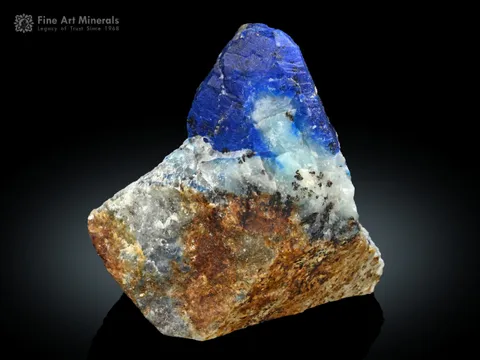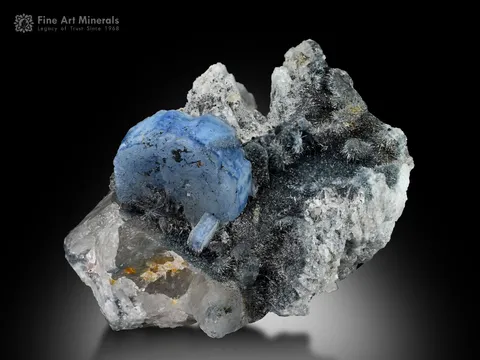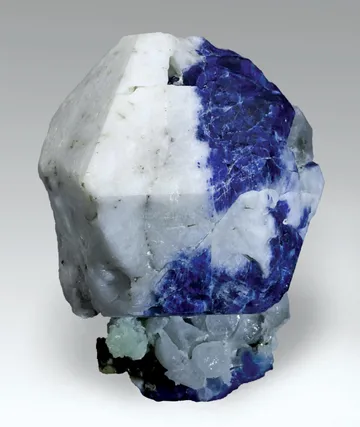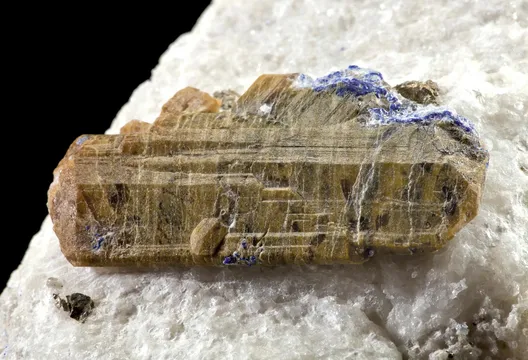
A collector's guide to Ladjuar Medam, Afghanistan: its geology, mining history and notable minerals, illustrated with the 80 specimens documented from this locality on EarthWonders.
Key facts
Ladjuar Medam is the collector’s name for the legendary lapis-lazuli workings at Sar-e-Sang in the Kokcha Valley of Badakhshan, northeastern Afghanistan. In Dari, Lajur Madan is simply the “Blue Mine,” an admirably plain name for one of the most storied mineral localities on Earth. For specimen collectors, however, this is much more than a source of carved lapis: it is a high-grade metamorphic and metasomatic marble-skarn system that has produced world-class crystals of lazurite, sodalite var. hackmanite, afghanite, richterite-group amphiboles, phlogopite pseudomorphs, and a suite of rare feldspathoids and calc-silicate minerals.
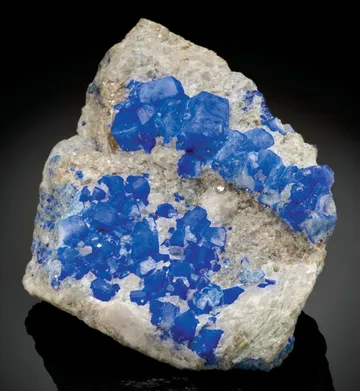
Geologically, the deposit belongs to the high mountains of the Hindu Kush, on the east side of the Kokcha River near Sar-e-Sang. The lapis bodies occur in calcite- and dolomite-rich marbles, calciphyres, and skarns associated with diopside, scapolite, forsterite, phlogopite, pyrite, and sodalite-group minerals. The best specimens have the unmistakable Sar-e-Sang look: saturated royal-blue to midnight-blue crystals set starkly in white calcite or marble, often sharpened visually by brassy pyrite and, in rarer pieces, by lavender hackmanite or pale to deep-blue afghanite.
The locality’s historical weight is almost without equal among mineral-specimen sources. Sar-e-Sang lapis was traded across Asia and the Near East in antiquity, appears in archaeological discussions of Mesopotamia, Egypt, and the Indus world, and was admired long before mineralogy had names for lazurite, afghanite, sodalite, or richterite. Modern collectors value the locality for a different reason: among the old carving-stone mines, loose blocks, replacement textures, and marble pockets occasionally yielded true crystal specimens rather than merely massive lapis.
Regional View
Country View
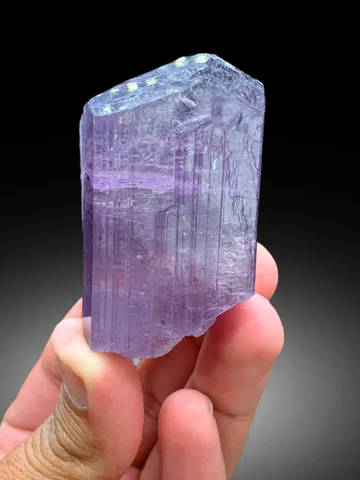
The best Ladjuar Medam specimens are not subtle. A fine lazurite can show bold rhombic-dodecahedral form and a saturated blue surface rising from white marble like enamel against porcelain. Hackmanite from the richterite occurrence adds a second personality: grey, lilac, greenish, or pale violet in ordinary light, then yellow-orange, pink, or white under UV, with notable tenebrescence and afterglow in the better pieces. Afghanite, the locality’s namesake type-locality mineral, ranges from pale, chalky, or colorless material to handsome blue hexagonal prisms, some translucent on the edges. The locality rewards the collector who looks carefully at texture: blue coatings that preserve mica books, pale amphibole prisms threading calcite, and blue feldspathoids partly replacing one another are often more interesting than a simple lump of fine lapis.

Photo: Wikimedia Commons
Search for specimens: View all specimens from Ladjuar Medam, Afghanistan
Ladjuar Medam lies in the Sar-e-Sang area of Kuran wa Munjan District, Badakhshan Province, Afghanistan, in the high Hindu Kush above the Kokcha River. The old mine camp was described at roughly 2500 m elevation, with workings higher on the mountainside, around 2700–3400 m. The locality coordinates used in modern mineral databases place the deposit near 36.21° N, 70.80° E. Labels vary widely: Ladjuar Medam, Lajur Madan, Lapis-lazuli Mine, Sar-e-Sang, Sar-i Sang, Sare Sang, Sary Sang, Kokcha Valley, and Koksha Valley all occur in the literature and mineral trade.
The deposit is a lapis-lazuli-bearing marble and skarn system developed in high-grade metamorphic rocks of northeastern Afghanistan. The host sequence includes gneiss, carbonaceous marble, calciphyre, crystalline schist, amphibolite, and skarn, cut locally by granitic and mafic intrusions. The lapis bodies are lenses, layers, and skarn zones in calcite- and dolomite-rich marble, commonly associated with diopside, scapolite or marialite, forsterite, phlogopite, pyrite, sodalite-group minerals, and rarer feldspathoids. Published descriptions give ordinary skarn lenses on the order of one to several metres thick, with some reported lapis-bearing zones extending tens to hundreds of metres laterally.
The mineralization reflects a strongly metamorphosed carbonate-evaporite environment modified by metasomatic fluids. Modern petrologic work on scapolite-bearing rocks from Sare Sang found high-pressure amphibolite-facies conditions, with peak estimates around 750°C and 1.3–1.4 GPa. That is why the locality’s assemblage is so distinctive: it combines carbonate-marble minerals, calc-silicate skarn minerals, chlorine- and sulfur-bearing feldspathoids, scapolite, amphiboles, mica, and sulfides. For the collector, the key visual result is the classic blue-white-gold triad of lazurite, calcite or marble, and pyrite, with the rarer lavender, greenish, yellow, and pale-blue phases appearing in pockets and replacement zones.
Historically, the mines were worked for lapis lazuli rather than for mineral specimens. Early accounts describe the hard rock being fractured by fire-setting, with wood fires built against the quarry face before workers hammered and levered away blocks. Later work used explosives. Detached lapis masses could weigh many kilograms, although large blocks were not necessarily homogeneous; the most desirable carving material was intensely blue, compact, and low in calcite veining or fractures. Specimen crystals often came not from the finest carving blocks but from discarded or less uniformly colored marble and skarn, where open spaces, replacements, or softer contacts allowed individual crystals to be exposed.
Production has fluctuated with season, access, politics, and conflict. The workings are remote, snowbound or difficult for much of the year, and historically were accessible only during a limited season. Before the Soviet occupation period, published gemological accounts described roughly one ton of lapis lazuli being extracted annually, with a small fraction sorted as the highest jewelry grade. In the modern era, control of Badakhshan’s lapis trade has been complicated by official contracts, local powerbrokers, illegal extraction, insurgent taxation, and changing government authority. For collectors, that history matters: old-stock material, specimens from Pakistani or Afghan dealers, and newer market pieces may all carry imprecise locality labels, and ethical provenance can be as important as species identification.
Collecting access today should be regarded as closed to casual collectors. Ladjuar Medam is not a roadside collecting site; it is an active or intermittently active mining district in difficult terrain, with legal, security, and mineral-rights issues. Serious field access requires permission from the appropriate authorities and rights holders, as well as local logistical support. Most collector specimens reach the market through Afghan and Pakistani trading channels, old dealer stock, dispersals of study collections, and specimens sold under broader “Sar-e-Sang,” “Kokcha Valley,” or “Badakhshan” labels.
Notable specimen-producing material includes the classic lazurite-in-white-marble pieces, afghanite-bearing calcite and lazurite assemblages, hackmanite and sodalite specimens from the richterite occurrence, and pseudomorphs in which blue lazurite or haüyne-group material preserves the form of phlogopite mica books. The mid-2000s were especially important for sodalite-group and richterite-associated material entering Western collections, and early 2000s afghanite finds brought unusually attractive blue crystals to the mineral market. The very best pieces combine scientific interest with display power: a sharp crystal, clear locality style, contrasting matrix, and enough preservation to show the original growth or replacement texture.
Sodalite from Ladjuar Medam is most prized as hackmanite from the richterite occurrence, where it occurs in crude to sharp dodecahedral crystals, commonly with trapezohedral modifications, embedded in or perched on calcite-rich marble and associated with richterite or fluoro-richterite, phlogopite, pyrite, pyrrhotite, and occasional tiny uranium-bearing black grains. Colors range from clear, white, grey, and greenish to lilac and purple, with the finest pieces showing saturated purple or pinkish-purple crystal groups, glassy translucency, and strong UV response. Some of the largest and best sodalite crystals from the occurrence have been reported to about 5 cm, but many specimens are contacted where crystals grew embedded in marble rather than freely in open cavities. The collector distinction here is not merely color: a superior Ladjuar Medam sodalite shows sharp form, attractive calcite or richterite contrast, convincing tenebrescence or phosphorescence, and minimal bruising or recutting on the exposed crystal faces.
Lazurite is the signature blue mineral of Ladjuar Medam lapis, occurring as massive blue zones in marble-skarn lenses and, far more desirably for collectors, as well-formed royal-blue to midnight-blue crystals in white calcite or marble with pyrite. Classic crystals are rhombic dodecahedra, sometimes modified by cube and octahedral faces, and documented examples reach about 5 cm across; most available pieces are smaller, contacted, or partly embedded. The finest specimens show a saturated ultramarine color, sharp geometric outline, bright contrast against white calcite, and a natural arrangement of pyrite that enhances rather than clutters the piece. Replacement specimens add another collecting category: lazurite may coat or pseudomorph phlogopite mica, preserving pseudohexagonal mica-book forms and sometimes leaving amber-brown phlogopite visible in the core or at the terminations.
Calcite at Ladjuar Medam is both a major host mineral and the stage on which the locality’s blue species perform. It forms the white crystalline marble and coarse calcite matrix that encloses lazurite, afghanite, sodalite, pyrite, phlogopite, diopside, and scapolite-group minerals, and in some sublocality material it appears as simple rhombs or granular marble rather than as isolated showy calcite crystals. Collector-quality calcite specimens from here are valued less for calcite as a standalone species than for matrix character: bright white, clean, crystalline calcite that contrasts sharply with blue lazurite or afghanite is far more desirable than stained, massive, fractured, or sawed matrix. Under UV, calcite in some assemblages may show red to whitish fluorescence, but responses vary by specimen and associated phases, so the best pieces are judged first by form, contrast, and preservation.
Richterite-group amphiboles from the Ladjuar Medam richterite occurrence are important accessory-display minerals rather than common matrix filler. They have been reported as terminated prisms, colorless to yellow-brown, and as translucent white prismatic crystals to a few centimetres; some material initially called winchite or richterite has been shown by analysis to be potassian fluorine-bearing richterite or fluoro-richterite. The best collector pieces place pale, glassy amphibole crystals in direct contrast with lavender or purple hackmanite, producing an unusually elegant Afghanistan assemblage very different from ordinary lapis lazuli. Quality depends on clean prismatic form, visible terminations, analytical confidence, and association: richterite with sharp hackmanite in calcite is much more desirable than loose, ambiguous pale amphibole without documentation.
Afghanite is one of Ladjuar Medam’s great mineralogical distinctions: the Sar-e-Sang lapis-lazuli deposit is the type locality for the species, described in 1968 from material associated with lazurite. At the locality it occurs as thin veinlets cutting lazurite, as grains or crystals in calcite-rich marble, and as terminated hexagonal prisms ranging from colorless or white through blue-grey to rich blue. Fine collector pieces show deep-blue prismatic crystals, sometimes translucent along edges or near terminations, on calcite or lazurite with pyrite; early-2000s finds brought especially attractive deep-blue crystals into Western collections. Afghanite also participates in replacement textures, including specimens partly replaced or coated by lazurite, so the best Ladjuar Medam examples combine clear hexagonal habit, strong blue color, minimal repair, and a readable association with the classic lapis assemblage.
Phlogopite is a characteristic mica of the Ladjuar Medam calc-silicate and marble assemblage, reported in the lapis-bearing zones and sometimes forming well-shaped crystals up to about 2 cm in the classic descriptions. In hand specimens it is most familiar as amber-brown to bronze mica books in calcite or as the original mineral whose pseudohexagonal form has been preserved by lazurite replacement. The most interesting pieces are partial pseudomorphs: blue lazurite or haüyne-group material coats or replaces a phlogopite book while leaving mica visible at the core, edges, or terminations. For collectors, a good phlogopite-bearing specimen from this locality should show the mica clearly rather than merely list it on a label, and the best examples document the replacement relationship with sharp pseudohexagonal outline, blue coating, white calcite matrix, and small pyrite accents.
Other minerals documented from Ladjuar Medam and its immediate sublocalities include haüyne, marialite, nepheline, diopside, hedenbergite, omphacite, forsterite, monticellite, grossular, spinel, fluorapatite, chlorapatite, titanite, pyrite, pyrrhotite, molybdenite, native sulfur, colusite, fluoro-richterite, and uranium-bearing thorianite-uraninite series grains. Afghanite is the best-known type-locality mineral, while lazurite and the sodalite-group minerals from Sar-e-Sang remain central to the locality’s scientific identity because their chemistry records the unusual sulfur-, chlorine-, carbonate-, and evaporite-influenced metamorphic environment. Rarer collector names from the district should be treated cautiously unless accompanied by analytical work, because visually similar blue feldspathoids and pale amphiboles are easily confused.
Ladjuar Medam specimens demand careful labeling. “Lapis lazuli,” “lazurite,” “haüyne var. lazurite,” “sodalite,” and “hackmanite” are often used loosely in trade descriptions, and the blue minerals can be difficult to separate by eye. Massive lapis is a rock, not a single mineral species; it may include lazurite or haüyne-group blue material, calcite, diopside, pyrite, afghanite, sodalite, and other phases. A specimen sold as “lazurite” should ideally show crystal form, reliable provenance, or analytical support. A specimen sold as “sodalite var. hackmanite” should be checked for tenebrescence, fluorescence, and, where value is high, analytical confirmation.
Mislabelling is common at several levels. Afghanistan material may appear under Pakistan labels because many specimens have historically moved through Pakistani trading centers. Sar-e-Sang, Kokcha Valley, Ladjuar Medam, Lapis Mine, and Badakhshan may be used interchangeably even when a piece came from a specific sublocality such as the richterite occurrence, Dar-e-Zu, or an unnamed sodalite occurrence. Older labels may call phlogopite “muscovite,” or call richterite “winchite,” and some amphiboles in the assemblage require modern analytical work to distinguish richterite, fluoro-richterite, and potassian fluorine-bearing variants.
Condition is a major issue. Many blue crystals grew embedded in marble, so back contacts, broken rear faces, and sawn or trimmed matrix are normal. The front of a fine specimen should still show natural luster and geometry. Watch for repolished blue faces, oiled or waxed massive lapis, glued tips, crude repairs, filled cracks, and matrix that has been carved or sanded to create an artificial display surface. Calcite and marble are relatively soft and acid-sensitive; avoid acid cleaning. Pyrite is usually stable in fine specimens, but any sulfide-rich, fractured, or damp-stored piece should be kept dry.
For hackmanite and other fluorescent pieces, light history matters. Afghan hackmanite can darken to purple after UV or sunlight and fade under visible light; different specimens respond at different rates. Collectors who value UV behavior should ask for photos in ordinary light, longwave UV, shortwave UV, and afterglow, with the specimen rested between exposures if possible. Longwave yellow-orange fluorescence, shortwave pink responses, white afterglow, and tenebrescent purple coloration are all reported from Sar-e-Sang sodalite-group material, but they are not universal. Display under strong sunlight may temporarily change the color of hackmanite and can complicate comparison between specimens.
Authenticity concerns are especially important for massive lapis. The gem trade has long seen lapis substitutes and imitations, including glass, dyed stones, reconstructed material, synthetic or imitation lapis products, and mixtures using pyrite fragments. For carved or polished objects, dye concentrations in fractures, unnatural uniformity, plastic-like texture, or pyrite that looks sprinkled rather than naturally included are warning signs. For collector crystals, the bigger concern is usually not outright fake blue mineral, but wrong species name, enhanced surfaces, repair, or vague locality attribution.
Market availability is uneven. Massive Sar-e-Sang lapis remains familiar in the gem and carving trade, but fine crystals from Ladjuar Medam are much less common. Good lazurite-on-white-marble specimens, sharp hackmanite with richterite, and deep-blue afghanite crystals command strong prices when the aesthetics are clean and the label is credible. Study-grade pieces with contacts, mixed feldspathoids, or uncertain species names remain available, but the best specimens have largely passed into established collections and reappear mainly through auctions, old-stock dealers, and collection dispersals.
In December 1838, Captain John Wood reached the Sar-e-Sang lapis mines while searching for the source of the Oxus. The scene he described is still one of the most vivid accounts ever written of a classic mineral locality. The Kokcha valley, at the lapis deposit, was only about 200 yards wide, hemmed in by high, bare mountains. The entrance to the mine was cut into the mountain face on the right bank of the stream, roughly 1,500 feet above the water. It was not a romantic grotto but a hard, hazardous working: black-and-white limestone, steep approach, no soil, no vegetation, and a path made dangerous as much by neglect as by terrain.
Inside, Wood found a shaft about ten feet square leading down to an eighty-pace gallery. The passage descended gently, then ended in a hole about twenty feet across and twenty feet deep. In places, roof falls had narrowed the gallery so badly that a visitor had to go forward on hands and knees. One spot in the mine carried the memory of miners crushed by falling rock. No pillars had been left to support the roof. The whole excavation, in Wood’s telling, was a place where more work could continue only at “the most imminent risk to the miners.” At the far end, he recorded the temperature as 36°F, compared with 29°F at the entrance.
The mining method was simple and ancient. Workers built a fire under the rock they wanted to quarry, feeding the flame with dry furze until the heated stone could be attacked with hammers. When the workers’ target appeared, they picked grooves around the blue stone, inserted crowbars, and detached the lapis with part of its matrix. Wood recorded three trade grades by local color name: Neeli, the indigo material; Asmani, the light blue; and Suvsi, the green. Their value followed that order. Even in that early account, the collector’s eye recognizes the same judgments still used today: depth of blue, purity, and the balance between attractive matrix and unwanted impurity.
The logistics of Sar-e-Sang were never gentle. Twentieth-century visitors described two main approaches from Kabul. One route went by jeep toward the Panjshir and then required the final leg by foot or horse over the Anjuman Pass. The other, longer route passed through Kunduz, Khanabad, Taloqan, Feyzabad, and Jarm before ending in a rough trail along the Kokcha gorges. From Hazrat-Said, roughly 40 km of narrow mountain track remained. At the mines, blocks were carried down from the workings on men’s backs before donkeys could take over. That physical fact explains something about the specimens: large, perfect, delicate pieces had to survive not only blasting and extraction, but a mountain descent by hand.
The scientific rediscovery of the district has its own charm. In the 1960s and early 1970s, French mineralogists Jean Wyart, Pierre Bariand, and Jean Filippi studied the Sar-e-Sang lapis and its mineralogy. Their work bridged archaeology, gemology, and crystallography: the same blue material that had traveled to ancient cities was now being examined as a sodalite-group mineral assemblage formed in a complex metamorphic environment. Bariand’s collecting helped bring afghanite to science. In 1968, Pierre Bariand, Fabien Cesbron, and Roger Giraud described afghanite as a new mineral species from Sar-e-Sang, fixing Ladjuar Medam permanently in the type-locality literature.
A later chapter belongs to collectors. In the early 2000s, deep-blue afghanite crystals began appearing more visibly in the Western market. Some were elongated hexagonal prisms with slightly rounded edges, pyramidal terminations, and patches of translucency; a few were good enough to shift afghanite from an obscure rare-species name into a display-specimen mineral. Around the same broad period, unusual sodalite and hackmanite specimens from the richterite occurrence began drawing attention: lavender, grey, greenish, and purple crystals, some associated with pale richterite-group amphiboles, and some with optical behavior that made them change character under UV light. These finds widened the meaning of “Sar-e-Sang specimen” beyond lazurite and lapis.
The locality’s modern story is also inseparable from conflict minerals. Reports in the 2010s described official contracts, local commanders, illegal extraction, armed-group taxation, and collapsing or volatile lapis prices. For collectors, the lesson is not abstract. A beautiful blue specimen from Ladjuar Medam may carry 6,000 years of human admiration, but it may also carry a recent chain of custody that deserves scrutiny. The finest collecting now combines mineralogical appreciation with responsible provenance: old labels, known collections, dealer transparency, and avoidance of material whose recent path cannot be explained.
Bariand, P., Cesbron, F., and Giraud, R. (1968). “Une nouvelle espèce minérale: l’afghanite de Sar-e-Sang, Badakhshan, Afghanistan. Comparaison avec les minéraux du groupe de la cancrinite.” Bulletin de la Société Française de Minéralogie et de Cristallographie, 91, 34–42. The original description of afghanite, the key type-locality mineral from Sar-e-Sang/Ladjuar Medam.
Blaise, J., and Cesbron, F. (1966). “Données minéralogiques et pétrographiques sur le gisement de lapis-lazuli de Sar-e-Sang, Hindou-Kouch, Afghanistan.” Bulletin de la Société Française de Minéralogie et de Cristallographie, 89, 333–348. A foundational French mineralogical and petrographic study of the Sar-e-Sang lapis deposit.
Wyart, J., Bariand, P., and Filippi, J. (1981). “Lapis-Lazuli from Sar-E-Sang, Badakhshan, Afghanistan.” Gems & Gemology, 17(4), 184–190. A classic gemological and geological account, including access, mining methods, lapis lenses, lazurite crystals, and commercial sorting.
Faryad, S. W. (2002). “Metamorphic Conditions and Fluid Compositions of Scapolite-Bearing Rocks from the Lapis Lazuli Deposit at Sare Sang, Afghanistan.” Journal of Petrology, 43(4), 725–747. The key modern petrologic paper on metamorphic conditions and fluid compositions in the scapolite-bearing Sar-e-Sang assemblage.
Schreyer, W., and Abraham, K. (1976). “Three-stage metamorphic history of a whiteschist from Sar e Sang, Afghanistan, as part of a former evaporite deposit.” Contributions to Mineralogy and Petrology, 59, 111–130. Important for understanding the evaporitic component and high-grade metamorphic history of the Sar-e-Sang district.
Yurgenson, G. A., and Sukharev, B. P. (1985). “Localization of Lapis Lazuli Bodies of Badakhshan and Their Mineral Zonation.” International Geology Review, 27, 230–237. A deposit-scale treatment of the distribution and zonation of Badakhshan lapis bodies.
Hogarth, D. D. (1979). “Afghanite: new occurrences and chemical composition.” The Canadian Mineralogist, 17, 47–52. A useful follow-up on afghanite chemistry and occurrences, including Afghan material.
Woodside, R. M., and Moore, T. P. (2014). “Famous mineral localities: The Sar-e-Sang lapis mines, Kuran Wa Munjan district, Badakhshan Province, Afghanistan.” The Mineralogical Record, 45(3), 280–336. The major collector-oriented locality treatment frequently cited in modern Sar-e-Sang mineral entries.
Handbook of Mineralogy: Afghanite. Concise reference data for afghanite, including occurrence in veinlets cutting lazurite crystals at Sar-e-Sang.
Mindat locality page for Ladjuar Medam, Sar-e-Sang, Kuran wa Munjan District, Badakhshan, Afghanistan. The central locality record for coordinates, synonyms, sublocalities, species list, references, and specimen photographs.
“Lapis Lazuli Mines, Afghanistan” — SOPA Images. Photojournalistic gallery from the Badakhshan lapis mines, valuable for seeing the remote mining landscape and 2016 mine setting.
“The Sar-e-Sang Lapis Lazuli Deposit” — International Union of Geological Sciences Geoheritage Sites. Geoheritage profile with locality images and a concise geological summary placing Sar-e-Sang among globally significant geological sites.
Mindat: Ladjuar Medam, Sar-e-Sang, Afghanistan — The most useful single online locality page for mineral list, coordinates, sublocalities, references, and specimen data.
GIA: “Lapis-Lazuli from Sar-E-Sang, Badakhshan, Afghanistan” — Classic gemological article covering the deposit, mining access, mineral assemblage, and lapis quality categories.
IUGS Geoheritage: The Sar-e-Sang Lapis Lazuli Deposit — Clear geoheritage overview tying mineralogy, metamorphic petrology, and archaeology together.
Daniel Russell: “Mining Lapis in 1838” — Readable presentation of Captain John Wood’s 19th-century account of the Sar-e-Sang mines.
Peter Bancroft: “Lapis Lazuli from Afghanistan” — Collector-oriented classic account reprinted from Gem and Crystal Treasures.
Global Witness: “War in the Treasury of the People” — Essential background on modern conflict, illegal mining, and governance issues surrounding Badakhshan lapis.
Fluorescent Mineral Society: Afghanite Crystal from Ladjuar Medam — Useful reference for UV-active afghanite from the locality.
Fluorescent Mineral Society: Sodalite Crystal with Richterite — Practical UV and tenebrescence observations for Afghan sodalite/hackmanite with richterite.