






Sar-e-Sang, Afghanistan — renowned lapis lazuli locality in the Hindu Kush, prized for ultramarine lazurite crystals and rare blue feldspathoid assemblages for…
Key facts
Sar-e-Sang is the great lapis locality: a high, remote cluster of workings in the Kokcha Valley of Badakhshan where blue feldspathoid mineralization cuts through marble, skarn, and calc-silicate rocks of the eastern Hindu Kush. For collectors, its importance is twofold. It is the ancient source of the finest lapis lazuli known to the civilizations of Mesopotamia, Egypt, Persia, India, and later Europe; and it is also a serious specimen locality, capable of producing sharp royal-blue lazurite crystals, blue afghanite, sodalite-group minerals, phlogopite, pyrite, calcite, scapolite, diopside, forsterite, and a scatter of rare associated phases that reward careful study.
The deposit is not a simple vein of “blue stone.” Sar-e-Sang lapis occurs in lens-like bodies and layers in calcite- and dolomite-marble, closely associated with diopside skarn and forsterite-bearing calciphyre. The best geological interpretations point to metasomatic reactions involving carbonate rocks, granitoid-related fluids, and evaporitic components: in plain collector language, sulfur- and chlorine-bearing fluids remade parts of the marble-skarn sequence into one of the richest blue feldspathoid assemblages on Earth.
Regional View
Country View
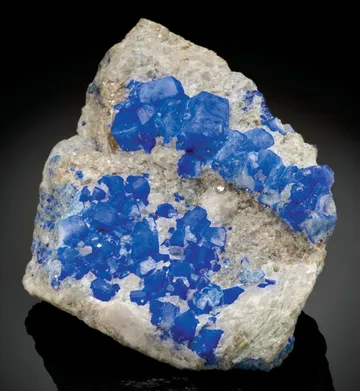
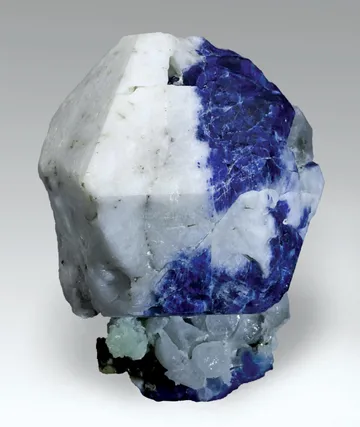
The visual signature is unmistakable when the piece is good: saturated ultramarine to violet-blue feldspathoid crystals or massive lapis set against white calcite or marble, often with brassy pyrite scattered like metallic dust or assembled in small blebs and seams. The finest crystallized lazurite specimens are not merely decorative; they show well-formed equant crystals, commonly rhombic dodecahedral in aspect, rising from pale carbonate matrix. Such pieces are rare because the mine’s main purpose has always been lapidary lapis, not specimen collecting, and because many crystals are recovered from waste rock and dumps rather than deliberately saved from pockets.
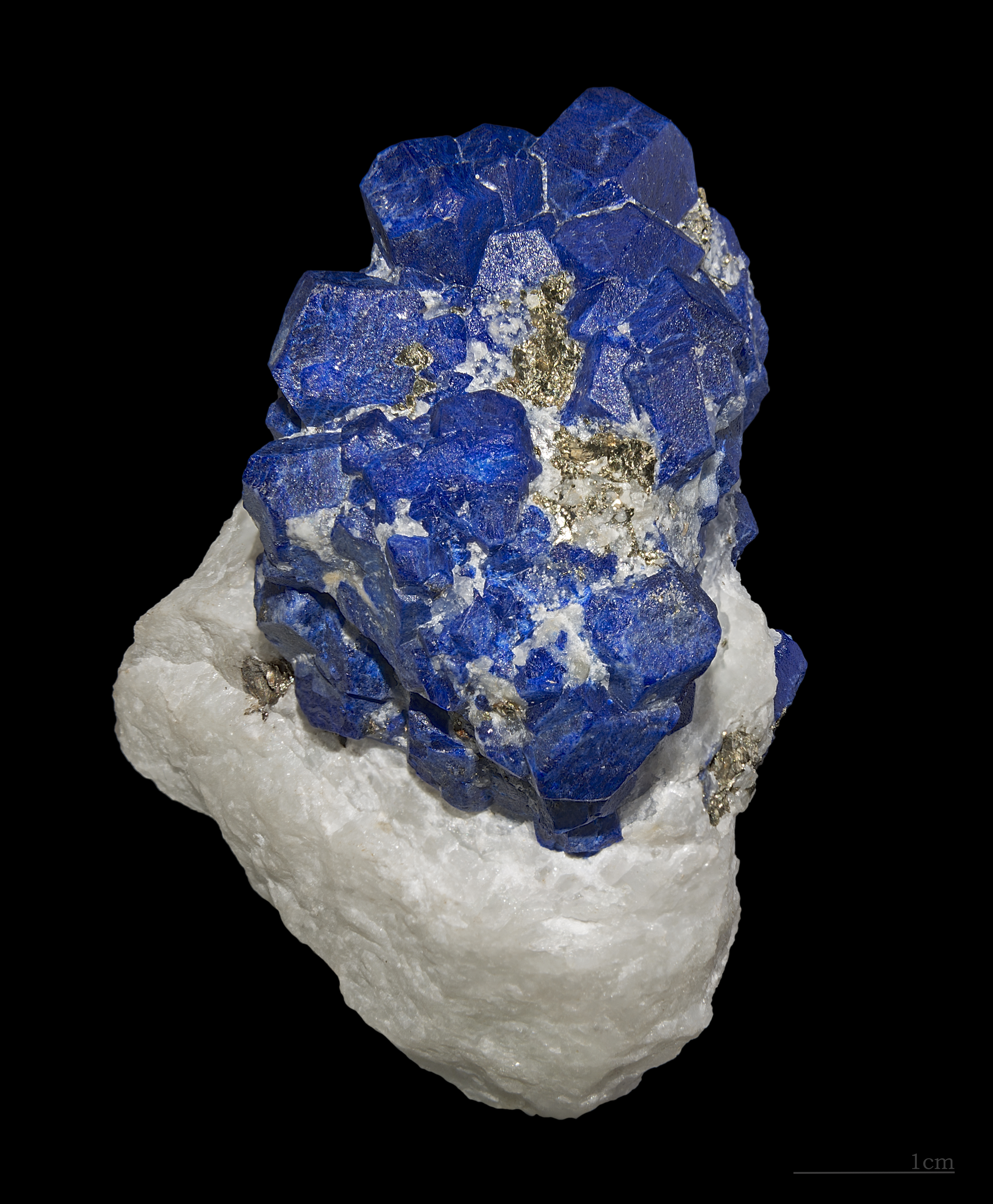
Photo: Wikimedia Commons
A Sar-e-Sang cabinet specimen at its best has contrast, form, and history in the same hand: deep blue crystals, snowy calcite, bright pyrite, and a provenance tied to one of the oldest working gem-mineral localities in human commerce. Even a modest thumbnail from Sar-e-Sang carries that ancestry; a top lazurite or afghanite association from the district is a centerpiece.
Search for specimens: View all specimens from Sar-e-Sang, Afghanistan
Sar-e-Sang lies in the Kuran wa Munjan area of Badakhshan, in northeastern Afghanistan, on the east side of the Kokcha River. Older mineral labels may use a range of spellings and place names: Sar-i-Sang, Sare Sang, Sar Sang, Kokcha or Kokscha Valley, Ladjuar Medam, Lajur Madan, Lapis-lazuli Mine, Pitwak, Petawuk, Chelemuk, Junduk, or simply “Badakhshan.” For collectors, the most useful practical distinction is between the broad Sar-e-Sang district and named mines or occurrences within the lapis-bearing belt.
Geologically, the locality sits in a high-grade metamorphic terrane of the Hindu Kush, with gneiss, crystalline schist, amphibolite, marble, cipolin, skarn, leucocratic granite veins, and mafic to ultramafic dikes reported from the complex. The lapis bodies occur in a gray skarn band within white carbonate rocks. Classic field descriptions describe skarn beds and lenses generally 1–2 meters thick, locally thicker, extending laterally tens to hundreds of meters. Later summaries of the Badakhshan bodies record lazurite-bearing zones from about 0.7–1 meter to 6 meters thick, with lengths on the order of 70–450 meters.
The mineralization is zoned. Productive lapis is developed in carbonate-calc-silicate rock: calcite and dolomite with diopside, forsterite, scapolite, phlogopite, and pyrite, plus the sodalite-group and cancrinite-group feldspathoids that make Sar-e-Sang so distinctive. In large lenses, the better blue zones may be concentrated inward, with marginal assemblages richer in calcite, diopside, forsterite, and pyrite. The presence of pyrite is more than aesthetic; sulfur is central to the formation and color of the blue feldspathoids, and old studies repeatedly note that deeper blue material tends to correlate with sulfur-rich compositions and pyrite-bearing zones.
Mining has taken place for thousands of years. Ancient lapis from Badakhshan moved westward into Mesopotamia and Egypt, eastward into Central Asian and Chinese trade routes, and eventually into European pigment history as ultramarine. By the twentieth century, Sar-e-Sang was still being worked in essentially mountain-mining fashion. The camp was described near the Kokcha River at roughly 2,500 meters elevation, with workings higher on the mountain; other modern remote-sensing summaries place the settlement at about 2,400 meters and nearby mining sites around 2,500–2,750 meters, while older geological descriptions give some workings up to about 3,400 meters. The seasonal window has always been narrow because of snow, elevation, and access.
The traditional extraction method was fire-setting: wood fires were built against the hard rock so that sudden heating and cooling cracked the marble and skarn enough for picks and hammers. In modern times, dynamite and, where possible, powered drills have replaced the fires. Blocks of lapis were historically carried down by men and then moved by pack animals toward Hazrat-Said, Jarm, Feyzabad, and Kabul. The same physical reality still governs the specimens: the mine is steep, remote, and logistically difficult, and material is commonly sorted as lapidary rough before mineral specimens are recognized.
Named workings matter. Junduk has been reported as one of the larger, more reliable production sites, commonly yielding lower to lower-middle quality lapis but on a scale attractive to traders. Smaller or riskier shafts such as Chelemuk, Petawuk, Jeruk, and numbered mines have been reported as capable of better stone, but less predictable output. Pitwak and Ladjuar Medam are especially important names on specimen labels because many collectible feldspathoid associations—lazurite, afghanite, sodalite-group material, calcite, pyrite, mica, and scapolite—are attached to those sublocality names.
Collecting access today is not comparable to an open public collecting locality in Europe or North America. Sar-e-Sang is an active, remote Afghan mining district with complex local control, political risk, security concerns, and legal/export complications. Responsible collectors should assume that access is restricted, that direct field collecting is impractical without legitimate local authority, and that the market supply arrives through Afghan and Pakistani trading networks rather than through hobby collecting trips. Since the 2000s and especially after 2014, investigations have documented armed-group involvement, disputed concessions, smuggling, and conflict-finance concerns around Badakhshan lapis. Provenance, chain of custody, and date of export are therefore not minor ethical details; they are part of the specimen’s documentation.

Photo: Wikimedia Commons
Specimen finds from Sar-e-Sang are usually tied to two circumstances: blue crystals liberated or noticed in pale carbonate waste, and lapis-bearing blocks broken during ore extraction. The classic crystallized lazurite crystals reaching about 5 cm came from such hard carbonate-skarn material, and the best modern collector pieces still show that same anatomy—blue feldspathoid on white calcite or marble, with pyrite and mica as accents rather than distractions.
Sar-e-Sang lazurite is the locality’s visual and historical heart: deep royal-blue to violet-blue feldspathoid occurring as massive lapis, granular zones, and rare well-formed crystals in calcite- and dolomite-marble skarn. Classic descriptions record single crystals to about 5 cm, commonly dominated by rhombic dodecahedral 110 form and locally accompanied by cube faces; such crystals are rare because the mining targets carving rough rather than pockets. The strongest specimens combine saturated blue color, obvious crystal form, and clean white calcite or marble matrix with bright pyrite and minimal bruising. Ordinary pieces are massive, veined, or chalky with too much white carbonate; excellent pieces have the unmistakable Sar-e-Sang contrast of ultramarine crystals, white matrix, and discreet golden pyrite.
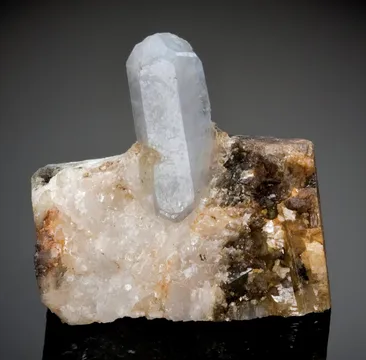
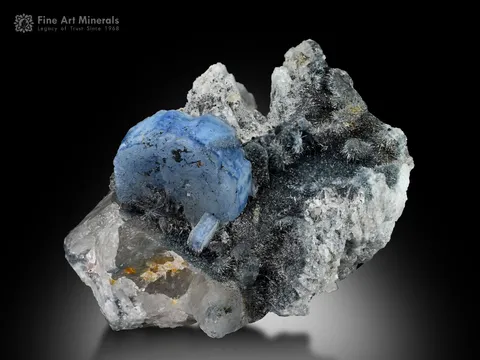
Afghanite was first described from Sar-e-Sang material and remains one of the locality’s signature collector species. It occurs in the lapis assemblage as blue to pale blue or nearly colorless crystals and grains, historically noted in thin veinlets cutting lazurite and associated with lazurite, sodalite, nepheline, phlogopite, diopside, olivine or forsterite, vesuvianite, calcite, and pyrite. Good Sar-e-Sang afghanite is judged by separation from the surrounding blue mass: sharp or aerial blue crystals on white calcite, strong contrast with pyrite, and visible individuality rather than an indistinct patch of blue feldspathoid. Under ultraviolet light, afghanite may show bright orange to yellow-orange fluorescence, a useful collector feature when evaluating mixed lapis specimens, though fluorescence alone is not a substitute for species identification.
Calcite at Sar-e-Sang is not an accessory afterthought; it is the principal pale carbonate stage on which the blue minerals perform. The lapis lenses and skarn zones are hosted in calcite- and dolomite-rich marble, and collectible pieces commonly show white to off-white calcite matrix carrying lazurite, afghanite, sodalite-group minerals, pyrite, and mica. Massive calcite is far more common than display-quality calcite crystals, but it is crucial to specimen aesthetics: a clean white calcite base makes the blue feldspathoids appear deeper and sharper, while excessive carbonate veining downgrades lapidary lapis. Fluorescent-mineral collectors also prize some Sar-e-Sang calcite because it can fluoresce red to pink under ultraviolet light, especially in mixed specimens with afghanite and sodalite-group phases.
Sodalite from Sar-e-Sang belongs to the same chemically complex blue feldspathoid world as lazurite and haüyne, and the locality’s labels can be treacherous because massive blue sodalite-group minerals may look alike without analysis. Documented Sar-e-Sang sodalite occurs with calcite, pyrite, afghanite, phlogopite, nepheline, and other lapis assemblage minerals; small crystals to around 5 mm have been noted from Ladjuar Medam-style material, and some specimens fluoresce bright yellow-orange under longwave ultraviolet. The best collector pieces are those where sodalite is not merely inferred from “lapis” appearance, but is either visibly distinct, fluorescently useful, or analytically supported. Ordinary “sodalite” labels from Afghanistan should be treated with caution unless the dealer can explain why the blue phase is not lazurite, haüyne, afghanite, or a mixed sodalite-group aggregate.
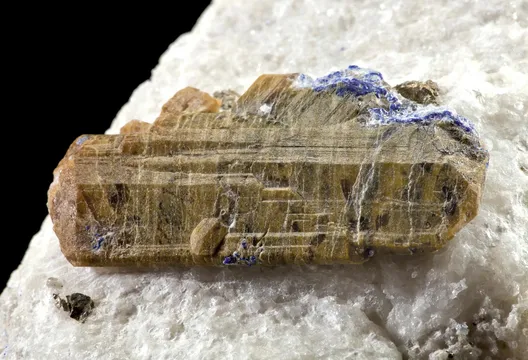
Phlogopite is a characteristic mica of the Sar-e-Sang calc-silicate environment, reported in the exploitable lapis zones and in the transition rocks between marble, skarn, and mica-rich cipolin. Classic descriptions mention well-formed phlogopite crystals to about 2 cm, and later specimen labels show bronze-brown to honey-brown mica plates with lazurite or haüyne, pyrite, and calcite. For collectors, phlogopite is most desirable when it provides sculptural contrast: sharp lustrous books or flakes partly embedded in white carbonate and set beside blue feldspathoid rather than scattered as dull mica in a massive lapis block. Because mica labels from Sar-e-Sang may be loosely assigned, phlogopite-rich pieces should be distinguished from muscovite-labeled material by color, habit, and, when needed, analysis.
Muscovite-labeled specimens from Sar-e-Sang are uncommon compared with phlogopite-rich lapis assemblages, and the collector should be aware that some old or casual labels may use “mica” imprecisely. Where muscovite is present, it appears as pale silvery to light mica flakes or small books in calcite or marble with lazurite and pyrite, giving a cooler, brighter look than the bronze-brown phlogopite associations. Good pieces are association specimens: blue lazurite crystals or masses, brassy pyrite, white carbonate, and distinct mica plates that add texture without obscuring the blue. The best examples need locality and species documentation because Sar-e-Sang mica-bearing lapis is easily generalized in the trade.
Pyrite is the classic gold in the blue-and-white Sar-e-Sang palette, present as disseminated grains, blebs, seams, and small crystals in lapis, calcite, and marble matrix. Its importance is aesthetic, diagnostic, and genetic: the lapis-bearing assemblage is sulfur-rich, and pyrite is repeatedly noted as a near-constant companion of the blue material. Collector-grade pyrite associations show bright, fresh metallic pyrite placed naturally among sharp blue lazurite or afghanite crystals, not overloaded brassy patches that dominate the piece or artificial-looking glitter in lapidary objects. Condition matters, since bruised blue feldspathoid and tarnished or oxidized pyrite can make an otherwise classic Sar-e-Sang specimen look tired.
Other minerals documented from Sar-e-Sang and its named sublocalities include haüyne, nepheline, diopside, forsterite, scapolite-group minerals including marialite, richterite, dravite, fluorapatite or carbonate-hydroxylapatite, vesuvianite, pyrrhotite, galena, molybdenite, spinel, cordierite, and additional calc-silicate and feldspathoid phases. Afghanite is the celebrated type-locality species tied to Sar-e-Sang, and the locality is also central to lazurite topotype material and to the difficult modern discussion of lazurite, haüyne, sodalite, and related sodalite-group compositions in lapis lazuli. For high-end collecting, that complexity is not a nuisance; it is part of the locality’s intellectual appeal.
The first authenticity issue at Sar-e-Sang is not whether Afghan lapis exists—it certainly does—but whether a given specimen is correctly represented. Massive blue lapis from Afghanistan is abundant in the trade, but labels can be vague, recycled, or inflated. “Sar-e-Sang” may be used for any Badakhshan lapis, and “lazurite” may be applied to blue sodalite-group material without analysis. Serious collectors should prize pieces with old labels, named sublocalities, reputable dealer history, or analytical confirmation, especially for afghanite, sodalite, haüyne, and unusual fluorescent assemblages.
The second issue is imitation and treatment. Lapis lazuli has long been imitated by dyed stones, glass, synthetic spinel, reconstructed material, plastic mixtures with pyrite fragments and lapis powder, and Gilson-type imitation lapis. These are more common in beads, carvings, cabochons, and decorative objects than in sharp mineral specimens, but the collector market is not immune. Watch for unnaturally uniform blue color, dye concentration in cracks, overly even “pyrite” distribution, resinous luster, suspiciously low density, or matrix contacts that look assembled rather than grown. Acetone testing, magnification, specific gravity, Raman/FTIR work, and careful UV observation can all help, but valuable pieces should be assessed conservatively.
Condition is a real concern. Lazurite and afghanite crystals can be chipped along exposed edges; calcite matrix can bruise, cleave, or powder; and mica-rich matrix can flake. Many specimens were not mined with collectors in mind, so repaired contacts, trimmed blocks, sawn bases, and bruised blue surfaces are common. A sharply crystallized lazurite on white calcite with minimal edge damage is much rarer than a colorful but rough lapis chunk. For lapidary-quality pieces, fewer calcite veins and fewer fractures increase value; for mineral specimens, composition, crystal form, and natural contrast matter more than pure carving grade.
Fluorescence adds another layer of interest. Afghanite may fluoresce orange; sodalite-group phases can show yellow-orange to orange responses; calcite may fluoresce red to pink; and fluorapatite, marialite, and other associated minerals may contribute additional shortwave or midwave responses. Because several Sar-e-Sang minerals can fluoresce in overlapping colors, UV response should be treated as a clue rather than a final identification. Avoid prolonged soaking, harsh acids, or aggressive ultrasonic cleaning on mixed calcite-lapis specimens; carbonate matrix and mica associations are better cleaned gently and mechanically.
Rarity is species- and quality-dependent. Massive lapis is common. Attractive lapis chunks with pyrite and calcite remain readily available. Sharp lazurite crystals on matrix are much scarcer. Well-presented afghanite crystals on calcite with pyrite are scarcer still. Sodalite, haüyne, marialite, richterite, dravite, and complex fluorescent assemblages from named Sar-e-Sang sublocalities are best approached as specialty specimens requiring documentation. The market supply is active but ethically complicated: recent material continues to appear through Afghanistan–Pakistan trade routes, while older exported stock and long-held collection pieces are especially desirable for buyers concerned with chain of custody.
Marco Polo never reached the mine itself, but the sentence attached to him has followed Sar-e-Sang for centuries: a mountain where the finest azure in the world was found “in veins, like silver.” It is a remarkably good medieval description. Anyone who has handled a fine Sar-e-Sang specimen understands why a traveler’s report could outlive empires. The blue is not a surface stain or a soft wash through rock; it comes in bodies, patches, crystals, and veins locked in pale carbonate, and the best material looks as if a piece of the night sky has been set into marble.
The nineteenth-century approach was less romantic. Lieutenant John Wood of the English East India Company reached the Kokcha Valley in the 1830s while exploring toward the source of the Oxus. His warning about the valley—“If you do not wish to die, avoid the Valley of Kokcha”—has become one of the great grim field quotations attached to a mineral locality. The landscape explains it: a long, narrow defile, in places only about 200 meters wide, hemmed in by jagged peaks and high cold, with the mines perched on steep ground above the river.
The French geological visits of 1964, 1967, and 1971 read like a bridge between old caravan geography and modern mineralogy. One route from Kabul went by jeep from Charikar up the Panjshir Valley to Dasht-i-Rawat for about 160 km, then continued about 135 km on foot or horseback over Anjuman Pass. The alternate route was longer but, at the time, faster: roughly 750 km by vehicle from Kabul through Salang Pass, Qonduz, Khanabad, Taloqan, Feyzabad, and Jarm, followed by a 40 km climb along the narrow Kokcha gorges. These routes were practical only between June and November. At the mine, the camp sat near the Kokcha at about 2,500 meters, while the workings rose higher on the mountain. Lapis blocks were carried down on men’s backs and then moved onward by donkey.
One old description of the main mine entrance is especially vivid: a steep footpath ending at a platform only about 2 by 2 meters, opening into a cavern blackened by smoke from ancient mining. Before dynamite, miners cracked the hard rock by building large wood fires against it. The blackened roof and walls were not decoration; they were the residue of centuries of fire-setting. Later miners used explosives, but the basic difficulty remained unchanged: the rock is hard, the slope is steep, and every kilogram of blue stone has to leave the mountain the hard way.
The waste dumps also have their own collector mythology. The miners were after carving-grade lapis, not isolated crystals for mineral cabinets. Blocks with poor color were thrown from the working platform down toward the Sar-e-Sang streambed, hundreds of meters below. Those discarded pale cipolin and marble pieces were precisely where a mineral collector might look for well-crystallized lazurite. Classic descriptions record single lazurite crystals reaching 5 cm, a size that still defines the locality in the minds of collectors. The irony is perfect: the stone rejected by the lapidary miner could contain the crystal coveted by the mineralogist.
The twentieth and twenty-first century history is darker. Sar-e-Sang’s remoteness has never isolated it from politics; it has amplified the value of whoever controls the route, the shafts, and the trucks. During the Soviet-Afghan war, lapis was moved through Pakistan and sold to raise money. In later decades, control shifted among commanders, militias, political figures, contractors, and insurgent networks. A 2016 investigation described miners, traders, local strongmen, disputed contracts, tolls, checkpoints, and armed groups taking money from one of Afghanistan’s great natural treasures. One miner named in the report carried more than 100 kilos of lapis down to the valley. A local elder summarized the district’s predicament in a sentence that could have been spoken about many mineral rushes: “This mine is itself a general... It will make people fight.”

_1.jpg)