






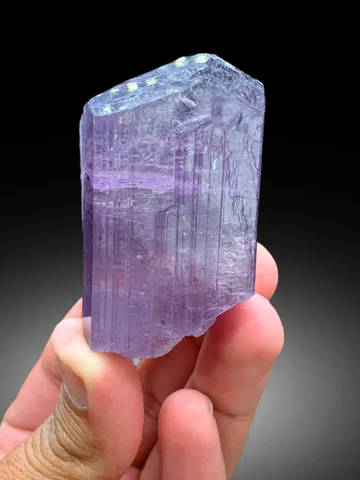
Badakhshan, Afghanistan — Sar-e-Sang lazurite district famed for royal-blue lapis crystals in white marble, Afghanite, and scapolite; a historic, premier local…
Key facts
Badakhshan’s collector identity is anchored by the Sar-e-Sang lapis lazuli district in the Kokcha Valley of northeastern Afghanistan: a high, severe Hindu Kush locality where blue sodalite-group minerals formed in calcite- and dolomite-rich marbles, calc-silicate rocks, and skarns during intense metamorphism and metasomatism. For mineral collectors, this is not merely a lapis source but one of the great classic localities of the world—famous for saturated royal-blue lazurite crystals on white calcite marble, brassy pyrite accents, blue afghanite, violet to colorless scapolite-group crystals, sodalite/hackmanite, haüyne, phlogopite, diopside, forsterite, and a suite of halogen- and sulfur-bearing minerals that make the district chemically and visually distinctive.
Sar-e-Sang matters historically on a scale few mineral localities can match. Badakhshan lapis moved into the material culture of early Mesopotamia, Egypt, Iran, Central Asia, and the wider ancient world; scientific and archaeological literature has long treated the deposit as the probable or principal source for much of the finest ancient lapis. The locality is also mineralogically modern: afghanite was described from Sar-e-Sang in 1968, and later work on scapolite, sodalite/hackmanite, and lapis provenance has kept the district at the center of gemological research.
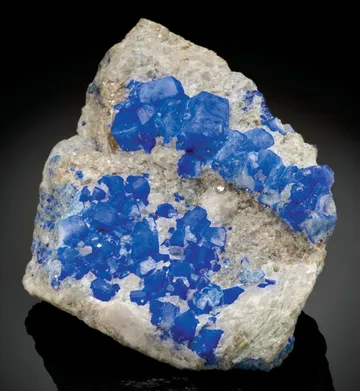
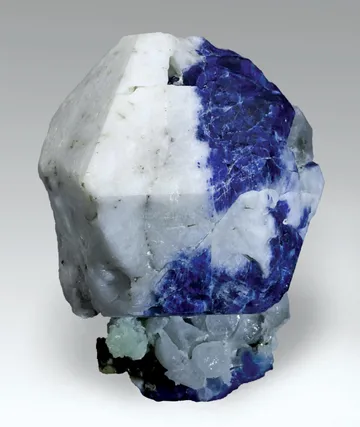
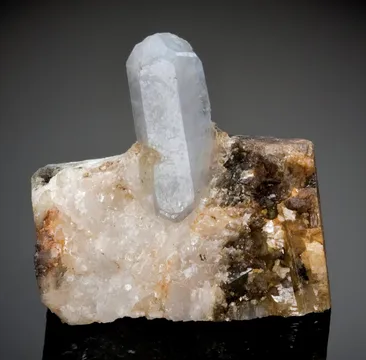
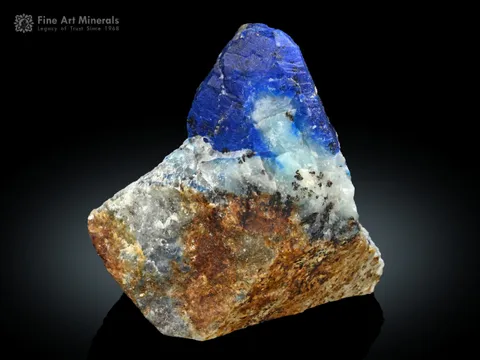
The best specimens have a look that is instantly recognizable. Lazurite appears as sharp to somewhat rounded royal-blue crystals embedded in white marble, sometimes with fine pyrite flashing like gold leaf along fractures or crystal margins. Afghanite tends toward brighter cyan to deep blue, often as stout or elongated terminated crystals on calcite, and can be intensely attractive under ultraviolet light. Scapolite from the district ranges from pale violet to colorless, with some material showing exceptional tenebrescence and fluorescence. Ordinary pieces are massive lapis with mixed calcite and pyrite; the collector-grade pieces preserve crystals, contrast, orientation, clean matrix, and intact terminations.
Regional View
Country View

Photo: Wikimedia Commons

Photo: Wikimedia Commons
Search for specimens: View all specimens from Badakhshan, Afghanistan
In collector usage, “Badakhshan, Afghanistan” usually points to the Sar-e-Sang–Kokcha Valley lapis lazuli district, especially the Ladjuar Medam/Lajuar Madan lapis mines and related workings in the Kuran wa Munjan area. The better labels may specify Sar-e-Sang, Kokcha Valley, Ladjuar Medam, Pitwak, Dar-e-Zu, Sar-e-Sang River, or nearby unnamed meta-evaporite occurrences. Older labels vary widely in spelling—Sar Sang, Sary Sang, Sare Sang, Kokscha, Kokcha, Badakshan, and Badahsan all occur in the literature and trade.
Geologically, the lapis bodies belong to a high-grade metamorphic and metasomatic environment in the South Badakhshan block. The IUGS geoheritage description places the deposits in the Sakhi Formation of the Archean Sanglich Group, with the major mines near Sar-e-Sang on the east side of the Kokcha River. Classic GIA and French descriptions portray a steep mountain of cipolin marble over gneiss, with a gray skarn band roughly 40 m wide standing out from white marbles. The lapis-bearing skarns form beds and lenses commonly 1–2 m thick, locally up to about 4 m, generally extending 20–100 m laterally and only rarely more than 400 m. Later summaries describe lapis bodies up to about 6 m thick in calcite- and dolomite-marble, associated with diopside skarn and forsterite-bearing calciphyre.
The essential mineralization is not a simple vein of blue rock but a zoned calc-silicate assemblage. Calcite and dolomite are intimately associated with diopside, forsterite, scapolite, phlogopite, pyrite, and sodalite-group minerals. In large lapis lenses, older descriptions record composite central zones of plagioclase, diopside, calcite, and lazurite, surrounded by darker fine-grained zones rich in lazurite, diopside, and scapolite, and bordered by marginal assemblages of calcite, diopside, forsterite, and pyrite. This zonation is the reason so many specimens show abrupt contrasts: royal-blue lazurite set in white marble, pyrite concentrated in seams or margins, and accessory silicates appearing as pale, greenish, brown, or colorless crystals in the same rock.
The deposit’s chemistry is fundamentally tied to evaporitic components in the protolith. Scapolite, sodalite, haüyne, lazurite, afghanite, phlogopite, amphibole, apatite, and other halogen-bearing minerals record the role of chloride-, sulfur-, and carbonate-bearing fluids during metamorphism and retrogression. Faryad’s work on scapolite-bearing rocks calculated peak metamorphic conditions of about 750°C and 1.3–1.4 GPa for the Sare Sang rocks, and described scapolite compositions ranging from strongly Cl-rich to more calcic members depending on host rock. For collectors, that petrology explains why Sar-e-Sang produces not just lapis but unusual fluorescent, tenebrescent, and chemically subtle species.
Mining history at Badakhshan is inseparable from the history of lapis itself. The mines have been worked since extreme antiquity; ancient Near Eastern and Egyptian lapis objects are a central part of the deposit’s fame. Scientific visits and descriptions accumulated through the 20th century, including French work in the 1960s, Russian geological and economic studies in the summers of 1963 and 1964, and later gemological and petrological studies. GIA’s 1981 account described the camp on the right bank of the Kokcha River at about 2500 m elevation, with mine workings between about 2700 and 3400 m. The workings were accessible only seasonally because of climate, with operation historically limited to a few summer months.
Traditional extraction was brutally simple. Early miners used large wood fires to fracture the very hard marble and skarn, leaving black smoke traces in old cavern workings; later miners used dynamite. Lapis blocks were carried down to camp on men’s backs and then taken onward by donkey. Waste rock was thrown from a small platform down to dumps hundreds of meters below in the Sar-e-Sang streambed. Those dumps and “reject” pale cipolin pieces are important in specimen history because well-crystallized lazurite was not always found in the highest-value massive gem lapis; crystals could be hidden in material too irregular, white, or fractured for the lapidary trade.
Production has fluctuated with access, politics, and conflict. Before the Soviet occupation in late 1979, GIA reported approximately one ton of lapis lazuli extracted annually, with about 200 kg sold to Afghan lapidaries and the rest exported. The Afghan Ministry of Mines historically sorted lapis into five categories: top-grade massive deep-blue, inclusion-free material formed only a small fraction of production, while lower grades with calcite veins and variable pyrite were used for ornamental objects. Later government summaries have described Sar-e-Sang as the principal or only currently worked lapis deposit among formerly numerous Badakhshan lapis mines, though production figures are difficult to verify and may reflect incomplete or politically constrained reporting.
Modern collecting access should be treated as effectively closed to casual field collectors. Badakhshan is remote, mountainous, politically sensitive, and has been repeatedly cited in conflict-resource reporting. Since the 2000s, most specimens reaching collectors have moved through Afghan and Pakistani trade channels rather than by direct collecting trips by foreign mineral collectors. Labels may be imprecise, sometimes intentionally so, and the market commonly compresses multiple Kokcha Valley occurrences into “Badakhshan” or “Sar-e-Sang.” The most desirable modern pieces are those with specific sublocality data, old dealer provenance, laboratory confirmation for unusual sodalite/scapolite/afghanite material, and no evidence of artificial assembly, oiling, irradiation, or color manipulation.
Badakhshan lazurite is the locality’s defining mineral: intensely royal blue to slightly violet-blue, occurring both as massive lapis and as rare, well-formed crystals in white calcite marble. The classic crystals are isometric, commonly dominated by rhombic dodecahedral 110 faces, with some examples reported to reach about 5 cm in diameter; IUGS illustrates a Sar-e-Sang lazurite crystal measuring 7 x 4.5 cm. The best specimens show saturated color, sharp form, clean contrast against marble, and restrained pyrite that adds sparkle without overwhelming the blue. Ordinary lapis blocks can be attractive, but the true collector pieces are crystal specimens from pale cipolin or marble, often associated with calcite, diopside, scapolite, forsterite, phlogopite, and pyrite, where crystal faces survived mining and transport.
At Badakhshan, pyrite is not usually the headline mineral but it is essential to the locality’s look and geology. GIA’s classic description notes that pyrite is always present in the lapis, and the finest pieces use it as a visual accent: brassy specks, seams, or small crystals against deep lazurite and white calcite. In the zoned lapis bodies, pyrite is especially characteristic of marginal calcite-diopside-forsterite zones and of sulfur-rich retrograde or metasomatic assemblages. Good collector pieces balance metallic contrast with blue saturation; too much disseminated pyrite can make lapis visually busy or lower grade, while sharply lustrous pyrite in clean association with lazurite, afghanite, sodalite-group minerals, or calcite gives specimens the classic “night sky” effect that made Badakhshan lapis famous.
Badakhshan scapolite is best understood as a scapolite-group occurrence dominated, in analyzed crystallized specimens, by marialite-rich compositions tied to chloride-bearing evaporitic protoliths. In the lapis district it occurs in calc-silicate and marble assemblages with calcite, dolomite, diopside, phlogopite, forsterite, sodalite-group minerals, pyrite, and locally gypsum or other evaporite-related phases. Collector pieces include pale violet prismatic crystals on matrix, colorless to gray gem material, fluorescent and tenebrescent specimens, and crystals associated with phlogopite; Wikimedia-documented material includes violet gem-quality crystals about 2.5 cm long, and a Ladjuar Medam specimen with scapolite to 23.5 mm and phlogopite to 15 mm. The best pieces are intact, transparent to translucent, well-terminated, and demonstrably natural in color response; because Afghan scapolite has been confused with sodalite/hackmanite and because irradiation can affect tenebrescence, serious specimens merit careful testing.
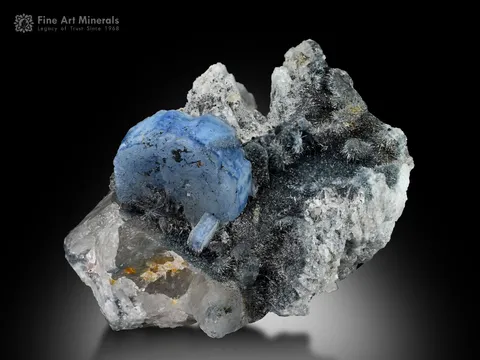
Afghanite is one of Badakhshan’s great type-locality minerals, first described from Sar-e-Sang in 1968 and named for Afghanistan. At the locality it occurs in blue to cyan crystals, rounded grains, and veinlets cutting lazurite, with associated lazurite, sodalite, nepheline, phlogopite, olivine/forsterite, diopside, vesuvianite, calcite, and pyrite. Collector-quality crystals are commonly stout to elongated, terminated, and set in white calcite or marble; Mineralogical Record index data and dealer records note Sar-e-Sang crystals to about 4 cm, while IUGS illustrates a large afghanite crystal specimen measuring 12.5 x 7.5 cm. What separates excellent afghanite from ordinary material is strong blue color, transparency or translucency, complete terminations, elevation on contrasting matrix, and convincing distinction from lazurite or sodalite, which can be visually similar on quick inspection.
Badakhshan sodalite is most important to collectors in its sulfur-bearing, tenebrescent hackmanite-like expression, though the boundary between “sodalite” and “hackmanite” has been treated inconsistently in the literature. GIA studied Afghan sodalite/hackmanite material produced from Badakhshan since 2002, including transparent faceted stones and cabochons; Afghan samples were generally less included and more transparent than comparable Burmese material, often showing strong yellow to orange long-wave fluorescence and yellowish-white phosphorescence after short-wave UV. Some stones deepened from near-colorless, pale violet, pinkish purple, or bluish tones to stronger purple or violet after short-wave UV, while others showed little or no tenebrescence and are best called sodalite. The strongest specimens are transparent to translucent, visibly tenebrescent, fluorescent, and well documented; buyers should expect confusion with afghanite, lazurite, haüyne, and scapolite unless the material has been tested.
Beyond these headline species, the Sar-e-Sang–Badakhshan mineral suite includes haüyne, marialite, phlogopite, richterite, diopside, forsterite, dravite, nepheline, vesuvianite, calcite, dolomite, apatite, titanite, clinohumite, amphiboles, feldspars, and rarer sulfides such as galena, molybdenite, pyrrhotite, and pentlandite reported in petrological studies. The district is especially notable for type-locality afghanite and for classic lazurite, and it remains one of the world’s most instructive localities for the interplay of evaporites, high-grade metamorphism, sulfur-bearing fluids, and vivid blue sodalite-group minerals.
Badakhshan material rewards skepticism and good labels. “Badakhshan” may mean Sar-e-Sang proper, a nearby Kokcha Valley occurrence, an imprecise trade label, or simply “Afghan blue mineral.” Lazurite, sodalite, haüyne, and afghanite can be confused visually, especially when the specimen is blue, granular, or embedded in calcite. Scapolite/marialite has also been sold as sodalite or hackmanite, and obsolete names such as “wernerite” still appear. For important pieces—especially afghanite, sodalite/hackmanite, tenebrescent scapolite, and unusually fine lazurite crystals—Raman spectroscopy, XRD, or a reliable old collection provenance is worth more than a romantic label.
Lapis lazuli has a long history of imitation. GIA’s 1981 article specifically notes glass, synthetic spinel, dyed jasper, mixtures of pyrite fragments with plastic rich in lapis powder, and Gilson imitation lapis, with and without pyrite. Massive lapis cabochons, carvings, beads, and decorative objects are more vulnerable to imitation or composite manufacture than crystallized specimens on marble, but mineral collectors should still watch for glued pyrite, dyed matrix, resin fills, and assembled fragments. On genuine Sar-e-Sang lapis, pyrite should appear integrated with the rock fabric rather than scattered like decorative glitter in plastic or resin.
Sodalite/hackmanite and scapolite from Badakhshan bring additional treatment concerns. GIA reported that rough sodalite/hackmanite from Afghanistan and Myanmar was commonly oiled to improve apparent transparency, and some cut stones were re-oiled after recutting because cracks reappeared. Afghan scapolite is more complicated: natural tenebrescent marialite exists, but irradiation can strengthen tenebrescence in scapolite, and there may be no simple visual test to distinguish all natural color-response behavior from treated material. Daylight purple scapolite from Badakhshan can be natural, but collectors should be cautious of unusually vivid color, vague locality data, or claims of exceptional tenebrescence without documentation.
Condition is a serious issue. Lazurite and afghanite crystals are commonly embedded in tough marble or calcite but can show bruised edges, saw marks, contact points, repaired matrix, or broken terminations from dynamite extraction and rough transport. Pyrite can oxidize if stored in damp conditions, though most small Sar-e-Sang pyrite flecks are stable when kept dry. Calcite matrix scratches and bruises readily, and acid cleaning is dangerous because it can attack calcite matrix and change the specimen’s aesthetic balance. Fluorescent and tenebrescent specimens should be stored away from unnecessary strong light and excessive heat; sodalite/hackmanite color response is reversible under normal light cycling but can be destroyed by high heat.
Market availability is uneven rather than truly scarce across the board. Massive lapis from Badakhshan remains widely available, though top deep-blue, low-calcite, low-fracture material has always been a small fraction of production. Crystallized lazurite on marble is much less common and commands a premium when crystals are sharp, saturated, and undamaged. Afghanite has become more visible in the specimen market than it once was, but fine terminated blue crystals on matrix remain expensive and competitive. Sodalite/hackmanite and scapolite appear periodically in parcels and dealer inventories, yet precise identities and treatment histories vary, so the best purchases combine visual appeal with testing, provenance, and conservative labeling.
Ethical sourcing matters for Badakhshan more than for many classic localities. Conflict-resource investigations have documented revenue from lapis and other Badakhshan gemstones flowing to armed groups and power brokers, especially during the instability of the 2010s. That does not make every old specimen problematic, and many collector pieces in circulation predate recent conflicts, but buyers should ask dealers when and how material was acquired. Older collection pieces, documented pre-2000 specimens, museum deaccessions, and transparent modern supply chains are preferable to vague “fresh from the mine” claims.
The old stories of Badakhshan begin thousands of kilometers away from the mine. By the time lapis appears in the royal cemetery of Ur, it has already crossed a staggering human geography: stone from the mountains of northeastern Afghanistan moving westward into Mesopotamia, where it became cylinder seals, beads, animal figures, and prestige objects. GIA’s 1981 account emphasizes the economic and artistic importance of this trade more than 4,000 years ago, when Badakhshan lay over 2500 km east of ancient Iraq. The stone’s value was not only its color. In a world without synthetic ultramarine, the intense blue of lapis was a portable fragment of sky.
The locality entered European travel lore through distance and hearsay before it entered modern geology. Marco Polo did not personally inspect the workings, but the line attached to his account still reads like a collector’s dream: a mountain where “the finest azure in the world” was found in veins. The French article by Blaise and Cesbron preserves a similar tradition, quoting the mountain of fine azure as something found “in veins, like silver.” The comparison is mineralogically imperfect and poetically exact: blue material cutting pale carbonate rock, hidden in hard mountain.
The physical approach to Sar-e-Sang was still formidable in the 20th century. GIA described two routes from Kabul. The shorter in distance went by jeep from Charikar up the Panjshir Valley to Dasht-i-Rawat, about 160 km, followed by another 135 km to the mine on foot or horseback via Anjuman Pass. The faster route still took at least four days: Kabul to Qonduz through Salang Pass, then through Khanabad, Taloqan, Feyzabad, and Jarm until the road died a few kilometers beyond Hazrat-Said, about 750 km from Kabul. From there the traveler faced roughly 40 km of narrow, rough trail along the gorges of the Kokcha.
At the mine itself the romance becomes work. The camp sat at about 2500 m near the junction of the Kokcha River and the Sar-e-Sang stream. The workings were higher, between about 2700 and 3400 m, and the season was short—roughly June to November for access, with exploitation of the royal mine limited to at most five months a year. Blocks of lapis were carried down to camp on men’s backs, then taken by donkey toward Hazrat-Said. When modern collectors hold a sharp crystal on marble, it is worth remembering that some part of that specimen’s journey began not in a padded flat, but on a human back descending a steep mountain path.
The old main working had a theatrical entrance. GIA described a steep footpath ending at a platform only about 2 m by 2 m at the mouth of a large cavern. Inside were traces of black smoke from ancient mining. The smoke had a practical cause: before dynamite, miners built great wood fires against the hard limestone and marble to fracture it. Later blasting broke the lapis-bearing rock more efficiently, but not gently. Lapis lenses came away as masses of many kilograms, rarely exceeding 100 kg, while colorless or poor material was thrown from the platform to dumps about 300 m below in the Sar-e-Sang streambed. For the lapidary, that rejected pale rock was waste. For the mineral collector, it could be treasure, because well-crystallized lazurite was often hidden in the very cipolin that massive-lapis miners rejected.
One of the most memorable modern gemological stories does not begin in Afghanistan, but at Tucson. At the 2004 Tucson gem shows, dealer Herb Obodda showed GIA personnel colorless rough and cut stones from Badakhshan that local dealers had been calling “hackmanite.” Under a strong ultraviolet source, the stones turned blue; in daylight or strong incandescent light, they faded back to colorless within seconds. GIA examined four faceted stones from 0.91 to 5.17 ct and rough pieces from 13.37 to 55.54 ct. Raman spectroscopy confirmed that the material was not hackmanite but scapolite, specifically marialite with a minor sulfide component. Obodda had noticed a practical field mark even without UV: a subtle schiller effect under a strong pinpoint light. The episode changed how collectors looked at Badakhshan’s pale crystals—some “hackmanite” was a different mineral entirely.
The Badakhshan sodalite/hackmanite story added another layer. GIA examined Afghan material produced since 2002 and reported that Hussain Rezayee had cut approximately 1,000 carats of faceted Afghan stones and 10,000 carats of cabochons, with cabochons up to about 40 ct and clean faceted stones reportedly up to 18 ct. Under short-wave UV, some Afghan stones deepened in seconds from pale or nearly colorless states to stronger violet or purple; after exposure to white light, they faded again. The study also found a more prosaic but important trade reality: rough was commonly oiled to improve transparency, and recut stones were re-oiled when cracks reappeared. In other words, Badakhshan produced genuinely remarkable photochromic gems, but they entered a market where enhancement and misnaming were already part of the parcel.
The most sobering modern story is political. In 2016, Global Witness described Badakhshan’s lapis mines not as romantic ancient workings but as assets fought over by commanders, political figures, and insurgent groups. Its reporting estimated that armed groups were earning up to $20 million per year from Afghanistan’s lapis mines and warned that the stone had become a conflict mineral. The same mountain blue that moved through ancient trade routes and Renaissance pigment history had become entangled in war finance. For collectors, that story does not erase the beauty or significance of old Sar-e-Sang specimens, but it does sharpen the responsibility to ask hard questions about modern sourcing.
Blaise, J., and Cesbron, F. (1966), “Données minéralogiques et pétrographiques sur le gisement de lapis-lazuli de Sar-e-Sang, Hindou-Kouch, Afghanistan,” Bulletin de la Société française de Minéralogie et de Cristallographie, 89, 333–343 — Foundational French mineralogical and petrographic description based on 1960s field work at Sar-e-Sang.
Bariand, P., Cesbron, F., and Giraud, R. (1968), “Une nouvelle espèce minérale: l’afghanite de Sar-e-Sang, Badakhshan, Afghanistan. Comparaison avec les minéraux du groupe de la cancrinite,” Bulletin de la Société française de Minéralogie et de Cristallographie, 91, 34–42 — Original description of afghanite from Sar-e-Sang, the type locality.
Handbook of Mineralogy, “Afghanite” — Concise mineral data sheet summarizing afghanite chemistry, habit, occurrence in thin veinlets cutting lazurite at Sar-e-Sang, associated minerals, and type material.
Schreyer, W., and Abraham, K. (1976), “Three-stage metamorphic history of a whiteschist from Sar e Sang, Afghanistan, as part of a former evaporite deposit,” Contributions to Mineralogy and Petrology, 59, 111–130 — Important metamorphic study tying Sar-e-Sang whiteschists to former evaporitic rocks.
Wyart, J., Bariand, P., and Filippi, J. (1981), “Lapis-Lazuli from Sar-E-Sang, Badakhshan, Afghanistan,” Gems & Gemology, Winter 1981, 184–190 — Classic gemological treatment of Sar-e-Sang lapis, access routes, mining, geology, zoned lenses, production, and lazurite crystals.
Yurgenson, G. A., and Sukharev, B. P. (1985), “Localization of Lapis Lazuli Bodies of Badakhshan and Their Mineral Zonation,” International Geology Review, 27, 230–237 — Key reference on the spatial localization and zoning of Badakhshan lapis bodies.
Faryad, S. W. (2002), “Metamorphic Conditions and Fluid Compositions of Scapolite-Bearing Rocks from the Lapis Lazuli Deposit at Sare Sang, Afghanistan,” Journal of Petrology, 43(4), 725–747 — Major petrological study of scapolite-bearing rocks, halogen-rich minerals, peak metamorphic conditions, and fluid compositions.
McClure, S. F., Rossman, G. R., and Shigley, J. E. (2005), “Tenebrescent Scapolite from Afghanistan,” Gems & Gemology, Fall 2005 Gem News International — First widely cited GIA report on Badakhshan tenebrescent scapolite/marialite shown at Tucson by Herb Obodda.
Kondo, D., and Beaton, D. (2009), “Hackmanite/Sodalite from Myanmar and Afghanistan,” Gems & Gemology, 45(1), 38–43 — Peer-reviewed GIA study of Afghan sodalite/hackmanite, transparency, tenebrescence, fluorescence, phosphorescence, sulfur traces, and oiling.
Woodside, R. M., and Moore, T. P. (2014), “Famous mineral localities: The Sar-e-Sang lapis mines, Kuran Wa Munjan district, Badakhshan Province, Afghanistan,” The Mineralogical Record, 45(3), 280–336 — Major modern collector treatment of the Sar-e-Sang mineral suite and specimen history.
SSEF, “Afghanite from Badakhshan in Afghanistan” — Gemological note on unusually large, clean faceted afghanite from Badakhshan, including stones up to 4.2 ct.
Smithsonian Institution, Afghanite specimen record, Sar-E-Sang District, Badakhshan Province, Afghanistan — Museum collection record documenting Sar-e-Sang afghanite in a major institutional collection.
IUGS Geoheritage: The Sar-e-Sang Lapis Lazuli Deposit — Excellent concise overview of the deposit’s geology, geoheritage significance, mineral assemblage, coordinates, and key references.
GIA: Lapis-Lazuli from Sar-E-Sang, Badakhshan, Afghanistan — Essential article for the geology, mine access, mining methods, production grading, and historical lapis trade.
Persée: Blaise and Cesbron 1966 Sar-e-Sang article — Original French petrographic and mineralogical treatment from the 1960s.
EPA HERO: Faryad 2002 scapolite-bearing rocks reference — Useful abstract and bibliographic record for the key Journal of Petrology paper on scapolite, fluids, and metamorphism.
Handbook of Mineralogy: Afghanite PDF — Compact reference for afghanite chemistry, habit, occurrence, associated minerals, and type material.
GIA: Hackmanite/Sodalite from Myanmar and Afghanistan — Best gemological source on Afghan sodalite/hackmanite properties, tenebrescence, fluorescence, phosphorescence, and oiling.
GIA: Fall 2005 Gem News International — Includes the important note on tenebrescent scapolite from Badakhshan shown by Herb Obodda.
Global Witness: Afghanistan’s famous lapis mines funding the Taliban and armed groups — Important conflict-resource context for modern Badakhshan lapis sourcing.
Global Witness: War in the Treasury of the People — Long-form investigation into lapis, tourmaline, armed groups, political control, and mine revenues in Badakhshan.
Afghanistan Ministry of Mines: Badakhshan contracts page — Government contract listing useful for modern administrative context.
Wikimedia Commons: Lazurite from Sar-e-Sang — High-resolution photograph of lazurite with calcite and pyrite from Sar-e-Sang.
Wikimedia Commons: Afghanite, pyrite, and calcite from Sar-e-Sang — High-resolution photograph of blue afghanite on calcite with pyrite.
Wikimedia Commons: Scapolite from Badakhshan — Public-domain photograph of violet gem-quality scapolite crystals on matrix.
_1.JPG)
_1.jpg)
