






A collector's guide to Keweenaw Peninsula, USA: its geology, mining history and notable minerals, illustrated with the 209 specimens documented from this locality on EarthWonders.
Key facts
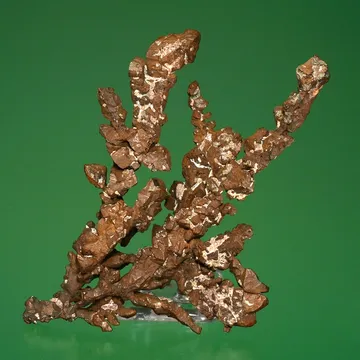
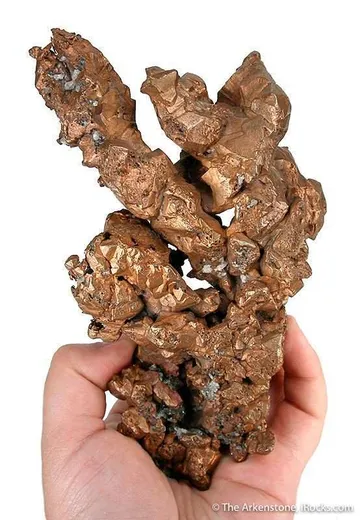
The Keweenaw Peninsula is the archetype of a native-copper district: a long, cold finger of northern Michigan thrust into Lake Superior, built from Midcontinent Rift volcanics and interlayered sedimentary rocks, then mineralized by hydrothermal fluids that placed copper not chiefly as sulfides or oxides but as the metal itself. For collectors, that distinction is everything. Keweenaw copper is heavy, ductile, sculptural, and unmistakably metallic, occurring as wiry arborescences, herringbone growths, crystallized plates, hackly masses, “shot copper,” copper-in-calcite inclusions, and copper-silver “halfbreed” associations that have defined American mineral collecting for more than a century.
The district’s classic hosts are amygdaloidal basalt flow tops, copper-bearing conglomerates, and fissure veins cutting the volcanic pile. The mineral suite reflects that low-grade metamorphic and hydrothermal history: native copper and native silver with calcite, quartz, prehnite, pumpellyite, epidote, laumontite, analcime, datolite, chlorite-group minerals, microcline/adularia, and local copper arsenides and sulfides. The best cabinet pieces have a character unlike copper from any other district: bronzy-red metal with old brown patina, delicate dendrites rising from dark basalt, orange copper suspended inside pale calcite rhombs, bright silver perched against copper, or mossy copper woven through green prehnite and epidote.
Regional View
Country View
Historically, the Keweenaw was also one of North America’s great mineral frontiers. Indigenous people worked native copper here thousands of years before industrial mining; the 1840s copper rush preceded the California gold rush; and the later Calumet & Hecla, Quincy, Copper Range, and allied operations made the peninsula a national copper producer. That history matters in the specimen world because labels such as Cliff, Central, Copper Falls, Quincy, Kearsarge, Ahmeek, Wolverine, Mohawk, Seneca, Minesota, and Caledonia are not interchangeable. Each mine name suggests a different host rock, paragenesis, style of copper, likelihood of silver, and preservation history.
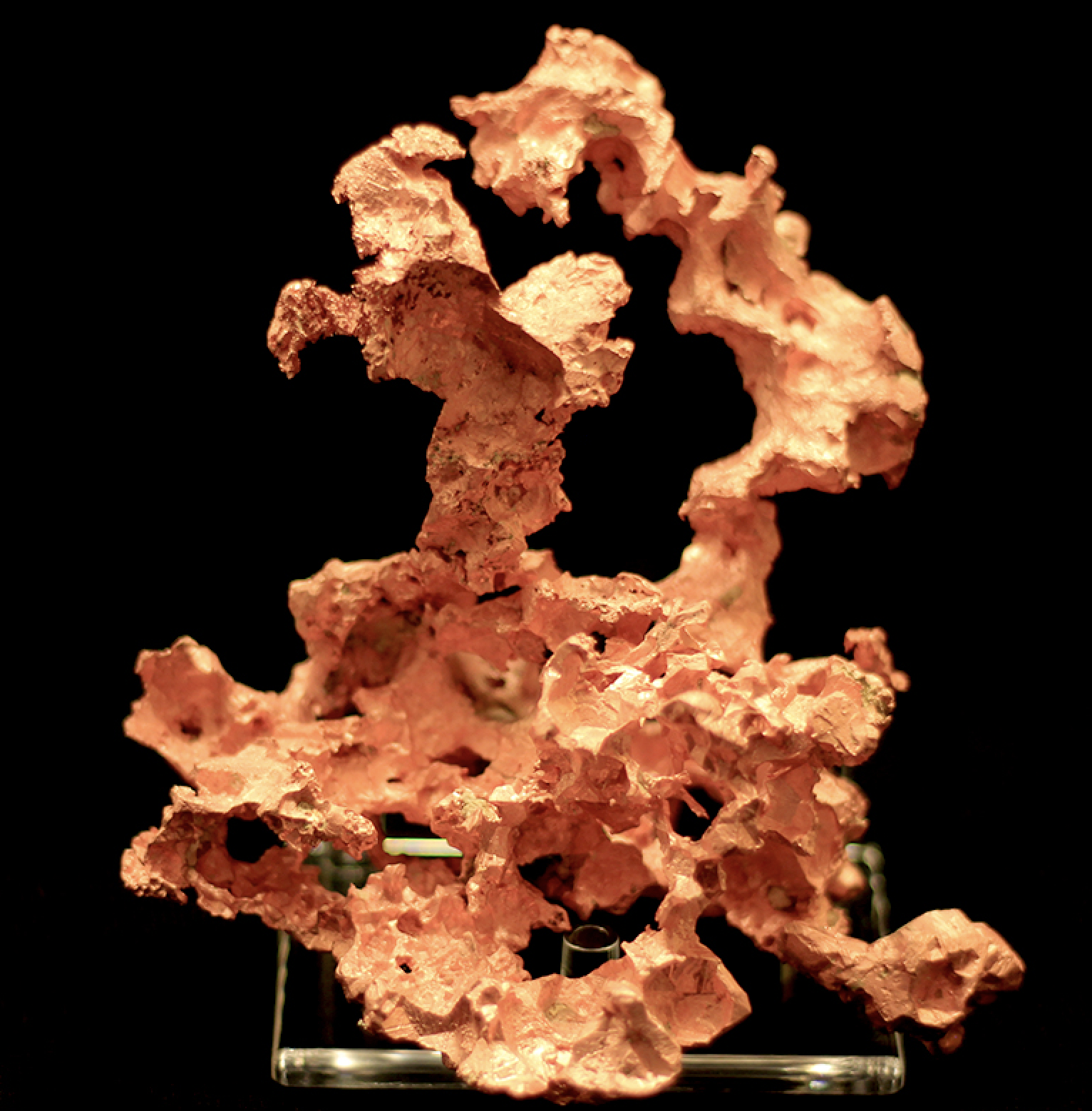
Photo: Chad Knutsen / Wikimedia Commons


Search for specimens: View all specimens from Keweenaw Peninsula, USA
The Keweenaw native copper district is the exposed, mine-studded portion of a Mesoproterozoic rift basin along the southern side of Lake Superior. Its productive rocks belong chiefly to the thick basaltic volcanic succession long known in the mining literature as the Portage Lake volcanics, with important interflow conglomerates and associated sedimentary units. The ore was not one simple vein system but a family of related deposit styles: fissure veins, amygdaloid lodes in porous and brecciated lava flow tops, and conglomerate lodes in permeable sedimentary beds between flows. Hydrothermal fluids moved through the mechanically weak horizons and open spaces, depositing copper, silver, calcite, quartz, epidote, prehnite, pumpellyite, chlorite, laumontite, analcime, datolite, and late feldspar over a broad district.
The old miners used practical language that still helps collectors read specimens. “Amygdaloid” pieces come from vesicular or brecciated basalt where gas cavities and broken flow-top textures were later filled by minerals; these specimens commonly show dark trap rock, greenish alteration minerals, and copper distributed through pockets or amygdules. “Conglomerate” pieces are tied to copper-bearing sedimentary beds such as the great Calumet & Hecla conglomerate, where copper filled spaces among pebbles and cement. “Fissure” material, famous from early Keweenaw County mines, formed in cross-cutting veins and often produced the most dramatic open-growth copper and silver specimens.
The district was mined along a long northeast-southwest belt through Ontonagon, Houghton, and Keweenaw counties, with Isle Royale geologically related but separated in Lake Superior. Early production emphasized rich fissure veins at places such as Cliff, Central, Phoenix, Copper Falls, and Minesota. Later, the great stratiform amygdaloid and conglomerate lodes drove the industrial era: Quincy on the Pewabic amygdaloid, Calumet & Hecla on the conglomerate and associated lodes, plus the Kearsarge, Osceola, Wolverine, Baltic, Champion, Trimountain, Mohawk, Ahmeek, and many others. The Baltic Mine, for example, worked an amygdaloid flow-top breccia that dipped steeply northwest, was several meters thick, and yielded copper with quartz, pumpellyite, epidote, and calcite; its scale and productivity made it one of the major native-copper operations.
Industrial mining began in the 1840s, flourished through the second half of the nineteenth century, and persisted in changing form into the twentieth century. By 1849 the district supplied the overwhelming majority of U.S. copper, and from 1845 until the rise of western districts in the late 1880s it was the country’s leading copper-producing region. The Keweenaw’s native-copper mines produced roughly 10.5 billion pounds of copper between the mid-1840s and 1968; the White Pine Mine in Ontonagon County, a younger copper-sulfide operation rather than a classic native-copper lode, suspended underground operations in 1997 and marked the end of industrial copper mining on the peninsula.
Collectors encounter the Keweenaw today through museum specimens, old collections, dealer stock, legally accessible mine-rock piles, shore and stream float, and organized collecting events. Underground mine entry is unsafe and commonly illegal; many mine lands are private, gated, reclaimed, or historically protected. Modern collecting is best approached through explicitly permitted sites, tours, heritage sites, and events that obtain landowner permission and prepare surface material. Public guidance in the region has repeatedly emphasized permission, safety, and restraint: old shafts, unstable stopes, hidden openings, and steep rock piles are part of the collecting landscape.
The specimen record is unusually rich because the mines themselves intersected vugs, fissures, copper masses, and open seams that were more visually rewarding than ordinary ore. Cliff Mine is celebrated for sharp copper crystals, wire and moss copper, and silver-copper pieces associated with prehnite. Central Mine produced fine crystallized copper and calcite associations, including dodecahedral copper groups and vug material. Copper Falls was renowned in early literature for superb copper crystals and yielded some spike copper. Quincy is indispensable for copper-in-calcite, silver on prehnite and copper, and classic amygdaloid-suite specimens. Kearsarge and North Kearsarge produced some of the district’s most admired silver-copper specimens. Mohawk is famous not only for copper but for the arsenide-rich material historically called mohawkite. The Caledonia Mine in Ontonagon County has been an important modern specimen producer, especially for native copper, silver, datolite, calcite, epidote, and adularia.
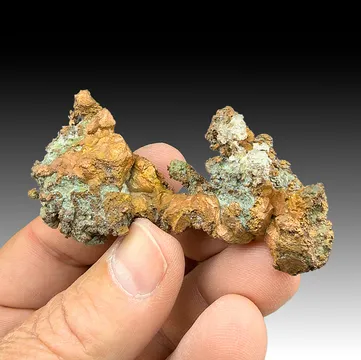
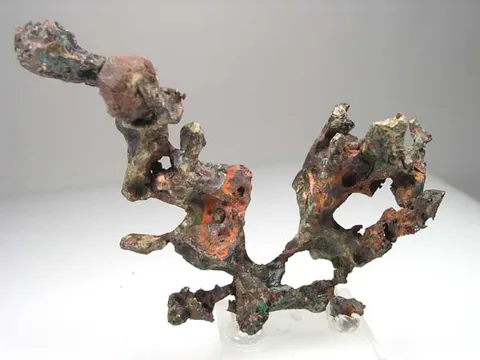
Copper from the Keweenaw is the district’s signature species and one of the defining mineral specimens of North America, ranging from thumbnail-size sharp crystals and dendritic wires to cabinet plates, heavy hackly masses, and mine-scale copper slabs measured in tons. In the best fissure-vein pieces from Cliff, Central, Copper Falls, Phoenix, Northwestern, and related Keweenaw County mines, the metal forms cubes, octahedrons, dodecahedrons, tetrahexahedral crystals, herringbone aggregates, leaf copper, moss copper, and arborescent sprays, commonly with prehnite, calcite, quartz, epidote, pumpellyite, and dark basaltic matrix. Conglomerate and amygdaloid material adds a different aesthetic: copper replacing spaces in pebbly rock, “shot copper,” copper in amygdules, and copper inclusions preserved inside calcite. Strong pieces are not merely large; they show natural three-dimensional growth, undamaged terminations or dendrites, attractive patina, contrast with gangue, and ideally a mine-specific label such as Cliff, Central, Quincy, Kearsarge, Ahmeek, Wolverine, Copper Falls, Iroquois, Seneca, or Caledonia.
Silver from the Keweenaw is the brilliant counterpoint to the copper: less abundant, more capricious, and at its best intensely sculptural, occurring as jagged crystal groups, plates, dendritic to herringbone aggregates, small trees, spikes, and copper-silver associations rather than the long wire silver familiar from Kongsberg. It is documented from many of the native-copper mines, with especially prized material from Kearsarge, North Kearsarge, Quincy and its Pewabic workings, Cliff, Wolverine, Copper Falls, Mohawk, Caledonia, and Minesota. The classic collector term “halfbreed” refers to native silver with native copper in one specimen, but the category must be handled carefully because natural growths, glacially deformed pieces, and stamp-mill composites can all enter the market. The best Keweenaw silver is sharply crystallized, visibly natural under magnification, unsmeared and unpolished, ideally on copper, prehnite, calcite, or quartz, and accompanied by credible old provenance.
Calcite from the Keweenaw is important not as an isolated carbonate curiosity but as one of the district’s main visual stages for native copper and silver. It occurs in amygdules, veins, vugs, and late fillings, ranging from white to colorless, translucent to transparent crystals, often as rhombohedra or scalenohedral forms, and it can enclose native copper so cleanly that the copper appears suspended within the crystal. Quincy Mine is especially famous for calcite crystals with native copper inclusions, including crystals studied for fluid inclusions and paragenesis; Ahmeek is noted for calcite with copper inclusion phantoms; Central yielded copper with calcite crystals; and many fissure and amygdaloid localities produce calcite with copper, silver, prehnite, quartz, epidote, and chlorite. Fine collector pieces show intact crystal faces, transparency or translucency sufficient to display copper, minimal bruising, and a convincing mine association rather than anonymous “Michigan copper in calcite.”
Quartz in the Keweenaw belongs to the hydrothermal gangue suite and is most collectible when it documents the copper district rather than when it resembles ordinary quartz from elsewhere. It occurs as massive vein quartz, milky seams, colorless to white prismatic crystals, pale greenish crystals affected by inclusions or coatings, hematite-stained crystals at some copper-range workings, and agate-like amygdule fillings locally carrying native copper or silver. The Red Jacket Shaft of the Calumet & Hecla Mine is known for superb lustrous colorless crystal groups; the Isle Royale Mine produced colorless crystals to several centimeters with calcite and barite; the Wolverine Mine produced quartz and agate with copper bands; the Laurium Mine yielded crystals with epidote, pumpellyite, and calcite in basalt amygdules; and a Copper Harbor-area occurrence produced banded agate with small flecks and crystals of native silver. The best pieces are mine-labeled, undamaged, and clearly tied to Keweenaw paragenesis through associations with copper, silver, prehnite, epidote, pumpellyite, calcite, or basaltic matrix.
Epidote from the Keweenaw is a paragenetic marker as much as a specimen species, belonging to the higher-temperature part of the district’s hydrothermal alteration system and commonly appearing as pistachio-green to dark olive-green granular, massive, bladed, or crusty aggregates with native copper, quartz, calcite, pumpellyite, prehnite, and chlorite in basaltic hosts. Collectible examples come from many mines and prospects, including Cliff, Central, Phoenix, Mohawk, North American, Petherick/Copper Falls, Baltic, Caledonia, and Isle Royale occurrences; at Baltic it is part of the copper-associated suite in the amygdaloid flow-top breccia, while at Caledonia and other Ontonagon County localities it can provide a vivid green matrix to copper and silver. Fine pieces are judged by color contrast, crystallinity, and association: sharp or sparkly epidote with copper or quartz is far more desirable than dull massive green alteration, and an old mine label is particularly valuable because epidote-rich Keweenaw material can look deceptively similar from one dump to another.
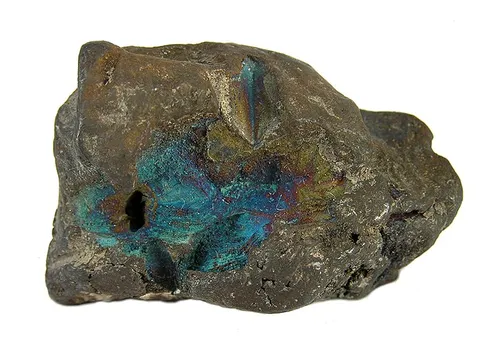
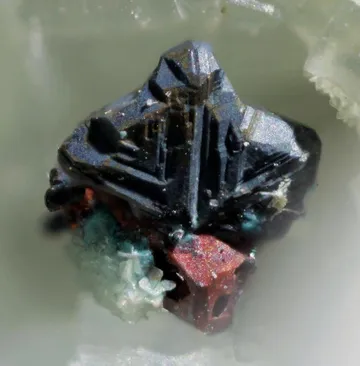
Beyond the five headline minerals above, the Keweenaw suite is unusually broad. Prehnite, pumpellyite-(Mg), laumontite, analcime, datolite, natrolite, chlorite-group minerals, microcline/adularia, barite, chalcocite, cuprite, malachite, and local arsenides such as domeykite and algodonite all contribute to the collector vocabulary of the district. The region is also important for type-locality and historically named minerals: pumpellyite-(Mg) is tied to Keweenaw County as a type locality; jeankempite, a hydrated calcium arsenate described from the Mohawk Mine, is a modern valid type-locality species; macfallite is listed from the Manganese Mine at Copper Harbor; and the famous name “mohawkite” survives in collecting usage for a metallic arsenide-rich mixture from the Mohawk Mine, even though it is treated mineralogically as a mixture rather than a valid single mineral species.
Keweenaw copper is common enough that almost every serious U.S. mineral dealer has handled it, yet truly fine specimens are far scarcer than the market volume suggests. Small massive copper pieces, waterworn float, sawed copper-in-rock slabs, and cleaned dump specimens are abundant. Well-crystallized copper with undamaged arborescences, sharp faces, silver association, good matrix, old patina, and credible mine provenance is much less common. Mine-specific labels add value because a general “Keweenaw Peninsula” label is often used when the true mine is unknown.
The most important authenticity issue is the distinction between natural growth and mechanically modified metal. Copper is soft and malleable, so it can be bent, flattened, polished, wire-brushed, acid-cleaned, mounted, or artificially brightened. Some old specimens were lacquered or heavily cleaned to prevent darkening; others were stripped until they became bright orange but lost their original surface character. Many collectors prefer honest brown to reddish patina with protected coppery highlights over over-cleaned, brassy-looking pieces. Verdigris, cuprite-red films, malachite-green coatings, or black oxide patches can be natural or post-mining alteration; none should be assumed desirable unless they enhance the specimen and do not obscure crystallization.
“Halfbreed” copper-silver material deserves special scrutiny. Natural copper and silver intergrowths certainly occur in the district, and some of the finest Keweenaw silver specimens are natural silver on copper, prehnite, or calcite. But many rounded or nugget-like copper-silver pieces in commerce are products of stamp-mill processing, where copper and silver were crushed, smeared, and mechanically joined during ore treatment. These can still be historically interesting, but they should not be valued the same way as a natural crystallized silver-copper specimen. Warning signs include overly rounded outlines, smeared silver skins, polished contacts, indistinct matrix relationships, and lack of old provenance.
Condition issues are predictable but important. Dendritic copper bends and breaks easily; crystal edges can be rounded by tumbling on dumps; calcite cleaves and bruises; quartz points chip; and green prehnite or epidote matrices can crumble along fractures. Copper-in-calcite specimens should be protected from impact, temperature shock, and aggressive cleaning because a damaged calcite host cannot be restored. Silver darkens with sulfide tarnish and should not be casually dipped or polished; cleaning a crystallized Keweenaw silver can destroy the very surface that proves its natural origin.
Fluorescence is not a major selling point for classic Keweenaw copper specimens, although calcite from many districts can fluoresce and individual Keweenaw pieces may respond variably. Handling is more important: copper is dense for its size, and heavy specimens can damage themselves or other minerals if unsecured. Arsenide-rich material from Mohawk and related occurrences, including specimens sold as mohawkite, should be treated with basic arsenic-mineral precautions: avoid creating dust, do not saw or grind dry, wash hands after handling, and keep polished or massive pieces away from children and food-preparation surfaces.
Market availability is strongest for general native copper, copper in basalt, copper-in-calcite fragments, and small float pieces. The middle market contains attractive miniatures and cabinet specimens from old collections, especially copper with prehnite, calcite, epidote, or quartz. The upper market is driven by old labels and aesthetics: Cliff crystals, Central crystallized groups, Quincy copper-in-calcite, Kearsarge silver-copper, Caledonia silver or copper, large herringbone groups, and documented museum-caliber pieces. For serious buying, provenance and surface integrity matter as much as weight.
Long before shafts, stamp mills, and steam hoists, the Keweenaw was already a copper district. Indigenous miners found native copper where glaciers, streams, and weathering exposed it, then worked pits and shallow excavations with stone mauls. On Isle Royale, related copper workings were later described as pits as much as 9 meters across and 18 meters deep. Some rock-copper masses were so large that they appear to have been raised by cribwork, and pieces weighing as much as 2,700 kilograms were recorded. The mining technique was direct and ingenious: heat the enclosing rock with fire, quench it with water, break it, and free the metal.
The industrial story begins with the same clue that guided earlier miners: copper visible in the rock. At the Cliff Mine, a vein on the greenstone bluff was followed into the cliff wall in 1845 and widened into a rich copper mass. The place became the first great success of the Copper Country, and the old mine name still carries weight on a specimen label. A good Cliff specimen is not simply copper from Michigan; it is copper from the mine that convinced outsiders the Keweenaw could pay.
Central Mine reads almost like a nineteenth-century prospecting parable. In 1854, John Shawson, an agent of the Cliff Mine, found native copper in the bottom of an ancient pit several miles from Cliff. That discovery led to the Central Mining Company, and the mine became one of the celebrated fissure-vein producers of Keweenaw County. By 1892, as fissure mining dwindled, Michigan’s Commissioner of Mineral Statistics called Central “The Last of the Mohicans,” a phrase that captures why Central labels still stir collectors: they evoke the last great survival of the early style of Keweenaw mining.
Calumet & Hecla became a different kind of legend: not a romantic fissure mine in the woods, but an industrial organism with shafts, rail lines, shops, company housing, libraries, bathhouses, and a paternalistic grip on community life. The copper lode near Calumet was recognized in 1858 by Edwin Hulbert, and by the late nineteenth century C&H was one of the best-known industrial enterprises in the United States. Swiss-born Alexander Agassiz, who led the company for many years, saw the scale of the prize early; an 1867 remark attributed to him described the value of the Calumet and Hecla mines as “beyond the wildest dreams of copper men.”
Not all Keweenaw stories are triumphant. In 1913, workers’ frustrations over wages, hours, and conditions erupted into a strike that lasted nearly a year and wounded the district deeply. In 1966, seven-year-old Ruth Ann Miller fell one mile down an old Calumet mining shaft, a tragedy that pushed authorities toward stricter abandoned-mine safety measures. Two years later, in 1968, Calumet & Hecla closed permanently after more than a century. The geology remained, but the industrial culture that had built towns over the lodes was gone.
Collectors have their own modern legends. In 1971, Don Pearce of Calumet collected many hundred kilograms of well-crystallized copper from an underwater vein in Lake Superior near Eagle Harbor, a place known locally as Grand Marais or Gull Rock. The specimens were enclosed in calcite and included herringbone to arborescent copper groups. One reported piece weighed about 45 kilograms and carried a face roughly half a meter across covered with fine herringbone copper, with large blocky crystals on the opposite side. It is the kind of find that keeps the Keweenaw alive in collectors’ imaginations: even after the mines, Lake Superior could still reveal copper of astonishing quality.
Another modern episode belongs to the Point prospect, about 10 kilometers southeast of Copper Harbor, where road construction exposed a small fissure vein that yielded some of the world’s largest native copper crystals. The crystals had an overall dodecahedral aspect, often modified by another complex form, and examples up to 6.4 kilograms are known. For a species as soft and distortable as copper, a crystal measured in kilograms rather than centimeters is extraordinary.
The district also produced giant native-metal objects rather than ordinary specimens. The A. E. Seaman Mineral Museum’s Copper Pavilion displays a 19-ton mass of native copper recovered from the bottomlands of Lake Superior offshore between Eagle River and Eagle Harbor. The Smithsonian’s famous Ontonagon Boulder, a native-copper boulder weighing about 3,708 pounds, carries a still deeper cultural story, including a repatriation request from the Keweenaw Bay Indian Community. Such masses are too large for the cabinet, but they frame the scale of the district: in the Keweenaw, native copper was not merely a mineral occurrence, it was a landscape-forming fact.


.JPG)