






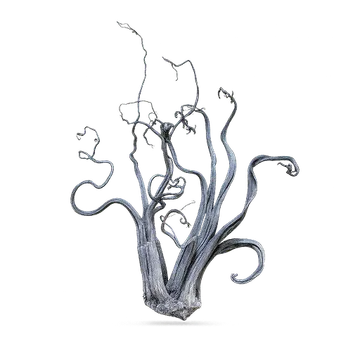
Silver from Keweenaw Peninsula, Michigan — native Ag with arborescent and herringbone forms, brilliant sheen, and copper-rich locality appeal for collectors.
Key facts
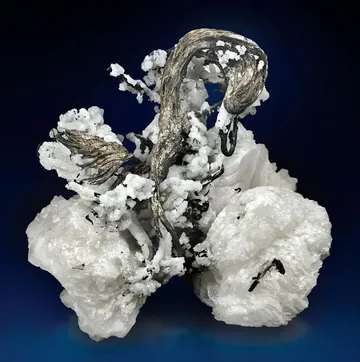
Silver from Michigan’s Keweenaw Peninsula belongs to one of the most recognizable native-metal traditions in mineral collecting. It is the bright, white-metal counterpart to the district’s native copper: a soft, lustrous native element, Ag, occurring as dendritic sprays, herringbone aggregates, distorted crystals, plates, sheets, “spikes,” and intimate copper-silver intergrowths long known in the trade as “halfbreeds.” The appeal is immediate. Fresh silver from the Keweenaw has a cool, brilliant sheen that contrasts dramatically with reddish copper, white calcite, pale green prehnite, quartz, epidote, and the dark basaltic matrix of the Lake Superior copper district.

Photo: James St. John via Wikimedia Commons
Geologically, Keweenaw silver is inseparable from the great native copper system of the Midcontinent Rift. The ore-bearing rocks are Mesoproterozoic basaltic lava flows, interflow conglomerates, fissure veins, and related sedimentary units. Copper dominated the district overwhelmingly, but silver occurred with it in small but economically meaningful amounts and, for collectors, in forms far more elegant than the production records suggest. The finest pieces are not simply “silver from Michigan”; they are miniature records of a hydrothermal system in which late fluids moved through amygdaloidal flow tops, fractures, calcite veins, prehnite-lined openings, and copper-rich cavities.
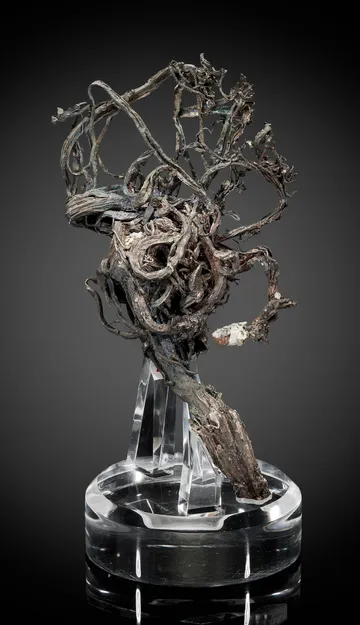
The classic collector image is a specimen from the Kearsarge, Wolverine, Quincy-Pewabic, Cliff, Copper Falls, or related mines: arborescent silver rising like frost from copper, flattened herringbone branches showing repeated growth along one axis, sharp octahedral or dodecahedral forms distorted into elegant spears, or silver perched cleanly on prehnite or calcite. Wire silver, so familiar from localities such as Kongsberg, is rare to essentially absent here; Keweenaw silver has its own language of plates, trees, bells, spikes, and jagged silver-white crystals seated in copper.

Historically, the silver rode in the shadow of copper. The Keweenaw district was the great native copper district of the United States, producing on an industrial scale from the 1840s into the 20th century. Yet silver had a strange double life underground. It was valuable enough to be coveted, common enough in certain pockets to be familiar to miners, and elusive enough that much of it never entered formal mine records. Some early mines encountered enough silver in shallow workings to be described, briefly and optimistically, as silver mines. More often, silver appeared as a prize in copper stopes: bright pieces pocketed by miners, saved by superintendents, traded locally, melted, lost, rediscovered, or eventually passed into museums and private collections.

For serious collectors, the locality’s strongest material combines three virtues: crystallization, association, and provenance. A sharp silver crystal group on prehnite from Quincy, a herringbone silver aggregate with copper from the Kearsarge lode, a complex silver from the Cliff fissure, or a well-labeled old halfbreed with clean silver-copper relationships can be far more desirable than a larger, shapeless lump. The best Keweenaw silver looks unmistakably natural under magnification: growth textures, minute crystal faces, copper contacts, matrix relationships, and honest age all matter.
Search for specimens: View all silver specimens from Keweenaw Peninsula, Michigan, USA
The Keweenaw Peninsula and the broader Michigan Copper Country form the classic Lake Superior native copper district. In mineral-collecting usage, “Keweenaw silver” is often applied to material from Houghton, Keweenaw, and Ontonagon County mines of the native copper belt; precise mine labels remain important because specimens from Cliff, Quincy, Kearsarge, Wolverine, Copper Falls, Caledonia, Mass, Minesota, White Pine, and other occurrences can differ markedly in habit and matrix.
The dominant ore type of the central Keweenaw is native copper hosted by Mesoproterozoic rift rocks. The key environments are amygdaloidal tops of subaerial basalt flows, interflow conglomerates, and fissure veins cutting the volcanic pile. Copper and silver were deposited by hydrothermal fluids that moved through permeable flow tops, fractures, brecciated zones, and sedimentary horizons. In many specimens silver appears later than copper in the paragenetic sequence, occupying vugs, depressions, coatings, and late openings rather than forming massive primary ore bodies of its own.
The classic basalt-hosted and vein-hosted copper mines of the peninsula differ from the sediment-hosted White Pine system to the southwest, where native silver occurs with copper and chalcocite in the Nonesuch Shale and associated units. White Pine material can produce excellent dendritic, arborescent, and herringbone silver, particularly in late calcite veins, but it should not be casually lumped with fissure-vein Cliff material or Kearsarge-lode silver when specimen labels are available.
Mining began industrially in the 1840s after the copper rush transformed the peninsula. The Cliff Mine, opened in the 1840s near the Keweenaw Fault, became the first profitable native copper mine in the region and remains one of the great names for crystallized silver as well as copper. The broader district ultimately produced about 11 billion pounds of refined copper from 1845 to 1968, while recorded silver production reached more than 16 million troy ounces by the late 1970s; because silver was often treated informally underground, the true total may have been substantially higher.
Silver production was uneven and highly local. The Isle Royale, Sheldon and Columbian, Huron, Portland, and Lake Superior mines were among early operations noted for silver-rich zones. At the Lake Superior mine, the upper part of the shaft produced so much silver that management briefly reclassified the operation in spirit, if not in lasting economics, as a silver mine; the silver diminished with depth. The Cliff fissure was described as the most silver-rich fissure in the district, with recorded production of about 60,000 ounces over intervals from 1847 to 1871. The Quincy and Pewabic mines together recorded nearly a million dollars in silver from 1862 to 1925. Calumet and Hecla recorded about 1 million ounces for 1916 to 1919. Copper Falls yielded about 30,000 ounces of silver, much of it from fissure veins, with the Owl Creek fissure particularly productive.
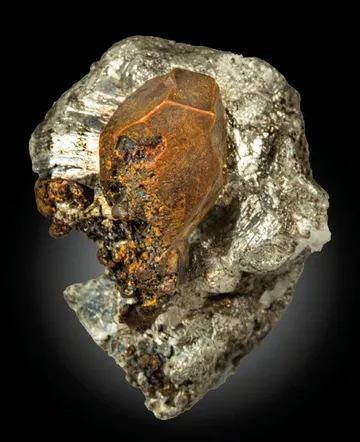
For collectors, the most celebrated specimen sources include the Kearsarge amygdaloid lode, worked by the Kearsarge and Wolverine mines, and the Pewabic amygdaloid at Quincy. The Kearsarge-Wolverine area produced many of the finest groups of crystallized silver in the literature. Quincy and Pewabic are famous for silver with rounded dodecahedral copper, prehnite, quartz, and calcite. The Cliff Mine produced sharp, brilliant, morphologically complex crystals on prehnite, chloritic alteration products, copper, and basaltic cavities. Copper Falls produced unusual cubic and skeletal cubic silver from a small prospect pit near the Petherick vein, as well as delicate crystal groups from fissure-related workings.
Collecting access today is highly restricted compared with the old days. Many historic mine dumps and ruins are private property, protected heritage sites, unstable industrial landscapes, or otherwise closed. Legal collecting is possible only where permission is explicit, such as certain prepared or opened rock piles during organized events, a few publicly identified collecting areas, or fee/permission localities. Serious collectors should treat every mine dump as closed unless current permission is verified. Old shafts, sealed workings, underground entries, ruins, and stamp-mill sites are not collecting opportunities; they are dangerous historic resources.
Keweenaw silver is native silver, Ag, and its most desirable habits are strongly locality-specific. Wire silver is rare to absent. Instead, collectors look for dendritic and arborescent growths, herringbone aggregates, elongated crystals, flattened plates, curved or distorted crystals, crystalline “spikes,” jagged silver seated in copper, and complex crystal groups on prehnite, calcite, quartz, or basalt. Many crystals are distorted along one axis, giving the best pieces a stretched, directional look unlike the ropey wires of other silver districts.
Crystallography can be excellent even when the crystals are not conventionally symmetrical. Octahedral and dodecahedral forms are common in descriptions, often in combinations and often distorted. Some crystals are twinned. Rare cubic silver is known from the Copper Falls area, especially the small prospect pit north of the Petherick vein, where crystals up to about 5 mm and unusual skeletal cubic aggregates were found on prehnite. The Cliff Mine is especially noted for complex forms, sharp brilliance, and silver on prehnite or chloritic matrix; some Cliff crystals are associated with chalcocite and may show acanthite rims.
Color ranges from brilliant silver-white on fresh surfaces to warm gray, dark gray, or blackened tarnish. Copper association adds orange-red to brown contrast, sometimes with green oxidation. Matrix minerals can make or break the aesthetic: pale green prehnite sets off silver beautifully; white calcite and quartz brighten the composition; dark basalt and chloritic material provide a strong background; native copper gives the locality its signature two-metal look. Epidote, datolite, quartz, calcite, prehnite, and copper are among the commonly reported associates in specimen photography and literature.
Typical cabinet-quality silver specimens from the Keweenaw are not huge. Fine miniatures and thumbnails are common in the market relative to larger, fully aesthetic pieces. Individual silver crystals may be millimeter-sized to over a centimeter in good examples. Aggregates in the 2–7 cm range are especially desirable when three-dimensional and undamaged. Museum examples include miniature crystallized silver from South Kearsarge, fern-like Quincy growths several centimeters long, silver on prehnite and copper from the Pewabic shaft, and larger crystallized groups from Minesota and other mines. Massive halfbreeds and copper-silver nuggets can be physically larger, but size alone rarely equals mineralogical quality.
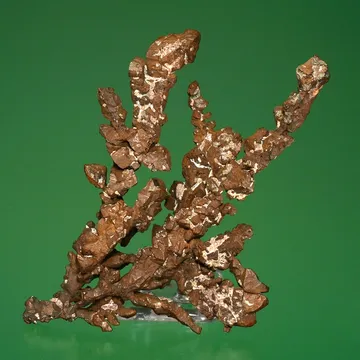
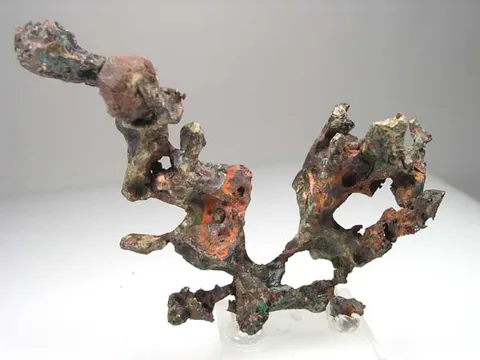
The district’s classic “halfbreed” specimens are intergrowths or composites of native silver and native copper. Natural copper-silver intergrowths do occur, and a few nugget-like pieces may have been modified naturally by glacial action before being found in gravels. However, many nugget-like halfbreeds in commerce are products of stamp mills, where crushing and processing mechanically combined, flattened, or “amalgamated” copper and silver. This distinction matters. A natural crystal group with silver clearly grown on copper or matrix is judged differently from a rounded, mill-formed nugget, even if both are historically tied to the district.
The strongest Keweenaw silver specimens show one or more of the following qualities: sharp visible crystal faces; three-dimensional dendritic or herringbone architecture; natural copper-silver contact without smearing, solder, plating, or polishing; attractive matrix; an old mine-specific label; minimal breakage to dendrites or spikes; and believable surface texture. A small, sharp, labeled Quincy, Cliff, Kearsarge, Wolverine, or Copper Falls specimen can outrank a much larger but shapeless mass.
Authenticity in Keweenaw silver begins with the label. A specimen labeled simply “Michigan” or “Keweenaw” may still be genuine, but mine-specific provenance adds both scientific and market value. Labels naming Cliff, Quincy, Pewabic, North or South Kearsarge, Wolverine, Copper Falls, Mass, Caledonia, Minesota, White Pine, or another specific mine should be preserved, photographed, and kept with the specimen. Old institutional, dealer, or collection labels are particularly important because many of the best crystallized pieces were recovered decades ago.
Halfbreeds require special caution. The word can refer to natural copper-silver intergrowths, but it is also used for stamp-mill products and rounded composite nuggets. Many marketplace halfbreeds are historically interesting but not crystallized natural-growth specimens in the strictest sense. Look for crystal continuity, matrix relationships, and undisturbed contacts. Under a loupe or microscope, natural silver should show growth features, tarnish behavior, and contact relationships consistent with the rest of the specimen. Smoothed, smeared, flattened, polished, or rounded metal masses may be mill products, tumbled float, cleaned nuggets, or altered pieces.
Specific fakery concerns include added silver-colored material, solder, silver paint, plating, or artificially attached copper-silver combinations. These are not as pervasive as ordinary mislabeling and overcleaning, but they are known concerns in the halfbreed niche. A suspiciously bright silver patch on copper, especially without crystal form or natural contact, deserves testing. Non-destructive XRF, careful specific-gravity comparison, microscopic inspection, and evaluation by someone familiar with Keweenaw material are preferable to destructive scratch or acid tests.
Condition issues are common because both silver and copper are soft and malleable. Dendrites bend. Spikes flatten. Thin silver sheets tear. Copper branches kink. Crystal faces can be burnished by handling or cleaning. Many old pieces were acid-cleaned, wire-brushed, polished, or otherwise “improved” before modern specimen standards were common. A light natural tarnish is not a defect; aggressive polishing is. Harsh cleaning can remove patina, brighten recesses unnaturally, damage calcite, loosen matrix, or make an old specimen look suspiciously new.
Silver on calcite or prehnite should be handled especially carefully. Calcite is vulnerable to acids, and prehnite-rich vugs can be fragile. Copper oxidation products may be part of the specimen’s history and contrast; stripping them can make a piece less convincing and less attractive. Store silver away from sulfur-rich materials, rubber, acidic paper, and high humidity if you want to slow tarnish, but do not assume that bright white is always better than honest gray.
Rarity varies sharply by type. Small copper-silver halfbreeds and copper-rich nuggets remain available from old collections and local dealers, but fine crystallized silver with strong form, good matrix, and reliable mine provenance is scarce. Cliff, Kearsarge-Wolverine, Quincy-Pewabic, and Copper Falls specimens with attractive crystallization are actively sought. White Pine silver can be excellent, especially in dendritic and herringbone habits, but should be labeled accurately as White Pine rather than vaguely “Keweenaw” when possible. Fresh collecting from classic localities is limited, seasonal, permission-dependent, and rarely produces material comparable to the best historic pieces.
Silver was the metal that refused to stay in the ledger. In the copper mines of the Keweenaw, it was valuable, compact, easy to hide, and not always recorded with the discipline applied to copper. Mine managers and miners treated it as a private windfall whenever opportunity allowed. The district’s recorded silver production exceeded 16 million troy ounces by 1977, but the real figure may have been far higher because so much silver simply disappeared into pockets, bars, jewelers’ crucibles, and family keepsakes.
The old underground nickname says everything: “white copper.” New miners were reportedly told to set it aside for management, with the implication that the person giving the instruction would retrieve it later. In town, silver specimens became a shadow currency. Miners paid for drinks with them. Others melted the metal and sold it to jewelers. One story from the Wolverine mine has a superintendent looking out at Gay, Michigan, and remarking that the automobiles there ought to have belonged to Calumet and Hecla, because high-graded silver had paid for them.
At the Lake Superior mine, silver briefly threatened to rewrite the identity of the operation. In the first 10 meters of the shaft, enough silver came out that management told shareholders the mine would henceforth be classed as a silver mine. It was a moment of intoxicating optimism, the sort that appears again and again in 19th-century mining camps. Then the shaft went deeper, and the silver diminished. Copper, not silver, remained the district’s engine.
The Minesota mine supplied one of the most memorable tales of Keweenaw carelessness. Between 1848 and 1870 the mine was said to have been run so loosely that two kegs of silver nuggets could go missing and the loss be shrugged off. They were found two years later in an abandoned shed. It is hard to imagine a better Copper Country image: not a single pocketed crystal or a hidden hand specimen, but kegs of silver misplaced long enough to become part of the mine’s folklore.
The Iron River silver excitement in Ontonagon County produced a different kind of lesson. In 1875, a bar of silver weighing 523 ounces was poured and valued at $732.20. Early reports described “veins” of silver, but later mapping and drilling showed that the supposed veins were actually the basal portion of the Nonesuch Formation. The early miners had mistaken a mineralized transition between the Copper Harbor Conglomerate and the first black shale of the Nonesuch for a vein filling. A one- to two-foot interval of mineralized rock, sharpened visually by the contrast between formations, became a silver vein in the eyes of men eager to find one.
Copper Falls offers the collector’s version of a prospector’s dream. In 1980 a small surface occurrence just north of the Petherick vein was found by a prospector using a metal detector. What looked like a vein proved to be a mineralized basalt flow top: vuggy prehnite, minor analcime, chalky white datolite, and a small number of exceptional silver crystal groups. The prize was rare cubic silver, some crystals reaching about 5 mm, with unusual skeletal cubic aggregates on prehnite. Two years later, in 1982, Don Pearce of Calumet recovered delicate and beautiful silver crystal groups from the Copper Falls area, adding modern field-discovery drama to a district already crowded with 19th-century legends.
The Cliff Mine supplied a more visual story, one best imagined by lamplight underground. Silver there occurred with copper, prehnite, and in basalt amygdules. Some crystals were perched on copper or on copper-silver wires. Others reportedly hung like little bells from arches of copper wire. The Cliff fissure was the district’s most silver-rich fissure, and the best specimens carry that identity: brilliant, sharp, complex, and unmistakably Keweenaw.
_(17099329679).jpg)

