






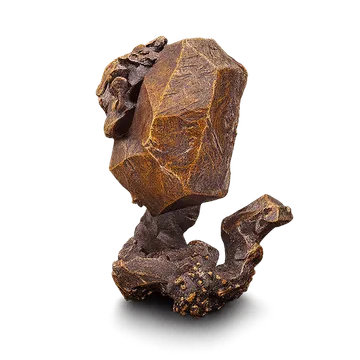
Keweenaw Peninsula copper - classic native copper from Michigan, famed for wiry arborescent sprays, sharp crystal faces, and historic mines prized by collector…
Key facts
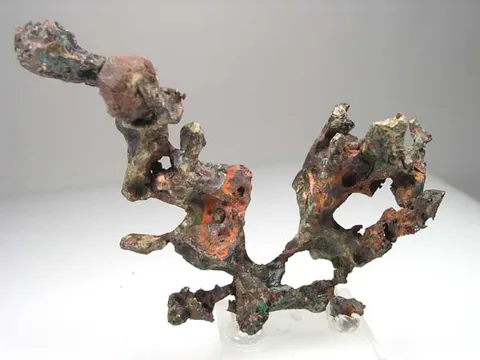
The Keweenaw Peninsula is the classic native-copper locality: a place where copper was not merely an ore mineral locked in sulfides, but the metal itself—dense, malleable, and often sculptural—precipitated as copper, Cu, in billion-year-old volcanic rocks. For collectors, “Keweenaw copper” is a category unto itself. It can appear as wiry arborescent sprays, thick hackly sheets, crystal groups with sharp metallic faces, rounded glacial float nuggets, massive vein copper, copper-filled amygdules in basalt, and copper in conglomerate where the metal laces between volcanic pebbles.
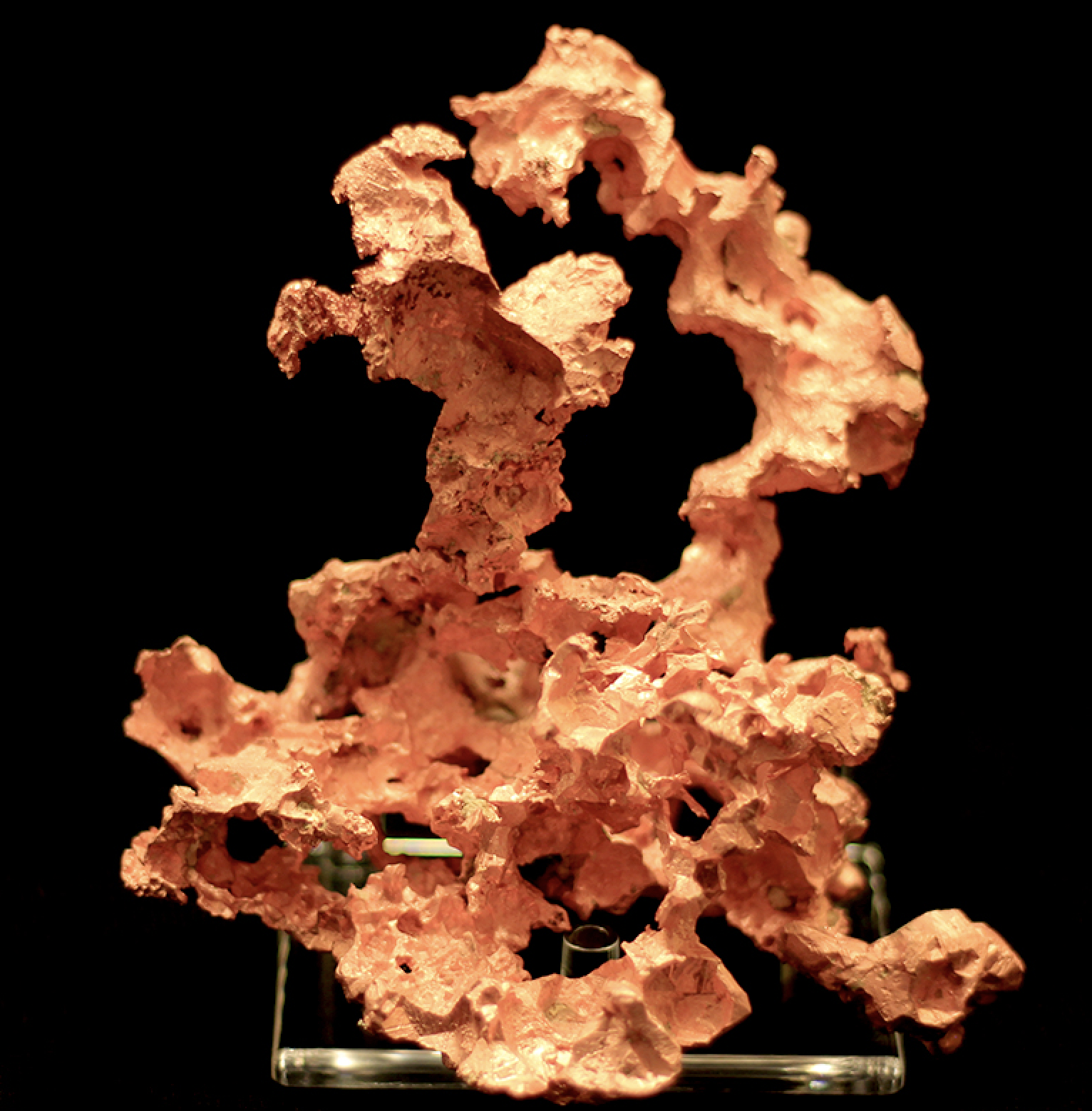
Photo: Wikimedia Commons
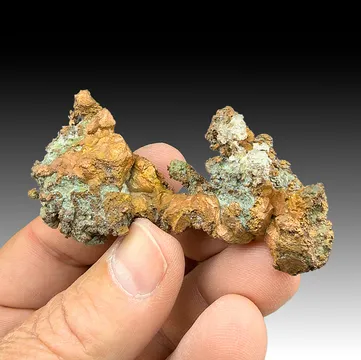
What makes the Keweenaw material visually distinctive is the meeting of metal and volcanic texture. Freshly exposed copper has the warm salmon-orange color collectors love, but many old specimens carry chestnut, chocolate, black, or red cuprite-rich skins. Some pieces retain green epidote-rich “greenstone” or basaltic matrix; others show calcite, prehnite, datolite, quartz, pumpellyite, analcime, or native silver. The best examples are not simply lumps of copper. They have architecture: open branching, clean crystallization, sharp negative spaces, preserved amygdule surfaces, contrasting matrix, or a historic mine attribution such as Central, Cliff, Quincy, Ahmeek, Mohawk, Kearsarge, Calumet & Hecla, or Minesota.
Geologically, the peninsula sits on the southern flank of the Midcontinent Rift, where immense Mesoproterozoic basaltic lava flows and interbedded conglomerates of the Portage Lake Volcanics were tilted, faulted, altered, and mineralized. Hydrothermal fluids moved through permeable lava-flow tops, amygdaloidal zones, conglomerate beds, and fissures. Instead of forming a typical sulfide copper camp, the system deposited enormous quantities of native copper, with native silver as the famous accessory metal. This is why Keweenaw specimens feel so different from copper specimens from most other districts: they are products of a regional native-metal system, not merely oxidation-zone curiosities.

Historically, the Keweenaw copper district was one of the great mineral districts of North America. Indigenous people mined and worked the region’s native copper thousands of years before industrial mining. In the 1840s, the peninsula became the scene of one of the earliest American mineral rushes, predating the California Gold Rush. By 1849, the area supplied nearly all U.S. copper production, and for decades the Keweenaw was the country’s principal copper source. Industrial mining ended, but the collectors never left. Today the old rock piles, museum collections, private collecting operations, and inherited mine specimens continue to feed a market that ranges from affordable cleaned float nuggets to old-time crystallized cabinet pieces and rare copper-silver “halfbreed” specimens.
Search for specimens: View all copper specimens from Keweenaw Peninsula, Michigan, USA
The Keweenaw Peninsula lies in Michigan’s Upper Peninsula, projecting northeastward into Lake Superior. In mineral-collecting usage, “Keweenaw copper” often refers broadly to the native-copper district extending through Keweenaw, Houghton, and Ontonagon counties, with famous subdistricts and mines distributed along the tilted volcanic range. The locality is not a single mine but a province: a long belt of basaltic lava flows, interflow conglomerates, fissure veins, historic mine workings, glacial float occurrences, lake-bottom copper masses, and mine dumps.
The deposit type is best understood as a native-copper hydrothermal system hosted principally by Mesoproterozoic rift volcanics. The Portage Lake Volcanics contain hundreds of basalt flows, many with vesicular or amygdaloidal flow tops. Those porous flow tops provided permeability for mineralizing fluids and became major ore horizons. Conglomerate beds between lava flows formed another important host: native copper fills spaces between rounded volcanic clasts or coats pebbles and cobbles. Fissure veins, particularly important in the early mines of Keweenaw County and Ontonagon County, cut across the volcanic and conglomeratic strata and locally carried spectacular masses and crystallized copper.
Mining history followed the geology. Early prospectors were attracted by visible copper, ancient pits, float copper, and large masses. The Cliff Mine, opened in 1845, became the first large-scale profitable copper mine on the peninsula and worked a fissure vein. Other early fissure mines such as Central, Phoenix, and Minesota became famous for masses of native copper. Later, the great commercial success of the district shifted strongly to amygdaloid and conglomerate lodes mined on an industrial scale by companies such as Quincy and Calumet & Hecla. From 1845 to 1968, the native-copper district produced roughly 11 billion pounds of refined copper, with native copper making up essentially all of that output.
The mining period was long, but not uniform. The first rush began in the early 1840s. The Cliff and other fissure mines dominated the earliest years. By the later 19th century, larger corporate operations and lower-grade but extensive amygdaloid and conglomerate lodes transformed the district into a mature industrial mining landscape. The Keweenaw’s national dominance eventually waned as western U.S. copper districts developed, but the Michigan mines continued into the 20th century. The great era of native-copper mining effectively ended in 1968, though White Pine to the southwest continued as a sediment-hosted copper producer until 1995–1996 and is often discussed in broader Michigan copper history.
Collecting access today is mixed and must be treated carefully. Many mine dumps and poor-rock piles remain visible, but many are privately owned, controlled by companies or local entities, or part of historic landscapes. Permission is essential. Some legal collecting opportunities are organized through local events such as Keweenaw Mineral Days, where prepared former mine piles can be collected under event rules. There are also private fee-collecting opportunities, including the Iroquois Copper Shop & Mine, which advertises collecting on its own mine property. On Michigan state-owned land, hobby collecting is limited by state rules; private land requires landowner permission, and historic or protected sites may have additional restrictions.
Notable finds from the district include everything from hand-sized crystallized groups to underground masses weighing many tons. The A. E. Seaman Mineral Museum displays a 19-ton mass of native “Lake Copper” recovered from Lake Superior bottomlands offshore between Eagle River and Eagle Harbor. The museum notes that even larger underground masses were encountered historically, including native copper masses reportedly reaching hundreds of tons at the Minesota Mine. The famous Ontonagon Boulder, a 3,708-pound mass of native copper removed in the 1840s and now associated with the Smithsonian’s National Museum of Natural History, became one of the great symbolic objects of the early copper rush.
Keweenaw copper occurs in several collector-recognizable modes, each with its own appeal.
The most familiar is massive and hackly native copper, irregularly torn from veins or amygdaloid zones. These pieces often show jagged, sharp-edged surfaces where the copper was broken from enclosing basalt or calcite. Old-time specimens may be naturally oxidized to brown, red-brown, or black, while heavily cleaned pieces show bright pink-orange metal.
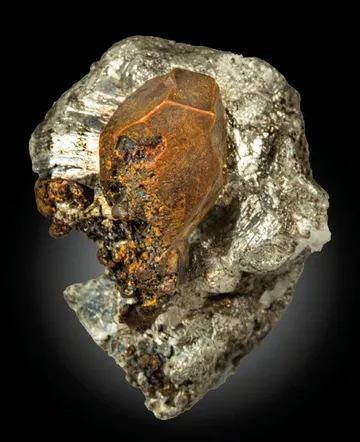
Crystallized copper is the collector’s prize. Keweenaw crystals may be subhedral to well-formed, commonly distorted, stepped, spinel-twinned, or branching into arborescent forms. Instead of isolated textbook crystals, the district is best known for sculptural aggregates—branching sprays, skeletal sheets, and open metallic growths. Fine crystallized examples from mines such as Central, Cliff, Phoenix, Quincy, Ahmeek, and related localities are far more desirable than ordinary massive pieces.
Amygdaloidal copper forms in vesicles in basalt. These specimens may show copper occupying rounded cavities, sometimes with calcite, prehnite, epidote, pumpellyite, or other secondary minerals. A polished or broken surface through amygdaloidal basalt can reveal bright blebs of copper scattered through dark green to gray volcanic rock.
Conglomerate copper is another signature style. Here native copper fills intergranular spaces or coats pebbles in rift-related conglomerate beds. Cut slabs may show copper netting around red, brown, or green volcanic clasts; in three-dimensional pieces, weathering or removal of clasts can leave shell-like copper forms sometimes called “skull copper.”
Fissure-vein copper is historically important and often mineralogically rich. Fissure specimens may include copper with quartz, calcite, datolite, prehnite, epidote, chlorite, or native silver, and the best vein specimens can be highly sculptural. Early Keweenaw mining chased these rich fissures because they could contain spectacular concentrations of native metal, even if they were not always as extensive as later amygdaloid and conglomerate lodes.
Float copper is glacially transported native copper. It is typically rounded, smoothed, and darkly patinated, often with green malachite or red cuprite coatings. Float pieces are beloved as tangible Ice Age objects: copper plucked from bedrock, dragged and abraded by glacial ice and meltwater, then left in soils, rivers, beaches, or fields. They are usually less sharply crystallized than mine specimens but can have superb sculptural form and heavy, satisfying density.
Copper-silver “halfbreed” specimens are among the most charismatic Keweenaw collectibles. Native silver and native copper can occur together as intergrown masses or nuggets. The contrast between warm copper and white metallic silver is visually striking, and examples with clear, natural intergrowth and old provenance are strongly sought. Silver-rich examples are less common than copper-dominant pieces, and many halfbreeds on the market are small.
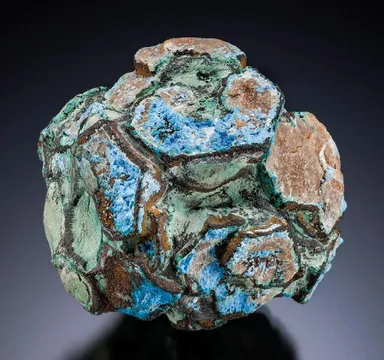
Color is an important quality factor. Fresh copper is metallic salmon to rose-orange. Natural aged surfaces may be reddish, brown, black, or green-coated. Cuprite can produce a red to brick-red skin, while malachite gives green coatings on weathered float or mine pieces. A specimen with completely bright, uniform pink color has often been aggressively cleaned; this is not necessarily bad for display, but it should be understood as a presentation choice rather than a natural patina.
Size ranges are unusually broad. Micromount and thumbnail collectors can find copper in amygdules, small crystals, and delicate wires. Miniature and small-cabinet specimens dominate the commercial market. Cabinet-size crystallized copper with good form is much scarcer. Large masses exist, of course, but most ton-scale copper belongs in museums, industrial history, or outdoor displays rather than private mineral cabinets. For serious collectors, form, mine attribution, matrix, and provenance usually matter more than raw weight.
The most common associated minerals on collector pieces include native silver, calcite, quartz, datolite, prehnite, epidote, pumpellyite, analcime, chlorite-group minerals, microcline, and copper alteration minerals such as cuprite and malachite. The broader district mineralogy is far richer, but a copper specimen is best judged by the relationship of the copper to its host: copper in basalt, copper in conglomerate, copper with datolite or prehnite, copper with silver, or copper as a freestanding crystallized mass.
High-quality Keweenaw copper is distinguished by one or more of the following: sharp crystallization, open arborescent growth, attractive natural patina, contrasting matrix, visible association with native silver or datolite, clear mine attribution, old collection history, and minimal modern damage. A rounded float nugget may be charming; a crystallized Central Mine copper with provenance is a different level of specimen.
Keweenaw copper is common in the broad sense and rare in the fine-mineral sense. Small nuggets, cleaned bits, and copper-bearing basalt fragments are widely available. Fine crystallized groups with documented mine attribution are much less common, and truly excellent old-time specimens can be expensive. Copper-silver halfbreeds, especially silver-rich or well-crystallized examples, are always in demand.
The main authenticity and presentation issue is cleaning. Much Keweenaw copper on the market has been acid-cleaned to remove calcite, iron staining, basaltic grime, or oxidation. Local cleaning traditions have included muriatic acid, nitric acid, commercial brighteners, and Copper Bright–type treatments. Cleaning can reveal beautiful copper but can also strip natural patina, leave an unnaturally uniform pink surface, damage associated minerals, or produce residues in crevices. For display specimens, bright cleaning is not automatically unacceptable, but it should be disclosed when known. For old-time and scientific specimens, original patina and labels often carry more value than shine.
Condition issues are also distinctive. Copper is soft and malleable, so points, wires, and crystal edges bend easily. Hackly projections can be flattened, clipped, or polished by handling. Fine arborescent forms are vulnerable to compression. Float copper is normally abraded by nature; that smoothness is not damage, but saw-cut or polished faces should be recognized. Acid-cleaned pieces may continue to spot or darken if not thoroughly neutralized and rinsed. Specimens with calcite, datolite, or prehnite associations require more conservative cleaning because the accessory minerals can be more sensitive or more valuable than the copper brightness gained.
Halfbreed specimens require special scrutiny. Natural copper-silver intergrowths from the Keweenaw are real and classic, but buyers should look for convincing metal-to-metal intergrowth rather than a loose silver fragment wedged into copper. Check the contact under magnification. Natural halfbreeds commonly show complex boundaries, oxidation differences, and old surface continuity; suspicious pieces may show glue, fresh tool marks, improbable placement, or silver confined to a convenient display face. Provenance from an old collection or a trusted dealer matters.
Locality precision matters greatly. “Keweenaw Peninsula” is acceptable for older or unlocalized specimens, but mine-specific labels add value and context. A copper labeled simply “Michigan” may still be attractive, but it is less desirable than one tied to Central Mine, Cliff Mine, Quincy Mine, Ahmeek Mine, Iroquois Mine, Kearsarge Mine, Mohawk Mine, Minesota Mine, or another documented locality. Be especially cautious with vague “Lake Superior copper” labels; that phrase can refer to Keweenaw material, glacial float found far from bedrock source, or a broadly regional specimen.
Collectors should also distinguish native copper specimens from copper ore slabs, slag, and industrial copper. Keweenaw mine-rock slabs showing copper in conglomerate or basalt are legitimate geological specimens, but they are different from crystallized native copper. Smelter slag and industrial copper artifacts are historically interesting but should not be sold as natural mineral specimens. Likewise, polished float copper can be handsome, but a polished surface changes the specimen category.
Market availability remains good because the district has a long collecting tradition and large volumes of old mine rock. Affordable pieces are easy to obtain. The best material—sharp crystals, elegant arborescent groups, old labels, halfbreeds, datolite-associated copper, and natural patinated cabinet pieces—is much harder to replace. Serious collectors should buy the most specific label and the best form they can afford, because Keweenaw copper rewards connoisseurship: two specimens of identical weight can differ enormously in mineralogical and historical importance.
Long before industrial shafts and stamp mills, copper was already drawing people to the Keweenaw. Native peoples mined, hammered, and traded the metal for thousands of years. The attraction is easy to understand: copper here could be used as found. It did not require smelting from sulfide ore. It could be hammered into tools, points, ornaments, and trade objects. Archaeological and historical accounts place Keweenaw copper far beyond the peninsula, carried through exchange networks deep into eastern North America.
The Ontonagon Boulder became the great emblem of the early copper imagination. It was a mass of native copper weighing 3,708 pounds, known from the Ontonagon River country and eventually removed in the 1840s. In an era when eastern investors were trying to understand what the Lake Superior copper region might become, a multi-thousand-pound piece of nearly pure metal was irresistible evidence. It helped feed the idea that the Upper Peninsula held not just ore, but treasure in the form of copper boulders and veins. The boulder’s later association with the Smithsonian made it even more legendary: a mineral specimen, a sacred and contested cultural object, and a promotional symbol for a mining rush all at once.
The Cliff Mine gave the rush its proof of profit. Opened in 1845, it became the first large-scale profitable copper mine on the Keweenaw Peninsula. It worked a fissure vein, the kind of deposit early miners could understand because the copper was concentrated into rich masses rather than diffused through low-grade rock. For a time the Cliff was the mine everyone else hoped to imitate. The early grade was extraordinary by later standards, and the mine’s success showed that the Keweenaw was not merely a place of rumors, ancient pits, and float copper—it could produce dividends.
The district later outgrew the romance of single veins. Companies learned that the real industrial future lay in extensive amygdaloid and conglomerate lodes, even if they were lower grade. This shift changed the landscape. Shaft-rock houses, stamp mills, rail lines, smelters, company towns, docks, and immigrant neighborhoods grew around the mines. Quincy and Calumet & Hecla became names with national weight. Keweenaw copper was not only collected; it was crushed, stamped, concentrated, smelted, cast, shipped, and wired into a rapidly industrializing country.
One of the most memorable modern copper stories happened underwater. In 1991, divers Robert Barron and Donald Kauppi found a huge native copper mass on the bottomlands of Lake Superior in the Great Sand Bay area, offshore between Eagle River and Eagle Harbor. It lay horizontally, though geologically it had formed as a near-vertical tabular vein. Glacial ice had passed over the exposed top, smoothing it and cutting grooves; the underside remained rough because it had rested protected on the lake bottom. The mass was eventually recovered and displayed by the A. E. Seaman Mineral Museum as “Lake Copper.” Its weight, now given as 19 tons, makes it one of the great native-copper display pieces in the world. What collectors see in a hand specimen—the density, the skin of secondary copper minerals, the strange sculptural surfaces—appears there on architectural scale.
The old mine piles continue the story on a human scale. A collector walking a Keweenaw rock pile is not just looking for a bright metal speck. The piles are fragments of vanished underground maps: amygdaloid flow tops, conglomerate beds, vein material, altered basalt, calcite seams, datolite nodules, and occasional native silver. The best finds are often not obvious at first. A dull brown mass may hide copper under oxidation. A green-black basalt fragment may show a salmon glint only when wet or broken. A conglomerate cobble may look ordinary until cut, when copper suddenly appears between the clasts like metal grout in ancient volcanic gravel.
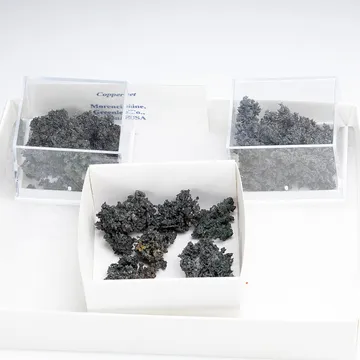

_3_(17277777476).jpg)