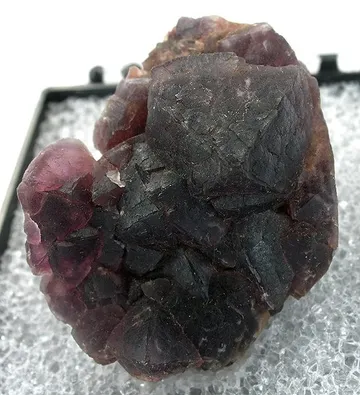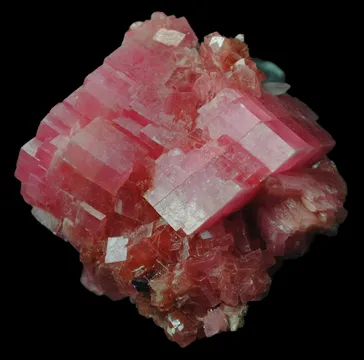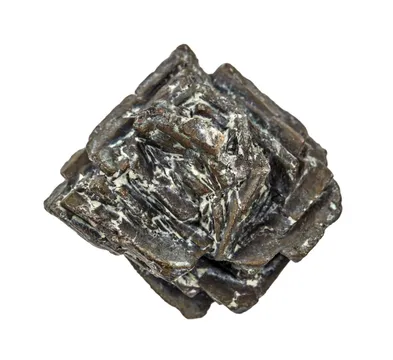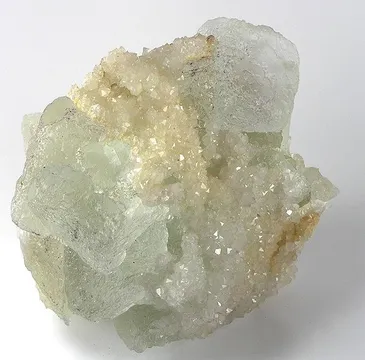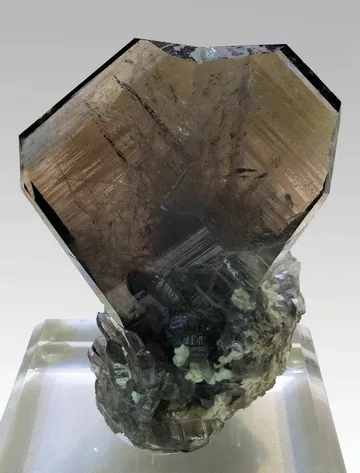
Kerr McGee Section 17 Mine - cobalt-blue halite in sylvite-rich ore from the Carlsbad evaporite district; a restricted locality prized by collectors.
Key facts
Kerr Mcgee Section 17 Mine is the collector name attached on EarthWonders to the celebrated Kerr McGee–Intrepid East potash mine near Carlsbad, in the great Permian evaporite country of southeastern New Mexico. Its fame rests on a short-lived and extraordinarily photogenic occurrence of blue to violet halite in sylvite-rich ore: transparent to translucent NaCl cubes and cleavage masses colored in saturated cobalt, indigo, electric blue, and purple, commonly set against colorless to white sylvite. The deposit is part of the Carlsbad Potash District, where flat-lying Ochoan evaporites of the Salado Formation and its McNutt potash zone supplied sylvite- and langbeinite-bearing ore to one of the most important potash-mining districts in the United States.
The best specimens are not simply blue salt. They are sculptural evaporite pieces from deep underground workings: blocky halite cubes perched on sylvinite, blue cores “frozen” inside clear sylvite, rich purple-blue cleavage sections that ignite under backlighting, and uncommon matrix pieces where the contrast between blue halite and pale sylvite gives the specimen real cabinet presence. The locality became a modern classic because the attractive material was collected from a restricted underground zone, not from an open collecting site, and because the finest examples quickly entered serious private, museum, and published collections.
Regional View
Country View
The wider mine has had a long industrial life under several names, including Kermac, Kerr McGee, Vertac, Fermetia, New Mexico Potash, Mississippi Potash East, and Intrepid Potash East. For mineral collectors, however, the name “Kerr McGee” has persisted because the blue halite suite was publicized, labelled, and traded under that classic name. The specimens belong to a peculiar intersection of ore geology and post-mining opportunity: a large commercial potash mine, deep bedded evaporites, old rooms slowly squeezing shut under rock pressure, sylvite seams that locally hosted blue and purple halite, and a brief period when knowledgeable collectors with mine access recognized that the material deserved careful specimen recovery rather than treatment as ore.
Search for specimens: View all specimens from Kerr Mcgee Section 17 Mine, USA
Kerr Mcgee Section 17 Mine specimens come from the Carlsbad Potash District of Eddy County, New Mexico, in the Delaware Basin portion of the Permian Basin. The productive stratigraphy is evaporitic: dominantly halite, anhydrite, polyhalite, and potassium salts in the Salado Formation, with the potash ore minerals concentrated especially in the McNutt potash zone. The Carlsbad district’s ore minerals are principally sylvite and langbeinite, with carnallite, kainite, leonite, kieserite, polyhalite, anhydrite, clay minerals, and halite forming part of the broader assemblage. The collectible blue halite occurs in the same chemical world as the ore: NaCl crystals intimately associated with KCl-rich sylvite and sylvinite.
Industrial geology explains the look of the specimens. The East Mine historically mined sylvinite in the 10th ore zone, while modern East Mine operations emphasize langbeinite-bearing ore in the 3rd, 4th, and 5th ore zones. Technical descriptions of the Intrepid Potash-New Mexico property describe the East Mine as a room-and-pillar operation with common minerals including halite, sylvite, montmorillonite-bearing clay, sulfate minerals, and carnallite; the eastern parts contain carnallite and kieserite, and older 10th-zone workings contain irregular barren clay pods. Collector material is most closely associated with old sylvite-rich workings, especially the 10th ore zone seams later remembered by collectors as the Blue Ice and Frozen Blue seams.
The Carlsbad potash story began when drilling east of Carlsbad encountered soluble red potassium salts in the 1920s. The U.S. Potash mine followed as the first major development, and the Known Potash Leasing Area was established in the 1930s to protect and organize exploitation of the fertilizer resource. Kerr-McGee’s East Mine operation dates from the mid-1960s; later operators and names followed, with Intrepid Potash acquiring Carlsbad assets in 2004. The mine remained an industrial producer, not a public mineral-collecting locality. That distinction matters: essentially all legitimate specimens with collector provenance came through permitted underground access by mine personnel or authorized collectors, especially the period when Philip Simmons and associates were able to collect the blue halite zone.
The famous blue halite material was collected chiefly between 2007 and 2014, with particularly important finds around 2010–2012. Early collecting produced many richly colored cleavage fragments from large, fractured crystals in sylvite seams. Later, better zones yielded complete crystals and matrix specimens, including halite cubes partly or completely embedded in sylvite. The best-known pocket/seam names are Blue Ice and Frozen Blue. The Frozen Blue seam was memorable because dark forms on the floor and ribs of the low drift proved to be blue halite crystals waiting in and around sylvite; many needed careful mechanical removal of surrounding sylvite to reveal the blue halite inside.
Access today should be treated as closed to ordinary collectors. The mine is an active industrial potash property, underground access is controlled, and the old blue-halide collecting areas were reported by the collector who documented them to have become inaccessible by 2014 because of roof convergence in the soft salt beds. The specimens on the market are therefore not casual recent field-collecting pieces; they are finite, provenance-sensitive examples from a short collecting window in deep old mine workings.
Halite from Kerr Mcgee Section 17 Mine is the locality’s signature mineral: colorless, blue, deep blue, violet-blue, and rare purple NaCl occurring as cleavage masses, sharp cubes, cube sections, and complete crystals on or in sylvite and sylvinite. The famous material came from sylvite seams in old underground workings, with the Blue Ice and Frozen Blue seams producing the most desirable collector pieces; early material was commonly cleaved from large fractured crystals, while the later and more coveted specimens show complete cubes, blue crystals encased in transparent to white sylvite, or blue halite perched aesthetically on pale sylvite matrix. Published and collector-documented examples range from thumbnail and miniature crystals to large cabinet cleaves, with individual blue crystals described at around 15 cm in situ and some enormous fractured crystals in widened sylvite seams reaching far larger sizes before breaking under mine pressure. Fine pieces separate themselves by saturated blue or violet color, transparency when backlit, sharp cubic form, minimal bruising or dissolution, and a strong contrast with clean sylvite rather than dull, shattered sylvinite.
Sylvite from Kerr Mcgee Section 17 Mine is more than a matrix mineral: it is the KCl ore mineral that hosted and framed the blue halite, and good specimens show why the combination became famous. It occurs as colorless, white, transparent, translucent, or locally iron-stained KCl in sylvinite, as cleavage sections, as cubic crystals with diagnostic octahedral modifications, and as enclosing material around blue halite cubes. The most prized pieces are those in which sylvite remains transparent enough to reveal “frozen” blue halite inside, or where a dominant sylvite crystal carries small blue halites as accent crystals; collector records include a rare highly modified 10.2 cm euhedral sylvite crystal and an older 12 cm sylvite crystal from the early mine years, while EarthWonders and dealer specimens often emphasize gemmy, colorless sylvite in the miniature range. Good sylvite pieces from this mine are difficult because KCl is soft, soluble, cleaves readily, and is commonly damaged or massive, so sharp, transparent, three-dimensional crystals with blue halite association are far superior to ordinary sylvinite fragments.
Other documented minerals from the Kerr McGee–Intrepid East locality include anhydrite, carnallite, gypsum, hematite, kainite, kaolinite, kieserite, langbeinite, leonite, montmorillonite, muscovite/illite, polyhalite, quartz, and chlorite-group material. For collectors, the most interesting rarities after halite and sylvite are the evaporite sulfates and chlorides: carnallite crystals from upper levels, leonite with halite from the 5th ore zone, langbeinite crystals from lower levels and the 5th ore zone, and polyhalite from the 10th ore zone. No accepted type-locality mineral is tied specifically to the Kerr McGee Mine in the sources consulted, but the assemblage is significant because it preserves collector-quality examples of minerals that are usually encountered in potash mines as ore, alteration products, or friable evaporite masses rather than aesthetic specimens.
Authenticity at this locality is primarily a matter of provenance and appearance. The market contains genuine Kerr McGee/Intrepid East blue halite with sylvite, but labels may vary: Kerr McGee Mine, Kermac Mine, Intrepid Potash East Mine, Carlsbad Potash District, 10th Ore Zone, Blue Ice seam, Frozen Blue seam, and, on EarthWonders, Kerr Mcgee Section 17 Mine. Those names can refer to the same broad collector occurrence, but a serious specimen should carry as much detail as possible: collector, date range, seam name, ore-zone information, and prior collection. Philip Simmons/Enchanted Minerals provenance, published references to the 2013 Mineralogical Record article, and established dealer or museum records add real confidence.
No recurring, well-documented fake industry is attached to this locality, but misdescription is a practical risk. Bright blue halite from elsewhere, dyed salt, or artificially irradiated halite should not be accepted as Kerr McGee material without credible provenance. Genuine pieces commonly show blue to violet coloration within transparent or translucent halite, often with color zoning, clear areas, cleavage faces, and association with colorless to white sylvite or sylvinite. The blue is not a surface coating, and dissolving or wetting the specimen is destructive rather than diagnostic. Avoid pieces whose color looks like a superficial dye stain, whose matrix is inconsistent with sylvinite, or whose label gives only “New Mexico blue halite” without a chain of custody.
Condition is the great issue. Halite and sylvite are soft, brittle, perfect-cleaving, and highly soluble; sylvite is especially unforgiving. Many Kerr McGee pieces were born damaged because the large halite crystals were fractured underground by lithostatic pressure and by the convergence of old salt-mine rooms. Natural cleavage faces are normal, and some excellent pieces are display-quality cleaves rather than complete crystals. Still, fresh bruises, rounded water-dissolved edges, cloudy surface bloom, salt dust, and crumbling sylvite reduce value sharply. The best examples retain crisp cubic geometry, clean luster, stable dry surfaces, and vivid internal color.
Storage should be dry, stable, and deliberate. Do not wash these specimens, do not clean them with water, and avoid damp display cases, ultrasonic cleaners, outdoor shows in humid weather, and repeated handling with moist hands. A sealed acrylic box with desiccant is appropriate for important miniatures and thumbnails. Keep pieces away from temperature swings that encourage condensation. Because the best blue color often responds dramatically to lighting, judge a specimen under both reflected light and backlighting; some seemingly dark halites become electric blue when light passes through them, while others are attractive mainly as surface-blue cubes on pale sylvite.
Rarity is now well established. Common small cleaves and partial crystals appear intermittently, but top matrix specimens with complete blue cubes on sylvite, clear “frozen” halite-in-sylvite examples, rich violet-purple cleaves, and large undamaged cabinet pieces are genuinely scarce. The mine’s productive blue halite zone is no longer a collecting destination, and published major specimens have already migrated into advanced private collections and institutions, so replacement quality is difficult.
The modern story begins with an office shelf. In the summer of 2007, Philip Simmons was working in the Carlsbad Potash District as a mining engineering intern when his boss, Chief Mine Engineer Tom, had a few dark blue halite cleavage fragments from the underground workings. Simmons had not expected much from an evaporite mine as a specimen locality; potash mines normally mean ore, dust, brines, and industrial salt, not classic mineral specimens. The blue pieces were enough to change that expectation. He persuaded Tom to take him to the source area, a trip he later described as one of the most memorable experiences of his life. After graduating in 2008, Simmons accepted a position as a planning and ore-control engineer, and the company permitted collecting on his own time. Weekends in the old workings followed.
The logistics were not romantic in the usual field-collecting sense. After descending the shaft, the first step was not to shoulder a pack but to pick up a mantrip, because the collecting area lay more than 10 km from the bottom of the shaft. Walking was not realistic. The approach into the old zone acquired its own signposts: after several kilometers underground, the turnoff was marked by “saltsicles,” halite stalactites formed where groundwater had percolated through drill holes in the mine roof. Beyond that, blue began to appear in white sylvite seams. In one documented scene, dark blue halite crystals about 15 cm across sat in a sylvite seam; farther in, the seams widened and the halite grew larger.
The mine itself was closing around the collectors. Simmons described the workings as about 500 meters deep, with rooms slowly squeezing shut because the rock salt is soft under pressure. Rooms that had originally been more than 2 meters high had narrowed to around 1.2 meters in many places, and some passages were under 0.6 meter high. A photograph he called a “big” tunnel still showed a low, compressed crawl of a room. That convergence shaped the specimens. The biggest halite crystals were gorgeous but badly stressed; almost all of the large crystals were fractured or fragmented by the pressure. One large in-situ crystal, nearly extracted from its sylvite casing, fell apart after the sylvite was removed; a crack along one side told the story before the crystal failed.
Scale is part of the legend. In places, sylvite seams widened until they filled an entire working face, and halite crystals grew to over 2 meters on a side. One photographed example was nearly 1.2 meters across. Those crystals were not museum specimens waiting to be plucked whole; they were trapped in an underground salt machine that had been tightening around them for years. The early collecting years therefore produced countless five-gallon buckets of cleavage pieces from large broken crystals. Some cleaves were still exceptional: purple was the rarest hue, a 30 cm cleave showed blue and purple variation, and one huge approximately 45 cm cleave was described by Simmons as the finest large cleave he knew of, almost impossible to recover at that size because of convergence pressure and access problems.
Then came the more specimen-like finds. Before mid-2011, complete matrix specimens were uncommon, but the Blue Ice and Frozen Blue seams changed the character of the occurrence. When the Frozen Blue seam was first opened, the drift was less than 1 meter high even though it had once been over 2 meters. Dark forms scattered across the floor and ribs were crystals. Some were larger blue halites on the left side of the seam; others were smaller crystals encased in sylvite. Two specimens helped give the Frozen Blue seam its name: a 7.3 cm piece in which a blue halite cube was completely encased in sylvite, and a 14.9 cm piece where only a small corner of the halite crystal was exposed.
Recovery could be surprisingly simple or maddeningly delicate. Simmons recorded that many Frozen Blue specimens were collected by picking them off the floor. Once collected, they went back to his house for preparation, where sylvite often had to be removed mechanically from around the halite to expose the blue crystal inside. One approximately 15 cm specimen was found on the ground already in fine form; it needed only wrapping and transport in a wheeled crate back to the mantrip. Another 18.7 cm specimen required post-collection preparation because most of its halite crystals were completely encased in sylvite; that piece later entered the Lyda Hill collection.
The great named specimen is “Royal Passion,” an 18.2 cm halite with sylvite that Simmons called the finest specimen collected from the mine. It appeared on the cover of the January-February 2013 Mineralogical Record and later entered the mim Museum collection in Beirut. Another 8.1 cm specimen from the Blue Ice seam appeared on the cover of the German magazine Lapis in December 2012. These were not anonymous mine curiosities; within a few years of discovery, the best Kerr McGee blue halites had become illustrated, named, and museum-level specimens.
The occurrence also produced oddities that reward close looking. One 5.5 cm halite-sylvite piece had a colorless zone outside the blue zone, the inverse of nearly all the other crystals; Simmons noted it was found in a pool of water and suggested that colorless halite may have crystallized over older blue halite while it sat in the brine. Nearby brine pools also produced post-mining colorless halite crystals and mixed halite-sylvite crystals; on those pieces, octahedral modifications on cubic crystals help distinguish sylvite from halite. Elsewhere in the mine, halite stalactites developed faden-like growth through stacks of individual crystals, with small sylvite crystals attached along the sides.
The window closed quickly. Collecting was halted in 2014 because the old area became inaccessible as the ceiling continued to converge. That is why good Kerr McGee pieces feel different from many modern mine finds. They are not the product of an open, renewable collecting face. They represent a few years of recognition, permission, endurance, and timing in a deep potash mine where the rooms themselves were slowly disappearing.