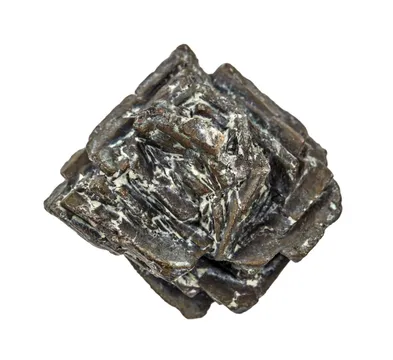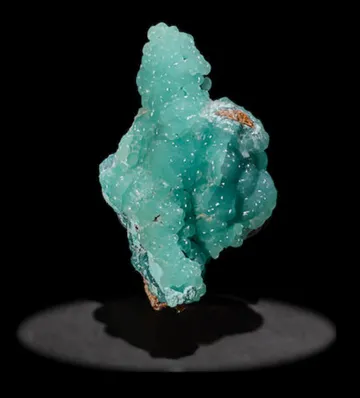
Kelly Mine, USA – premier New Mexico locality for zinc–lead–silver ore and blue to apple-green smithsonite, with notable secondary minerals for collectors.
Key facts
Kelly Mine is one of the essential American carbonate-replacement localities: a zinc-lead-silver mine in the Magdalena Mining District of Socorro County, New Mexico, where the practical business of ore mining produced one of the most recognizable collector minerals in the United States. The mine lies in the northern Magdalena Mountains, just southeast of Magdalena and immediately north of the old townsite of Kelly. Its ore bodies were developed chiefly in the Mississippian Kelly Limestone, a carbonate unit that was fractured, silicified, invaded by hydrothermal fluids, and locally replaced by sulfides and later by spectacular secondary zinc, lead, copper, and barium minerals.
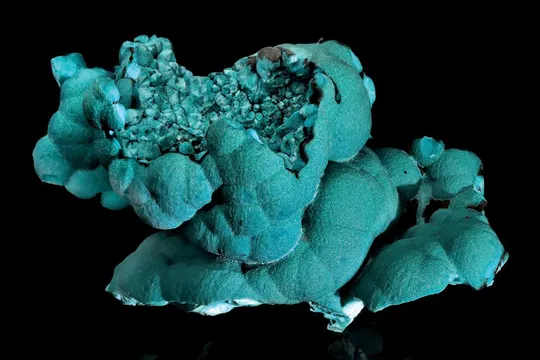
To collectors, “Kelly” almost always means smithsonite first: blue, blue-green, apple-green, and seafoam botryoids with waxy to silky luster, commonly lining cavities or forming rounded, mammillary masses on pale limestone, jasperoid, quartz-rich matrix, iron oxides, or earlier carbonate. The best specimens have a depth and translucency that make the surface look wet, with rolling botryoids that catch light across the whole face rather than appearing chalky or granular. Yet the locality is more than a one-mineral name. Aurichalcite, calcite, barite, rosasite, azurite, cerussite, malachite, wulfenite, hemimorphite, and an extended list of late supergene sulfates and rarities give the mine the sort of mineralogical depth that rewards close labels and careful study.
Historically, Kelly sits at the junction of ore, town, railroad, smelter, and specimen culture. The district began as a lead-silver camp; the later recognition that some “waste” limestone was actually zinc carbonate helped revive the camp as a zinc producer. Kelly’s mine plant, shafts, dumps, smelter remains, and church became part of one of New Mexico’s best-known mining ghost-town landscapes. For mineral collectors, the place matters because it supplied enough fine smithsonite for museum showcases, old collections, lapidary work, and the international specimen trade, while still retaining a distinctly local visual signature: rounded blue-green smithsonite from a dry New Mexico mining camp, not a generic carbonate crust.
Regional View
Country View
The old workings were extensive. The Kelly property was reported as forty claims covering 578 acres, with access by the Traylor, Paschal, and Billings shafts and the Kelly tunnel; later descriptions speak of ten levels and, when adjoining mine workings are considered, a connected underground system measured in tens of miles. That scale is important for collectors because “Kelly Mine” labels can cover material from different levels, periods, and styles of mining, and because similar Magdalena District mineralization occurs at nearby mines such as the Graphic-Waldo and Juanita. Good old labels that say Kelly specifically should be preserved.
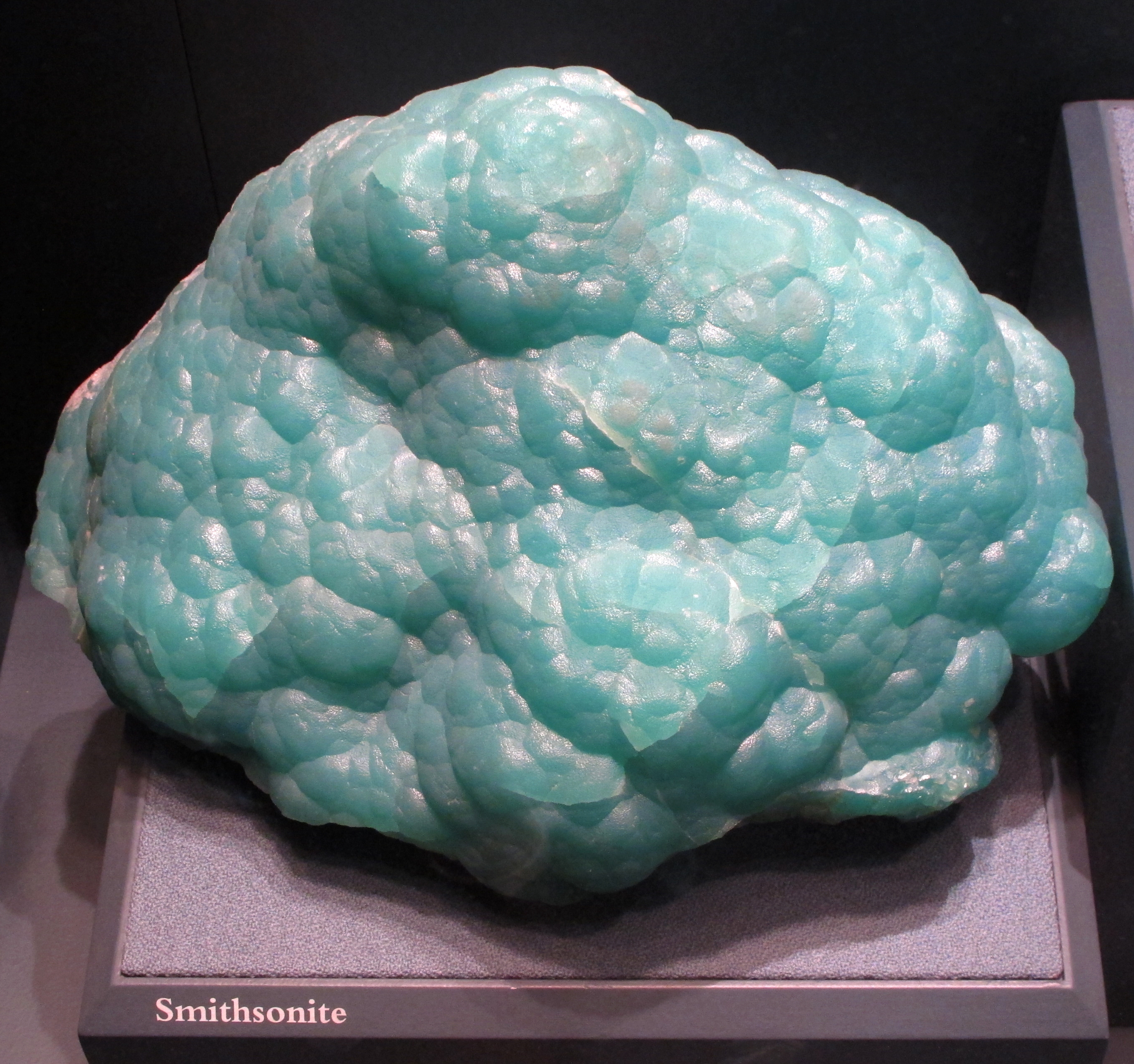
Photo: Wikimedia Commons

Photo: Wikimedia Commons
Search for specimens: View all specimens from Kelly Mine, USA
Kelly Mine is in the Magdalena Mining District, Socorro County, New Mexico, in the northern Magdalena Mountains roughly 3 to 5 miles southeast of Magdalena. The district is a classic carbonate-replacement and contact-metasomatic ore camp. Mineralization was hosted predominantly by the Mississippian Kelly Limestone, a light bluish-gray, medium- to coarse-grained, thick-bedded limestone that includes a dense argillaceous “silver pipe” or “indicator” bed known to miners. The Kelly Limestone is both stratigraphically and historically central: it was named for the Kelly area, it carried much of the ore, and its replaced fossiliferous carbonate fabric later produced some of the district’s most curious pseudomorphic collector pieces.
The ore bodies were not uniform veins so much as replacement pods, shoots, stopes, and fault-controlled masses developed in limestone and silicified limestone. Published mine data emphasize the Kelly-Graphic fault zone and Brown fault, with a general north-northwest structural grain, and record monzonitic intrusive rocks in association with the deposit. Later work on the Kelly Limestone jasperoids interpreted silicification of the upper Kelly Limestone as hydrothermal, with silica-rich fluids moving through karsted carbonate rocks along faults and dikes, while less permeable Pennsylvanian shales and siltstones acted as an upper seal. Primary sphalerite, galena, pyrite, chalcopyrite, and other sulfides supplied the metals; oxidation and groundwater alteration then produced smithsonite, cerussite, anglesite, aurichalcite, rosasite, malachite, azurite, hydrozincite, wulfenite, and other secondary minerals.
Kelly’s mining history is inseparable from the town that grew beside it. J. S. Hutchason, remembered locally as “Old Hutch,” is credited in local histories with discovering rich lead outcrops in 1866 and staking the Juanita and Graphic mines. A nearby claim was staked by Andy Kelley; when the camp was recorded at the Socorro County Courthouse in 1879, a clerical spelling made it “Kelly,” the name that stuck. The camp expanded rapidly in the 1880s after Gustav Billing erected a smelter in Socorro in 1881 and the Atchison, Topeka and Santa Fe railroad spur reached the area in 1885. By then, the logistics of hauling ore by wagon had given way to smelter and rail economics, and Kelly grew into a full mining town with stores, saloons, hotels, schools, churches, and families.
Lead and silver drove the early camp, but zinc changed the district’s trajectory. In the early 1900s the significance of zinc carbonate ore was recognized, and the camp was revitalized by smithsonite as an ore mineral, not merely a collector curiosity. The Graphic Mill, also called the Ozark Mill, was built in 1896 to treat lead, zinc, and silver ores. In 1904 the Graphic Mine passed to Sherwin-Williams Paint Company, and soon afterward the Kelly Mine was acquired by the Tri-Bullion Smelting and Development Company, which built a smelter next to the mine. The property was sold to Empire Zinc Company in 1913. After 1915 the Traylor shaft became the principal access, reaching roughly 1,100 feet and ten levels.
Production waxed and waned with metal prices and ore reserves. Kelly was idle during the 1921–1922 depression; a 1929 company report concluded that known pay ore had been largely removed and that new ore bodies would be costly to discover. Smaller-scale mining continued into the 1930s, especially from the eastern reaches of the mine, with oxidized copper ores, some barite, and calcite noted along quartz cross faults. There was renewed activity during the World War II years, but by the early 1950s the mine had removed or sold its machinery, dismantled much of the plant, and ceased meaningful operations. The Traylor shaft and underground workings are now closed and sealed for safety.
Collecting access has changed sharply and must be treated as a current legal and safety matter. The Kelly Mine is private property. For years the owners allowed paid public visits under defined safety and time conditions, and visitors could search the tailings for smithsonite and other minerals. As of April 9, 2025, the owners announced that the mine is closed to all visitors until further notice while repairs, upgrades, and improvements are undertaken, with trespassing explicitly monitored. Collectors should not assume that older guidebook references to fee collecting are valid today; permission must come from the present owners, and underground entry is not an option.
The famous smithsonite came from oxidized zinc zones and cavities in the old workings, and old accounts make clear that some of the best material was collected directly underground before modern closures. Sherman P. Marsh described being taken into the Kelly Mine in the early 1950s by former miner Fito Tafoya to a stope where blue smithsonite could still be collected. The largest preserved pieces and museum-grade plates represent a much older era of mining and collecting: the New Mexico Bureau of Geology Mineral Museum’s C. T. Brown smithsonite is a 61 x 38 x 38 cm, 34 kg blue-green botryoidal specimen, while another signature specimen, NMBGMR Museum #16315, is a 7.6 cm stalactitic smithsonite with aurichalcite and goethite. These specimens show the range that made Kelly famous, from cabinet-sized velvety botryoids to monumental ore-cavity masses.
Smithsonite is the defining Kelly Mine mineral, occurring as blue, blue-green, apple-green, gray-blue, white, brown, and locally banded botryoidal to mammillary crusts, stalactitic aggregates, cavity linings, “rice-grain” crystalline overgrowths, and pseudomorphs after earlier minerals and fossiliferous limestone textures. Fine specimens range from thumbnails and miniatures with saturated, translucent botryoids to very large cabinet and museum pieces; the most celebrated museum example, the C. T. Brown smithsonite at the New Mexico Bureau of Geology Mineral Museum, measures 61 x 38 x 38 cm and weighs 34 kg. The best pieces are not merely blue: they combine undamaged rolling botryoids, translucency, wet waxy to satin luster, strong color consistency or attractive banding, and enough matrix or cavity form to show how the smithsonite grew. Commoner Kelly smithsonite can be pale, chalky, massive, or abraded from dump exposure, and much of the district’s zinc carbonate ore was milky white and easy to mistake for limestone or calcite in hand specimen; the collector-grade material is the luminous “Kelly blue” to blue-green material, especially when associated with aurichalcite, goethite, calcite, barite, or rosasite.
Aurichalcite from Kelly is a delicate zinc-copper secondary carbonate, usually encountered as pale blue to greenish-blue acicular tufts, silky sprays, feathery aggregates, thin platy rosettes, or plush coatings on matrix and smithsonite. Mindat photo associations and collector specimens show it as one of the most common companions to Kelly smithsonite, and modern specimen descriptions record aurichalcite rosettes only a few millimeters across supporting tiny translucent blue “rice-grain” smithsonite crystals. It is more fragile and less dominant than the smithsonite, so quality is judged by freshness, density of coverage, preservation of individual sprays, attractive contrast against blue-green smithsonite or iron-stained matrix, and absence of matted or rubbed fibers. The best Kelly aurichalcites are not large in crystal size; they are successful because the fibrous blue-green texture is intact and aesthetically placed, often turning a smithsonite specimen into a true combination rather than a single-species plate.
Calcite at Kelly is both a host-rock and specimen mineral: it appears as white to colorless rhombohedral and scalenohedral crystals, “dogtooth” calcite, rosette-like flattened rhombs, and as a crucial precursor shape for smithsonite pseudomorphs that preserve calcite form. On combination pieces, calcite commonly sits as bright white or colorless crystals scattered across blue-green smithsonite, giving sharp contrast to the rounded carbonate surface beneath; recent documented specimens include colorless scalenohedrons to about 1.8 cm on sculptural vug matrix and flattened rhombohedral clusters on smithsonite plates. Good Kelly calcite is judged by clarity, crispness, fluorescence when present, and compositional balance with the smithsonite rather than by giant crystal size. The most desirable pieces show calcite as a clean accessory on high-grade smithsonite or as unusually rich, undamaged crystal coverage from the locality, while ordinary examples are small, bruised, iron-stained, or visually overwhelmed by massive carbonate.
Barite from Kelly is a secondary gangue and specimen mineral tied to the district’s quartz-barite and oxidized replacement assemblages, occurring as cream to brown blades, tabular aggregates, and delicate bladed clusters, sometimes with malachite, smithsonite, or quartz. Local collecting literature notes cream to brown barite blades from the district, while specimen records from Kelly describe small-cabinet clusters of delicate barite blades partly coated by malachite and older quartz-barite associations from related Kelly-zone workings. Compared with the district’s smithsonite, Kelly barite is uncommon and generally collected as a locality mineral or association mineral rather than as a world-class barite occurrence. The best examples have intact blades, open sculptural form, clean contrast with malachite or smithsonite, and a convincing old Kelly or Magdalena District label; ordinary pieces tend to be edge-worn, massive, or difficult to separate visually from broader district material without provenance.
Beyond these four collector staples, Kelly Mine has a long documented mineral list that reflects the oxidation of a polymetallic Pb-Zn-Cu-Ag system in limestone. Important and attractive associated species include azurite, malachite, rosasite, cerussite, anglesite, wulfenite, hydrozincite, hemimorphite, quartz, goethite, hematite, pyrite, sphalerite, galena, chalcopyrite, siderite, magnetite, and specularite. The mine’s rarity story is especially strong in modern micromineralogy: aldridgeite, (Cd,Ca)(Cu,Zn)4(SO4)2(OH)6 · 3H2O, was identified from Kelly as the second reported occurrence in the world, associated with secondary sulfates including ktenasite, niedermayrite, chalcanthite, gypsum, and other minerals. Fossil-related pseudomorphic curiosities are also part of the locality’s character, because the ore occurs in fossiliferous Kelly Limestone; crinoid stems, brachiopods, and horn corals can be preserved or mineral-coated, giving rise to collector shorthand such as “smithsonoids” for smithsonite pseudomorphs after crinoid stem sections.
Kelly smithsonite is a classic enough material that the main authenticity issue is not a famous named fake industry, but overconfident or incorrect locality attribution. Blue-green botryoidal smithsonite is sold from several world localities, and some pieces from Mexico, Greece, Namibia, Arizona, or other New Mexico districts can superficially resemble Kelly material. For high-value specimens, the label matters: “Kelly Mine, Magdalena District, Socorro County, New Mexico” is stronger than a vague “New Mexico smithsonite,” and old collection labels from recognized collections, museum deaccessions, or long-established dealers can materially affect confidence and value.
Color alone should not be treated as proof. Kelly’s celebrated blue-green to green smithsonite has been studied chemically, and copper carbonate in solid solution is a documented coloring factor in strongly colored green bands; however, “cuprian” or “copper-bearing” on a retail label is still best treated as descriptive unless accompanied by analysis. The finest Kelly material can be intensely blue-green without needing promotional adjectives. Conversely, not all Kelly smithsonite is blue: white, brown, gray, pale green, and iron-rich varieties are real from the mine, but they usually command far less unless they show unusual form, pseudomorphism, size, or provenance.
Condition is central. Botryoidal smithsonite looks durable but is not immune to bruising, cleaving, edge chipping, dull abrasion, and acid damage. Dump-collected pieces may show matte worn high points, embedded dirt, sun bleaching of matrix, or broken botryoids along plate edges. Fine old specimens should have a continuous surface skin, undamaged domes, and luster that has not been dulled by harsh cleaning. Be cautious with pieces whose edges show selectively eaten layers or etched surfaces; carbonate minerals react with acids, and careless cleaning can permanently change the surface. Avoid soaking combination specimens where aurichalcite, rosasite, or fragile sulfate species are present, and never use acids on Kelly material unless the goal is destructive testing of an expendable chip.
Fluorescence can add interest but should not be assumed for all specimens. Documented Kelly calcite can fluoresce bright orange under longwave ultraviolet light, while smithsonite itself is more valued for color, form, and luster than for fluorescence. If a specimen is a smithsonite-calcite combination, UV response may help distinguish the calcite accessory from the main zinc carbonate, but fluorescence is not a substitute for proper identification.
The market remains active because Kelly smithsonite is a named American classic with broad recognition outside regional collecting. Small and modest pieces still appear from old collections and older dump collecting, while large, saturated, undamaged botryoidal plates, stalactitic forms, and major old-time specimens are much more competitive. Associations with aurichalcite, calcite, barite, rosasite, azurite, malachite, goethite, or wulfenite can add interest, but the premium remains strongest for clean, lustrous, blue to blue-green smithsonite with unmistakable Kelly character and credible provenance. Because the property is presently closed to visitors, fresh legal supply should be presumed limited unless the owners announce otherwise.
The first great Kelly story is the one collectors understand instantly: the miners threw away part of the ore. In the early lead-silver years, a pale heavy rock in the district looked enough like limestone that it went to the dumps as waste. Asa B. Fitch, manager and lessee at the Graphic Mine, knew zinc was present in the sulfide ore and wondered why it seemed absent from the oxidized material. He had once noticed the unusual weight of the “limestone” and assayed it for lead, finding none. Years later, around 1903, the missing-zinc question returned. He sent similar samples for zinc determination, and the assay showed the supposedly worthless limestone ran 37% zinc. That discovery was not just a Kelly anecdote; it helped reveal a pattern of zinc carbonate replacement deposits across the U.S. Southwest. To a specimen collector, it also explains why the prettiest Kelly mineral began life in the camp as ore, waste, puzzle, and prize all at once.
The town’s name has its own frontier accident. Local histories credit J. S. Hutchason, “Old Hutch,” with the early lead discoveries, while Andy Kelley staked a nearby mine and lent his name to the camp. When the growing settlement was recorded in 1879, the courthouse spelling became Kelly. The clerical error endured. In the decades that followed, the place grew into a hard-working mining town with boardwalks, houses, saloons, stores, churches, schools, doctors, mills, smelters, and ore traffic. Before the railroad reached the district, ore moved by horse- and ox-drawn wagons. After the smelters and rail spur came, Kelly belonged to a larger industrial world; lead, silver, zinc, copper, and gold moved out of the mountains, and supplies, miners, families, and speculation moved in.
Sherman P. Marsh left one of the best collector accounts of Kelly in the years after the boom. His first memory was from 1947, when he traveled there as a twelve-year-old with his grandfather, a traveling salesman. The mine was still working, the town still had a main street with houses and boardwalks on both sides, and what fixed itself in the boy’s mind was an old-time sheriff coming down the boardwalk with hat, vest, badge, and six-guns. It “impressed the bejeepers” out of him.
In the early 1950s Marsh returned with Bill Adkinson for a week of exploring and collecting. They stayed in one of the abandoned houses. A few houses away lived Fito Tafoya, a former Kelly miner, and one evening the young collectors introduced themselves. Tafoya asked if they wanted to go underground and see where the blue smithsonite came from. The main entrance adit was partly caved, so they squeezed around timbering, entered the main adit, turned left down a small ladder, passed through stopes, and at one point slithered through a fissure tilted at 45 degrees with “very dubious timbering.” The route became so convoluted that Marsh later admitted he could not possibly repeat it. At the end of it was a stope with blue smithsonite, and the trip was a success.
A later Marsh episode has the slapstick danger of old collecting. He and Bill brought their future wives, Carol and Colleen, to the mine, imagining they might want to see the smithsonite stope. The women looked at the entrance and declined, preferring to wait outside. That gave the men an idea: they could collect underground, tie the specimen packs to a rope, and have the women haul them up a shaft near the stope. The plan worked until the loaded packs had risen about 30 feet. Then they stopped, reversed, and began sliding down. Above, the weight was pulling the women toward the shaft; below, the collectors shouted, “The packs are coming back down!!!!” The packs crashed to the bottom. The solution was not heroic—just practical. They repacked the specimens into several smaller loads and hauled them out that way.
Public television preserved a different kind of Kelly memory in a New Mexico documentary segment: the town as echo, music, and boom-bust economy. One old voice remembered dances when musicians were called in to play violin, not guitar, and when “everybody in town went to it.” Another summed up the town’s governing law: “The money, the money was the one that moved up.” The program described men racing to Kelly in the late 1870s after silver was found in the lead-zinc ores, hoping either for a strike or for work in mines running three shifts, 24 hours a day, seven days a week. In its telling, Kelly’s heyday held more than 3,000 people, mines with names like Lynchburg, Morning Star, Juanita, Legal Tender, and Young America, and more than $50 million in ore.
The same broadcast gives Coney Brown the dramatic moment every mining camp seems to need. In 1902, Brown picked up greenish rock that laced through the mines and had it assayed. Miners had cursed the stuff; dumps were filled with it. When Brown saw the assay, he quietly leased one of the biggest mines. The rock was smithsonite, zinc carbonate. The furnaces roared, Kelly revived, and Sherwin-Williams bought into the district at a time when zinc from Kelly could end up in white paint used far beyond New Mexico. By the documentary’s late-twentieth-century reckoning, the smithsonite that had once moved “by the thousands of tons” was mostly being sold in Magdalena rock shops by the carat, not by the ton.
Even after mining faded, Kelly did not simply vanish. The church, families, former miners’ descendants, and annual gatherings kept the place from becoming only ruins. Carlos and Olivia Tafoya served as mayordomos of Kelly, and Tafoya family history reached back into the mines: Carlos’s father and grandfather had both worked there, and the family retained property including the church site. June fiestas brought matanza, potluck food, live music, entertainment, Mass, and family reunions for old residents and descendants who sometimes traveled from many states away. In that sense, Kelly specimens carry more than a locality name. They come from a camp where ore built a town, where the town outlived the ore, and where blue smithsonite became the most portable relic of both.