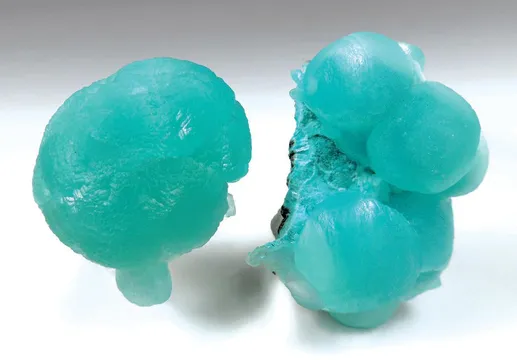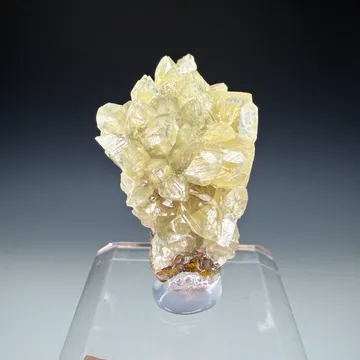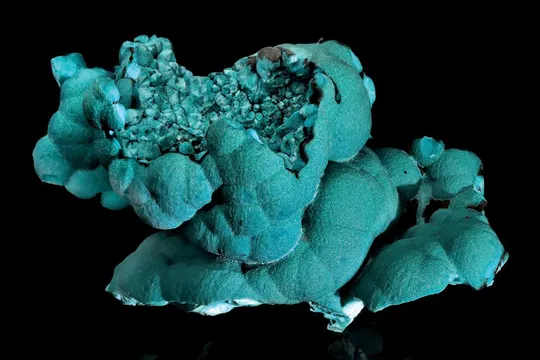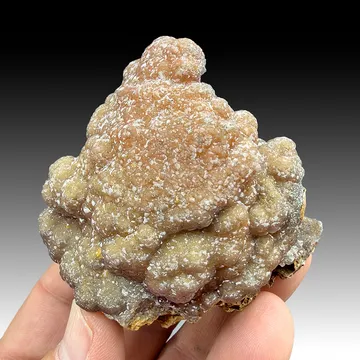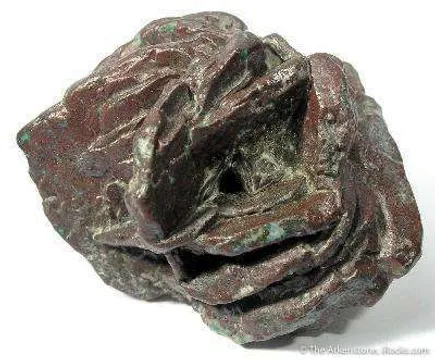
Smithsonite from Kelly Mine, New Mexico, USA: vivid blue-green botryoidal forms, a defining American classic prized for color, luster, and locality.
Key facts
Kelly Mine smithsonite is one of the defining American classics: rounded, grape-like masses of blue to blue-green zinc carbonate with a glow that can look less like a mineral surface than a pool of frozen water. The best pieces are the famous “Kelly blue” specimens—translucent, lustrous botryoidal crusts and spheroids, often with pale internal banding visible along broken edges or natural windows. Fine examples combine color, luster, depth, and undamaged rolling form in a way that makes them instantly recognizable across a room.

Photo: Wikimedia Commons
The locality sits in the Magdalena mining district of Socorro County, on the west side of central New Mexico near the old town of Kelly, southeast of Magdalena. Its smithsonite formed in the oxidized zone of a Zn-Pb-Cu-Ag-Au system, where zinc-bearing sulfides and related ores were altered in carbonate host rocks. The district’s ore deposits are chiefly contact-metasomatic and replacement bodies in the Kelly Limestone; at the Kelly Mine itself, ore occurred as podiform bodies and shoots controlled by fractures, favorable limestone beds, and local silicification.
For collectors, the attraction is not merely that Kelly produced smithsonite, but that it produced smithsonite in a very particular visual language: saturated aqua to green-blue botryoids, sometimes stacked into rounded stalactitic or mammillary forms, often with aurichalcite, goethite, calcite, barite, rosasite, or limonitic matrix. Cabinet specimens with broad, intact, glassy-to-satiny coverage are major pieces in any American suite. Smaller specimens can still be superb if the color is deep, the botryoids are three-dimensional, and the surface has not been bruised or dulled.
The historical weight of the locality is just as important as its color. Kelly’s smithsonites helped build the reputation of the New Mexico School of Mines and later the New Mexico Bureau of Geology Mineral Museum. The C. T. Brown collection, acquired in 1938, preserved major Kelly pieces that became public reference specimens, and the museum still displays signature “Kelly blue” smithsonites that set the standard for the locality.

Photo:
Search for specimens: View all smithsonite specimens from Kelly Mine, New Mexico, USA
The Kelly Mine is in the Magdalena mining district, Socorro County, New Mexico, about 5.1 km, or 3.2 miles, southeast of Magdalena in the headwaters area of Kelly Gulch. Mindat records it as a former lode Zn-Pb-Cu-Ag-Au mine on private land, with historical names including the Tri Bullion shaft, Paschal shaft, Traylor shaft, and Kelly tunnel. The deposit was discovered and first produced in 1878, and commercial ore mining closed in 1957.
Geologically, the Kelly Mine belongs to the district’s carbonate-replacement and contact-metasomatic ore systems. Mineralization is hosted in the Kelly Limestone of the Magdalena Group, with podiform ore bodies and shoots. Hydrothermal solutions rose along fractures and replaced favorable host rock, producing local silicification. The district geology includes the Kelly-Graphic Fault zone and the Brown Fault, both important structures in local ore control. Associated intrusive and volcanic rocks reported for the locality include monzonite, rhyolite, latite, andesite, and granite, set against Pennsylvanian and older basement rocks.
The mine was extensive. Recorded workings include drifts, crosscuts, stopes, three shafts, a tunnel, and ten working levels. In collector terms, this underground scale matters because it explains why Kelly material appears in several different habits and associations: classic blue-green smithsonite, paler gray or white botryoidal material, barite, calcite, aurichalcite, azurite, rosasite, cerussite, goethite, and other secondary minerals from different parts of the oxidized system.
Kelly’s mining history is inseparable from the neighboring ghost town. The broader camp began with lead discoveries credited to J. S. Hutchason, “Old Hutch,” and developed through the late nineteenth century as lead, silver, zinc, and copper ores were mined and smelted. The arrival of smelting capacity and railroad transport transformed the district from scattered prospects into a major mining camp. In 1904, after the importance of zinc carbonate ore was recognized, the Kelly Mine passed to the Tri-Bullion Smelting Co., and zinc became a major product of the district.
Collecting access has changed over time. For years, the privately owned Kelly Mine allowed paid public visits under defined safety and time conditions, including collecting on tailings for smithsonite and other minerals. The owners announced that the mine would be closed to all visitors effective April 9, 2025, until further notice. As of the current guide date, the locality should be treated as closed private property unless the owners publicly reopen it and grant permission. Historic collecting at Kelly has always depended on permission; modern collectors should not assume that old access reports, old fee-collecting arrangements, or older guidebook directions still apply.
Notable finds span more than the classic blue smithsonite. The locality has produced compact aurichalcite resembling smithsonite, small “rice-grain” smithsonite on aurichalcite, wulfenite on azurite from the sixth level, fluorescent calcite with smithsonite and hydrozincite, and high-quality museum specimens of blue-green smithsonite with aurichalcite and goethite. The greatest pieces are the large, old-time blue to green-blue smithsonites preserved in institutional and major private collections, especially those with documented early provenance.
The typical collector image of Kelly smithsonite is botryoidal: rounded, mammillary to grape-like aggregates of ZnCO3 coating limestone or iron-stained matrix. The finest pieces show well-separated, three-dimensional spheroids rather than a flat crust. Surfaces range from glossy to satiny, and the best examples have enough translucency that light penetrates into the rounded forms rather than reflecting only from the surface.
Color is the locality’s great signature. The classic palette runs from apple-green through blue-green and aqua to vivid robin’s-egg blue. “Kelly blue” is the most coveted trade description, but the strongest specimens are rarely a simple flat blue; they often have greenish undertones, cloudy internal zoning, pale seams, or subtle banding. The color is most persuasive when it remains saturated across the entire display face rather than appearing only in isolated patches.
Forms range from thin crusts to thick botryoidal plates, rounded nodules, stalactitic stacks, and masses with visible banded growth. Some old specimens show broken or sawn edges where concentric growth layers can be seen; those edges can be attractive if they are old, natural-looking, and do not interrupt the main display face. Massive lapidary-grade material from Kelly has also been cut into spheres, cabochons, carvings, and polished objects, but specimen collectors generally prize natural botryoidal surfaces above cut material.
Typical specimen sizes on the market range from thumbnails and miniatures with isolated blue botryoids to small-cabinet and cabinet pieces with matrix coverage. Exceptional cabinet and large-cabinet examples are the prestige material. The best museum-scale pieces are much larger: the C. T. Brown smithsonite in the New Mexico Bureau of Geology Mineral Museum is recorded at 61 × 38 × 38 cm and 34 kg, an extraordinary survival among large Kelly smithsonites.
Common and meaningful associations include aurichalcite, barite, calcite, rosasite, limonite or goethite, azurite, hydrozincite, malachite, cerussite, quartz, and limestone matrix. Aurichalcite adds pale blue to blue-green silky sprays or coatings and can be especially attractive when it softens the transition between smithsonite and matrix. Calcite appears as dogtooth or rhombohedral crystals on or near smithsonite, sometimes fluorescent. Barite, including cream to brown bladed crystals, is a useful locality association and appears on a number of better Kelly combinations.
Quality is judged first by color, then by luster, form, coverage, and condition. A fine Kelly piece should have saturated blue-green color, rolling botryoidal relief, a bright surface, and a composition that displays naturally. Damage is particularly important because bruises on smithsonite botryoids tend to show as pale scuffs, dull abraded patches, or chipped white spots that break the watery illusion. Small specimens with perfect color and surface can be more desirable than larger but dull, chalky, or heavily contacted cabinet pieces.
Kelly smithsonite is common enough in the historical sense that examples appear regularly, but fine examples are not common. The mine’s fame and long specimen history mean that small pieces, older collection specimens, and dealer stock surface with some frequency. Strong cabinet examples with saturated “Kelly blue” color, high luster, clean botryoidal coverage, and old labels remain expensive and competitive. Top pieces sit firmly in the classic American-mineral market.
The most important authenticity issue is locality confidence. Blue-green botryoidal smithsonite is not unique to Kelly, and attractive smithsonite has been produced from Mexico, Greece, Namibia, Sardinia, and other districts. A credible Kelly attribution is strongest when supported by old labels, institutional or dealer provenance, district-appropriate matrix, associated aurichalcite, barite, calcite, goethite or limonite, and the familiar blue-green Kelly surface. A specimen labeled only “Kelly Mine” with no history should be judged on mineralogical fit and the reliability of the source.
Condition deserves close inspection. Smithsonite has a hardness around 4 to 4.5 and is brittle; botryoidal surfaces can be bruised, chipped, or dulled by careless washing, trimming, or storage. Look for pale impact marks on the tops of rounded lobes, broken edges hidden near the base, glue repairs where botryoidal plates have separated from matrix, and old saw cuts disguised as natural backs. On matrix pieces, make sure the main smithsonite layer is stable and not flaking from a friable limonitic or limestone support.
Treatments are not a defining part of Kelly smithsonite collecting, but cleaning and presentation can matter. Over-cleaned pieces may lose the soft satiny glow that distinguishes better material; under-cleaned pieces may hide good color beneath clay or iron staining. Polished lapidary material from Kelly is legitimate when sold as such, but it occupies a different collecting category from natural botryoidal specimens. A polished face on an otherwise natural specimen should be disclosed and valued accordingly.
Current market availability favors patience. Small blue-green fragments and miniatures appear periodically, often from old stock. Good small-cabinet and cabinet pieces are available less often and usually command a premium, especially with labels from respected collections or dealers. Large, undamaged, saturated, fully covered pieces are classic-level acquisitions and should be bought for quality, not merely for size.
The most consequential Kelly story begins with a mistake that was not really a mistake at all. Early miners in the Magdalena district were looking for lead and silver, and the heavy, pale carbonate rock that did not assay as lead could pass for limestone waste. Asa B. Fitch, manager and lessee of the Graphic mine, understood that zinc was present in the sulfide part of the ore system, yet he was puzzled by its apparent absence in the oxidized ores. He had noticed the strange weight of some “limestone” and once had it assayed for lead, with no result. Years later, around 1903, when zinc carbonate suddenly had market value, he returned to the puzzle and had similar material assayed for zinc. The supposed limestone ran 37% Zn. In one stroke, waste rock became ore, and the “missing” zinc of the Magdalena district was found hiding in smithsonite.
That realization changed the camp. Lead-silver carbonate mining had already built Kelly, but zinc carbonate gave the district a second life. The same mine dumps that had received smithsonite as low-value or misunderstood rock became proof of a much larger resource. The discovery also pointed prospectors and mine operators toward similar zinc carbonate deposits elsewhere in the Southwest. For collectors, the irony is delicious: the mineral that now defines the locality was once easy to overlook because it looked too much like altered limestone to men chasing lead.
The town’s name carries its own frontier oddity. J. S. Hutchason, remembered as “Old Hutch,” is credited as the father of the Magdalena mining district. He discovered rich lead outcrops in 1866 and staked the Juanita and Graphic mines. Another nearby mine was staked by Andy Kelley, who named it after himself. The camp was first known as Middle Camp, but in 1879 the growing settlement was registered at the Socorro County Courthouse. A clerical slip recorded Kelley as Kelly, and the misspelling stuck. The town, the mine, and generations of specimen labels have carried that courthouse error ever since.
Kelly was not a romantic ruin at its height; it was a full mining town. The building of the Gustav Billing smelter in Socorro in 1881 and the arrival of the AT&SF railroad spur in 1885 helped turn ore production into sustained industry. By the early twentieth century, Kelly had stores, saloons, hotels, doctors, schools, churches, and families. The population exceeded 2,000 during the boom years, and the surrounding hills were cut by shafts, tunnels, stopes, mills, and haulage routes. The same district that later became a mineral-collector pilgrimage site was first a working industrial landscape.
The New Mexico School of Mines built an early public reputation on exactly the kind of material collectors still prize. Its mineral cabinet won a gold medal at the St. Louis World’s Fair in 1904, with colorful zinc ores from the Magdalena district—almost certainly smithsonite from Kelly and neighboring mines—among the display’s highlights. The collection won another gold medal at the 1915 Panama-California Exposition in San Diego. Then, on July 5, 1928, Old Main Hall burned to the ground, and the mineral collection inside was lost.
One great Kelly smithsonite escaped that fire because it was not in the building. Coney T. Brown had kept a massive blue-green specimen in his personal collection. In 1938, the museum purchased Brown’s collection, including that piece. Today the C. T. Brown smithsonite, NMBGMR Museum #793, measures 61 × 38 × 38 cm and weighs 34 kg—24 × 15 × 15 inches, 75 pounds. It has long been considered a signature specimen of the Mineral Museum. It is sometimes confused with the legendary lost “Blarney Stone,” another Kelly smithsonite used in early St. Patrick’s Day ceremonies at the School of Mines, but the museum explicitly distinguishes the surviving Brown specimen from that now-lost object.
Kelly continued to surprise collectors long after the great ore days. In the early 1970s, collectors encountered an aqua botryoidal mineral that looked enough like smithsonite to be tempting, but it proved to be a compact variety of aurichalcite. Some of those specimens carried small “rice-grain” smithsonite on the surface, a detail that makes them particularly charming: a Kelly mineral masquerading as the locality’s star, dusted with the real thing. In 1987, Chris Cowan found small yellow-green dipyramidal wulfenite crystals on azurite on the sixth level, the first recorded occurrence of wulfenite in the district.
The modern mine has had a quieter, more fragile afterlife. For years, visitors came to the private property under paid access to see the headframes, tailings, and mountain views, and to search the dumps for smithsonite and more than thirty other minerals. Then the owners closed the property to all visitors effective April 9, 2025, citing the need for repairs, upgrades, and improvements. The closure is a reminder that Kelly is not just a name on an old label. It is private land, a historic mining site, and a place whose preservation depends on restraint as much as enthusiasm.