Aurichalcite from Kelly Mine, Magdalena, New Mexico — blue-green botryoidal crusts, notable for the locality’s zinc-lead history and prized by serious collecto…
Key facts
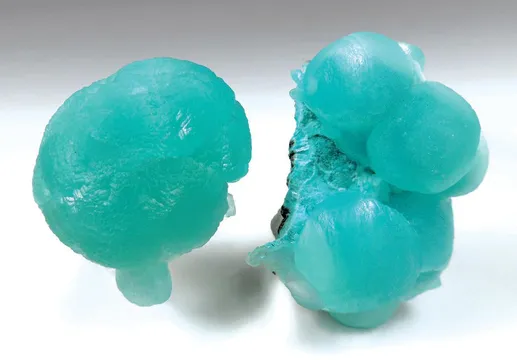
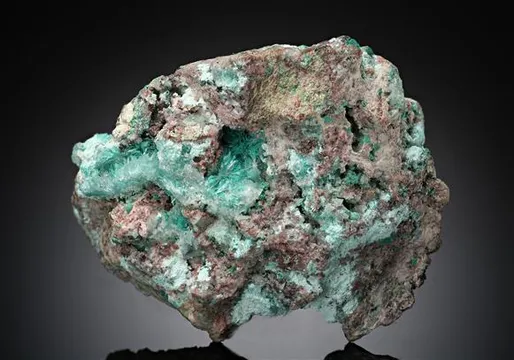
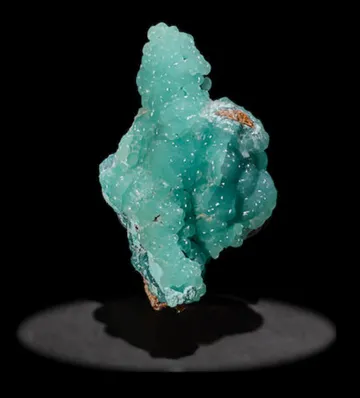
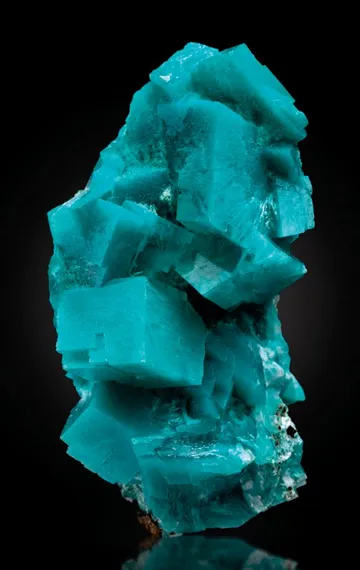
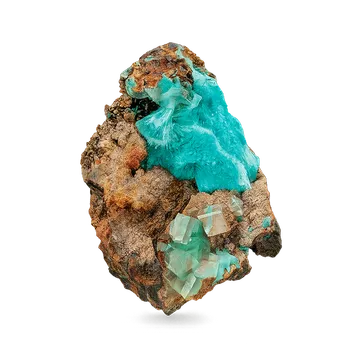
Aurichalcite from the Kelly Mine is the quieter classic from a locality famous enough that many collectors need only hear “Kelly” to picture blue-green smithsonite. The best aurichalcite specimens carry the same southwestern palette—powder blue, aqua, turquoise, and blue-green—but in a softer, fibrous carbonate language: botryoidal crusts, compact rounded aggregates, acicular linings, and banded radial growths that can look almost like the mineral has grown in small cushions or rosettes over gossan and silicified limestone.

Photo: Wikimedia Commons
The collector appeal is inseparable from the Kelly Mine’s zinc-lead history. The district’s primary ores were sulfide replacement bodies in carbonate rocks, and the celebrated specimen minerals formed in the oxidized zone where zinc, lead, and copper were remobilized into secondary carbonates, sulfates, and oxides. In that setting, smithsonite became the headline species, while aurichalcite, (Zn,Cu)5(CO3)2(OH)6, appeared as a secondary zinc-copper carbonate where copper joined the zinc-rich oxidation chemistry.
The finest Kelly aurichalcite has a locality look that is easy to enjoy but not always easy to buy: saturated blue-green botryoids or radiating crusts, sometimes partly covered by translucent “rice-grain” smithsonite, and sometimes carrying late calcite. That association is what serious collectors prize most. A pure aurichalcite specimen from the mine is desirable; a balanced Kelly aurichalcite with discrete blue smithsonite or lustrous calcite is a true locality piece, because it tells the paragenetic story in miniature.

Photo: Wikimedia Commons
Kelly specimens also matter historically. The Magdalena district was one of New Mexico’s great lead-zinc camps, and the ghost town of Kelly grew around the mines during the boom. The mine and its dumps became part of New Mexico collecting culture long after ore mining waned, with generations of collectors visiting for smithsonite and the associated secondary suite. Today, old aurichalcite pieces from Kelly carry the appeal of a classic American mining camp, a distinctive color, and a finite supply.

Photo: Wikimedia Commons
Search for specimens: View all aurichalcite specimens from Kelly Mine, Magdalena, New Mexico, USA
The Kelly Mine lies in the Magdalena Mining District of Socorro County, New Mexico, near the old camp of Kelly south-southeast of Magdalena. The district sits on the west side of the Magdalena Mountains, in a belt of Paleozoic carbonate rocks cut and influenced by Tertiary igneous activity. The principal ore host was the Mississippian Kelly Limestone, historically described in older literature as the Lake Valley or Kelly limestone, a carbonate unit that proved especially favorable for replacement mineralization.
The ore bodies were chiefly replacement deposits in limestone, controlled by fractures, faults, and receptive carbonate horizons. The district’s primary sulfide stage included sphalerite, galena, pyrite, and lesser chalcopyrite, with gangue including quartz, calcite, and locally barite and fluorite. Near the surface, oxidation transformed these ores into a collector’s suite: smithsonite and cerussite were the dominant economic oxidized minerals, with anglesite, malachite, azurite, aurichalcite, goslarite, chalcanthite, and related secondary species present in lesser amounts.
Mining in the Magdalena district began with oxidized lead ores. Early accounts record ore discovery in the late 1860s or 1870s, followed by primitive smelting and long-distance hauling. Gustav Billing’s Socorro smelter, erected in 1881, treated Kelly ore, and the Graphic smelter at Magdalena followed in 1896. The lead-carbonate era was followed by the discovery of zinc carbonate ore in 1903, which revived the camp and made the district a major New Mexico zinc producer. The Kelly Mine was later associated with Empire Zinc and New Jersey Zinc interests, and the broader district’s most productive years centered on the early twentieth century.
The underground workings were extensive, with multiple levels, shafts, tunnels, drifts, crosscuts, and stopes. The Kelly locality is not just a dump or prospect; it was a major mine complex in a district whose carbonate-replacement ores produced both industrial metal and cabinet-quality mineral specimens.
For collectors, access has changed. The mine and surrounding property are private. The official Kelly Mine site states that the property, formerly open to paid public visits under strict conditions, has been closed to all visitors effective April 9, 2025, until further notice. That closure includes the tailings piles. No collector should assume access, and the old reputation of the mine as a pay-to-collect destination should not be treated as current permission.
Notable finds are dominated by Kelly smithsonite, especially blue-green botryoidal and “rice-grain” forms, but aurichalcite is a meaningful part of the classic suite. The best aurichalcite material is not abundant compared with smithsonite. Documented specimens include compact botryoidal aqua aurichalcite from a limited early-1970s occurrence, old matrix pieces sprinkled with small rice-grain smithsonite, calcite-on-aurichalcite pieces, and later collector-market examples that preserve the mine’s zinc-copper oxidation chemistry in unusually attractive form.
Kelly aurichalcite is most familiar as blue to blue-green secondary crusts on limonitic or silicified carbonate matrix. Good pieces show fibrous, radial, acicular, botryoidal, or compact aggregates rather than large individual crystals. Under magnification, some surfaces resolve into fine needles or silky sprays; on cabinet-scale specimens, the visual impression may be a smooth botryoidal carpet, banded radial crust, or powder-blue layer beneath later smithsonite.
The color range is one of the locality’s strengths. Kelly aurichalcite can be pale aquamarine, powder blue, teal, turquoise-green, or deeper blue-green. The most attractive pieces have saturated color and visible radial structure, especially when the botryoids are rounded enough to show concentric or fibrous growth. Matte surfaces are common, but the best material has a silky or subtly lustrous sheen.
Specimen sizes vary widely. True thumbnails and miniatures are the most frequently encountered attractive examples. Older and better pieces in the 2–6 cm range are realistic collector targets, while larger small-cabinet to cabinet examples exist but are much less common. Recorded examples include compact aurichalcite crusts only a few centimeters across, miniature aurichalcite with calcite around 5 cm, smithsonite-on-aurichalcite pieces around 5–10 cm, and unusually rich botryoidal aurichalcite plates approaching cabinet size.
The most desirable association is smithsonite. Kelly smithsonite may occur as blue, blue-green, or translucent “rice-grain” crystals on or over aurichalcite, and this combination can be diagnostic in style as well as aesthetically important. Some specimens show aurichalcite as an earlier blue layer beneath later Kelly-blue smithsonite botryoids. Others have small isolated smithsonite crystals scattered across aurichalcite, a combination that collectors immediately recognize as classic Kelly material.
Calcite is another important associate. White to colorless calcite can sit on a pastel aurichalcite coating, creating a bright contrast between soft aquamarine fibrous carbonate and lustrous carbonate crystals. Other associated oxidation-zone minerals at Kelly and in the district include malachite, azurite, rosasite, hemimorphite, cerussite, barite, fluorite, pyrite, sphalerite, galena, and limonite-group iron oxides, though not all occur on aurichalcite display specimens.
Quality is judged first by color and texture, then by association and condition. The strongest Kelly aurichalcites have even blue-green coverage, rounded or radial botryoidal structure, minimal bruising, and enough relief to avoid appearing like a flat powdery coating. Association with undamaged rice-grain smithsonite dramatically increases interest. Calcite can enhance a piece when the calcite is sharp and not visually overwhelming. Matrix matters, too: dark gossan or brown limonite can make the blue aurichalcite read more vividly, while silicified limestone gives the specimen a clear Kelly context.
Kelly aurichalcite is scarcer on the market than Kelly smithsonite. Smithsonite specimens from the mine appear regularly because the species is the locality’s calling card; aurichalcite appears more selectively, often as an associated mineral, and rich pure aurichalcite pieces are notably less common. The most available examples are miniatures, thumbnails, and older combination pieces. Large, undamaged, saturated aurichalcite specimens from Kelly should be treated as uncommon.
Condition is the main practical issue. Aurichalcite is soft and fragile, and the fibrous aggregates can be abraded, flattened, or dirtied by handling. On older Kelly pieces, expect some edge contacts where the specimen was removed from a pocket or trimmed from gossan. Botryoidal crusts may show rubbing on high points; acicular sprays may be crushed or dusted with limonite. Late calcite and smithsonite can be more lustrous and durable visually, but the aurichalcite layer beneath them may still be delicate.
Authenticity concerns center on locality and association rather than common outright fakery. Kelly aurichalcite has a strong but not unique color; other U.S. zinc-copper localities can produce blue acicular or botryoidal aurichalcite. A convincing Kelly label is strongest when the piece shows classic associated Kelly smithsonite, old collection provenance, or a documented dealer or museum history. Be cautious with unlabeled blue-green aurichalcite sold as Kelly simply because it resembles the locality.
No well-established pattern of Kelly-specific aurichalcite treatment is part of the collector literature. Still, the usual precautions apply: avoid specimens that look artificially dyed, consolidated, or repaired unless disclosed. Aurichalcite’s softness makes heavy cleaning risky, and polished or oiled-looking surfaces are not desirable for serious mineral collecting unless the specimen is being sold as lapidary material rather than a natural specimen.
Market prices vary sharply with association and aesthetics. Small, modest aurichalcite-only miniatures can still trade at approachable prices, while classic old smithsonite-on-aurichalcite combinations, especially those with rice-grain smithsonite and strong blue color, can command much more. Provenance to older collections, such as mid-twentieth-century or early-1970s material, adds value because the best Kelly specimen production is historical and current collecting access is closed.
The Kelly story begins with oxidized lead ore and hard logistics rather than glass cases. In the early mining days, Col. J. S. Hutchinson—“Old Hutch” in later collector retellings—found oxidized lead ore in the district. The first ore was simple enough to smelt in an adobe furnace, but nothing about moving it was simple: the product was hauled to Kansas City by ox teams. That image sits behind every polished museum label from Kelly—the blue-green carbonates that collectors admire came from a camp first built on heavy wagons, primitive furnaces, and lead carbonate ore.
The camp then changed character. The Billing smelter at Socorro was built in 1881 to handle Magdalena district ore, and the Graphic smelter at Magdalena followed in 1896. For a time, the important ore was oxidized lead, but by 1902 the lead-carbonate period was largely exhausted. The real revival came in 1903, when zinc carbonate ore was discovered. That single shift turned the district toward the chemistry that collectors now associate with Kelly: smithsonite, copper-tinted blue-green carbonates, and a secondary mineral suite that could be both ore and specimen.
The collector’s aurichalcite story is more elusive. In the early 1970s, an unusual aqua botryoidal mineral from the Kelly Mine resembled smithsonite closely enough that it needed determination. It proved to be a compact variety of aurichalcite. The specimens were attractive, and some were sprinkled with the small rice-grain smithsonite crystals that make Kelly pieces so recognizable, but the find was limited. That scarcity is part of why old Kelly aurichalcites still feel special: they are not simply “the other blue mineral” from a famous mine, but a short-lived, easily overlooked expression of the same oxidized zinc-copper system.
One old-market memory captures the transition from collecting ground to classic locality. A described 1960s or early-1970s Mullane collection specimen carried tiny gemmy rice-grain smithsonites peppered over powder-blue botryoidal aurichalcite on gossan. The dealer note added that such pieces were already choice and unusual even in the era when one could walk into the mine owner’s rock shop and buy Kelly material “by the pound.” That is the paradox of Kelly aurichalcite: it came from a place collectors visited, but the best combinations were never merely common dump rock.
By 1987, the mine was still yielding surprises underground. Chris Cowan found small yellow-green dipyramidal wulfenite crystals on azurite on the sixth level, the first recorded wulfenite occurrence for the district. That find is not an aurichalcite discovery, but it belongs in the same collector landscape: even after generations had chased Kelly smithsonite, the oxidized workings still held overlooked micro-mineral stories in blue, green, yellow, and brown.