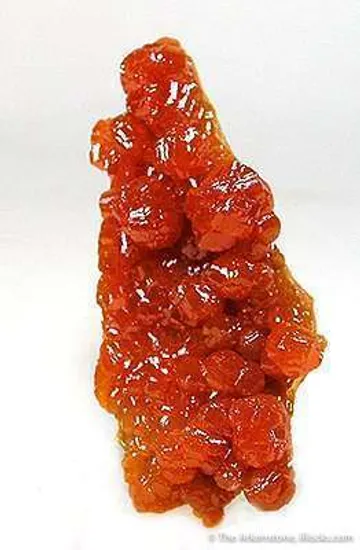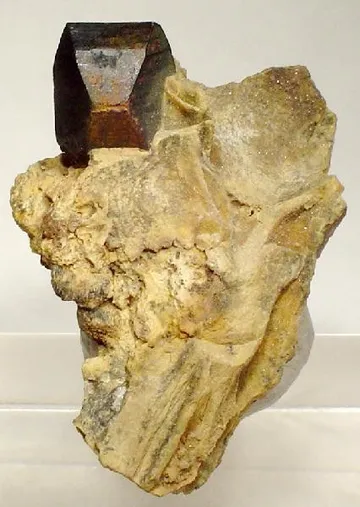
Kellogg, USA - a premier collector locality at the western Coeur d’Alene district, famed for orange and yellow pyromorphite, cerussite, and mining history.
Key facts
Kellogg, in Idaho’s Silver Valley, is one of the great American collector localities because it sits at the western end of the Coeur d’Alene mining district where the Bunker Hill mine turned an immense lead-zinc-silver ore system into both an industrial landmark and a mineral-specimen classic. The mine is a vein and replacement deposit in deformed Belt Supergroup quartzites and argillites, with ore dominated by galena, sphalerite, argentiferous tetrahedrite, and pyrite in quartz, siderite, and ankerite gangue. To economic geologists, Bunker Hill is a giant Coeur d’Alene-type polymetallic vein system; to collectors, Kellogg means the oxidation-zone lead suite—above all the orange, yellow, and yellow-green pyromorphites from the Jersey vein and associated workings.
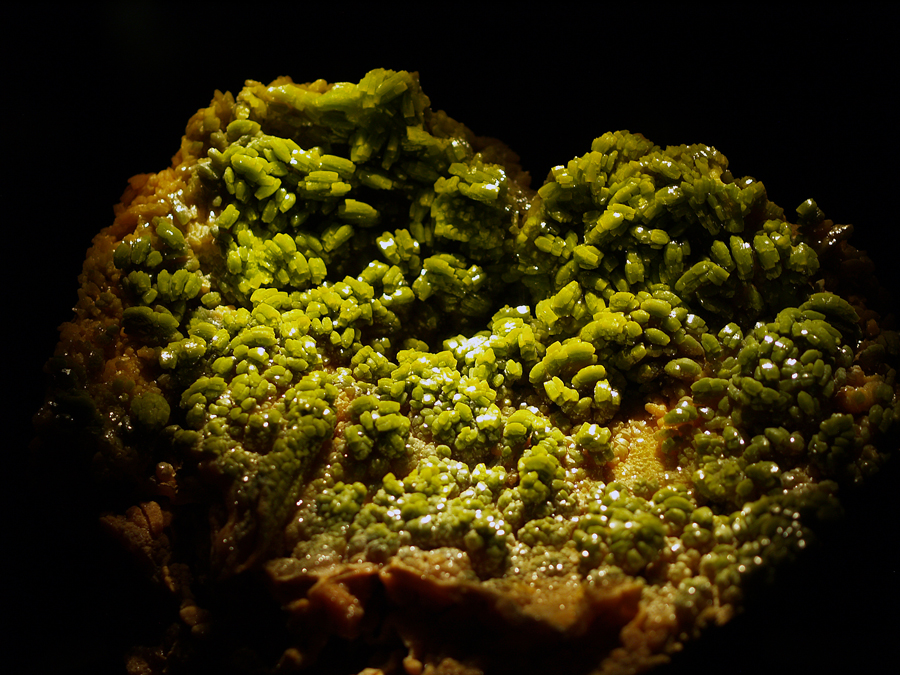
The finest Kellogg specimens have a look that is instantly recognizable: wet-luster, barrel-like to skeletal pyromorphite prisms in citrus yellow-green, mustard yellow, honey orange, and burnt-orange arsenian tones, often built in several generations over porous, vuggy, iron-stained matrix. The best plates and knobs are not merely colorful; they have relief, crystal definition, and a glossy “fresh candy” surface that separates Bunker Hill classics from flatter, duller secondary lead pieces. Cerussite, anglesite, and locally linarite or caledonite add another, older face to the locality—transparent to translucent lead-carbonate and lead-sulfate crystals perched on weathered galena, usually scarcer and more delicate than the pyromorphite that made the mine famous.
Regional View
Country View
Kellogg’s importance is inseparable from mining history. The Bunker Hill lode was discovered in 1885 and first produced in 1886; for nearly a century it was one of the anchor mines of the Silver Valley. The smelter and zinc plant made Kellogg an industrial town as much as a mining camp, while the later Superfund designation made the locality a case study in the environmental cost of large-scale lead and zinc production. Specimens entered the collector world through several distinct episodes: early secondary lead pieces from oxidized stopes, the famous 1980–1981 pyromorphite discoveries, the mid-1980s yellow material, and the 1993–1994 Bob Hopper/Wayne Thompson-era pockets that supplied many of the best modern cabinet specimens.

Photo: Rob Lavinsky, iRocks.com / Wikimedia Commons
Search for specimens: View all specimens from Kellogg, USA
Kellogg lies in Shoshone County, northern Idaho, in the Coeur d’Alene mining district, a long, structurally complex belt of Proterozoic metasedimentary rocks famous for silver-lead-zinc veins. The collector name “Kellogg” most often refers to specimens from the Bunker Hill mine and Bunker Hill properties between Kellogg and Wardner, including the Bunker Hill and Sullivan, Stemwinder, Tyler, and related workings. The main Kellogg Tunnel level gave access into the mountain from Milo Gulch, while the mine extended through a large network of levels, shafts, raises, stopes, and named ore bodies.
The Bunker Hill deposit is classically treated as a Coeur d’Alene-type polymetallic vein system. Ore occurs in structurally controlled veins and replacement bodies, especially where quartzite units are cut by vein structures. The mine sits in the Page-Galena mineral belt, where lead-zinc-silver mineralization gives way eastward to the more silver-rich Silver Belt. Bunker Hill ores include galena, sphalerite, argentiferous tetrahedrite, pyrite, pyrrhotite, chalcopyrite, and local acanthite, in gangue dominated by siderite, ankerite, and quartz. Historic descriptions emphasize that galena-rich ore bodies and sphalerite-rich ore bodies vary markedly across the mine; above and below the Kellogg Tunnel level, miners encountered different proportions of zinc-rich and lead-rich ore.
For collectors, the essential zone is the oxidized upper lead environment, especially around the Jersey vein and related 9 Level or 800 Level workings. Here, primary galena and other sulfides were altered to cerussite, anglesite, pyromorphite, and other secondary lead minerals in open spaces and mud seams. The pyromorphite formed in multiple generations: orange arsenian botryoidal to barrelly crusts; sparkling yellow-green microcrystals; larger lustrous yellow-green to honey-brown prisms; and in some specimens, contrasting green and orange faces on the same piece. This multistage growth is the heart of the Kellogg aesthetic.
Mining began after the 1885 discovery of the Bunker Hill lode and commercial production followed in 1886. Early development was tied to the Bunker Hill and Sullivan claims; by the late nineteenth and early twentieth centuries, Bunker Hill had become one of the dominant operations in the district. The company expanded into milling, smelting, silver refining, and zinc production, with a primary lead smelter operating at Kellogg beginning in 1917 and an electrolytic zinc plant added in 1928. The old company became associated with Gulf Resources and Chemical Corporation in the late 1960s. Major operations ceased in the early 1980s, and the Bunker Hill Mining and Metallurgical Complex was listed as a federal Superfund site in 1983 because of extensive heavy-metal contamination.
The post-closure story matters to collectors because specimen recovery did not simply end with conventional ore mining. Bob Hopper and Placer Mining/New Bunker Hill interests became central to the 1990s chapter. Idaho Geological Survey annual mining reports note that, after Hopper acquired mineral rights in the early 1990s, a small crew rehabilitated the mine while pyromorphite crystals were mined and sold to collectors. Newspaper accounts from the period describe “finger mining” along a mud seam, with one small air pocket only about three feet wide and twelve inches deep yielding pyromorphite crystals valued at a conservative $30,000, and a single flat reportedly selling for more than $15,000. The 1993–1994 pockets, especially those connected with Bob Hopper and Wayne Thompson, are among the most desirable late-production Bunker Hill material.
Access today is not a casual field-collecting matter. Bunker Hill is an industrial mine property within the Bunker Hill/Coeur d’Alene Basin Superfund area, and modern operations are controlled by Bunker Hill Mining Corp. The company acquired the mine in 2022, refurbished infrastructure, and in 2026 announced first concentrate production and shipment from a new 1,800 ton-per-day processing plant. That restart is important for the mining history of Kellogg, but collectors should not interpret it as collecting access. Specimens on the market are overwhelmingly from older mining and specimen-recovery episodes, old dealer stocks, or collection recycling; unauthorized entry is unsafe, illegal, and environmentally inappropriate.
Kellogg pyromorphite is the signature mineral of the Bunker Hill mine and one of the finest American expressions of the species, especially from the Jersey vein and 9 Level or 800 Level oxidation-zone pockets. Habits range from tight druses of barrel-shaped hexagonal prisms to hoppered, skeletal, doubly terminated, botryoidal, and multigeneration crusts; colors include lime-green, yellow-green, mustard yellow, honey brown, orange, and richly burnt-orange arsenian material. Crystal sizes on fine specimens commonly run from millimetric sparkling coatings to individual prisms around 5–15 mm, with exceptional aggregates forming small-cabinet to cabinet plates and three-dimensional knobs. The best pieces show wet luster, sharp terminations, strong relief, contrasting color generations, and minimal bruising; ordinary pieces are flatter, duller, more granular, or damaged on exposed terminations.
Cerussite from Kellogg is much less abundant on the market than pyromorphite but is an important part of the same oxidized lead system, typically forming colorless, white, pale tan, or cognac bladed crystals on altered galena, sometimes with anglesite, linarite, caledonite, leadhillite, lanarkite, or powdery yellow lead-oxide alteration products. Bunker Hill cerussites are often twinned—thin V-twins, cyclic groups, and flattened blades are characteristic—and specimen crystals are commonly in the millimeter to low-centimeter range, with small cabinet pieces known when protected in vugs. Fine examples are judged by transparency, sharp twin form, glassy to adamantine luster, protected placement, and association with fresh-looking galena or blue secondary lead-copper minerals; many otherwise desirable specimens suffer edge chipping because the thin blades are fragile.
Galena is the ore backbone of Kellogg rather than the usual showpiece mineral, but it is the mineral that made Bunker Hill possible and the parent of much of the collector-grade secondary lead suite. In the mine it occurs as massive to coarsely crystalline argentiferous galena, as vein and replacement ore with sphalerite, tetrahedrite, pyrite, and chalcopyrite, and as weathered dark-gray matrix for cerussite, anglesite, and pyromorphite. Collector pieces are most desirable when galena provides clear geological context—bright metallic cleavage or crystalline masses partly altered to cerussite or anglesite, or oxidized galena supporting pyromorphite growth—rather than as ordinary massive ore. The best labels sometimes cite specific ore bodies or levels, such as the Orr orebody or Jersey-related workings, which adds considerable locality value.
Tetrahedrite at Kellogg is chiefly an ore mineral and a carrier of silver values rather than a common display species, occurring with galena, sphalerite, chalcopyrite, pyrite, quartz, and siderite in the Coeur d’Alene vein system. Geological accounts describe tetrahedrite in the Bunker Hill mine as irregular blebs and veinlets with galena, particularly within the Page-Galena belt style of mineralization, and the Jersey-type bodies include galena with lesser sphalerite, chalcopyrite, and tetrahedrite. Collectible tetrahedrite from Kellogg is therefore scarce and usually valued as a labeled ore or association specimen; the strongest pieces show visible dark steel-gray tetrahedrite rather than anonymous sulfide patches, and they gain interest when paired with argentiferous galena or siderite gangue from a documented orebody.
Anglesite from Kellogg is a classic secondary lead mineral of the Bunker Hill oxidation zone, found as colorless to pale tan, vitreous orthorhombic crystals on oxidized galena and commonly associated with cerussite. Documented specimens include blocky crystals, thin prismatic “sword” crystals, needlelike crystals to about 7 mm on galena from the Orr orebody, and larger drusy or intergrown groups from deeper levels such as the 11 Level and 2000-foot-level material. The best Bunker Hill anglesites are transparent, sharply edged, and well isolated on contrasting dark galena, while many examples are incomplete or chipped because the crystals were exposed in vugs and on friable altered ore. Combination pieces with cerussite, linarite, or caledonite are especially appealing because they capture the full lead-oxidation paragenesis of the mine.
Siderite is one of the fundamental gangue minerals at Kellogg, occurring massive to coarsely crystalline in the Bunker Hill veins and replacement ores, commonly with galena, sphalerite, tetrahedrite, chalcopyrite, pyrite, and quartz. Unlike alpine-style rhombs or display-quality carbonate plates, Bunker Hill siderite is usually collected as contextual ore gangue: brownish to gray carbonate masses, cleavages, and vein material enclosing or crosscut by sulfides. Its value on a collector specimen is highest when it helps document a particular ore type—galena-siderite ore, tetrahedrite-bearing silver ore, or recently described galena-siderite vein material—rather than when it appears as plain carbonate. Well-labeled siderite-rich pieces from older collections are useful references for understanding the mine’s primary mineralization beneath the celebrated oxidation zone.
Beyond these headline species, Kellogg has yielded a broad Bunker Hill suite: sphalerite, pyrite, pyrrhotite, chalcopyrite, quartz, ankerite, acanthite, native silver, linarite, caledonite, leadhillite, lanarkite, massicot, litharge, and other alteration products recorded from oxidized lead ore. Acanthite is reported as minute black blade-shaped crystals from the Orr orebody, while native silver is genuinely rare as a specimen mineral despite silver’s economic importance in the mine. The locality’s reputation rests less on type-species novelty than on world-class specimens from a very specific lead-oxidation environment: pyromorphite first, then the scarcer cerussite-anglesite-galena associations that place those pyromorphites in their natural paragenetic setting.
Kellogg specimens should be bought with locality precision in mind. Many older labels say only “Kellogg, Idaho,” “Bunker Hill,” or “Coeur d’Alene,” and that is often acceptable for older material, but top specimens benefit from more exact information: Bunker Hill Mine, Jersey vein, 9 Level, 800 Level, Orr orebody, Cherry vein, or a named collection/dealer history. Because the city-level locality can also include nearby mines, unlabeled secondary lead minerals should not automatically be assumed to be Jersey vein Bunker Hill material.
The main authenticity issue is not a flood of laboratory fakes, but overconfident relabeling and exaggerated pocket attribution. Bright yellow-green pyromorphite plates from Bunker Hill are distinctive, yet similar-looking pyromorphites from other localities, or lower-grade Bunker Hill pieces promoted as “Jersey vein” or “1981 find,” deserve scrutiny. Provenance to Wayne Sorenson, Bob Hopper, Wayne Thompson, Bob Sullivan, Harvey Gordon, Kay Robertson, Jack Halpern, or other well-documented collections and dealers can materially affect confidence and value, but such names should be supported by labels, invoices, or long-standing collection records.
Condition is critical. Bunker Hill pyromorphite is lead-rich and comparatively soft; exposed prisms bruise, rub, and chip easily, and old mining recovery was not always gentle. Examine high points, terminations, and edges of flat plates under magnification. On the best specimens, even tiny bruises stand out against the glossy yellow or orange surfaces. Cerussite and anglesite are even more vulnerable: thin cerussite blades chip along edges, and anglesite crystals commonly show incomplete terminations or impact marks. A specimen protected in a natural vug may be far preferable to a larger but battered open plate.
Color and texture drive the market. Orange arsenian pyromorphite, multigeneration green-over-orange pieces, and high-relief yellow-green cabinet specimens are the most sought after. “Bunker Hill Yellow” material, especially from the mid-1980s and early 1990s pockets, has a dedicated following. Three-dimensional knobs and floaters are generally more desirable than thin flat plates, all else equal. Minor micro-damage may be tolerated on rich older examples, but major rubs, dull crusts, and repaired plates should be priced accordingly.
Several Bunker Hill lead minerals can fluoresce, but responses are specimen-specific. Pyromorphite has been documented with strong orange fluorescence under midwave UV in at least some examples, while cerussite and anglesite may show weaker or variable responses depending on impurities and alteration. Fluorescence should be treated as an extra feature, not a primary identification tool. Avoid heating, acid cleaning, ultrasonic cleaning, or aggressive washing. These are lead minerals from a lead-mining Superfund locality: handle with normal mineral-collector hygiene, keep dust out of the display environment, wash hands after handling, and do not cut, grind, or lick specimens.
Market availability is periodic rather than steady. Common small Bunker Hill pyromorphites appear regularly, but truly fine, undamaged, well-provenanced pieces tend to come from old collections and can vanish for years. Cerussite, anglesite, tetrahedrite, and siderite from Kellogg are much scarcer as attractive display specimens; they are often bought by locality specialists, Idaho collectors, and collectors of classic American lead minerals rather than by casual species buyers.
Kellogg’s origin story begins with a stubborn animal and a piece of galena. Noah S. Kellogg was prospecting in 1885 with a grubstake traditionally remembered as a jackass and $18.75 worth of flour, bacon, and beans. The burro wandered off near Milo Creek. When Kellogg found it again, the animal was standing by, or gazing toward, a tremendous outcrop of galena above Wardner. Whether the story is polished folklore or literal fact, it became the defining myth of the Silver Valley: a mine that would produce tens of millions of tons of lead, zinc, and silver was first announced by a jackass. Idaho’s highway marker still preserves the tale in almost campfire language, and even the later ski area above Kellogg carried the “Jackass” name in memory of the discovery.
The legal and human aftermath was less charming. Kellogg took samples back to Murray, where Philip O’Rourke recognized the material as high-grade lead ore. The Bunker Hill claim was staked in September 1885, but the ownership story quickly became tangled because John T. Cooper and Origin O. Peck had provided the grubstake. Court decisions later acknowledged their interest; Jim Wardner raised development capital and gave his name to the town above Kellogg. In the usual compressed myth, one burro discovered one mine. In the real history, that one outcrop created a web of claims, mills, lawsuits, syndicates, company towns, and ultimately one of the major industrial mining complexes of the American West.
A century later, the mine produced a very different kind of treasure. In the early 1990s Bob Hopper was trying to revive a battered post-bankruptcy Bunker Hill, restoring electricity, rail, timber, concrete areas, and underground access. In the meantime, he mined pyromorphite—delicate, beautiful, and utterly unrelated to the tonnage-minded ambitions of the old smelter. A local newspaper described his “finger mining” along a mud seam, a soft parting between hard rock layers, where he finally found an air pocket only about three feet wide and twelve inches deep. Hopper estimated the crystals from that tiny space at a conservative $30,000, and one flat alone had reportedly sold for more than $15,000. It is hard to imagine a more collector-perfect contrast: a colossal lead-zinc-silver mine reduced, for a moment, to fingers teasing fragile orange and yellow crystals out of a pocket smaller than a kitchen cabinet.
The fragility of those crystals became part of their mystique. In 1996 Hopper donated a pyromorphite specimen valued around $2,000 to a Kellogg Chamber of Commerce and Project Uplift auction. He compared owning one to owning a Picasso: “You can always buy a $5 print, but this is the real thing.” He also understood the collector’s brutal arithmetic of condition—one careless touch could slash the value of a specimen that had taken geological time to grow and patient underground work to recover.
Then, in November 2017, the collector story turned into a burglary case. Thousands of Bunker Hill crystals and artifacts were stolen from a residence on Railroad Avenue in Kellogg where Bob Hopper Jr. had been storing material for a hoped-for Bunker Hill Mine Museum. Hopper was in Montana when he heard and drove back to Kellogg. The Shoshone News-Press was there when he saw the damage. “This is my family’s legacy here,” he said, visibly shaken, adding that the material belonged not just to him but to the mine, his family, and the community. He believed the stolen pyromorphite alone was worth between $500,000 and $1 million. A social-media push produced a name; police obtained a warrant; and just before 3 p.m. the next day, officers searched the residence of Joshua Easley of Kellogg. Police said they recovered “a lot of the pyromorphite,” estimating that 50 to 75 percent of the stolen material had been found. For collectors, the episode is a reminder that Bunker Hill specimens are not just commodities. In Kellogg, they are family history, mining memory, and, in some cases, evidence.