Laxey Mine, USA — a key South Mountain locality yielding sharp ilvaite on quartz with historic skarn; prized by collectors for large, lustrous crystals.
Key facts
The Laxey Mine is the collector’s name attached to one of the great American ilvaite occurrences: the Laxey level and associated workings of the South Mountain polymetallic deposit in Owyhee County, Idaho. Although the page title says “USA,” the important locality is specifically the Laxey Mine in the South Mountain Mining District, on the northwest flank of South Mountain in southwestern Idaho. Its specimens are products of a zinc-lead-silver-copper-gold skarn and carbonate-replacement system developed in the Laxey Marble, a marble member in a roof pendant of metamorphosed sedimentary rocks surrounded by granodioritic intrusive rocks related to the Idaho batholith system.
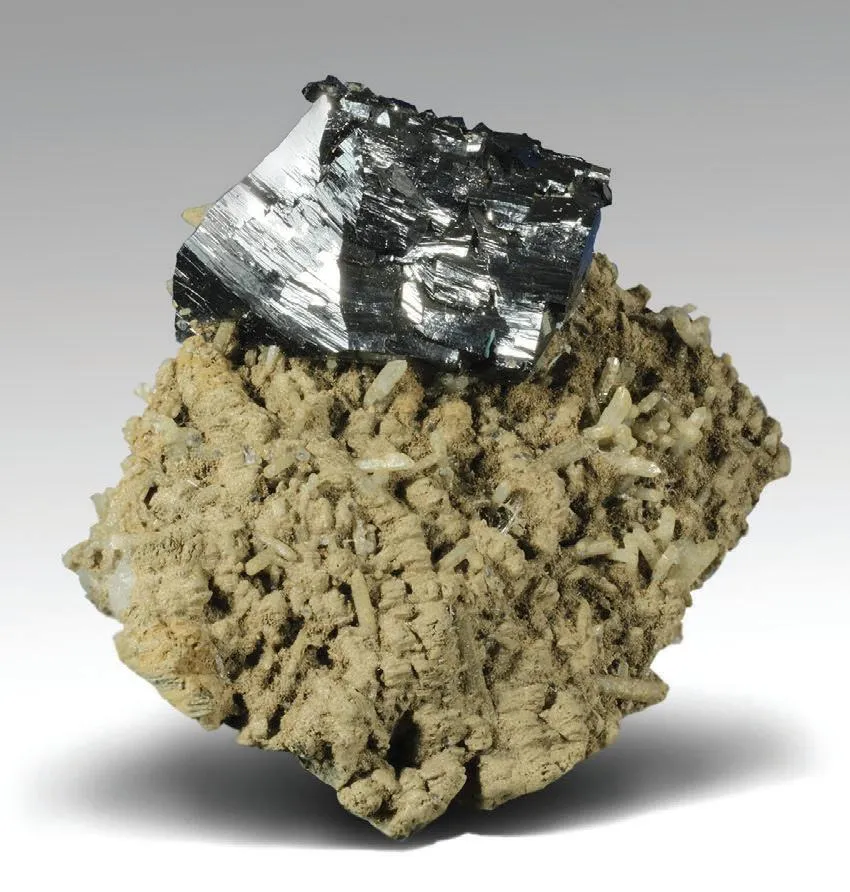
For mineral collectors, Laxey matters for one reason above all others: sharp, lustrous, black ilvaite crystals on quartz, hedenbergite, calcite, and skarn matrix. The best pieces are unmistakably North American classics—orthorhombic, wedge-terminated prisms with a submetallic sheen, commonly striated, sometimes clustered, sometimes isolated as chunky crystals rising from pale quartz or buff-to-greenish hedenbergite-rich matrix. The mine is not merely another occurrence of ilvaite; older literature singled out South Mountain crystals as among the largest then known in the United States, and the locality still ranks as one of the finest American sources for the species.
Historically, the Laxey workings belong to the broader South Mountain story. Gold-bearing quartz veins were found there in 1868, oxidized silver-lead veins soon followed, and by 1874 the principal mines had been gathered under the South Mountain Consolidated Mining and Smelting Company. The most sustained production came much later, when the Exploration Company of California developed the Sonneman, Golconda, and Laxey levels in 1929–1931 and Anaconda’s International Smelting and Refining operation shipped high-grade wartime ore from the Laxey ore zone in 1940–1946. That mining history is why old Laxey ilvaites turn up with venerable American labels, estate provenances, and mid-20th-century collection histories.
Regional View
Country View
At South Mountain, the visual contrast is part of the appeal. Laxey ilvaite is iron-black to dark greenish black, and its best crystals have enough luster to read as almost metallic against pale quartz, tan calc-silicate matrix, or bladed hedenbergite. Many specimens are busy, intergrown, or partly contacted; the standouts show clearly separated crystals with intact chisel or wedge terminations, strong face luster, and enough matrix to place the crystal in its skarn setting rather than leaving it as an isolated black prism.
Search for specimens: View all specimens from Laxey Mine, USA
The Laxey Mine is in the South Mountain Mining District, Owyhee County, Idaho, at about 42° 44′ 40″ N, 116° 55′ 5″ W. It is part of the South Mountain mine complex, which includes the Laxey, Golconda, Sonneman, and Texas workings. The named Laxey tunnel lies in the upper Williams Creek drainage, above the old cabins at the base of South Mountain, and is the uppermost of the three eastward-driven adits—Laxey, Golconda, and Sonneman—that explored the main ore system.
Geologically, the locality sits in a roof pendant of marble, quartzite, and schist enclosed by intrusive rocks. The key host is the Laxey Marble, a carbonate unit within an approximately 1,800-foot-thick metasedimentary sequence. Modern technical descriptions treat the South Mountain system as a carbonate-replacement deposit with skarn-hosted massive sulfide bodies. Earlier collector usage often simply called it a skarn locality, and that remains a useful shorthand for specimens: the ilvaite occurs with hedenbergitic pyroxene, quartz, calcite, garnet-group minerals, and sulfides in calcium-iron-rich replacement rock.
The ore bodies are structurally controlled and are described as irregular pipe-like massive sulfide and replacement bodies, plunging roughly 40–50 degrees southwest within the Laxey Marble. Two mineralization styles are important. The earliest mined material was oxidized lead-silver replacement vein ore in marble—cerussite-rich material that early operators could smelt with the technology and transport available in the 19th century. The later, more economically significant ore was high-grade zinc-rich polymetallic massive sulfide associated with hedenbergite-rich skarn and carbonate replacement. The unoxidized sulfide assemblage includes sphalerite, galena, chalcopyrite, arsenopyrite, pyrite, and pyrrhotite, with silver largely tied to galena and tennantite-tetrahedrite and some gold associated with arsenopyrite.
The Laxey tunnel was described in early Idaho geological work as a 60-foot drive into oxidized material near the footwall of the contact rock, with a 15-foot crosscut in oxidized ore. That oxidized zone produced the secondary lead, zinc, and copper suite for which the mine is also mineralogically interesting: malachite, azurite, cerussite, smithsonite or historical “calamine,” caledonite, linarite, limonite, and hematite. The hedenbergite-ilvaite contact rock was reported at the surface beginning about 100 feet west of the Laxey tunnel portal and extending southeastward, locally reaching widths up to about 200 feet along the Mississippi claim.
The district’s history began with discovery of gold-bearing quartz veins in 1868 and oxidized silver-lead ores shortly afterward. In 1874, the South Mountain Consolidated Mining and Smelting Company acquired the principal mines and built a small smelting furnace, but the operation failed in 1875 and the district was largely abandoned for decades. A brief 1906 shipment by American Standard Mining Company amounted to only 14 tons. The modern Laxey ore-zone story began when the Exploration Company of California developed the Sonneman, Golconda, and Laxey levels from 1929 to 1931. From 1940 through 1946, International Smelting and Refining Company, part of the Anaconda organization, shipped roughly 53,635 tons of direct-shipping ore from the Laxey ore zone to Tooele, Utah. Available smelter records for the wartime period record about 15.59 million pounds of zinc, 2.56 million pounds of lead, 1.49 million pounds of copper, 566,440 ounces of silver, and 3,118 ounces of gold.
Postwar work shifted through several operators and exploration campaigns. The Texas shaft was active from about 1950 to 1955 under the South Mountain Mines partnership, and a DMEA-financed flotation mill processed additional material. Potash Company of America leased the property in 1956 and operated sporadically into the 1960s. W. A. Bowes, Inc. later held and developed the property, with South Mountain Mines and subsequent corporate owners continuing exploration. Thunder Mountain Gold acquired the South Mountain property in 2007 through Thunder Mountain Resources, and the project remains an active exploration and development asset rather than an open collecting area.
Collectors should treat the Laxey Mine as private, controlled mine ground with underground hazards, active mineral rights, and a long record of professional exploration. The Laxey adit has been described as gated, and recent public company materials show continuing geological work, land acquisition, and drilling at the South Mountain project. Modern specimen availability therefore comes overwhelmingly from old collections, estate material, earlier dealer stocks, and historic collecting, rather than casual field collecting.
The notable specimen finds were not recorded in the pocket-by-pocket style familiar from gem pegmatites, but the surviving specimens tell their own story. Good Laxey ilvaite occurs from skarn zones in and around the Laxey level, especially where quartz and hedenbergite give the crystals contrast and support. Older collector specimens are known with Al McGuiness, Bart Cannon, Brian Kosnar, George Loud, Joe Cilen, Dr. David Ellis, Ralph Merrill, Dawn and Jim Minette, and other American collection provenances. Those labels are important: they help separate true Laxey material from the many superficially similar black ilvaites now available from Dalnegorsk, Huanggang, Serifos, and other world localities.
Laxey ilvaite is the locality’s signature mineral: black to dark greenish-black, commonly lustrous, striated, orthorhombic prisms with wedge-shaped or chisel-like terminations, set in quartz, hedenbergite, calcite, or hedenbergite-rich skarn. Most collectible examples are thumbnails to small cabinets, with individual crystals commonly in the millimeter-to-centimeter range; documented market specimens include sharp matrix crystals around 1–2 cm, stronger examples with crystals to about 3 cm, and exceptional old pieces with crystals reported to roughly 4.3 cm. The best specimens are not merely rich—they are legible: a well-separated, lustrous crystal or cluster rising cleanly from pale quartz or bladed hedenbergite, with undamaged terminations and minimal bruising on the prism edges. Ordinary Laxey pieces can be dark, jumbled, contacted, or so intergrown with hedenbergite that individual ilvaite crystals are hard to read; fine pieces combine sharp form, face luster, contrast, and credible old provenance.
Other documented minerals from the Laxey Mine and immediate South Mountain mine complex reflect the full evolution from prograde skarn through sulfide replacement and supergene oxidation. Hedenbergite is the key skarn companion, often forming the dark bladed matrix against which ilvaite sits. Quartz and calcite are the common light-colored gangue minerals. The ore suite includes galena, sphalerite, chalcopyrite, arsenopyrite, pyrite, pyrrhotite, and covellite. The oxidized Laxey tunnel suite is especially attractive to locality specialists: azurite, malachite, cerussite, hemimorphite, aurichalcite, chrysocolla, caledonite, linarite, pyromorphite, bindheimite, and minium are all reported from the locality or closely tied South Mountain workings. No valid type-locality mineral is established specifically for the Laxey Mine, but the old reports are notable for early American descriptions of ilvaite and for rare secondary lead-copper species such as caledonite and linarite in the oxidized zone.
The main authenticity issue is locality discipline. “Laxey Mine” can be confused with the much more famous Great Laxey Mine on the Isle of Man, a completely different lead-zinc-copper locality. American ilvaite specimens should be labeled Laxey Mine, South Mountain Mining District, Owyhee County, Idaho, USA, or with equivalent South Mountain wording. A specimen simply labeled “Laxey Mine” is incomplete and should be checked carefully against the species and matrix: ilvaite on hedenbergite-quartz skarn strongly favors Idaho; galena-sphalerite-calcite vein material may indicate Isle of Man if the label is old or European.
No well-documented treatment industry is known for Laxey ilvaite, and the species itself is not normally enhanced. The practical concerns are condition and trimming. Ilvaite can chip along edges and terminations, and many Laxey pieces were recovered from mine workings or dumps rather than from protected crystal-lined cavities. Examine wedge terminations, the long prism edges, and contact points where black crystals meet quartz or hedenbergite. A specimen with one dominant, undamaged, lustrous crystal may be far more desirable than a larger but jumbled cluster.
Matrix is an asset when it tells the South Mountain story. Quartz contrast is especially desirable, and hedenbergite association is both aesthetic and diagnostic. Calcite association occurs but can leave surfaces more vulnerable to scuffing or acid damage if a prior owner attempted cleaning. Avoid aggressive acid cleaning: even if quartz survives, calcite, iron oxides, secondary copper minerals, and delicate supergene coatings may not. Secondary lead-copper minerals such as caledonite, linarite, cerussite, bindheimite, and minium should be handled with the usual caution appropriate to lead-bearing species: wash hands after handling, keep dust under control, and avoid ultrasonic cleaning of fragile oxidized material.
Market availability is limited and episodic. Good Laxey ilvaite usually appears as old collection material rather than fresh production. Smaller thumbnails can still be affordable, but attractive small-cabinet examples with lustrous, well-terminated crystals on contrasting matrix are substantially scarcer. Provenance adds real value here because many of the best pieces passed through western U.S. field collectors and long-established American collections during the late 20th century. Labels from Al McGuiness, Bart Cannon, Brian or Rich Kosnar, George Loud, Joe Cilen, Ralph Merrill, and other serious collectors should stay with the specimen.
South Mountain’s first rush had the shape of many western mining stories: discovery, consolidation, a brief flare of confidence, and collapse. Gold-bearing quartz veins were found in 1868, oxidized silver-lead ore followed, and by 1874 the principal mines were gathered under the South Mountain Consolidated Mining and Smelting Company. A small smelting furnace went up at the mountain, and the district seemed poised for permanence. Instead, the lack of a dependable market for the ore killed the enterprise within a year. By 1875, the district was largely abandoned, leaving workings, claims, and partially tested ore bodies for later generations.
The Laxey tunnel itself was modest on paper but revealing underground. Early descriptions put it at only 60 feet into oxidized ore near the footwall of the contact rock, with a short 15-foot crosscut driven toward the footwall. The assay attached to that little crosscut reads like a compact summary of South Mountain’s polymetallic character: gold, 26.4 ounces of silver, lead, copper, and zinc all in the same oxidized material. The mineral list from that drive is just as evocative—malachite, azurite, cerussite, smithsonite, calamine, caledonite, linarite, limonite, and hematite—blue, green, white, yellow, and rusty minerals replacing the earlier sulfide system.
A later chapter belonged to wartime zinc. After the Exploration Company of California developed the Laxey, Golconda, and Sonneman levels from 1929 to 1931, Anaconda’s International Smelting and Refining operation returned to the Laxey ore zone in 1940. During the war years, roughly 53,635 tons of raw ore were sent to Tooele, Utah. The metal totals are startling for a mine now better known to collectors for cabinet specimens: more than 15 million pounds of zinc, over half a million ounces of silver, and meaningful lead, copper, and gold credits. For the mineral collector, those numbers explain why the workings were substantial enough to expose the skarn zones that yielded the ilvaite.
Collectors’ stories around Laxey often come through labels rather than published field narratives. One EarthWonders specimen records a 9.5 cm ilvaite with quartz and hedenbergite collected by Al McGuiness and acquired from his estate in November 1992. Another documented arsenopyrite miniature was self-collected by Bart Cannon in 1983. Those are more than provenance flourishes. They place the surviving specimens in the era when serious Pacific Northwest and western collectors still had access to mine-dump and underground material that is no longer casually obtainable. A sharp Laxey ilvaite with its old label is a small piece of that collecting history as much as a crystallographic object.