






A collector's guide to Idaho, USA: its geology, mining history and notable minerals, illustrated with the 47 specimens documented from this locality on EarthWonders.
Key facts
Idaho is not a single locality in the way a classic mine is; for collectors it is a whole mineral province, and that is exactly why the state name carries weight on a label. Its specimens come from several very different geologic worlds: Mesoproterozoic Belt Supergroup metasediments in the north, Cretaceous to Paleogene granitic masses of the Idaho and Sawtooth batholiths in the mountains, Eocene volcanic and volcaniclastic rocks near Challis, skarn and polymetallic vein systems along intrusive contacts, and Miocene volcanic terrains in the south and southwest. The result is a state list that ranges from rugged mining-district classics—pyromorphite, galena, sphalerite, azurite, malachite, fluorite and copper minerals—to gem minerals that define American field collecting: star almandine from Emerald Creek, blue aquamarine from Sawtooth miarolitic pockets, fire opal, jasper, smoky quartz and topaz.
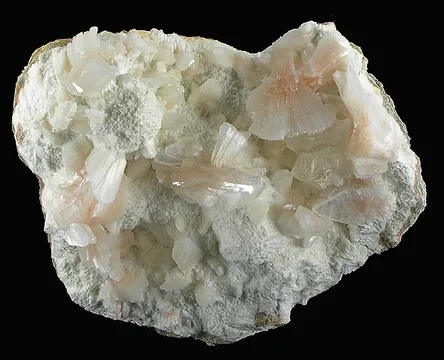
For serious specimen collectors, two Idaho faces stand out immediately. One is the Rat’s Nest claim near Challis, where peach, salmon-pink and pale cream heulandite-Ca fans sit on snowy fibrous mordenite in geode-like volcanic cavities; the best examples have the airy, architectural quality usually associated with the Deccan basalts of India, but with a color and texture recognizably their own. The other is the Sawtooth aquamarine suite: saturated blue, commonly etched beryl crystals from miarolitic cavities in pink Tertiary granite, associated with microcline, albite, smoky quartz, fluorite, topaz, bertrandite, carpholite and related late-stage granite-pocket minerals. Add the deep purple-red almandine dodecahedra of Emerald Creek—many capable of displaying a four-rayed, and more rarely six-rayed, star when correctly cut—and Idaho earns its reputation honestly.
Historically, Idaho also matters far beyond gem collecting. Gold was discovered near Pierce in 1860, but the state became internationally important through hard-rock mining: the Coeur d’Alene district of Shoshone County is one of the great silver-lead-zinc districts of the world, while southeastern Idaho’s Western Phosphate Reserve became a major phosphate province. The specimen record grew in the shadow of that industrial history. Old mine dumps, skarn workings, oxidation zones, placer gravels and remote granite pockets all contributed minerals that entered cabinets under labels reading Kellogg, Wardner, Mackay, Seven Devils, De Lamar, Sawtooth, Emerald Creek, Challis and Spencer.
Regional View
Country View
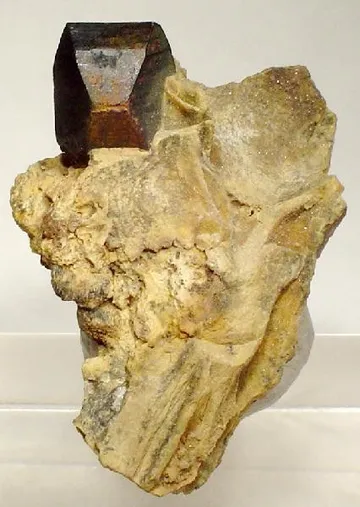
Idaho specimens tend to have a practical, field-collected honesty. The state’s finest zeolites are delicate and pale, its aquamarines are often etched rather than textbook-perfect, its garnets are commonly waterworn or included, and its copper minerals are more likely to be association pieces from historic mine ground than flawless display azurites. That is part of the appeal. The best Idaho specimens usually reward a collector who understands geology and provenance as much as sheer perfection: a Rat’s Nest heulandite that balances pink fans over white mordenite, a Sawtooth aquamarine with strong blue color despite natural etching, an Emerald Creek garnet that retains dodecahedral form, or a Seven Devils powellite from the species’ type region.

Photo: Wikimedia Commons

Photo: Wikimedia Commons

Photo: Wikimedia Commons
Search for specimens: View all specimens from Idaho, USA
Idaho’s collectible minerals are best understood by deposit type rather than by county alone. In northern Idaho, the Coeur d’Alene district is a long-lived polymetallic vein district dominated historically by silver, lead and zinc. Its classic mines—Bunker Hill, Sunshine, Hecla, Galena, Lucky Friday, Star-Morning and others—worked structurally controlled sulfide veins in Belt Supergroup sedimentary rocks. While the district is famous economically for argentiferous galena, sphalerite and tetrahedrite-group minerals, it also produced collectible secondary lead and copper minerals, including pyromorphite, cerussite, anglesite, linarite and associated oxidation-zone species. Much historic material came from mine workings and dumps during active or earlier mining periods, and modern access is heavily constrained by private ownership, active mining, reclamation and Superfund cleanup.
The Emerald Creek–Fernwood–Clarkia garnet area represents a very different setting. Here almandine-rich garnet formed in garnet-mica schist within the Belt Supergroup Wallace Formation. Weathering freed the garnets from the schist, and their high specific gravity concentrated them in creek gravels and residual placers along Emerald Creek, Carpenter Creek, Meadow Creek and nearby drainages. These deposits supported industrial garnet mining for abrasive sands beginning in the twentieth century, while the public Emerald Creek Garnet Area became one of the best-known fee/permit collecting sites in the United States. Recreational collecting is confined to the managed site and its season, with tickets and mineral permits administered through Recreation.gov and the U.S. Forest Service; collecting outside the designated area or outside the open season is not permitted.
The Sawtooth Batholith and related Tertiary granites are Idaho’s classic miarolitic-gem environment. These pink granites contain cavities and fracture-related pockets lined with euhedral minerals. Collectors prize them for aquamarine, smoky quartz, microcline, albite, topaz, fluorite, bertrandite, carpholite, potassic-carpholite, helvite and other late-stage species. The best aquamarines occur as blue subhedral to euhedral beryl crystals in vugs, fracture veinlets, disseminations and pegmatitic segregations. The Sawtooth occurrences are remote, discontinuous and difficult to work; many historically important pieces were recovered by persistent field collectors from small pockets rather than from commercial mining. Land status is critical in this region, because productive ground may fall within wilderness, national forest, claims, or other restricted areas.
Near Challis, the Rat’s Nest claim is a specimen deposit hosted in Eocene volcanic and volcaniclastic rocks. Its heulandite and mordenite occur in geode-like vugs, tubes and cavities rather than in ore shoots. The locality became a modern American zeolite classic because it produced display-quality heulandite-Ca—typically peach to salmon-pink, lustrous, wedge- or fan-shaped crystals—on contrasting white, hairlike mordenite crusts. Specimens were mined as mineral specimens, not as industrial zeolite ore, and the claim is not a casual public collecting ground. Rat’s Nest labels may also appear as Rat’s Nest mine, Rat’s Nest claim, Persistence mine, or simply Challis, Custer County; the most desirable labels preserve the specific claim and collector history.
Central and eastern Idaho add skarn, intrusive-contact and replacement systems. The Empire mine near Mackay, in the Alder Creek or White Knob district, is a copper-zinc skarn and replacement deposit formed where Eocene intrusive rocks met Mississippian limestone. Its oxidized copper assemblage includes malachite, azurite, chrysocolla, brochantite and silica-rich copper carbonate ore, while the broader district includes garnet-pyroxene-magnetite skarn and purple fluorite. The Seven Devils district in Adams County is another historically important copper-silver skarn/contact environment, notable not only for bornite-rich copper ore but also for powellite, first described from the Peacock mine area.
Southern and southwestern Idaho broaden the collector picture with volcanic gemstone deposits. Owyhee County is famous for jasper and agate from rhyolitic volcanic settings, while Spencer opal in eastern Idaho occurs in silica-rich volcanic host rocks and has supplied precious opal seams and triplets for the gem trade. These materials are often sold as lapidary rough rather than crystallized specimens, but they are central to Idaho’s identity as the “Gem State.” As with the mining districts, many productive areas are claimed, privately operated, seasonally restricted, or environmentally sensitive; serious collectors should treat published locality names as historical and geologic references, not as permission to collect.
Idaho heulandite for the specimen market is above all Rat’s Nest claim material from near Challis in Custer County, where heulandite-Ca occurs as lustrous peach, salmon-pink, pale pink and cream wedge-shaped crystals, sheaflike fans and parallel-growth clusters perched on snowy white mordenite. Good pieces show strong color contrast, undamaged terminations, three-dimensional placement and a clean mordenite base rather than flat crusts of scattered blades; the best fans may reach several centimeters across, while many attractive miniatures and small-cabinet pieces carry crystals in the sub-centimeter to 2–3 cm range. Calcite may be present, and the association with fibrous mordenite is not incidental but the visual signature of the locality. Compared with ordinary Idaho zeolite crusts, a first-rate Rat’s Nest heulandite has sculptural relief, saturated warm color, glassy luster and a display face that reads instantly from across the room.
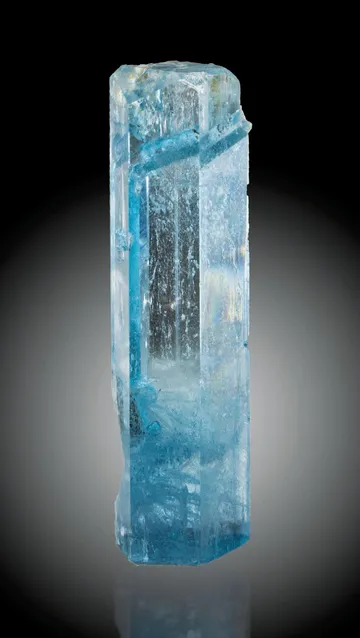
Idaho aquamarine is tied to the Sawtooth Batholith and related Tertiary granites, where blue beryl occurs in miarolitic cavities, fracture veinlets, disseminations and pegmatitic pockets with microcline, albite, smoky quartz, fluorite, topaz, bertrandite, carpholite and other late-stage granite minerals. The crystals are commonly etched, corroded, fractured, cloudy or only partly gemmy, but the color can be exceptionally saturated for North American aquamarine; old Sawtooth pieces with strong blue color, natural luster, visible hexagonal form and minimal contacts are far scarcer than their modest size might suggest. Documented crystals from the broader Sawtooth record include small gemmy crystals around thumbnail size and simple prismatic crystals reported to much larger dimensions, but most collector pieces are valued less by size than by color, transparency, pocket association and a credible old Idaho provenance.
Idaho almandine is most famous from the Emerald Creek area of northern Idaho, where purple-red to dark red dodecahedral garnets weather from garnet-mica schist and concentrate in placer gravels. Much of the material is waterworn, broken, included or abrasive-grade, but selected crystals and fragments are gemmy enough to cut; many contain oriented rutile needles that can yield a four-rayed star, with six-rayed stars much rarer and especially prized. Fine collector rough retains recognizable dodecahedral faces, good purple-red body color, promising translucency and minimal fracturing; cut stones depend on correct orientation, because an Idaho star garnet can look unremarkable until the cabochon dome meets the rutile inclusion geometry. Matrix pieces of garnet in schist are far less common on the market than loose placer garnets, and clean, well-formed crystals with Emerald Creek provenance remain the state’s emblematic gem specimens.
Idaho azurite is a secondary copper mineral of the state’s oxidized copper deposits rather than a single world-famous display-specimen occurrence. It is documented from districts including Seven Devils, Leadore, Bay Horse, South Mountain, Blackbird-related and Mackay-area copper occurrences, where it appears with malachite, chrysocolla, brochantite, chalcopyrite, bornite, calcite, quartz and iron oxides. At the Empire mine near Mackay, carbonate copper ore included malachite and azurite with chrysocolla, brochantite and banded amorphous silica in oxidized skarn-related copper mineralization. Good Idaho azurite specimens are usually valued as well-labeled association pieces—rich blue patches, crusts, small crystals or microcrystalline aggregates with contrasting green malachite—rather than as large freestanding crystals; strong color, undisturbed oxidized matrix and a precise mine or district label separate collectible pieces from ordinary blue-green copper-stained rock.
Idaho mordenite reaches its collector peak at the Rat’s Nest claim near Challis, where it forms thick white crusts and plush, hairlike to acicular aggregates lining volcanic cavities and supporting heulandite-Ca. Individual mordenite fibers are colorless, but the dense parallel to subparallel growth gives specimens a snowy white, velvety appearance; some fibers reach impressive lengths for the species, producing the soft architectural base that makes Rat’s Nest combinations so distinctive. Standalone mordenite pieces are collected, but the market strongly favors specimens where the mordenite is clean, undamaged and three-dimensional, especially when it frames salmon-pink heulandite fans. Ordinary mordenite crusts can be visually flat or dusty-looking; the best Idaho pieces have a crisp fibrous sheen, undamaged tufts, open vug form and a label connecting them specifically to Rat’s Nest rather than merely to “Challis zeolite.”
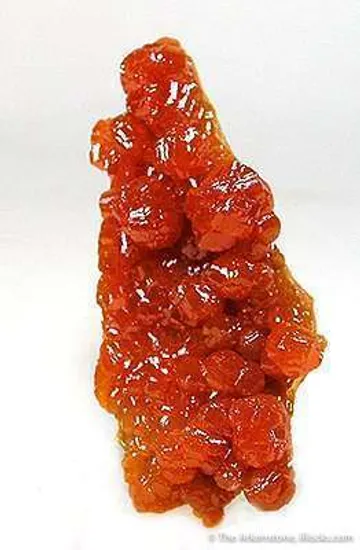
Beyond the five featured species, Idaho has an unusually interesting record of type-locality and rarity minerals. Powellite, CaMoO4, was first described from the Peacock mine in the Seven Devils district, where small pyramidal crystals occurred with bornite and garnet in contact-zone ore. Potassic-carpholite was described from Sawtooth Batholith material and later had its true type locality corrected to the Fall Creek drainage near Glens Peak in Boise County, a useful reminder of how sensitive and complicated Idaho pocket-provenance can be. The Menan volcanic complex near Rexburg is the type locality for several high-temperature oxide or nanomineral species, including luogufengite, valleyite and xuite. De Lamar in Owyhee County is documented as a source of rare selenium-bearing silver sulfosalts, including selenopolybasite. Bunker Hill and the broader Coeur d’Alene district remain classic for silver-lead-zinc ore minerals and secondary lead species, particularly well-labeled pyromorphite, while the Sawtooth area adds topaz, smoky quartz, microcline, albite, fluorite, bertrandite, carpholite-group minerals and unusual granitic-pocket accessories.
Idaho labels deserve close reading. “Idaho” alone is often too broad to be meaningful, and even county-level labels can conceal very different geologic origins. For zeolites, the essential distinction is Rat’s Nest claim versus generic Challis-area or southern Idaho zeolite occurrences; the classic salmon-pink heulandite on white mordenite should normally carry a Rat’s Nest, Challis, Custer County label, often with John Cornish, Lanny Ream or early-2000s collecting history. Mordenite may appear on older labels as “ptilolite,” an obsolete name, and Rat’s Nest may appear as Rat’s Nest mine, Rat’s Nest claim, or Persistence mine.
Sawtooth aquamarine is prone to vague or over-enthusiastic labeling. The best pieces are old, scarce and often small; many crystals are naturally etched, contacted or cloudy. A saturated blue, sharply terminated, fully gemmy Idaho aquamarine is not impossible, but it should prompt questions about provenance, collection history and whether the piece is actually from Idaho rather than Colorado, Pakistan, Brazil or Afghanistan. Heat treatment is common in the aquamarine gem trade generally, but for crystallized Sawtooth specimens the primary collector value is natural crystal form, color and locality history; ask for any known treatment disclosure when buying cut stones or unusually vivid crystals.
Emerald Creek garnets bring their own authenticity issues. A rough Idaho almandine is not automatically a star garnet. The star depends on rutile inclusions and cutting orientation, and many pieces only reveal their potential after careful cabochon cutting and progressive polishing. Conversely, some rough parcels sold as “star garnet” are simply dark placer almandine. Look for honest language: “Emerald Creek almandine,” “potential star garnet rough,” or “cut star garnet” with a visible star under a single-point light. Six-rayed stones are much rarer than four-rayed stones and should be priced accordingly.
Condition expectations vary by species. Rat’s Nest heulandite and mordenite are fragile: mordenite fibers crush, mat and collect dust easily, while heulandite fans chip along exposed edges. Avoid brushing fibrous mordenite; use air only with great caution, and store pieces away from abrasion. Sawtooth aquamarine commonly shows natural etching, rehealing, contact marks and pocket bruising, so learn to distinguish growth features from damage. Emerald Creek garnets are tough, but fractured rough may fail during cutting. Copper carbonates such as azurite and malachite should be kept dry and away from acids, and old mine specimens from lead-zinc districts should be handled with normal hygiene: wash hands after handling, do not create dust, and keep friable ore away from children.
Current market availability is uneven. Emerald Creek garnet rough and cut stones appear regularly because the public dig and commercial history keep material circulating, though fine six-rayed stones remain scarce. Rat’s Nest heulandite-mordenite is available intermittently, often from older finds, dealer inventories and collection recycling rather than constant fresh production. Sawtooth aquamarine is much scarcer, especially with strong blue color and unambiguous locality documentation. Idaho azurite, pyromorphite, powellite, potassic-carpholite and other rarities are usually specialist pieces; the label, mine name and collection provenance often matter as much as the visual specimen.
The best Idaho collecting stories often begin with someone refusing to accept that a line in an old report is the end of the trail. Rat’s Nest is a perfect example. Early references to mordenite near Challis were obscure enough that the locality might have remained a footnote, but Lanny Ream’s later work on Idaho minerals revived the search. The trail ran through old descriptions, local memory and the deceptively casual phrase that the mordenite was “behind the Drake Ranch.” What followed was not a romantic cavern full of glittering crystals, but the patient reality of field mineralogy: low hills south of Challis, volcanic rock, shallow pits and cavity zones that had to be recognized, opened and mined carefully enough to save fibrous mordenite and fragile heulandite fans. When the pockets were right, they produced something almost shocking for an American zeolite locality—soft white mordenite carpets carrying peach-pink heulandite fans large and bright enough to stand beside famous Indian zeolite specimens without apology.
The Sawtooth aquamarine story is quieter and more alpine. Idaho’s finest aquamarines did not come from a heavily mechanized gem mine but from remote granite, high country and small miarolitic cavities. Collectors learned that cavities could align along healed fractures and joints, and some believed the pockets occupied predictable horizons in the Sawtooth Batholith. That kind of knowledge is not found by casual wandering. It comes from climbing, mapping, returning, and reading the granite: pink host rock, joint direction, elevation, float, smoky quartz fragments, feldspar and pocket rubble. The reward might be a small etched blue beryl rather than a giant gem crystal, but when the color is right—the strong Sawtooth blue that made old Idaho collectors famous—the specimen has a presence out of proportion to its size.
Emerald Creek has a different rhythm: not alpine solitude, but mud, screens, sluices and the expectation that a dark garnet in the hand may hide a star no one can yet see. The public collecting area became famous because visitors could actually dig for Idaho’s state gem, but the process is wonderfully unglamorous. Garnets weather from schist, settle by weight, and wait in gravel. Collectors dig down, screen, wash, concentrate, and carry away rough that may still look like dark red-brown pebbles. Only later, under a lapidary’s wheel, does the test begin. A stone that seemed ordinary can suddenly show a floating cross of light; the rarer prize is a six-rayed star, the sort of stone that makes Emerald Creek more than a local collecting stop.
One of Idaho’s most revealing provenance stories belongs to potassic-carpholite. The mineral was described from Sawtooth Batholith material, but its locality was once reported imprecisely as near Centerville. Later, W. Chris Van Laer corrected the record: the true locality had been deliberately kept secret for 22 years and was in the Fall Creek drainage near Glens Peak, Boise County. For collectors, that episode is more than mineralogical housekeeping. It shows why Idaho labels can be both precious and treacherous. A single vague place-name may protect a pocket, mislead the literature, or change the scientific meaning of a specimen for decades.


.jpg)