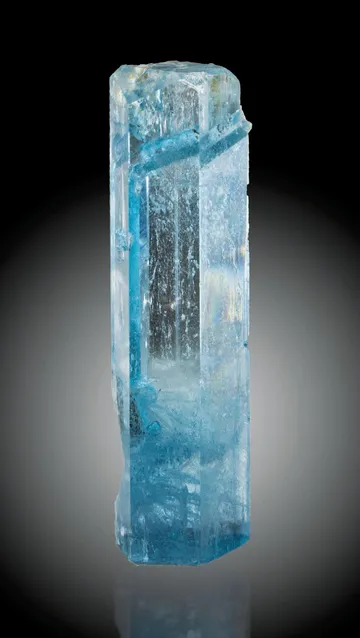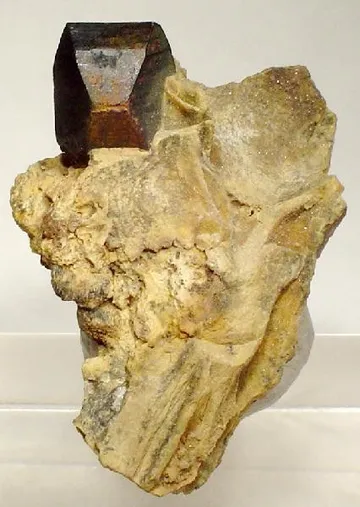
Blackbird Mine, Idaho — cobalt-copper district yielding phosphate minerals, notably ludlamite and vivianite, prized as a closed-locality classic.
Key facts
Blackbird Mine is one of the few American ore localities whose importance reaches well beyond regional collecting. In the Salmon River Mountains of east-central Idaho, it anchors the historic Blackbird cobalt-copper district, the heart of the Idaho cobalt belt: a northwest-trending belt of cobalt-copper occurrences hosted in Mesoproterozoic metasedimentary rocks of the Lemhi subbasin. For economic geologists, Blackbird is a reference locality for sediment-hosted cobalt-copper-gold mineralization. For collectors, it is something rarer still: a hard-rock strategic-metal mine that produced world-class phosphate specimens, especially ludlamite and the unmistakable purple to purple-green vivianite for which the locality is famous.
The deposit is not a pegmatite-style phosphate occurrence. The best collector specimens came from a cobalt-copper mine developed in altered, folded, and sheared siltite, argillite, quartzite, and schist, where sulfides and arsenides such as cobaltite, chalcopyrite, pyrite, pyrrhotite, arsenopyrite, and safflorite were the commercial interest. Against that dark and metallic background, the specimen minerals are visually dramatic: translucent apple- to olive-green ludlamite crystals sprinkled over sulfide-rich matrix, and elongated vivianite crystals that may appear nearly black in room light but glow internally with rose-purple, plum, green, or bicolored zones when backlit.
Regional View
Country View
Blackbird’s appeal also rests on finality. The mine closed in 1982 and has long been part of a major environmental cleanup and long-term monitoring program. The classic specimens in collections are old material, chiefly from the period when the mine and its associated workings were active in the mid-20th century. That history gives good Blackbird pieces the character of “closed locality” classics: finite, distinctive, and increasingly dependent on old labels and collection pedigrees.

Photo: U.S. Geological Survey

Photo:
Search for specimens: View all specimens from Blackbird Mine, USA
Blackbird Mine is in Lemhi County, Idaho, west of Salmon, in the Salmon-Challis National Forest and the Panther Creek drainage system. The broader district lies in the Salmon River Mountains, near the former townsite of Cobalt, and occupies the central part of the Idaho cobalt belt. The locality is generally described in specimen literature as Blackbird Mine, Blackbird mine complex, Blackbird Mining District, Lemhi County, Idaho, USA.
Geologically, the Blackbird district is a sediment-hosted cobalt-copper-gold system in Mesoproterozoic metasedimentary strata. Older reports placed the host rocks broadly in the Yellowjacket Formation of the Belt Series; later regional work refined the setting, especially by recognizing the importance of the Apple Creek Formation and its banded-siltite unit. In the mine area, the productive rocks include interbedded siltite and argillite that were altered to greenish biotite-rich rock, or biotitite, in multiple stratigraphic intervals. This altered, finely layered package was folded, sheared, cut by mafic dikes and later veins, and overprinted by metamorphism and remobilization. The result is a compact but complicated ore field in which stratabound cobaltite-rich zones and discordant copper-rich veins coexist.
The commercial ore minerals were chiefly cobaltite and chalcopyrite, with pyrite, pyrrhotite, arsenopyrite, safflorite, linnaeite, löllingite, enargite, sphalerite, galena, and minor native gold or silver documented in the district literature. The gangue and alteration assemblage includes quartz, biotite, chlorite, siderite, muscovite, tourmaline, calcite, and phosphates. Collectors should understand that Blackbird’s famous vivianite and ludlamite are the collectible expression of a chemically unusual mine environment rather than the economic heart of the ore.
The district contains multiple named ore zones and prospects. Historical production came from both underground and open-pit workings, including zones such as Idaho, Dandy, Chicago, Brown Bear, and Blacktail; later geological work and exploration also emphasized Sunshine, East Sunshine, Ram, Merle, Horseshoe, and related zones and prospects. The Blacktail open pit is the major visual scar of the mine, while the underground workings and older adits account for much of the locality’s mineral-specimen legacy. The mine was developed along steep canyons and ridges, and published mine descriptions note narrow valleys, heavy forest cover, deeply weathered upland surfaces, and relatively sparse natural outcrop away from cuts and workings.
Mining history began with late-19th-century prospecting for gold and copper. The district was first prospected in the 1890s, with early development at properties including Brown Bear and Haynes-Stellite. Cobalt became strategically important in the 20th century. Haynes-Stellite produced cobalt-bearing ore during the World War I period, and the Uncle Sam Mining and Milling Company worked the south end of the present Blackbird area from 1938 to 1941. During World War II, federal agencies investigated the district, and the Calera Mining Company, a division of Howe Sound, became the dominant operator. Full-scale production began in 1949, with ore processed through a flotation mill during the district’s mid-century boom. Calera’s cobalt production was tied closely to U.S. government demand and stockpiling; when supported purchasing ended, large-scale activity declined. Later operators and owners included Machinery Center, Idaho Mining Company, Hanna, and Noranda-related interests, with intermittent mining, exploration, and feasibility work continuing before final closure in 1982.
Published production figures vary by source and accounting method, but all agree that Blackbird was the outstanding domestic cobalt producer of its era. The district has been credited with millions of pounds of cobalt and tens of millions of pounds of copper, plus byproduct gold and silver. Modern geological summaries treat past production plus defined resources as a large cobalt-copper-gold endowment, and Blackbird is repeatedly used as a model or comparison point for related deposits in the Idaho cobalt belt.
Collecting access today should be considered closed for practical purposes. The mine is an inactive, remediated industrial site with private patented claims, unpatented claims, restricted vehicular access, water-treatment infrastructure, waste-rock caps, diversion works, and long-term monitoring. Public hiking access in the surrounding National Forest context is not the same thing as permission to collect minerals, enter workings, disturb remediation areas, or remove material. Serious collectors should assume that legitimate specimens are old pieces from mine-era collecting, old dealer stocks, or collection dispersals.
The finest known collector pieces appear to have come from limited pocket material recovered during the mine’s active years, especially the 1950s and 1960s. Good labels often mention Blackbird Mine, Cobalt, Lemhi County, Idaho, and may use older district terminology. Pockets produced ludlamite, vivianite, and combinations of the two with quartz, siderite, pyrrhotite, pyrite, or dark altered schist. A first-rate Blackbird specimen is not merely “from Idaho”; it should display the locality’s diagnostic color and texture: sharp green ludlamite crystals with glassy faces, or elongated vivianite blades and prisms whose purple interior is visible in transmitted light.
Blackbird ludlamite is one of the classic North American expressions of the species, occurring as pale to dark green, apple-green, olive-green, and sometimes yellow-green crystals on sulfide-rich or quartz-bearing matrix, commonly in association with vivianite, pyrite, pyrrhotite, chalcopyrite, quartz, calcite, and siderite. Documented crystals are typically in the 8–12 mm range and may reach about 25 mm, but collector-quality pieces are judged less by maximum size than by transparency, luster, sharp tabular habit, isolation on matrix, and freedom from bruising. The most desirable specimens show multiple gemmy crystals with crisp stepped or wedge-like faces and strong contrast against dark ore or pale quartz; ordinary pieces tend to be more granular, crowded, dull, contacted, or partly embedded in decomposing sulfide matrix. Combination pieces with purple vivianite are especially prized because they unite the mine’s two signature phosphate minerals on a single specimen.
Vivianite from Blackbird is famous for a color range that includes colorless, pink, green, gray-blue, purple, purplish black, and bicolored purple-green crystals, with the deep purple hue being the locality’s calling card. Crystals are usually elongated, bladed, or prismatic, occurring as singles and groups on dark altered schist, sulfide-rich matrix, ludlamite, siderite, and white quartz; published locality data records blades up to 22 cm, though most market specimens are much smaller and many fine display pieces are thumbnail to cabinet size. The best Blackbird vivianites are sharp, lustrous, complete, and translucent when backlit, with saturated internal rose-purple or plum color and, on some crystals, green zones near the base or along part of the crystal. Ordinary pieces may appear nearly black without transmitted light, may have edge chipping, or may show deterioration from their matrix; the collector should always test the visual appeal under gentle backlighting rather than judging only under reflected room light.
Beyond ludlamite and vivianite, Blackbird is important for cobalt and copper mineralogy rather than as a named-mineral type locality. Documented species from the mine and mine complex include cobaltite, chalcopyrite, pyrite, pyrrhotite, arsenopyrite, safflorite, linnaeite, löllingite, enargite, sphalerite, galena, native copper, cuprite, malachite, erythrite, heterogenite, quartz, siderite, calcite, tourmaline, muscovite and other mica-group minerals, biotite-rich alteration rock, chlorite, magnetite, hematite, jarosite, xenotime-(Y), zircon, uraninite, sillimanite, and epidote. Erythrite provides the expected cobalt-bloom accent in the oxidation environment, but fine display specimens from Blackbird are overwhelmingly collected and traded for vivianite and ludlamite rather than for ore minerals.
Blackbird specimens are finite old classics, and the first authenticity question is locality discipline. Many labels shorten the locality to “Blackbird Mine, Cobalt, Idaho,” which is acceptable when the specimen style matches; however, “Idaho vivianite” or “Idaho ludlamite” alone is not enough for a serious locality collection. Vivianite from Blackbird should be checked for the characteristic elongated habit, dark-to-purple appearance, and possible green zoning; ludlamite should show the locality’s sharp green crystals on ore, quartz, or associated phosphate matrix. Combination pieces with both species are uncommon and should be valued accordingly when the association is visually clear and the label is credible.
The main condition problem is fragility. Vivianite is soft, hydrated, and light-sensitive; it can darken with exposure, and thin blades are easily chipped along edges or terminations. Purple Blackbird vivianite is often best appreciated by brief backlighting, not by prolonged display in bright sun or strong case lighting. Store important pieces away from direct sunlight and high-intensity illumination, and avoid heat, desiccation, and repeated handling.
Ludlamite is also soft and should be handled as a delicate phosphate. Its crystals can have bright glassy faces, but edges abrade readily. Clean only with restraint; do not use acids, ultrasonic cleaning, aggressive detergents, or vigorous brushing. Some Blackbird specimens sit on sulfide-rich matrix that may oxidize or break down, and locality notes for vivianite specifically mention that washing in common dish soap may help halt matrix decomposition. That should not be read as a license for casual washing of every specimen: test cautiously, avoid soaking labels or friable matrix, and consult a conservator for significant pieces.
Mislabelling is more likely than outright fakery. Purple vivianite is now widely associated with Blackbird, but not every dark vivianite crystal in commerce is automatically from Idaho; conversely, some authentic Blackbird crystals look black until backlit. Good provenance matters. Old collection labels from the 1960s–1980s, references to Cobalt or Lemhi County, or pedigrees to recognized American collections add real confidence and market value.
Market availability is intermittent. Small vivianite crystals and modest ludlamite thumbnails appear periodically as old collections are broken up, while large, sharp, richly colored, minimally damaged pieces are much less common. Top Blackbird vivianites compete as classic American vivianites; top ludlamites compete internationally, especially because well-crystallized ludlamite is scarce from any locality. Prices rise sharply for gemmy green ludlamite with isolated crystals, purple-green vivianite with strong transmitted color, and matrix specimens showing both species together.
The Blackbird story has the odd rhythm of many strategic-metal districts: a remote mountain camp becomes nationally important only when politics, war, and metallurgy suddenly make its metal indispensable. In the early 1940s, Alfred L. Anderson of the Idaho Bureau of Mines and Geology examined the district and was struck by its cobalt potential. The story preserved in Idaho mining literature is wonderfully direct: Anderson contacted the chief of the mining branch of the U.S. Bureau of Mines and said that if the government wanted cobalt, the Blackbird district was the place to get it. Within a week, a Bureau of Mines engineer was assigned to begin bulldozer and drilling work. That rapid pivot—from reconnaissance to federal action—foreshadowed Blackbird’s Cold War role as the country’s dominant primary cobalt source.
By the 1950s, the mine was no longer just a set of adits in steep Idaho timber. It had become the reason for a company town. Cobalt, Idaho, about eight miles east of the mine along Panther Creek, had a post office, grocery store, recreation hall, bowling alley, pool tables, pinball machines, and families whose lives were tied to the mine road. Russell Steele, who later wrote about those years, remembered returning to Cobalt in 1956 as a teenager and going to work in the Blackbird open pit after graduating from Salmon High School in spring 1957. He moved from water-truck driver to driller’s helper to swing-shift oiler on one of the shovels stripping overburden from the cobalt deposit. In his recollection, the work is not abstract mining history; it is damp dust, diesel smoke, a narrow haul road, and a young man trying not to lose his job.
One of Steele’s most vivid episodes turns on a hard hat. Early in his job, he saw his new aluminum hard hat in the rear-view mirror, shining in the wet dust of the haul road. A Euclid #1268 dump truck was grinding uphill under a load of overburden, throwing black diesel smoke, and Steele imagined the hat flattened into “a flat aluminum saucer” if he did not retrieve it. He swung the surplus Army 4WD water truck around, accelerated, and then watched the horizon vanish from the passenger-side window as the truck rolled. Dust and loose material filled the cab, water poured out of the tank into the road, and fuel fumes filled the cab before he found the ignition and killed the engine. His first thought was brutally simple: “You’re fired!” It is a small incident, but it captures the mine as a working place before it became a closed locality and a Superfund file.
The town declined almost as quickly as it had risen. At its peak, contemporary accounts described hundreds of mine workers and a Cobalt population that may have reached roughly 1,500. By 1961, the population had dwindled dramatically, and a widely repeated New York Times phrase predicted that the town was “likely to be given back to the forest, the deer and the hawk.” Later recollections from former residents are just as melancholy: only empty foundations and a couple of houses at the miners’ end of town remained to testify to the old community. For collectors, that disappearance explains why old Blackbird labels feel so evocative. They are not merely locality tags; they are paper remnants of a mining town that largely vanished.
There is a darker river story as well. Panther Creek and its tributaries received metals from mine wastes, tailings, and acid rock drainage, and health and environmental reviews record a 1954 fish-kill event involving roughly 200 adult chinook salmon, steelhead, resident trout, and mountain whitefish. Long after mining ended, cleanup required water collection and treatment, waste-rock stabilization, caps, diversion structures, sediment removal, and ongoing monitoring. The same chemistry that made Blackbird geologically remarkable also made its legacy difficult: cobalt, copper, arsenic, acid drainage, and a remote mountain watershed below one of America’s most important cobalt mines.