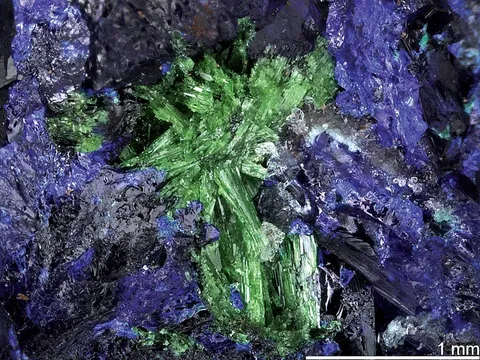
Inca de Oro mining district, Chile — famed for szenicsite as the type locality and vivid copper–molybdate minerals, with Atacama-style cabinet specimens.
Key facts
Inca de Oro is one of the most interesting collector districts in northern Chile because it sits at the junction of two different mineral stories: an old gold-and-copper mining camp of the Atacama Desert, and a modern copper–gold–molybdenum exploration and production district whose oxidized zones have yielded memorable cabinet minerals. For economic geologists, the district is known for Late Cretaceous low-sulfidation epithermal gold mineralization, tourmaline breccia–related Cu-Au mineralization at San Pedro de Cachiyuyo, and a significant Cu-Mo-Au porphyry system. For mineral collectors, however, Inca de Oro’s name is inseparable from Jardinera No. 1 and the 1990s discovery of szenicsite, a deep green copper molybdate that made the district a type locality of international importance.
The best specimens from the district are not large, showy “copper mine” pieces in the style of Michigan or Cornwall. Their appeal is more Atacama-like: intense color emerging from compact oxidized ore, silky blades of rare copper molybdates in reddish-brown matrix, chrysocolla and malachite coating quartz-lined cavities, bright secondary copper minerals, and occasional pieces that tie the collector assemblage back to gold-bearing epithermal veins and molybdenum-bearing hypogene ore. Inca de Oro rewards the collector who likes locality complexity—specimens whose labels may read Inca de Oro, San Pedro de Cachiyuyo, Delirio, Jardinera, Manto Cuba, or related workings, all part of a district where small mines, modern pits, and historical names overlap.
Regional View
Country View
The setting is classic Atacama mining country: a dry, open landscape north of Copiapó, with the town of Inca de Oro historically known by names such as Cuba, Oro del Inca, and San Pedro Nolasco. The district straddles the Chañaral–Copiapó provincial boundary and includes older vein workings as well as the Delirio area, where modern open pits have worked oxidized copper ore. This arid setting is important mineralogically. In the near-surface oxidized zones, copper, molybdenum, sulfur, chlorine, phosphate, arsenate, carbonate, and silica-bearing fluids produced a varied suite of secondary minerals, while the dry desert climate helped preserve delicate coatings, blades, and crusts that would be far less stable in a wetter environment.
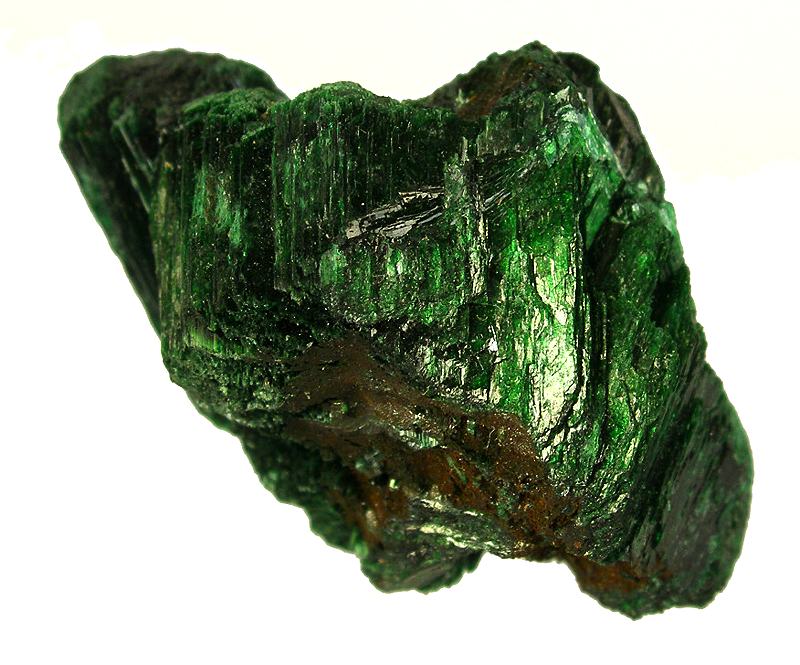
Photo: Rob Lavinsky, iRocks.com / Wikimedia Commons
Search for specimens: View all specimens from Inca de Oro mining district, Chile
The Inca de Oro mining district lies in the Atacama Region of northern Chile, centered on the historic mining settlement of Inca de Oro and extending into the San Pedro de Cachiyuyo and Delirio areas. The district is geologically varied: Jurassic volcanic rocks, Upper Cretaceous quartz monzodiorite and quartz diorite intrusions, hypogene Cu-Au-Mo mineralization, low-sulfidation epithermal Au veins and stockworks, and later oxidized copper zones are all part of the same broader mineral field. This is why Inca de Oro labels can legitimately cover very different specimen styles: gold-bearing quartz, chrysocolla-rich copper oxide ore, molybdenite–powellite–szenicsite assemblages, and rarer sulfate, phosphate, arsenate, and molybdate species.
The published epithermal model for Inca de Oro places the main gold mineralization in the Late Cretaceous and classifies it as low-sulfur, adularia-sericite type. Disseminated gold occurs in silica-cap material, while veins and stockworks carry a broader ore assemblage including pyrite, gold, sphalerite, argentite, galena, electrum, chalcopyrite, copper sulfosalts, bismuthinite, molybdenite, and cinnabar. Alteration is equally diagnostic: cryptocrystalline quartz in silicified zones; kaolinite, jarosite, and minor alunite in advanced and argillic alteration; and adularia, illite, and chlorite closely tied to veins and stockworks. Fluid-inclusion work indicates relatively shallow epithermal conditions, with boiling fluids around 225–250°C and estimated formation depths of a few hundred meters below the paleosurface.
San Pedro de Cachiyuyo, closely tied to the Inca de Oro collecting area, adds another deposit style: Cu-Au-bearing hydrothermal tourmaline breccia and related placer gold dispersion in a cold desert geomorphic environment. Studies of the placer system show that the gold dispersion halo is short—less than a kilometer from the source—and controlled strongly by slope breaks, alluvial fans, and ephemeral stream processes rather than by broad soil development. For collectors, that helps explain why native gold, electrum, chrysocolla, and quartz associations from the wider district can be localized, pockety, and highly dependent on the exact working or sublocality.
Modern mining has focused largely on copper. The Delirio project includes the Delirio, Barraza, Manto Cuba, Providencia, and Jardinera pits, with leaching and electrowinning infrastructure, and is reported by the operator as being in production. Nearby, the larger Inca de Oro Cu-Mo-Au porphyry project has been held through the Codelco–PanAust joint-venture structure and has been reported with substantial copper-gold resources. These modern operations matter to collectors in two ways: they confirm that the district remains an active mining area, and they make casual collecting unrealistic. Access to pits, dumps, and workings should be assumed to require explicit permission from landowners, operators, and mineral-rights holders.
Historically, Inca de Oro was not a single mine but a mining landscape. Nineteenth- and early twentieth-century accounts describe groups of mines spread across the Llano de Varas and neighboring sectors, with the settlement developing around mining services, transport, water, and later railway infrastructure. The town’s earlier names—Cuba, Pedro Nolasco, Oro del Inca, and related variants—still echo in old labels and documents. A collector should therefore read historical Inca de Oro labels with care: “Inca,” “Cuba,” “San Pedro,” “San Pedro de Cachiyuyo,” “Manto Cuba,” and “Jardinera” can refer to different levels of locality precision, not necessarily to identical workings.
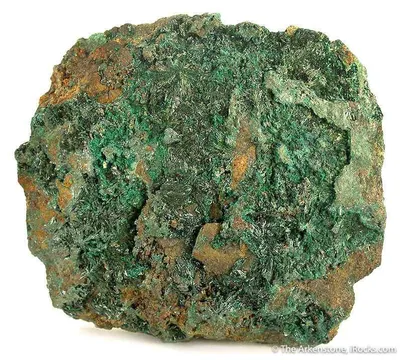
The most important specimen pocket in the modern collector literature is the szenicsite occurrence at Jardinera No. 1, about 5 km east of Inca de Oro. Szenicsite was found in a very restricted oxidized Cu-Mo zone in a mine exploiting secondary copper ores. The best pieces show lustrous, dark to electric green blades and fanlike aggregates on a reddish-brown, clay-like matrix, commonly with powellite and molybdenite. The discovery was small enough that major specimens are scarce, yet distinctive enough that even miniatures and thumbnails can be immediately recognizable.
Szenicsite from Inca de Oro is the district’s signature species and the reason Jardinera No. 1 is a type locality. The finest pieces show dark, saturated emerald-to-bottle-green blades with adamantine to metallic-looking luster, commonly arranged as jackstraw aggregates, fans, or parallel “books” in reddish-brown clay-like matrix; individual blades are typically around the centimeter scale and documented crystals reach roughly 1 x 3 cm, with terminated crystals distinctly rare. Classic associations include powellite, molybdenite, lindgrenite, chrysocolla, brochantite, gold, chalcocite, chalcopyrite, hematite, barite, and quartz. Top specimens are judged by richness, brilliance, crystal size, and three-dimensional arrangement: a dense patch of silky green blades with visible powellite or molybdenite is far more desirable than a dull smear of green molybdate in massive matrix.
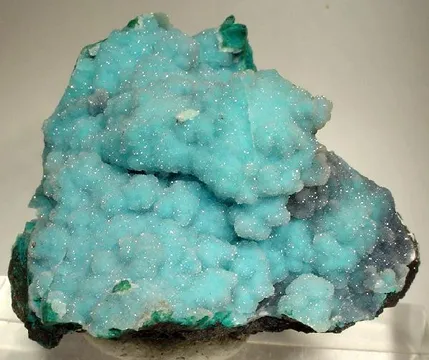
Chrysocolla is the most visually approachable Inca de Oro copper mineral: blue to blue-green coatings, crusts, and cavity linings associated especially with quartz, malachite, native gold, electrum, cuprite, tenorite, fluorite, brochantite, and tangeite. The district’s best chrysocolla specimens are not merely massive copper-stained rock; they have saturated color, sparkling quartz or chalcedonic surfaces, visible pocket texture, and contrasting companions such as malachite, cuprite, or gold-bearing quartz. Labels tied to Delirio, Manto Cuba, Jardinera, or San Pedro de Cachiyuyo deserve careful preservation, because the precise sublocality often explains whether a specimen belongs to an oxidized copper zone, a gold-bearing quartz association, or a molybdenum-rich pocket.
Quartz from Inca de Oro is both a collector mineral and a geological marker: it occurs as cryptocrystalline silica in epithermal silica-cap alteration, as vein and stockwork quartz tied to gold-bearing mineralization, and as drusy or chalcedonic surfaces in oxidized copper specimens. The most collectible pieces are those that carry the district story visibly—sparkling quartz with chrysocolla or malachite, quartz with native gold or electrum, or quartz-rich matrix supporting szenicsite, powellite, and molybdenite. Plain quartz from the district is rarely competitive as a species specimen, but quartz that frames bright secondary copper color or gold-bearing epithermal texture can be highly desirable as a locality piece.
Native copper at Inca de Oro belongs to the oxidized copper story rather than to a great native-copper lode. It is valued when it appears as recognizable hackly, branching, or metallic copper in association with cuprite, chrysocolla, malachite, and quartz, especially on pieces with strong district labels. Documented collector examples include cuprite on native copper, and the best Inca de Oro copper specimens have enough visible metallic copper to read as native copper rather than merely copper-colored matrix. Condition and contrast matter: a compact copper–cuprite combination with clean red oxide and blue-green chrysocolla interest will outclass a larger but dull, heavily coated copper mass.
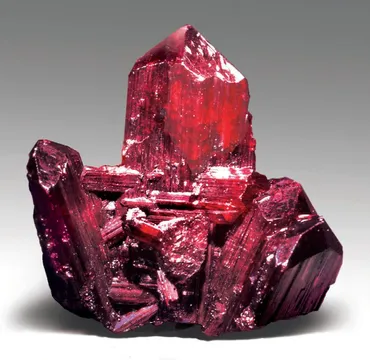
Cuprite from Inca de Oro is a scarce but attractive secondary copper mineral, best known to collectors in association with native copper and chrysocolla. The strongest pieces show visible red to deep reddish-brown cuprite crystals or crystal aggregates, ideally on copper or set off by pale quartz and blue-green chrysocolla; one well-known illustrated Inca de Oro example is a cuprite-on-copper specimen about 4.2 cm tall. As with most cuprite localities, the usual habits to watch for are octahedral, cubic, and modified crystals, but at Inca de Oro the greater value is the combination: red cuprite, metallic native copper, and oxidized copper color in a clearly documented Atacama district specimen.
Beyond these five collector staples, Inca de Oro is rich in minerals that tell the district’s chemistry. Szenicsite is the single valid type-locality mineral recorded for the district, but the associated molybdenum suite is much broader and includes powellite, molybdenite, lindgrenite, molybdofornacite, and wulfenite. Copper secondaries include atacamite, azurite, brochantite, malachite, antlerite, pseudomalachite, libethenite, ludjibaite, spangolite, cyanotrichite, tangeite, olivenite, agardite-(Y), and zálesíite. The ore and epithermal assemblage adds native gold, electrum, acanthite, galena, sphalerite, chalcopyrite, bornite, chalcocite, bismuthinite, cinnabar, pyrite, pyrargyrite, tetrahedrite-group minerals, enargite, hematite, magnetite, fluorite, barite, calcite, siderite, and alteration minerals such as kaolinite, jarosite, alunite, sericite, and adularia.
The principal authenticity issue for Inca de Oro specimens is not a wave of known fakes, but label history. Szenicsite specimens were originally circulated with Tierra Amarilla labels to conceal the true source, and that error entered early reports before being corrected to Jardinera No. 1, Inca de Oro. Older labels may therefore say Tierra Amarilla, “Tia Maria,” Copiapó Province, or other imprecise Atacama wording even when the specimen is now understood to be from Jardinera. A szenicsite specimen with old provenance is not automatically suspect because of a Tierra Amarilla label; rather, that label may be part of the known discovery history. Conversely, any expensive “Inca de Oro szenicsite” without strong visual match, provenance, or analysis deserves caution, because the species is rare and most fine material traces back to a very small discovery.
Condition issues vary by species. Szenicsite has good cleavage, modest hardness, and brittle bladed crystals, so edge chipping, crushed books, and rubbed luster are common downgrades. Specimens should be handled by the matrix, not by green blade aggregates. Powellite-bearing pieces may fluoresce creamy-yellow under ultraviolet light, but szenicsite itself is reported as non-fluorescent; fluorescence is therefore more useful for recognizing associated powellite than for confirming szenicsite. Chrysocolla and malachite pieces should be checked for chalky, friable surfaces, old glue, artificial stabilization, and sawn or polished faces sold as natural pocket specimens. Cuprite should be inspected for bruising and dull oxidation; native copper may be naturally darkened or coated, but fresh scratches, artificial brightening, or lacquer-like coatings reduce collector confidence.
Rarity is highly species-dependent. Chrysocolla, quartz, malachite, and general oxidized copper pieces from the district appear intermittently, but fine szenicsite is genuinely scarce and commands locality-rarity prices when rich and well-provenanced. The market favors specimens with precise sublocality names—Jardinera No. 1, Manto Cuba, Delirio, or San Pedro de Cachiyuyo—over vague “Atacama, Chile” labels. Because the area includes active mining and controlled properties, new specimen supply is irregular; collectors should expect most high-quality pieces to come from older collections, dealer inventories, and occasional releases of Chilean material rather than from casual field collecting.
The most memorable Inca de Oro story begins with a deception that later became part of mineralogical history. When the green molybdate later named szenicsite first appeared, specimens were intentionally labeled as coming from Tierra Amarilla, a well-known mining area southeast of Copiapó. The reason was practical and very old-fashioned: keep the source quiet while the pocket was being understood and worked. The camouflage succeeded well enough that early published references repeated the wrong locality, and the error even mutated into the misquoted “Tia Maria.” Only later was the correct source fixed in the collector literature: Jardinera No. 1, about 5 km east of Inca de Oro.
The pocket itself had the scale and drama of a classic rarity find. Nearly all known specimens have been attributed to a single, roughly cubic-meter block from Jardinera No. 1. In that small volume of oxidized ore, copper and molybdenum chemistry lined up in just the right way. The green mineral formed as bladed crystals—often not perfect terminated crystals, but lustrous blades, fans, jackstraw groups, and page-like books. Moving away from the szenicsite-rich zone, the chemistry reportedly changed: copper decreased, lindgrenite appeared, and farther out the molybdenum expression became powellite blebs. For a collector, that is the sort of zonation one hopes to see preserved on a specimen: szenicsite blades, powellite fluorescence, molybdenite patches, and the reddish-brown matrix that ties the piece to the exact oxidized pocket.
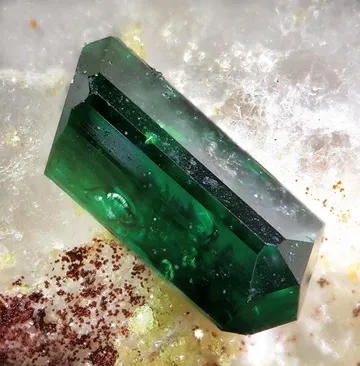
The naming of szenicsite is also unusually personal. It honors Terry and Marissa Szenics, the collectors and dealers associated with the first specimens, and the mineral became one of the signature Chilean species connected to their collecting legacy. In a marketplace where many rare species are known only as analytical powders or micromounts, szenicsite had the good fortune to be beautiful: deep green, lustrous, and displayable. That is why even a thumbnail crystal from the find can carry disproportionate importance. One well-known photographed specimen, just 2.6 x 1.8 x 1.7 cm, was described as a “superb large electric green crystal” from the type find of January 1993—small by cabinet standards, but large in the world of rare copper molybdates.
The town around the district has its own hard-edged mining narrative. Inca de Oro grew in a dry plain where names changed as mines, railway service, and water infrastructure changed. The place was known as Cuba, Pedro Nolasco, Oro del Inca, and Inca de Oro at different moments, and the railway station itself carried names before being renamed Inca de Oro in 1939. Old accounts divide the surrounding mineral ground into groups of mines—San Pedro, Santa Rosa, Colorada, Buena Esperanza, San Rafael, Candelaria, Descubridora, Constancia, Providencia, Magdalena, San Manuel, Tesoro, Guías del Norte, Guías del Sur, Tránsito, California, San Antonio, and others. Read together, those names make clear why a collector label from the area can be both precious and maddening: the district is a palimpsest of workings, camps, pits, and renamed places.