






Atacama, Chile — a mineral province famed for atacamite and rare szenicsite, rich copper–silver deposits, and desert-born crystals prized by collectors.
Key facts
Atacama is not a single pocket or one mine bench so much as a mineral province: a hard, sun-blasted strip of northern Chile where copper, silver, cobalt, arsenic, molybdenum, tellurium, sulfate, and chloride chemistry have been concentrated, oxidized, dried out, and preserved with a severity few districts on Earth can match. For collectors, its name immediately calls up the green copper hydroxychloride atacamite, named for the Atacama Desert and developed here in the arid, saline oxidized zones of copper deposits. But the broader Atacama Region also carries a deeper pedigree: Chañarcillo and Tres Puntas made Copiapó a nineteenth-century silver capital; La Farola and Las Pintadas gave the market elegant modern copper-oxide specimens; the Inca de Oro area produced one of the great late twentieth-century rarity stories in szenicsite; and the region’s arsenic-rich veins and sulfate occurrences have yielded an unusual concentration of type-locality minerals.
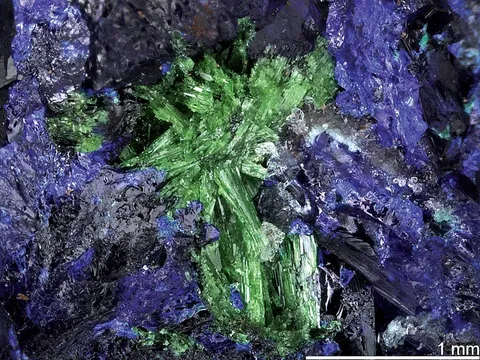
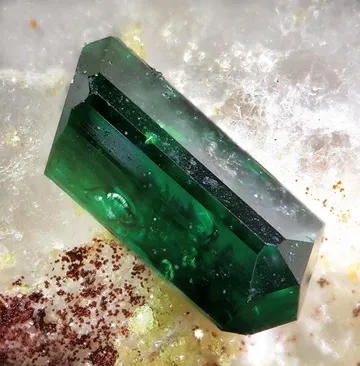
The best Atacama pieces are unmistakably desert-born. La Farola atacamite tends to appear as wet-looking emerald to nearly black-green sprays, needles, and bladed radial groups against white halloysite, pale quartz, chrysocolla, or brown iron-stained matrix. Inca de Oro szenicsite is a different green altogether: metallic, leaflike, and electric, often in curved platy crystals from a very small copper-molybdenum zone. Chañarcillo’s older silver suites supplied ruby-red proustite, silver species, arsenates, and adamite, while Freirina-area cobalt deposits contributed magenta erythrite on heavy cobaltite-bearing ore. In this region, specimen quality often comes from contrast: green on white, blue-green chrysocolla sealed beneath glittering quartz, crimson cobalt bloom on dark ore, or olive rodalquilarite tucked into pale alunite-lined cavities.
Regional View
Country View
Atacama’s collector importance rests on two overlapping geologic engines. The first is the coastal and Andean metallogenic framework of northern Chile: Mesozoic and younger magmatic arcs, faults, skarns, IOCG systems, manto and vein copper deposits, porphyry systems, high-sulfidation gold-silver systems, and arsenic-rich precious-metal veins. The second is the desert itself. Hyperaridity, saline waters, sparse vegetation, and deeply oxidizing near-surface conditions allow unstable-looking but beautifully preserved secondary minerals to survive in a way they rarely do in wetter districts. At La Farola, recent geological work on the Las Pintadas deposit interprets the system as a Cu-Fe-Au skarn or IOCG-related deposit with a well-developed supergene profile; atacamite is a late structural event tied to saline basin waters and hyperarid preservation, while earlier stages produced chrysocolla, libethenite/pseudomalachite, halloysite, iron hydroxides, and copper pitch.

Photo: Sailko, Wikimedia Commons

Photo: DerHexer, Wikimedia Commons
Search for specimens: View all specimens from Atacama, Chile
“Atacama, Chile” on specimen labels usually functions as a regional locality, and serious collectors should try to refine it to mine, district, province, and—where possible—pocket or find. The region includes Copiapó Province, Chañaral Province, and Huasco Province, and it spans a famous part of the Atacama Desert. Its mineral deposits include copper skarns, IOCG-style systems, manto and vein copper deposits, porphyry copper systems, cobalt-copper occurrences, arsenic-rich silver veins, iron oxide-apatite and iron-related deposits, and high-sulfidation precious-metal systems along the Andes. As a collecting region it is especially known for oxidized copper mineralization, silver-arsenic suites, cobalt arsenates, molybdates, and rare sulfate or arsenate species.
La Farola, at Cerro Pintado in the Las Pintadas district near Tierra Amarilla southwest of Copiapó, is the most important locality for the green copper specimens most collectors picture when they hear “Atacama.” Geological work on Las Pintadas places the deposit about 35 km southwest of Copiapó and describes it as a Cu-Fe-Au skarn with an extensive supergene profile. A separate study of Mina Farola describes a small operation southwest of Tierra Amarilla with volcanic Farola units, gabbroic, dioritic, and tonalitic dikes, alluvial and colluvial cover, a vertical transition from oxides to supergene and hypogene sulfides, many NW-SE faults, and oxide copper mineralization along structures. Those studies help explain the collector assemblage: atacamite, chrysocolla, halloysite, quartz, malachite, libethenite, pseudomalachite, sampleite, gypsum, and related copper secondaries.
The La Farola supergene sequence is especially useful for understanding specimen surfaces. Early banded chrysocolla formed under relatively neutral pH conditions, apparently favored by low pyrite abundance. Later microcrystalline chrysocolla, libethenite or pseudomalachite, and halloysite formed during continued weathering, with copper phosphates probably linked to apatite alteration. A further oxidizing stage added microcrystalline chrysocolla, iron hydroxides, and copper pitch. The late atacamite-sulfate event is tied to structures and saline waters, which is why the finest specimens often show sharp dark-green atacamite sprays sitting on pale clay or silica-rich matrix rather than buried in massive ore.
Modern La Farola is not simply an abandoned collecting hill. Environmental-review material for the La Farola exploitation and processing project describes an open-pit copper-gold operation with crushing, grinding, flotation, a filtered tailings deposit, and a projected 15-year mine life; the proposed pit footprint and industrial scale place present-day access firmly in the realm of permission, safety, and mine ownership. Collectors should not treat La Farola, Las Pintadas, or comparable Atacama mines as open public localities. Even old dumps may sit on active concessions, and the dry climate preserves unstable workings, shafts, trenches, and undercut faces long after production has ceased.
The Inca de Oro and Diego de Almagro area, north of Copiapó, is the other major specimen source represented in this locality grouping. The Jardinera No. 1 Mine, near Inca de Oro in Chañaral Province, is the type locality for szenicsite, Cu3(MoO4)(OH)4. The szenicsite occurrence was famously small: an isolated zone about one cubic meter in size, developed in cavities in a matrix rich in molybdenite and copper-bearing powellite. The surrounding alteration passed outward into lindgrenite and then into powellite-bearing ore lacking obvious copper. This is why top-quality szenicsite is not merely uncommon but finite-looking; the specimens on the market are largely tied to the original 1990s material and later dispersals of Terry and Marissa Szenics material.
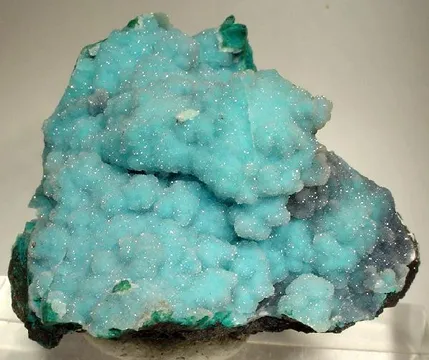
The same Inca de Oro–Diego de Almagro belt also produced handsome chrysocolla and quartz specimens, including Manto Tres Gracias material with rounded blue-green chrysocolla “balls” coated by sparkling drusy quartz. Some specimens carry Terry Szenics or Aurora Mineral Corp. provenance, a meaningful detail because much of the best collector-grade material was removed during field trips and marketed by a small circle of specialist dealers rather than by large mining companies.
Atacama’s historical silver heart is Chañarcillo, near Copiapó. Discovered in 1832, it transformed Copiapó into a mining capital in the nineteenth century and supplied classic silver and arsenic minerals, including proustite and the type-locality mineral adamite. Chañarcillo is a locality where labels can be deceptively broad—“Copiapó,” “Atacama,” “Chili,” or “Chanarcillo” may all appear on old European or American labels—so provenance, handwriting, old collection numbers, and associated species are important. The Chañarcillo suite belongs to a very different collecting tradition from La Farola’s bright copper chlorides: old, often smaller, historically significant silver and arsenate specimens that reward careful documentation.
The Freirina–Huasco cobalt occurrences, especially La Blanco or Blanca Mine material, add another strand. Old erythrite specimens from this area can occur as acicular metallic magenta crystals on cobaltite-rich matrix with cobaltian wad historically called “asbolite.” Such pieces may carry museum-era provenance, including late nineteenth-century labels and associations with Ignacio Domeyko’s Chilean mineral work. They are scarce compared with modern Moroccan or Canadian erythrite, and their value lies as much in locality and history as in crystal size.
Atacamite is the signature mineral of Atacama and the mineral whose name fixes the desert permanently in the collector vocabulary; the classic regional material is best represented by La Farola, where it occurs as deep emerald to blackish green acicular, bladed, and radial crystal sprays, commonly only a few millimeters across but capable of covering showy cabinet-size matrix. The best La Farola pieces have lustrous, translucent to gemmy sprays standing cleanly on white halloysite or pale matrix, sometimes with chrysocolla, quartz, libethenite, pseudomalachite, gypsum, or malachite; ordinary pieces are darker, more massive, rubbed, or confused visually with brochantite or mixed copper oxides. Late saline, hyperarid supergene conditions are central to the look of these specimens, and the finest examples show sharp individual needles or flattened blades rather than green crusts.
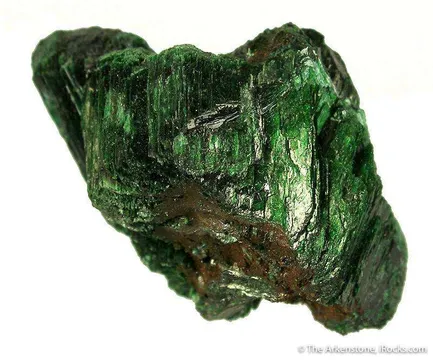
Szenicsite from Atacama means, above all, the Jardinera No. 1 Mine near Inca de Oro, where the species was discovered by Terry and Marissa Szenics in a very small copper-molybdenum occurrence and later described as a new copper hydroxy-molybdate. It forms dark to electric green, lustrous, platy to bladed crystals and curved leaflike aggregates, with the best specimens showing distinct plates rather than granular green coverage; associated species include powellite, copper-bearing powellite, molybdenite, lindgrenite, chrysocolla, brochantite, quartz, barite, hematite, chalcopyrite, chalcocite, and rare native gold. Fine crystals may reach the centimeter scale, but even miniature pieces are desirable when the crystals are sharp, bright, and visibly isolated on matrix, because the original occurrence was on the order of only one cubic meter and no comparable modern production has replaced it.
Quartz from Atacama is most collectible when it is part of the copper-oxide aesthetic rather than as isolated colorless crystals: drusy quartz over blue-green chrysocolla from the Inca de Oro and Diego de Almagro area, quartz-lined cavities in La Farola copper assemblages, and pale quartz matrix carrying atacamite, chrysocolla, malachite, or rare arsenic/silver species. The best pieces use quartz as sparkle and contrast—a dove-gray to clear druse that brightens botryoidal chrysocolla or frames green copper minerals—while ordinary pieces are simply silicified copper rock with little definition. Because quartz is ubiquitous across Atacama’s veins and altered rocks, locality precision matters: “quartz, Atacama” has modest meaning, but quartz with chrysocolla from Manto Tres Gracias or quartz with atacamite and halloysite from La Farola is a real specimen identity.
Alunite in the Atacama collecting context is tied to acidic sulfate alteration in copper, gold, and tellurium-bearing systems, appearing as pale cream, white, yellowish, or lenticular microcrystalline coatings and cavity linings rather than large display crystals. It is especially important as the contrasting matrix for Chilean rodalquilarite specimens from high-sulfidation-style material, where olive-green acicular to prismatic rodalquilarite sits in or on alunite-coated quartz; within Atacama Region proper, alunite is also documented from multiple altered copper and precious-metal localities, including Chañaral-area occurrences. Good alunite specimens here are judged less by alunite alone than by texture, freshness, and association: a clean yellow-white alunite surface carrying rare tellurium minerals or sharp copper secondaries is far more significant than a massive, chalky sulfate crust.
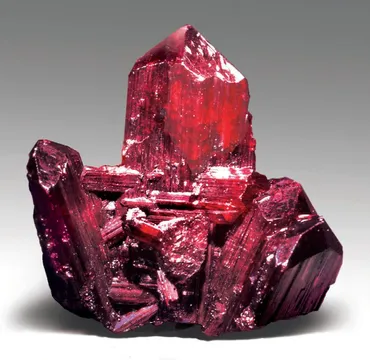
Erythrite from Atacama is a historic cobalt-mineral specimen, most notably from the La Blanco or Blanca Mine near Freirina in Huasco Province, where it occurs as vivid magenta to purplish-red acicular crystals and sprays on heavy cobaltite-rich ore with cobaltian wad historically labeled as asbolite. The best pieces are not the largest modern erythrites in the world, but they have a desirable old-Chile character: metallic needles, rich color, heavy matrix, and museum-style provenance, including specimens attributed to late nineteenth-century study collections. Ordinary Atacama erythrite is often thin bloom or powdery coating; collector-grade material needs visible needles, strong color, and a confirmed cobalt locality rather than a vague “Chile” label.
Chrysocolla is one of the essential visual minerals of Atacama’s oxidized copper deposits, especially at La Farola and in the Inca de Oro–Diego de Almagro area, where it ranges from banded and microcrystalline masses to botryoidal blue-green coatings and rounded balls coated by glittering quartz druse. At La Farola, chrysocolla belongs to multiple supergene stages and may occur with atacamite, halloysite, libethenite, pseudomalachite, malachite, quartz, iron oxides, and copper pitch; in some specimens chrysocolla partially or completely replaces earlier atacamite, preserving sprays as attractive blue-green pseudomorphs. Good specimens have saturated turquoise to blue-green color, rounded form, bright quartz contrast, or obvious replacement texture; ordinary pieces are dull copper-silicate crusts without definition.
Rodalquilarite on Chilean “Atacama” labels is a rare tellurium-mineral association best known from the Wendy open pit at Tambo, where it forms olive to deep green acicular, prismatic, and spheroidal microcrystals in cavities, typically on alunite-coated quartz. Though the classic Wendy pit locality lies in the El Indio-Tambo district of Coquimbo rather than Atacama Region, specimens are often discussed within the broader northern Chile/Atacama Desert high-sulfidation collecting suite, and the visual association—green rodalquilarite in yellow-white alunite and quartz—is distinctive. The best pieces show numerous lustrous, well-formed crystals in open vugs; ordinary examples are sparse green dustings that need magnification and reliable analysis to separate them from other green tellurites or copper secondaries.
Beyond these headline species, Atacama is remarkably rich in rarities and type-locality minerals. Atacamite itself is a type-locality species for the region. Chañarcillo is the type locality for adamite, with rare honey-brown to greenish material historically overshadowed by the district’s silver minerals. The Alacrán Mine in the Pampa Larga district is the co-type locality for alacránite and the type locality for bonazziite, within an arsenic-sulfide assemblage including realgar, orpiment, native arsenic, sulfur, stibnite, pyrite, arsenopyrite, greigite, sphalerite, acanthite, and barite-quartz-calcite gangue. Other documented Atacama Region rarities include alumolukrahnite, amarillite, nantokite, paracoquimbite, quenstedtite, segerstromite, and numerous arsenates, sulfates, copper chlorides, silver minerals, native elements, and oxidized copper species. For collectors, the lesson is simple: a modest-looking Atacama micro can be more important mineralogically than a showier cabinet specimen if the label and analysis are sound.
Atacama specimens reward disciplined locality work. Broad labels such as “Atacama,” “Atacama Desert,” “Copiapó,” “Chili,” or “Chile” may be historically legitimate, but they are not equivalent to a mine name. La Farola, Chañarcillo, Freirina, Inca de Oro, Pampa Larga, Jardinera No. 1, Manto Tres Gracias, and Wendy pit material represent different geology, chemistry, and market categories. A collector buying at a serious level should insist on the most precise provenance available and should preserve all old labels, even when the spelling is outdated or imperfect.
The most famous locality-label problem is szenicsite. Early public references placed the find at Tierra Amarilla, but the accepted type locality is the Jardinera No. 1 Mine near Inca de Oro. That misdirection is not a trivial clerical error; it is part of the collecting history of the species and still matters when evaluating older labels. Specimens labeled only “Tierra Amarilla” should be interpreted cautiously and, when possible, compared with later labels, dealer records, and the associated powellite-molybdenite matrix typical of Jardinera material.
Atacamite is commonly confused with brochantite, malachite, clinoatacamite, paratacamite, and mixed green copper oxides. On La Farola material, strong emerald color, acicular or bladed radial sprays, and association with halloysite and chrysocolla are helpful but not definitive; analysis is appropriate for high-value, unusual, or massive pieces. Some green coatings sold casually as atacamite may be mixed copper minerals, while blue-green pseudomorphs may be chrysocolla after atacamite rather than fresh atacamite itself. The same caution applies to “cuproadamite” or “cuprian adamite” from old Chilean arsenate suites, because some historical zinc-copper arsenate material from many districts has later proved to be zincolivenite or mixed olivenite-group material.
Condition is a major value factor. La Farola atacamite sprays are brittle and easily flattened; check for bruised tips, rubbed high points, clay-filled cavities, and old glue repairs where sprays detach from halloysite or friable matrix. Chrysocolla and quartz specimens often have soft or porous interiors beneath a hard silica skin; avoid soaking and avoid aggressive ultrasonic cleaning. Erythrite can be powdery and contains cobalt and arsenic, so handle with normal toxic-mineral precautions: wash hands after handling, keep dust out of the air, and store away from children and pets. Silver minerals from Chañarcillo, especially proustite, can darken with strong light exposure, so historic red silver specimens should be kept in low light.
Market availability is uneven. Small La Farola atacamite specimens remain obtainable, but top pieces with bright sprays on clean white halloysite or rich chrysocolla contrast are much less common. Szenicsite is genuinely rare and strongly provenance-driven; fine pieces usually come from old collections and command attention far beyond their size. Atacama erythrite is scarce compared with modern erythrite from better-known world localities, and its premium depends on old labels and locality certainty. Rodalquilarite is a micro-to-miniature rarity in which verified identity and a clear alunite-quartz association matter more than cabinet scale.
The great Atacama collecting story begins not with a specimen cabinet but with a silver outcrop. On May 16, 1832, the Chañarcillo discovery was credited to Juan Godoy, with local tradition also preserving the name Flora Normilla in connection with the find. Whatever version one favors, the result was immediate and immense. In 1833, about 20.3 metric tons of Chañarcillo silver reportedly reached the smelters of Copiapó. By 1839, the district counted 12 productive mines, 55 unproductive ones, and 518 workers. In 1840, Ignacio Domeyko visited the Atacama region, binding the district not only to Chilean mining history but to the scientific mineralogy of the young republic.
The district quickly became rich enough—and unruly enough—that its social history reads like a mining novel. In 1837, entry by women into Chañarcillo was restricted; permission had to come through a father, husband, or brother. In 1841, Juan Godoy died at only 52. The rush he helped ignite had already changed Copiapó. In the middle of the nineteenth century, the city became Chile’s mining capital, and the silver wealth of Chañarcillo and Tres Puntas helped finance the country’s first railway, the Copiapó-Caldera line opened in 1851. For a collector holding an old Chañarcillo label, that context matters: these are not anonymous silver-mineral curiosities, but fragments of the boom that built an industrial corridor across the desert.
The szenicsite story is almost the opposite: not a silver rush, but a secret small enough to hide in a truckload of rock. Terry and Marissa Szenics found the material that would bear their name in the early 1990s, and the true occurrence at Jardinera No. 1 was extraordinarily limited—about one cubic meter of szenicsite-bearing cavities in molybdenite- and copper-powellite-rich matrix. Outside that little green zone, the mineralization changed to lindgrenite and then to powellite blebs without obvious copper. To protect the find, the locality was initially misreported as Tierra Amarilla, roughly 100 km away from the accepted Jardinera No. 1 locality. That act of field secrecy is now part of the species’ identity: a modern, beautiful new mineral in crystals large enough for collectors, but from a pocket so small that every documented specimen feels like a survivor.
There is a quieter story in the old erythrite labels as well. A La Blanco Mine specimen in the Academy of Natural Sciences of Philadelphia collection was described with sharp metallic magenta erythrite on heavy cobaltite-rich matrix, associated with cobaltian wad. Its label links it to “San Juan, Chili,” and the specimen history states that it was given by Dr. Domeyko, who sent many Chilean study samples to the Academy during its early collecting period. That kind of specimen is more than a cobalt arsenate: it is a remnant of nineteenth-century scientific exchange, when Chile’s remote mineral districts were being translated into museum drawers in Europe and North America, sometimes with locality names that require modern detective work to decode.
Álvarez López, Blas Alejandro. 2024. “Evolución supérgena del depósito de cobre ‘Las Pintadas (La Farola)’, Región de Atacama, Chile.” Undergraduate geology thesis, Universidad de Chile. DOI: 10.58011/8yd0-ke91. A key modern study of La Farola/Las Pintadas supergene mineralization, including chrysocolla, libethenite/pseudomalachite, halloysite, copper pitch, atacamite, and sulfate stages.
Vidal Garrido, Braulio Javier. 2025. “Geología y metalogénesis de Mina Farola, Región de Atacama, Chile.” Universidad de Atacama. Geological and structural study of Mina Farola, interpreting the deposit in an IOCG framework and documenting oxide-to-sulfide transitions.
Francis, C. A., L. C. Pitman, and D. E. Lange. 1997. “Szenicsite, a new copper molybdate from Inca de Oro, Atacama, Chile.” The Mineralogical Record 28: 387–394. Original formal publication for szenicsite from the Jardinera No. 1 Mine area.
Burns, Peter C. 1998. “The crystal structure of szenicsite, Cu3MoO4(OH)4.” Mineralogical Magazine 62: 461–469. Structural study of the Atacama type-locality copper molybdate.
Mindat: Szenicsite mineral page. Useful for type-locality status, formula, associated minerals, and notes on the extremely small original occurrence.
Mindat: Atacamite mineral page. Source for the naming history, formula Cu2(OH)3Cl, and type-locality reference to Atacama, Chile.
Friedel, C., and A. Daubrée. 1866. Adamite original description, Académie des Sciences, Paris, 62: 692–695. Important because Chañarcillo is the type locality for adamite, though specimens from the district are rare.
Clark, Alan H. 1970. “Alpha-arsenic sulfide, from Mina Alacrán, Pampa Larga, Chile.” American Mineralogist 55: 1338–1344. Early work tied to the arsenic-sulfide suite at Alacrán Mine.
Popova, V. I., V. A. Popov, A. Clark, V. O. Polyakov, and S. E. Borisovskii. 1986. “Alacránite, As8S9—a new mineral.” Zapiski Vsesoyuznogo Mineralogicheskogo Obshchestva 115: 360–368. New-mineral description for alacránite, named from the Alacrán locality.
Bonazzi, Paola, Luca Bindi, Valentina Popova, Giovanni Pratesi, and Silvio Menchetti. 2003. “Alacranite, As8S9: structural study of the holotype and re-assignment of the original chemical formula.” American Mineralogist 88: 1796–1800. Reassessment of alacránite chemistry and structure.
Yang, Hexiong, Robert T. Downs, Robert A. Jenkins, and Stanley H. Evans. 2018. “Segerstromite, Ca3(As5+O4)2[As3+(OH)3]2, the first mineral containing As3+(OH)3, the arsenite molecule, from the Cobriza mine in the Atacama Region, Chile.” American Mineralogist 103: 1497–1501. Type-mineral work from Atacama Region demonstrating the continuing importance of the district for new arsenate mineralogy.
Mindat: Atacama, Chile regional locality page. Broad regional mineral inventory, including hundreds of valid minerals and numerous type-locality species.
Mindat: Atacama, Chile — Best single starting point for the regional mineral list, sublocalities, type-locality minerals, and species cross-checking.
Mindat: Atacama Desert, Chile — Useful broader desert-level locality page, especially for distinguishing Atacama Region records from wider Atacama Desert records.
Mindat: La Farola Mine, Atacamite entry — Focused record for atacamite from La Farola with associated species and photo links.
Wikimedia Commons: La Farola Mine category — Open image archive for La Farola specimens, including atacamite, chrysocolla, quartz, gypsum, sampleite, and related copper minerals.
Wikimedia Commons: Jardinera No. 1 Mine category — Image archive for szenicsite, powellite, and related Jardinera material.
Universidad de Chile: “Evolución supérgena del depósito de cobre ‘Las Pintadas (La Farola)’” — Modern thesis on La Farola/Las Pintadas supergene mineral evolution.
Universidad de Atacama: “Geología y metalogénesis de Mina Farola” — Geological and metallogenic study of Mina Farola.
SEA Chile: La Farola project field visit notice — Current environmental-review context for modern La Farola mining plans and access realities.
Atacama Minerales: Proyecto Delirio — Operator information for Delirio-area open pits including Jardinera, Manto Cuba, and related Inca de Oro-area assets.
Memoria Chilena: Minería de la plata — Historical overview of Chañarcillo, Tres Puntas, and the Chilean silver boom.
Memoria Chilena: Copiapó — Context for Copiapó’s nineteenth-century rise as Chile’s mining capital.
GeoVirtual: Chañarcillo history — Detailed chronology of Chañarcillo with dates, mine history, and historical images.
Mindat: Alacrán Mine, Pampa Larga district — Reference page for the arsenic-rich Alacrán locality and its type-locality species.
Mindat: Adamite “Best Minerals” page — Short collector-focused note on rare Chañarcillo adamite and the species’ type-locality status.
Wikimedia Commons: Atacamite from La Farola Mine — High-resolution open photograph of a La Farola atacamite specimen.
Wikimedia Commons: Harvard szenicsite from Jardinera No. 1 — Museum specimen photograph illustrating the classic Jardinera szenicsite look.

_2012-07-20.jpg)