A collector's guide to Chuquicamata Mine, Chile: its geology, mining history and notable minerals, illustrated with the 33 specimens documented from this locality on EarthWonders.
Key facts
Chuquicamata is one of the grand names in mineral collecting because it is not merely a large copper mine; it is a whole mineralogical province exposed in cross-section. Set in the Atacama Desert north of Calama, the deposit is a supergiant porphyry copper-molybdenum system tied to the Chuqui Porphyry Complex and controlled strongly by the West Fault/West Fissure structural zone. For ore geologists it is a textbook of hypogene copper sulfides, supergene enrichment, oxidation, and “exotic” copper transported outward into Mina Sur. For collectors it is the Chilean locality that made deep green antlerite, blue kröhnkite, rare copper sulfates, copper iodates, and a suite of type-locality secondary minerals into serious cabinet species.
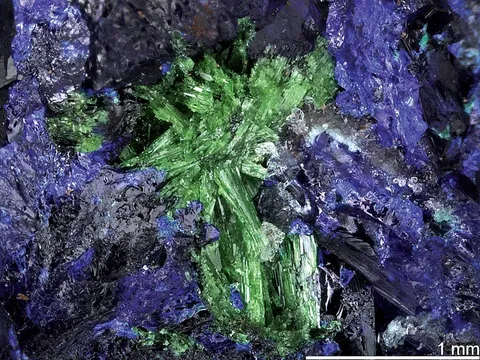
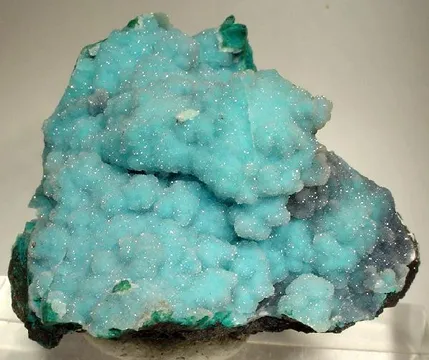
The classic Chuquicamata specimen is not a bright azurite-and-malachite showpiece in the Moroccan or Mexican style. Its best pieces have a harder, desert-oxidized look: emerald-green antlerite seams cutting pale, bleached porphyry; dark chalcocite or cuprite carrying small, sharp green crystals; powder-blue to blue-green phosphate or iodate films; and fragile sulfate assemblages that look as though they crystallized in the last breath of acidic mine water. The finest antlerites are richly crystallized rather than merely massive: lustrous prismatic or tabular crystals, compact sparkling crusts, and cross-fiber veinlets with a chatoyant green sheen. The locality’s importance also rests on scholarship. Mark C. Bandy’s 1938 work on northern Chilean sulfate deposits, the later descriptions of salesite and sampleite, and Robert B. Cook’s 1978 “Famous Mineral Localities” article together turned Chuquicamata from an orebody into a collecting landmark.
Regional View
Country View

Photo: Diego Delso, Wikimedia Commons
The mine’s scale is inseparable from its mineral collecting history. Industrial mining exposed vast volumes of oxidized and enriched copper ore, but the most collectible minerals generally came from selective seams, veinlets, borderland oxidation material, old workings, and pockets in zones that were geochemically narrow. Chuquicamata’s fragile sulfate mineralogy is a product of a fiercely arid climate: waters could become strongly charged with Cu, sulfate, chloride, sodium, potassium, calcium, and iron, then evaporate instead of flushing the system clean. That is why labels from Chuquicamata can carry minerals that are abundant as ore in one bench and almost never encountered as attractive specimens in the next.

Search for specimens: View all specimens from Chuquicamata Mine, Chile
Chuquicamata lies in the Chuquicamata District of the Calama area, El Loa Province, Antofagasta Region, northern Chile, at high desert elevation just north of Calama. In deposit terms it is a porphyry Cu-Mo system with an immense oxidation and enrichment history. The hypogene deposit is hosted principally by intrusive rocks of the Chuqui Porphyry Complex, with mineralization and alteration strongly influenced by the West Fault system, a major north-south structure that helped localize intrusions, veins, fracture permeability, and later displacement. The modern geological picture is of a long-lived Eocene-Oligocene magmatic-hydrothermal system overprinted by supergene leaching, enrichment, oxidation, and late arid-climate salt formation.
The primary ore assemblage belongs to the familiar porphyry copper family but with a distinctly Chuquicamata expression. Chalcopyrite, bornite, pyrite, enargite, digenite, chalcocite, covellite, molybdenite, quartz, K-feldspar, sericite, anhydrite, and related alteration minerals define the sulfide system. Potassic alteration, quartz-K-feldspar veinlets, quartz-sericite alteration, advanced argillic zones near the West Fissure, and structurally controlled high-sulfidation copper zones all appear in published geological accounts. Molybdenite is especially associated with quartz vein systems, while enargite and pyrite become important in the more acidic, structurally focused parts of the deposit.
The supergene profile is the reason Chuquicamata matters so deeply to collectors. Oxidation and enrichment converted enormous volumes of primary sulfide-bearing rock into a vertical and lateral sequence of leached material, copper oxides and sulfates, mixed oxide-sulfide ore, and chalcocite-covellite enrichment. In the oxidized zone, copper sulfate and sulfate-hydroxide minerals such as chalcanthite, antlerite, and brochantite were historically important ore minerals, joined locally by atacamite, kröhnkite, natrochalcite, leightonite, cuprocopiapite, römerite, gypsum, jarosite-group minerals, and numerous rare salts. Mina Sur, the Exótica deposit south of the main pit, records a related but different story: copper-bearing acidic waters moved away from Chuquicamata into gravels and bedrock, producing chrysocolla, copper pitch, copper wad, atacamite, and brochantite assemblages.
Mining is ancient here. Indigenous Atacameño or Lickanantay miners exploited near-surface native copper long before the modern mine, and Codelco’s historical account places early workings in the area as far back as roughly 500 B.C. The famous “Copper Man,” discovered in 1899 in the old La Restauradora workings, gives a human scale to that antiquity: a miner, preserved by the desert after being trapped by a rockfall, is generally dated to about the sixth century A.D. Nineteenth-century mining was fragmented among many claims and small operations. Large-scale modern development began in the early twentieth century, when Albert C. Burrage and then the Guggenheim interests assembled rights and developed low-grade oxide-ore treatment. The Chile Exploration Company was organized, large facilities were built, and the mine was formally inaugurated on May 18, 1915. Anaconda later controlled the operation; Chile acquired a controlling share in 1969, nationalized copper in 1971, and Codelco became the state operator in 1976.
Today Chuquicamata belongs to Codelco’s Chuquicamata Division. The operation has shifted from the historic open pit toward a major underground block-caving mine, with the first phase inaugurated in August 2019. The open pit, already one of the largest excavations made for copper anywhere on Earth, is no longer a collecting ground in any ordinary sense. It is an active industrial mine with security, blasting, heavy equipment, geotechnical hazards, chemical hazards, and no casual collecting access. Modern specimens reaching the market are therefore overwhelmingly old-stock pieces, material preserved from past mine staff, study suites, institutional exchanges, dealer stocks, and older collections rather than recent hand collecting.
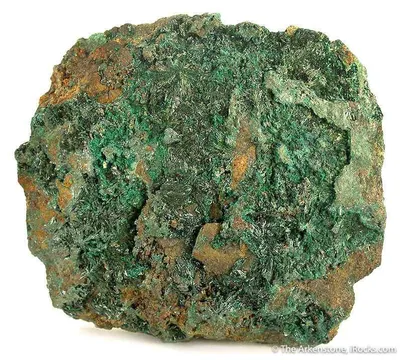
The best specimen-producing material appears to have come from the oxidized orebody, old sulfate-rich exposures, seams in bleached porphyry, and shallow borderland zones where evaporation and acid-sulfate chemistry created narrow mineralogical niches. Antlerite occurs as deep green veinlets, sparkling crusts, and crystals on matrix, including material associated with kröhnkite, gypsum, marshite, cuprite, leightonite, and natrochalcite. Leightonite was reported from shallow east and west sides of the open pit near the south end, generally within about fifty yards of the original surface and in lower-acidity borderland material rather than rich ore. Salesite was described from the south end of the oxidized ore body. Sampleite, libethenite, pseudomalachite, atacamite, chrysocolla, gypsum, calcite, and jarosite-group minerals belong to the same broad oxidized environment, though fine examples of each are far from equally available.
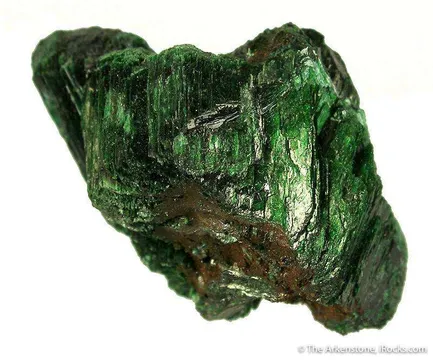
Antlerite is Chuquicamata’s signature collector mineral: deep emerald to blue-green Cu3(SO4)(OH)4 occurring here as fibrous veinlets, cross-fiber seams, sparkling crusts, and small but sharp crystals on altered porphyry or copper ore matrix. Published locality records describe fibrous, chatoyant deep green antlerite veinlets up to about 3 cm, with the fibers arranged parallel to subparallel and normal to the vein direction; other documented specimens show lustrous crystals to about 5 mm, and dealer-described exceptional pieces include prismatic crystals up to several millimetres across on cabinet-size matrix. Associations include kröhnkite, lindgrenite, gypsum, marshite, cuprite, leightonite, and natrochalcite, but the classic look is green antlerite against bleached white to pale tan porphyry or dark copper ore. Good Chuquicamata antlerite is judged by saturation of color, luster, crystallinity, coverage, and lack of bruising: a rich plate of sharp emerald crystals or chatoyant seam material is far superior to dull, granular green sulfate staining, and old labels from established collections carry real importance because new collecting from the mine is effectively unavailable.
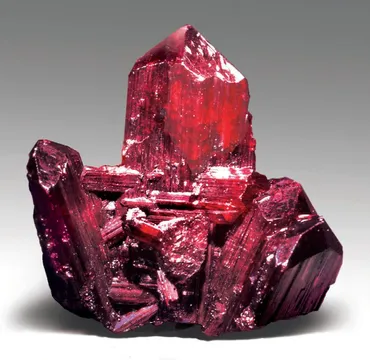
Chuquicamata is also a type-locality powerhouse. Mindat records the mine as the type locality for numerous valid mineral species, including bellingerite, cuprocopiapite, kröhnkite, leightonite, libethenite, lindgrenite, metahohmannite, natrochalcite, parabutlerite, salesite, sampleite, and ungemachite, with several modern betpakdalite- and obradovicite-group species also tied to the locality or district. Especially prized rarities include salesite, Cu(IO3)(OH), a bluish-green copper iodate named for Anaconda geologist Reno H. Sales; sampleite, NaCaCu5(PO4)4Cl · 5H2O, a pale blue to blue-green phosphate named for mine superintendent Mat Sample; natrochalcite, NaCu2(SO4)2(OH) · H2O, in glassy green crystals; and leightonite, K2Ca2Cu(SO4)4 · 2H2O, whose shallow, low-acidity occurrence at Chuquicamata was carefully noted in early mineralogical work. The broader mineral list is enormous for a copper locality, ranging from hypogene sulfides and molybdenite to atacamite, brochantite, chalcanthite, cuprite, chrysocolla, turquoise, jarosite-group minerals, rare iron sulfates, and soluble evaporite salts.
The first rule with Chuquicamata specimens is to respect the label. “Chuquicamata” has been used loosely in the trade for material from the mine proper, the Chuquicamata District, Mina Sur/Exótica, and sometimes nearby Atacama copper localities. For a serious specimen, the best labels specify Chuquicamata Mine rather than simply “Chile” or “Atacama,” and old collection provenance is especially valuable. Because the district contains many visually similar green copper sulfate and chloride minerals, visual identification alone can be weak: antlerite, brochantite, atacamite, malachite, chrysocolla, and mixed copper sulfate crusts can be confused, particularly on small specimens. Rare species such as salesite, sampleite, natrochalcite, leightonite, and ungemachite deserve analytical confirmation if the specimen is valuable.
No major, locality-specific tradition of fabricated Chuquicamata antlerite is well established in the classic literature, but misidentification is common enough to matter. Bright green copper minerals from desert copper deposits are frequently sold under more attractive names, and modern online “antlerite” listings can include material that does not resemble documented Chuquicamata habits. Be cautious with intensely colored, non-matrix, novelty-looking green clusters; with specimens lacking any old label or credible dealer history; and with pieces whose habit suggests dyed gypsum, synthetic copper salts, or another copper mineral. Genuine Chuquicamata antlerite normally shows a coherent ore or porphyry matrix, vein-controlled growth, microcrystalline to small-prismatic habit, and a color range from deep emerald to slightly bluish green rather than artificial neon.
Condition is a serious issue. Many Chuquicamata minerals are soft, brittle, or water-sensitive. Chalcanthite and other soluble sulfates should never be washed, soaked, or stored in fluctuating humidity. Even relatively stable antlerite can sit on crumbly altered porphyry, friable sulfate crusts, or delicate microcrystals that abrade easily. Old cabinet pieces often show edge rubbing, bruised crystal tips, powdering matrix, and losses along seam faces where the specimen was trimmed from ore. Store sulfate-rich specimens dry, avoid direct sunlight and heat, and keep them away from high humidity cycles. Do not test with acids or water on collectible surfaces; such tests can permanently damage the very minerals that make the locality important.
Fine Chuquicamata antlerite remains available but not common. Ordinary green vein material appears periodically, while rich, lustrous, well-crystallized cabinet pieces with old provenance are scarcer and increasingly desirable. The market for Chuquicamata rarities is narrower but more demanding: salesite, sampleite, natrochalcite, leightonite, cuprocopiapite, and other type-locality species attract collectors who value locality and species significance over showiness. For those minerals, small but verified specimens are often preferable to larger, uncertain pieces. The best purchases are specimens with old labels, analytical notes, ex-institutional provenance, or a recognized dealer trail.
Long before the benches, haul roads, concentrators, and maps, Chuquicamata was a place where people dug copper out of desert hills with wood and stone. Codelco’s historical account preserves the vivid old term “charqui de cobre,” native copper found in the rocks at shallow depth and worked by Atacameño miners. The phrase is wonderfully physical: copper imagined like dried meat, pulled from the hill in tough natural pieces rather than blasted from an orebody. In a modern mineral cabinet, a bright antlerite seam may look delicate; in the earliest mining story at Chuquicamata, copper was a substance that could be pried, hammered, and carried.
The most haunting episode is the discovery of the “Copper Man” in 1899. In the old La Restauradora mine, a prehistoric miner was found mummified after a rockfall had sealed him in the workings. The Atacama climate preserved what the collapse had taken. Later accounts date the miner to more than 1,500 years ago, around the sixth century A.D., making him a human witness to copper extraction at Chuquicamata long before the mine became an industrial symbol of Chile. For collectors, that story gives the locality a depth few copper mines possess: the same oxidized copper system that produced antlerite, kröhnkite, salesite, and sampleite had already drawn miners underground more than a millennium before mineral species were named.
The modern mine began with a different kind of drama: finance, metallurgy, and scale. Albert C. Burrage recognized that the low-grade oxidized copper material, dismissed by older standards, could become an industrial prize if treated at scale. He obtained authorization for a metallurgical plant of 250 tons per day but lacked the capital to carry the scheme alone. The Guggenheim brothers took up the challenge, consolidated claims, and organized the Chile Exploration Company. In 1913 the company was authorized to operate and began building the oxide plant, smelter, electrolytic house, and leaching facilities that would turn desert copper into a twentieth-century industry.
The official inauguration on May 18, 1915, had the theatricality of a new age. President Ramón Barros Luco did not stand at the pit to throw a switch by hand. From La Moneda in Santiago he sent the signal by telegraph, activating the Tocopilla power station and setting the Chuquicamata works into motion from afar. It is easy to miss how modern that must have felt: a desert deposit, a coastal power system, a capital-city signal, and a global copper market suddenly joined in one gesture.
Chuquicamata’s later story includes one of the strangest civic consequences of mining scale: the mine consumed the town that served it. The camp of Chuquicamata grew beside the operation, but the pit, waste rock, dust, gases, and smelter environment eventually pressed too close. Beginning in 2004, residents were relocated to Calama, about 15 kilometers away. More than 5,000 homes were built for families, and by September 2007 the town was officially abandoned. Satellite images now show what old residents already knew emotionally: the mine expanded not only through rock but through memory, leaving a ghost town at the edge of the waste dumps.
The transition underground is the latest chapter in the same long pattern of reinvention. A mine famous for its immense open pit began changing into a block-caving operation, with the first phase inaugurated in August 2019. For specimen collectors this has a bittersweet consequence. The old oxidation zones that made Chuquicamata famous were exposed by open-pit mining and earlier workings; the new underground mine is built for production, not collecting. The locality lives on in specimens already saved: green antlerite seams from bleached porphyry, rare blue-green salts in old drawers, and type-mineral labels that carry the name of a desert mine whose mineralogical story is much larger than copper tonnage.