Chañarcillo Mining District, Chile - renowned for high-grade silver minerals at specimen quality, especially proustite on calcite, plus native silver and sulfi…
Key facts
Chañarcillo is one of the great old silver names in mineral collecting: a desert district south of Copiapó where rich nineteenth-century workings yielded the ruby-silver specimens that made Chile a fixture in classic European and American cabinets. The district is not simply famous for silver ore; it is famous for silver minerals at specimen quality—especially proustite in lustrous, deep red crystals on pale calcite, together with native silver, acanthite, chlorargyrite and bromargyrite, iodargyrite, pyrargyrite, polybasite, pearceite, stephanite, and rarer mercury- and arsenic-bearing species.
Geologically, Chañarcillo belongs to the silver districts of the southern Atacama Desert, where mineralized veins and mantos cut Early Cretaceous sedimentary and volcanic sequences. The classic ore field is developed in interbedded limestones, tuffs, and volcanic rocks, with mineralization concentrated along fractures and favorable carbonate horizons. Older interpretations treated Chañarcillo as a textbook case of supergene silver enrichment beneath a rich oxidized zone; later work argued that much of the high-grade silver sulfide suite is better understood as hypogene vertical zoning in a native Ag-Co-Ni-As style system. For collectors, that debate matters because the district’s mineral suite bridges both worlds: oxidized-zone silver halides and secondary copper minerals above, and deeper ruby silvers, native silver, arsenides, sulfides, and sulfosalts below.
The best Chañarcillo specimens have an unmistakable nineteenth-century look. Proustite occurs as glossy scarlet to dark cherry-red prisms and scalenohedra, commonly perched on white to gray calcite or in calcite-lined openings; fine crystals over several centimeters are among the world standards for the species. Native silver may form sculptural wires, feathers, herringbone aggregates, and spinel-twinned forms, often dusted or replaced by black acanthite. Chlorargyrite and bromian chlorargyrite appear as waxy yellowish, greenish, brown, or gray crusts and microcrystalline sheets—the “horn silver” ore that helped make the discovery famous. Chañarcillo pieces are almost always old, and their labels can be as important as the minerals themselves.
Regional View
Country View

Photo: Wikimedia Commons

Photo: Wikimedia Commons
The district’s importance goes beyond mineralogy. Juan Godoy’s 1832 discovery triggered the Chilean silver boom and transformed Copiapó and Atacama during the young republic’s formative decades. Mines such as La Descubridora, Dolores, Colorada, Delirio, San Francisco, San José, Desempeño, San Francisquito, Manto de Cobo, and others entered the classic literature, and Chañarcillo specimens passed into the great public collections of Europe and North America during the same period when the district was financing railways, smelting, urban growth, and a mining culture that still shapes northern Chile.
Search for specimens: View all specimens from Chañarcillo Mining District, Chile
Chañarcillo lies in the Atacama Region of northern Chile, in Copiapó Province, roughly 50 km south of Copiapó in a direct line and about 70 km by road. The historic settlement of Juan Godoy grew at the foot of the mining hill, and today the site is an abandoned mining camp and ghost-town landscape of mine openings, dumps, ruined walls, foundations, tracks, and cemetery remains. Elevations in the old district are modest by Andean standards, around 880 m, but the collecting environment is true Atacama Desert: dry, exposed, remote, and historically overworked.
The deposit is a high-grade silver vein-and-manto district developed in a Cretaceous back-arc volcano-sedimentary belt. The ore field is hosted chiefly by interbedded limestones, calcareous sediments, tuffs, and volcanic rocks, with local skarn development near intrusive contacts in the broader district. Ore shoots occurred both in steep veins and in mantos where mineralizing fluids exploited reactive carbonate beds. Historic descriptions emphasize north- to northeast-trending fractures associated with doming, as well as crosscutting northwest faults; later summaries describe silver mineralization in veins and mantos rather than a single mine or lode.
The primary and enriched assemblage is one of the reasons Chañarcillo remains a collector locality rather than merely an old mining district. Hypogene stages reported for the district include calcite, barite, siderite, quartz, pyrite, sphalerite, proustite, chalcopyrite, galena, arsenopyrite, skutterudite, and several silver sulfosalts. The oxidized and halide zone produced the waxy silver chlorides, bromides, and iodides—chlorargyrite, bromargyrite, bromian chlorargyrite, iodargyrite, and related mixtures—that made the earliest ore spectacularly rich. Deeper and less oxidized parts yielded acanthite, native silver, ruby silvers, polybasite-pearceite series minerals, stephanite, and rare mercury-bearing phases.
Chañarcillo was discovered on 16 May 1832 by Juan Godoy, with his brother José Godoy and the Copiapó businessman Miguel Gallo tied to the first mining claim, La Descubridora. By 1833, more than 20 tonnes of silver from Chañarcillo were reportedly reaching Copiapó smelters. The boom was fast: by 1839 a dozen productive mines employed hundreds of workers, and by the early 1850s the district contained well over a hundred producing or registered mines, though only a minority were profitable at any given time. The most famous bonanza names include La Descubridora, Dolores, Delirio, Colorada, San Francisco, and San José.
Production rose and fell in sharp pulses as bonanza shoots were found, exhausted, and replaced by new workings. The Colorada mine gave the district an important renewal in 1838. In 1851, La Descubridora, Delirio, San Francisco, and San José were described as exceptionally rich. A railway connection between Pabellón and Chañarcillo was built in the mid-1850s and converted to steam operation by 1860; by 1865, three trains a day were reportedly carrying ore down from Chañarcillo. The district reached one of its statistical high points in 1869, when fine-silver production was recorded at more than 43 tonnes and the workforce approached 1,800 people. By the 1870s production was already uneven, and after the richest ore shoots failed, the old camp entered a long decline. By the early twentieth century, traditional Chañarcillo production was minor, with only small-scale miners and later dump reworking remaining.
For specimens, the critical collecting window was the nineteenth century, especially the period of intensive underground mining from the 1830s through the 1870s. The finest proustites are traditionally associated with the Dolores mine, particularly Dolores 1 and related Dolores workings, but old labels are often vague and many museum pieces simply say “Chañarcillo.” This ambiguity is not a defect so much as a fact of the locality: specimens were extracted during active mining, traded through dealers and scientific networks, and dispersed long before modern locality documentation became standard. Many classic pieces now in museums were collected before 1880.
Access today should be treated as restricted and historically sensitive. The district is abandoned in the sense that the old town and many nineteenth-century workings are ruins, but the area has seen later prospecting and dump reprocessing, and mining claims or operator rights may apply. Underground entries, stopes, shafts, and old dumps are dangerous, and Chañarcillo is also a heritage landscape tied to Chilean mining history. Modern collecting is not comparable to working an open public collecting site; serious collectors should expect nearly all legitimate specimens to come from old collections, museum deaccessions, or established dealers with credible provenance.
Chañarcillo proustite is the district’s signature mineral and one of the global standards for the species: translucent to subtranslucent ruby-red, scarlet, cherry-red, or dark claret crystals in sharp prismatic, scalenohedral, and complex rhombohedral forms, commonly on white to gray calcite and sometimes associated with chalcopyrite, galena, acanthite, palygorskite, and rare fettelite. The greatest specimens are old Dolores-type pieces with lustrous, undamaged, well-terminated crystals standing proud of contrasting calcite; crystals exceeding 5 cm are legendary cabinet minerals, and nineteenth-century accounts and later collector literature record examples over 9 cm. Ordinary Chañarcillo proustite tends to be massive, bruised, very dark from exposure, or poorly isolated; exceptional pieces retain vivid red internal color, bright faces, matrix contrast, and an early provenance.
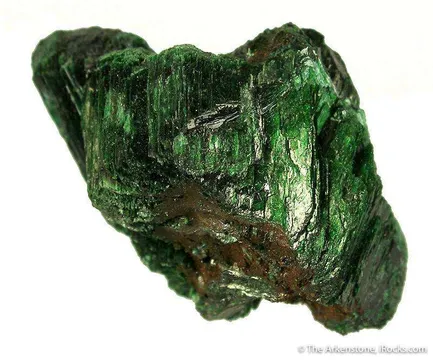
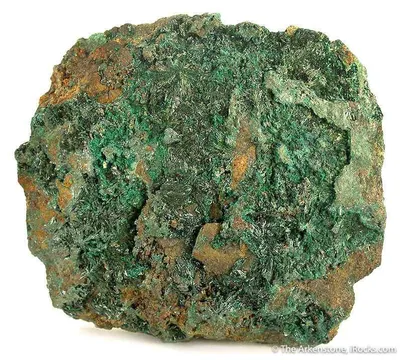
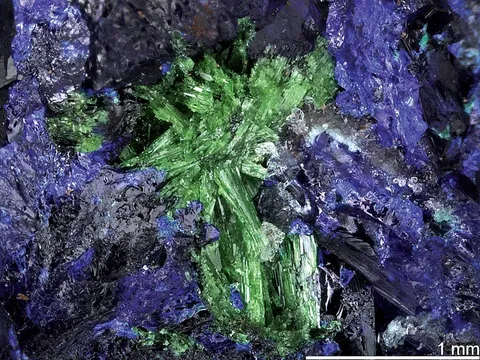
Atacamite from the Chañarcillo district belongs to the oxidized copper-bearing overprint rather than the main ruby-silver suite, and it is best understood in the context of the district’s arid chloride chemistry and old references to “atlasite,” a historic mixture involving atacamite and azurite from Chañarcillo. Collectible pieces are typically green, acicular to prismatic, drusy, or radiating aggregates on pale altered matrix, with the better specimens showing saturated color, sparkle, and discrete crystals rather than dull powdery coatings. Because fine Chilean atacamite is much more abundant from other Atacama localities, especially copper districts and mines north of Chañarcillo, strong provenance matters here: the best Chañarcillo-attributed pieces are those with old labels or clearly documented district association rather than generic “Atacama” labels.
Native silver from Chañarcillo ranges from massive ore and rich seams to elegant crystallized specimens, including wires, feathers, arborescent forms, spinel-twinned growths, herringbone aggregates, and compact metallic masses. It is commonly associated with acanthite, calcite, quartz, chlorargyrite, bromargyrite, arsenopyrite, and other silver sulfosalts, and some specimens show black acanthite dusting or partial replacement that gives the metal a mottled antique surface. The finest pieces combine recognizable crystallography or sculptural wire form with matrix and old provenance; loose bright wires are attractive, but Chañarcillo silvers with calcite or ore matrix, acanthite association, and a nineteenth-century label are much more desirable.
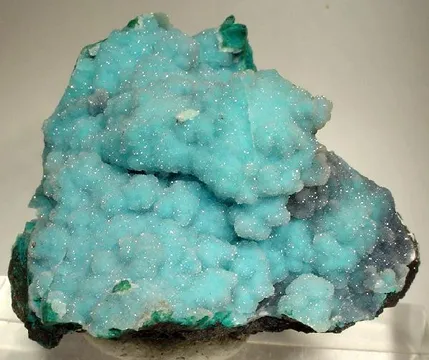
Chrysocolla at Chañarcillo is a secondary copper mineral from oxidized pockets and copper-bearing portions of the district, especially noted from Manto de Cobo–type material where it occurs with quartz, conichalcite, and bromian chlorargyrite. It is not the classic Chañarcillo show mineral in the way proustite is, but good examples can be attractive as blue-green to green globular, crustiform, or botryoidal coatings on siliceous matrix. The most collectible pieces are those that preserve a clear Chañarcillo mine attribution and show contrast with quartz, pale arsenate coatings, or silver-halide minerals; amorphous blue-green stains without locality documentation are much less convincing and should be valued cautiously.
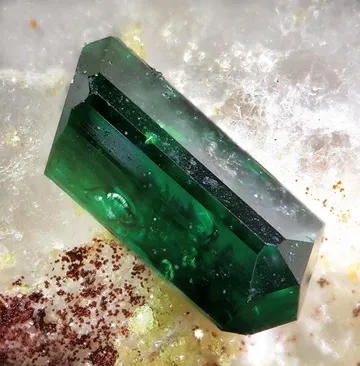
Rodalquilarite attributed to Chañarcillo should be approached with particular care, because the best-known Chilean rodalquilarite specimens with alunite and quartz are classic products of the Wendy open pit at the Tambo mine in the El Indio district, not the nineteenth-century Chañarcillo silver camp. Where Chañarcillo appears on a specimen label or database entry, the collector should look for analytical confirmation, label history, and a coherent paragenesis before accepting the locality. The expected appearance of legitimate rodalquilarite-quality material is olive to vivid green acicular or prismatic microcrystals, commonly in crusts or sprays on altered quartz-alunite matrix; visually attractive clusters with sharp terminations, intense green color, and verified provenance separate good pieces from mere green tellurate coatings or mislocalized El Indio material.
Chlorargyrite, including bromian chlorargyrite traditionally called embolite, is central to Chañarcillo’s early ore story: waxy, hornlike AgCl and Ag(Cl,Br) masses, crusts, and microcrystalline sheets were among the rich oxidized silver ores first worked after the 1832 discovery. Collector specimens are usually yellowish, olive-green, brown, gray, or darkened from exposure, and they may occur with bromargyrite, iodargyrite, native silver, quartz, calcite, limonite, and acanthite. The finest pieces show abundant waxy luster, visible microcrystals or octahedral forms, coverage on matrix, and an old label naming Chañarcillo, Descubridora, Colorada, Desempeño, San Francisquito, or another district mine; plain earthy horn-silver ore is historically interesting but less aesthetic.
Acanthite from Chañarcillo occurs as black to dark metallic Ag2S in crystals, granular coatings, replacements, and rich ore masses, often with native silver, calcite, quartz, polybasite, pearceite, proustite, and arsenate or halide minerals. It is an important member of the deeper silver assemblage and also appears as peppering on native silver feathers and wires, giving many old specimens their darkened, contrasty surfaces. Fine acanthite specimens from Chañarcillo are less commonly seen than proustite or horn-silver ore; the best examples show distinct metallic crystals or rich three-dimensional silver ore with meaningful associations, rather than indistinct black sulfide masses without matrix or provenance.
Quartz at Chañarcillo is primarily a gangue and pocket mineral rather than a standalone show species, but it is important in the district’s silver paragenesis and appears with native silver, acanthite, chlorargyrite-bromargyrite, proustite-pyrargyrite series minerals, and secondary copper minerals. Collectors should expect small colorless to milky crystals, drusy coatings, vein quartz, and siliceous matrix rather than large alpine-style crystals. The best Chañarcillo quartz specimens are valued because quartz frames a significant silver mineral—silver herringbones on quartz, bromian chlorargyrite on quartz, or ruby-silver crystals with quartz-calcite gangue—so clarity and crystal size matter less than paragenetic context and documented mine attribution.
Alunite attributed to Chañarcillo is a minor alteration mineral and should be evaluated in light of the broader Atacama desert oxidation and acid-sulfate alteration environment, not as a common classic Chañarcillo cabinet species. Specimens are most likely to appear as pale, yellowish, cream, or whitish crusts, fine druses, or coatings on altered matrix, sometimes confused in commerce with clay, jarosite, gypsum, or other pale secondary minerals. As with rodalquilarite, collectors should scrutinize labels carefully because fine Chilean alunite associations are better known from other districts; Chañarcillo examples are most compelling when tied to a specific old mine, accompanied by analytical support, or associated with the district’s recognized silver-halide and oxidized copper suite.
Beyond these species, Chañarcillo is documented for an unusually rich silver-district list: bromargyrite, iodargyrite, pyrargyrite, polybasite, pearceite, stephanite, miargyrite, xanthoconite, dyscrasite, domeykite, arsenopyrite, skutterudite, galena, sphalerite, chalcopyrite, pyrite, cinnabar, native arsenic, native copper, cuprite, malachite, conichalcite, calcite, dolomite, siderite, barite, gypsum, palygorskite, actinolite, diopside, garnet-group minerals, scapolite, and wollastonite. The district is also the type locality for adamite, first described from Chañarcillo in the 1860s, though modern collectors know the species far better from later prolific localities such as Ojuela, Mapimí. Rare or historically problematic Chañarcillo names include tocornalite, an obscure photosensitive silver-mercury iodide material described from the district and later revisited by Smithsonian work, and “chañarcillite,” an old silver-arsenic-antimony name now treated as a non-current or mixture-style term rather than a routine valid collector species. Fettelite is especially noteworthy: a structurally complex silver-mercury arsenic sulfosalt recognized on old Chañarcillo proustite specimens, where it occurs as dark red metallic plates and flakes, demonstrating that even long-held museum proustites from the district can still yield mineralogical surprises.
Chañarcillo is an old-label locality. The most desirable specimens—especially proustite, native silver, bromian chlorargyrite, and acanthite—usually come from nineteenth-century or early twentieth-century collections, and precise mine names are often absent. A label reading only “Chañarcillo” is normal for genuine old material; a highly specific mine attribution, such as Dolores, Descubridora, Colorada, or Manto de Cobo, is valuable but should be judged by label age, collection history, and specimen style.
Proustite is the chief condition risk. It is soft, brittle, and famously photosensitive: prolonged bright light darkens and dulls the red color, gradually turning fine crystals toward brownish, gray, or blackened surfaces. Store proustite in darkness, display it only briefly under low-intensity lighting, and avoid warm display cases. Edge bruising, cleaved tips, and surface dullness are common on Chañarcillo proustite because many specimens were mined, trimmed, and transported long before modern preparation standards. Fine color in transmitted light, intact terminations, and bright original luster justify major premiums.
Native silver specimens are less light-sensitive but still vulnerable. Wires and feathers bend easily, and cleaning can destroy the old surface that gives Chañarcillo silvers their character. Avoid aggressive chemical brightening: a shiny, unnaturally white silver surface may look new but can remove acanthite, halide crusts, or old patina and may reduce historical value. Matrix-attached silvers from Chañarcillo are scarcer than loose wires or rich ore fragments and deserve conservative handling.
Silver halides are another special case. Chlorargyrite, bromargyrite, iodargyrite, and mixed halide specimens can darken under light, and some are soft, waxy, and easily scratched. Greenish to yellow-brown bromian chlorargyrite crusts may be visually subtle but historically important; do not dismiss them because they lack the sparkle of proustite. Conversely, verify that a “chlorargyrite from Chañarcillo” is not simply an unattributed horn-silver ore from another Chilean or Australian locality.
Mislabelling is a real concern. “Atacama” and “Chañarcillo” are sometimes loosely used in the trade, and Chilean specimens from Caracoles, Tres Puntas, Inca de Oro, El Indio, Tierra Amarilla, and other districts can be confused with or casually folded into Chañarcillo. This is particularly important for atacamite, alunite, chrysocolla, and rodalquilarite, because comparable or superior Chilean material is well known outside Chañarcillo. Rodalquilarite with alunite and quartz, in particular, should be checked carefully for possible El Indio/Tambo origin.
Market availability is uneven. Small proustites and silver specimens appear periodically, but top-tier Chañarcillo proustite—large, bright, undamaged, red, and on matrix—is a major classic and is rarely inexpensive. Bromian chlorargyrite, acanthite, and native silver can be more accessible, but fine historic examples with labels from important collections can command strong prices. Pieces with old handwritten labels, museum numbers, or provenance to classic European, American, or Chilean collections should be preserved with their documentation; for Chañarcillo, the paper trail is part of the specimen.
Juan Godoy’s discovery story has been told so many times that it sits halfway between mining record and desert folklore. The hard date is 16 May 1832; the setting is the arid ground south of Copiapó; the first claim followed three days later, on 19 May, when Miguel Gallo, Juan Godoy, and José Godoy appeared before the mining judge in Copiapó to register a vein of silver-bearing ore in the Chañarcillo hills. Around that fixed legal act, Atacama memory built several competing versions. In one, Godoy was hunting guanacos and rested near an outcrop, where an unusually heavy stone or waxy vein material betrayed the silver. In another, the real keeper of the secret was his mother, Flora Normilla, an Indigenous woman of the Copiapó valley, who is said to have known the location and revealed it to her son near the end of her life, instructing him to share the fortune with Miguel Gallo. A more folkloric telling gives the desert its own supernatural agent: an alicanto or a red fox guarding the mineral, leading Godoy to the hidden wealth.
The paperwork moved faster than legend. The discoverers’ claim became La Descubridora, and within days or weeks the balance of fortune had shifted. Later accounts emphasize that Godoy, poor and illiterate, did not remain the great beneficiary of the bonanza he revealed. One Atacama historical tradition notes that only seven days after the claim, the Godoy brothers sold their two-thirds share to Gallo by an extrajudicial document, signing through others because of their literacy. Gallo and the mining families of Copiapó rose with Chañarcillo; Juan Godoy’s own life ended in poverty in La Serena in 1842. The district that carried his name—Pueblo de Juan Godoy—outlived him as both homage and irony.
Chañarcillo’s boom years were not abstract statistics; they were a sudden city of ore in the desert. By 1833, more than 20 tonnes of silver from the new district were reaching Copiapó smelters. In 1839, the district had 12 productive mines, many more idle or barren workings, and more than 500 workers. By 1842, the workforce had risen again, scattered through roughly a hundred labores, though only a small fraction were truly productive. The mining population lived with sharp social controls as well as opportunity: in 1837, entry of women to Chañarcillo was restricted unless permitted by a father, husband, or brother. The camp then burned in 1847 and was rebuilt on a more planned layout, an early sign that the place had become more than a rush—it had become an institution.
The railway gave Chañarcillo a second kind of drama: movement. The Pabellón-Chañarcillo line was built in the mid-1850s, experimented with steam power in 1858, and converted fully to steam operation by 1860. By 1865, three ore trains a day were reportedly descending from Chañarcillo, and a telegraph line connected the district with Carrizal Alto. A mail coach between La Serena and Chañarcillo took five days for a letter. These details matter because they show how a mineral locality became infrastructure: ruby-silver pockets underground, ore cars and smelters above, trains pulling Atacama silver into the economy of the Chilean republic.
The peak statistics are almost cinematic. In 1869, Chañarcillo produced 43,747 kg of fine silver, about 1.76 percent of world production for that year, with an average workforce of 1,796 people. In 1870, 63 mines were operating with 1,570 workers and produced about 30.4 tonnes of fine silver. But the decline was already written into the ore shoots. The great Delirio mine, one of the names repeatedly associated with extraordinary wealth, was exhausted and closed in 1875. Production figures in the early 1870s swung downward and upward unpredictably, then weakened. By 1907, the old Chañarcillo mines produced only about 52 kg of fine silver, while activity had shifted toward nearby Bandurrias. By 1913, the district was largely the province of pirquineros—small miners working what the bonanza era had left behind.
One of the most enduring Chañarcillo stories is not a discovery underground but a rediscovery in a museum. In the twenty-first century, researchers studying old Chañarcillo proustite in the Harvard Mineralogical Museum identified fettelite, a rare silver-mercury arsenic sulfosalt, on the proustite crystals. It occurred as dark red metallic plates up to 1 cm and as tiny ruby-colored flakes on palygorskite over a druse of centimeter-scale scalenohedral proustite. The specimen’s exact mine was not recorded—typical for old Chañarcillo material—and the authors cautioned that although the Dolores mine is often cited for the finest proustites, there was no proof that the Harvard specimen came from Dolores rather than one of more than a hundred mines in the area. That is classic Chañarcillo in miniature: breathtaking mineralogy, historic ambiguity, and the possibility that a specimen sitting quietly in a museum drawer still has something new to say.