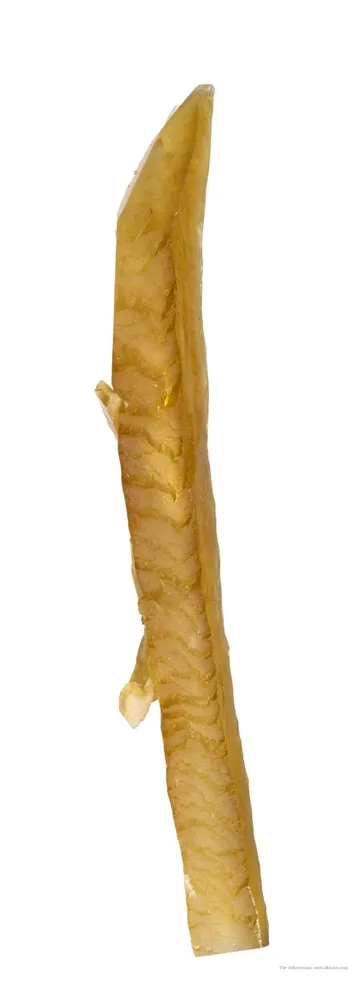
Hunan, China - Nanling belt mining province producing striking fluorite, quartz, calcite and antimony at Yaogangxian and Xikuangshan; highly prized by collecto…
Key facts
Hunan is not a single-pocket locality in the collector’s sense; it is a mineral province whose best specimens come from a chain of world-class ore systems in the Nanling metallogenic belt of South China. For collectors, the name “Hunan” most often points to southern Hunan’s granite-related tungsten, tin, beryllium, fluorine, lead-zinc, and polymetallic deposits: Yaogangxian at Yizhang, Shangbao near Leiyang, Xianghualing and Xianghuapu in Linwu County, Huangshaping near Guiyang, and, farther north, the legendary Xikuangshan antimony district. The geological setting is the key to the look of the specimens. Late Mesozoic granites intruded Paleozoic carbonate and clastic rocks, driving quartz-vein, greisen, skarn, carbonate-replacement, and later hydrothermal vein systems. In cabinet terms, that means fluorite, quartz, calcite, pyrite, scheelite, ferberite, cassiterite, bournonite, arsenopyrite, chalcopyrite, dolomite, stibnite, and rare Be-Li-Sn minerals in combinations that can be both scientifically layered and visually theatrical.
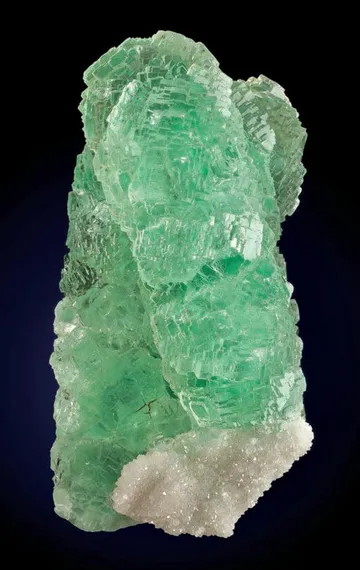
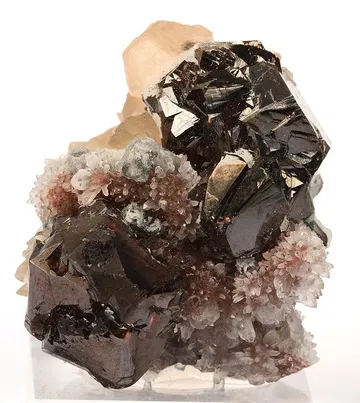
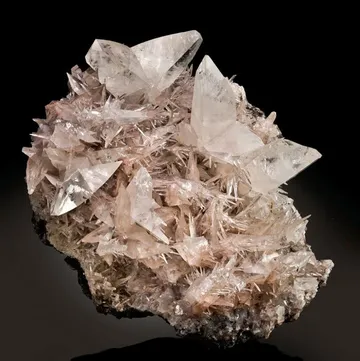
The finest Hunan specimens are immediately recognizable. Yaogangxian pieces may show purple or blue-green fluorite cubes and cuboctahedra perched on glittering quartz, black ferberite blades, scheelite, bournonite, muscovite, and delicate white to pale pink calcite. Shangbao fluorites tend toward stepped, architectural cubes and cuboctahedra, often internally zoned in sea-green, lavender, violet, and purple, set on white dolomite, quartz, pyrite, or calcite. Xikuangshan contributes the stark antimony aesthetic: steel-gray stibnite blades with calcite and quartz. Xianghualing adds a different register—gemmy fluorite and one of China’s most interesting rare-element skarn suites, including several type-locality minerals tied to Li, Be, Sn, and Al-rich assemblages.
Regional View
Country View
Historically, Hunan’s specimen reputation rose with the broader arrival of Chinese fine minerals on Western markets in the late twentieth century. Yaogangxian had been mined as a tungsten deposit since 1914, long before most collectors outside China knew its fluorites and bournonites. Shangbao, once known on older labels as the Shangbao Pyrite Mine, became a modern fluorite classic through relatively limited pocket production rather than through great industrial scale. Xianghualing was already mineralogically important through its rare Be-Li-Sn skarn minerals. Together these districts made Hunan one of the few regions where a serious collector can build not just a “China” suite, but a coherent geological suite: skarn fluorites, quartz-vein tungsten assemblages, carbonate-hosted antimony ores, and type-locality rare minerals from one province.

Photo: Wikimedia Commons

Photo: Wikimedia Commons
Search for specimens: View all specimens from Hunan, China
Hunan’s collector mineralogy is dominated by two overlapping stories: southern Hunan’s Nanling tungsten-tin-polymetallic belt and central Hunan’s antimony mineralization. In the south, granite intrusions and their contact zones created quartz-vein wolframite systems, scheelite skarns, greisen-style tin-tungsten mineralization, fluorite-bearing hydrothermal cavities, and polymetallic sulfide assemblages. Yaogangxian is the best-known example, with quartz-vein W-Sn mineralization and associated skarn mineralization in the contact aureole of the Yaogangxian pluton. Shangbao represents a skarn and hydrothermal polymetallic setting at carbonate–granite contacts. Xianghualing is a Sn-W-Be-Li rare-metal skarn and granite system around the Laiziling granite. Huangshaping is a W-Mo-Cu-Pb-Zn polymetallic skarn and vein/replacement system. These are not interchangeable localities, but they share the regional grammar of fluorine-rich, metal-rich hydrothermal fluids moving through fractured, chemically reactive rocks.
Yaogangxian is the anchor locality for many Western collectors. The mine lies in Yizhang County, Chenzhou, within the Yaogangxian W-Sn ore field. Its classic specimen zones are tied chiefly to wolframite-bearing quartz veins, with mineralization also developed in skarn bodies. The mine field includes vein systems grouped into ore blocks such as Yangmeiling, Luchangping, and Hamashi, while the Heshangtan skarn-type tungsten-tin deposit forms a second important style. Yaogangxian’s ore and specimen assemblage includes ferberite and other wolframite-series minerals, scheelite, cassiterite, arsenopyrite, fluorite, quartz, calcite, muscovite, chalcopyrite, pyrite, bournonite, boulangerite, stannite-group minerals, bismuthinite, dolomite, rhodochrosite, and numerous rarer species. The best collector pieces are not simply “fluorite from China”; they are paragenetic vignettes in which tungsten ore, late fluorite, carbonate, sulfide, and quartz stages can often be read visually.
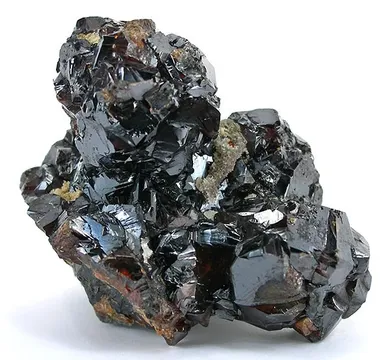
Shangbao lies near Leiyang in Hengyang and appears on older labels as Shangbao Pyrite Mine. Its ore history involved iron, pyrite, tungsten, tin, niobium, tantalum, and associated polymetallic mineralization, but its collector identity rests on fluorite. The deposit is a skarn-type polymetallic system developed where Carboniferous–Permian carbonate rocks were altered near a Jurassic granite stock. Fluorite occurs with dolomite, quartz, calcite, pyrite, chalcopyrite, sphalerite, bismuthinite, cassiterite, scheelite, and skarn minerals. The most prized pockets produced modified cubic to cuboctahedral fluorite with stepped faces and internal zoning. A notable late-2000s production, especially the 2008 fluorite-dolomite-quartz material described by collectors and field visitors, fixed Shangbao as one of the essential modern Chinese fluorite localities.
Xianghualing, in Linwu County, is both a specimen fluorite district and a rare-mineral locality of real mineralogical consequence. The Xianghualing skarn developed around the Laiziling granite and within carbonate rocks of the Qiziqiao Formation. Rare-element mineralization there involves Li, Be, Sn, W, Nb, Ta, and fluorine, and the skarn is described in the literature as banded or “ribbon” material with light fluorite-rich layers and darker Fe- and Be-rich layers. This locality is the source of type minerals such as hsianghualite, liberite, ferrotaaffeite-2N′2S, mengxianminite, and chukochenite. For collectors, Xianghualing material can range from showy fluorite and calcite combinations to rare species that belong more in a systematic cabinet than a display case.
Huangshaping, near Guiyang County in Chenzhou, is another major southern Hunan polymetallic system. Its W-Mo-Cu-Pb-Zn mineralization is associated with skarn systems at contacts between late Mesozoic granitoids and Carboniferous carbonate rocks. It is less famous among casual collectors than Yaogangxian or Shangbao, but it matters because it expresses the same regional metallogenic richness in a more overtly polymetallic style. Fluorite, quartz, calcite, garnet, actinolite, scheelite, sulfides, and related gangue minerals are tied to the skarn and hydrothermal history of the deposit.
Xikuangshan, in Lengshuijiang, Loudi, belongs to a different collector tradition. It is the great Hunan antimony name: a giant Sb deposit famous for stibnite with calcite and quartz. The ore assemblage is comparatively simple beside the Nanling rare-metal systems, but its specimens can be dramatic—metallic stibnite blades, radiating groups, and calcite-rich vein material. The district’s mineralization includes early quartz-stibnite, fluorite-quartz-stibnite, and barite-quartz-stibnite veins, followed by later calcite-stibnite veins with minor quartz.
Mining access today varies by district but should not be treated casually. These are industrial mines, historical workings, tourist-adjacent sites, or restricted properties—not open recreational collecting grounds. Yaogangxian is a major underground mining operation, and specimens have typically reached the market through miners, local recovery, Chinese dealers, old stocks, and international dealers rather than through collector field trips. Shangbao has been described as a small former mine associated with the Cailun Bamboo Sea tourism area and as a locality where major modern specimen production is not ongoing. Xikuangshan is an industrial and historically important antimony district. Any access would require explicit local permission and current safety clearance; old adits, dumps, and mine infrastructure should not be assumed safe or legal.
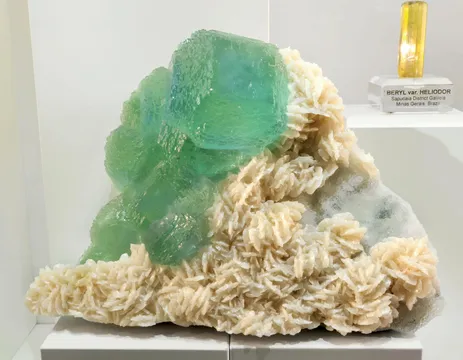
Calcite from Hunan is best collected by mine, not merely by province. Yaogangxian produces the most familiar collector calcite in white to pale pink “poker-chip” stacks, bladed rosettes, flattened rhombohedra, pagoda-like aggregates, and sharper scalenohedral or rhombohedral forms perched on fluorite, quartz, ferberite, scheelite, muscovite, pyrite, and chalcopyrite; the most desirable pieces use calcite as an architectural accent rather than a chalky crust, especially pale pink manganese-bearing calcite on quartz or delicate white discs contrasting with violet or blue-green fluorite. Shangbao calcite occurs with fluorite, dolomite, quartz, and pyrite, and Mindat records crystals to unusually large sizes for the locality, though most fine specimens are valued for association and balance rather than sheer dimension. Xikuangshan calcite is a different collecting category, where transparent scalenohedra and “butterfly” twins may accompany stibnite in Sb-rich vein material. Across Hunan, good calcite specimens are sharp, lustrous, undamaged at the edges, and tied convincingly to a known mine and assemblage; ordinary pieces are the pale, bruised, poorly localized carbonate coatings that too often carry only a broad “Hunan” label.
Pyrite from Hunan is most famous in collector specimens from Shangbao, where brassy cubes—recorded to about 5 cm on edge—can occur with fluorite, quartz, dolomite, and calcite. The strongest Shangbao pyrites are bright, sharp, striated cubes or compound cubic clusters that provide metallic contrast to pale dolomite, greenish quartz, and transparent purple or blue-green fluorite; lesser pieces show dull, granular, oxidized, or crowded pyrite with little composition. Yaogangxian pyrite is usually an associate rather than the star, but it can be important visually on fluorite-wolframite-ferberite-quartz combinations, where small golden cubes break up the dark tungsten ore matrix. Pyrite also belongs to the broader sulfide history of Huangshaping and other polymetallic deposits, but for the display cabinet the benchmark is Shangbao: mirror-luster cubic pyrite integrated with fluorite and quartz, preferably with the mine named specifically rather than hidden under the province.
Fluorite is the mineral most likely to draw collectors to Hunan. Yaogangxian fluorite ranges from purple and lavender cubes to blue, blue-green, color-zoned, phantom, cuboctahedral, and modified forms, commonly with quartz, calcite, ferberite, scheelite, arsenopyrite, pyrite, muscovite, chalcopyrite, bournonite, or dolomite; the finest pieces combine transparency, zoning, sharp form, intact cube corners, and a meaningful tungsten-mine association. Shangbao fluorite is more architectural, with cubes, dodecahedra, octahedra, spinel twins, stepped cuboctahedral forms, and crystals recorded to about 5 cm; its best specimens show sea-green to violet zoning, purple corner phantoms, stepped growth, and clean placement on white dolomite, quartz, pyrite, or calcite. Xianghualing and Xianghuapu contribute gemmy clear to green or pale fluorite styles, while Huangshaping adds fluorite to a polymetallic skarn context. Good Hunan fluorite is not merely colorful; it has depth, zoning, readable faces, undamaged cleavage-sensitive corners, and a label precise enough to distinguish Yaogangxian, Shangbao, Xianghualing, Xianghuapu, or Huangshaping material.
Quartz from Hunan is the structural stage on which many of the province’s best minerals perform. At Yaogangxian, quartz is central to the wolframite-bearing vein system and occurs as bright drusy crusts, prismatic crystals, intergrown plates, and matrix for fluorite, bournonite, ferberite, scheelite, arsenopyrite, pyrite, sphalerite, calcite, muscovite, and sulfosalts; the finest quartz-bearing pieces are valued for contrast and composition, such as bournonite on quartz, fluorite on quartz, or black ferberite rising through clear to white quartz. Shangbao quartz includes the greenish “artichoke” style reported on some fluorite-pyrite specimens, as well as frosted to white quartz matrix with dolomite and fluorite. Xikuangshan quartz is part of stibnite-bearing vein assemblages rather than a gem-crystal locality in the usual sense. For collectors, good Hunan quartz is rarely bought as “quartz alone”; it is bought because it frames and preserves the paragenesis of a Hunan ore system, and the best specimens have clean crystallization, minimal iron staining, and associated species placed in a way that makes the geology legible.
Other documented Hunan minerals are central to the province’s importance. Yaogangxian is a modern classic for ferberite and wolframite-series specimens, scheelite, bournonite, boulangerite, arsenopyrite, cassiterite, stannite-related species, bismuthinite, chalcopyrite, muscovite, dolomite, rhodochrosite, and fluorapatite. Xikuangshan is one of the world’s great stibnite names, with the classic association of stibnite, calcite, and quartz. Xianghualing is especially important for type-locality and rare-element minerals: hsianghualite Ca3Li2Be3(SiO4)3F2, liberite Li2Be(SiO4), ferrotaaffeite-2N′2S BeFe3Al8O16, mengxianminite Ca2Sn2Mg3Al8[(BO3)(BeO4)O6]2, and chukochenite LiAl5O8 belong to the skarn’s rare Li-Be-Sn-Al mineral story. Those species are not common display minerals, but they give Hunan a systematic-mineral weight far beyond its already formidable fluorite reputation.
The most important authenticity issue with Hunan specimens is locality precision. “Hunan, China” is often true but insufficient: a Yaogangxian fluorite-calcite-quartz specimen, a Shangbao fluorite on dolomite and pyrite, a Xianghualing fluorite-calcite piece, and a Huangshaping fluorite are not equivalent in geology, rarity, or market value. Older labels may say Shangbao Pyrite Mine for Shangbao material, while Yaogangxian may be abbreviated as YGX. Xianghualing, Xianghuapu, and vaguely labelled Chenzhou fluorites can be confused in the trade. Serious buyers should ask for the mine name, county or prefecture when available, former collection history, and whether the piece came from older production, recent recovery, or dealer stock.
Fluorite condition is the chief value trap. Hunan fluorites can be glassy and transparent enough that chipped corners, bruised edges, cleaved backs, contacted faces, and repaired crystals are easy to miss in photographs. This is especially true for Yaogangxian and Shangbao cuboctahedra, where stepped faces and complex zoning can distract the eye from damage. Calcite adds another layer of vulnerability: poker-chip calcites and thin blades chip along edges, and transparent scalenohedra may show tiny cleavage bruises. Pyrite generally handles better, but Shangbao pyrite can lose value quickly if the mirror luster is dulled, oxidized, or if cubes are incomplete.
Treatments are less formally documented for the classic Hunan fine-mineral trade than for mass-market decorative minerals, but caution is still warranted. Be skeptical of unnaturally saturated pink “manganoan calcite,” improbably even color on fluorite or quartz, and specimens whose strongest color is confined to cracks or exposed surfaces. Repairs and reattachments are a more realistic concern at the fine-specimen level than dyeing: heavy fluorite crystals on narrow quartz or dolomite contacts, detached matrix pieces, and calcite sprays are all plausible repair candidates. A strong seller should disclose repairs, stabilization, trimmed bases, and any acid cleaning that may have affected calcite or sulfide surfaces.
Fluorescence varies by species and mine. Some Hunan calcite can fluoresce, and fluorite may show blue responses, but fluorescence should be treated as specimen-specific rather than assumed from locality alone. Scheelite-bearing Yaogangxian specimens should be checked under shortwave UV, where scheelite may provide a useful diagnostic response; however, UV behavior is not a substitute for mineral identification or locality proof. Avoid wet storage and harsh cleaning. Calcite is acid-sensitive, fluorite cleaves readily, sulfides can tarnish or oxidize, and stibnite from Xikuangshan should be handled carefully because fine blades are brittle and antimony sulfide dust is best avoided.
Market availability is broad but uneven. Ordinary Yaogangxian fluorite-quartz-calcite pieces remain available because decades of production and trading have supplied the market, but top old-stock specimens with fine zoning, undamaged cubes, strong ferberite or bournonite association, or pale pink calcite are increasingly selective purchases. Shangbao fluorite is common enough in modest examples, yet the finest stepped, zoned, well-composed pieces from the major production years have largely moved into collections. Xianghualing fluorites appear regularly, but precise mine attribution and condition are crucial. Xikuangshan stibnite-calcite pieces range from modest to very serious, with value tied to bright, complete stibnite crystals and undamaged calcite.
Mario Pauwels’s 2015 visit to Yaogangxian gives the mine an unusually human scale. He approached from Changsha by high-speed train to Chenzhou, then faced the harder part: finding a taxi willing to make the roughly 150-kilometer drive south through monsoon heat and rain toward the remote village of Yaogangxian, near the Guangdong border. The final part of the route wound for about 50 kilometers through mountainous country. Along the saturated red slopes he saw countless small white mounds that at first glance looked like termite hills. They were graves. The high mountains around Yaogangxian are prized burial places, and Pauwels tied the sight to the meaning he gave for the mine’s name: “close to heaven.”
The mine he reached was not a romantic pocket mine but a large working tungsten operation wrapped around a village economy. Pauwels described Hunan Yaogangxian Mining Company, under China Minmetals, as the operator, with mine buildings and conveyor belts visible from much of the village. He gave a figure of about 5,200 people employed by the mining company in a village of roughly 10,000, with only about 450 of those workers being the actual underground miners. Whether read as economics or mineral lore, the implication is sobering: the fluorites, bournonites, scheelites, calcites, and ferberites admired in collections are byproducts of an industrial ore system that has sustained an entire settlement.
Inside the mine area, Pauwels saw the kind of activity that explains why perfect specimens from Yaogangxian feel improbable. Men in rubber boots carried heavy sacks of rock on their shoulders along steep, rain-slick paths; overloaded motorbikes moved sacks around the site; miners with helmet lamps stood eating in a small food shop. He described 24 working underground levels, from level 1 at about 1,512 meters elevation down to level 24 at about 540 meters, connected by a large tunnel network. Ore and rock moved through the workings in mine carts, while the underground environment was wet enough that water dripped and ran along the walls. The mine-cart tracks, mounted on wooden sleepers, provided the best footing. With electric overhead lines feeding the carts and water everywhere, Pauwels recalled hearing crackling and seeing sparks from the wires. Looking at those conditions, he thought of a fluorite-wolframite-pyrite specimen in his own collection and wondered how anything so nearly perfect could have survived extraction there.
Shangbao offers a very different story, smaller and almost cinematic. Pauwels visited it on the same Hunan trip. The mine sits near the village of Zhushan at the edge of the Hunan Leiyang Cailun Bamboo Forest, a bamboo reserve of about 100 square kilometers where the culms can reach around 20 centimeters in diameter. From Leiyang, he still had more than 40 kilometers to cover by taxi. Before leaving town, the driver stopped at a local garage, had all the tires checked and inflated, and passed the bill to Pauwels with a look that effectively said: you wanted to go to Shangbao, didn’t you? The road followed the lower banks of the Leishui River past small worn villages and roadside rice plots, through a landscape that alternated between lush green beauty and pollution-scarred ground.
The mine’s commercial life was never as grand as its best specimens. After government prospecting in the early 1960s, it was known first as Shangbao Huang Mine and later as Shangbao Pyrite Mine. The plan to make money from iron in pyrite failed, and analysis showed the fluorite was not well suited to industrial use. The turn toward specimens came because geologists from the Geological Institute of Hunan began marketing fluorite specimens at larger Western mineral shows at a time when, in Pauwels’s account, there was essentially no domestic Chinese market for mineral specimens. In 1995 the Chinese government closed the mine; that same year it was sold to five former miners, who kept it going for specimen recovery. For China at that time, a mine held open primarily for mineral specimens was unusual.
By the time Pauwels saw Shangbao, the physical scale matched the story: about two kilometers of tunnels distributed across levels and reaching roughly 300 meters deep. The original entrance had been little more than a tunnel into a green bamboo-covered hill, but in 2010 the owners built a more formal portal with a high wall and wrought-iron gate. There were plans to combine specimen recovery with underground tourist visits connected to the bamboo forest, yet an old visitor mine cart sat rusting on rails that looked unused for years. Around the entrance and mine buildings, the waste rock still glittered with the DNA of the deposit: small fluorites, slightly iridescent pyrite cubes more than 1 cm across, and well-formed dolomite and calcite rhombohedra to about 4 cm.
The find collectors still remember from Shangbao is the 2008 fluorite-dolomite-quartz production. Pauwels described it as the best fluorite-dolomite-quartz find in the mine’s history and the discovery that put Shangbao on the world map. That is the essence of Shangbao: not a vast, continuously replenished fine-mineral machine, but a small mine whose best pockets burned briefly and brilliantly, then dispersed into collections.