






A collector's guide to Huanggang Mine, China: its geology, mining history and notable minerals, illustrated with the 761 specimens documented from this locality on EarthWonders.
Key facts
Huanggang Mine—more precisely the Huanggang or Huanggangliang Fe-Sn polymetallic deposit of Hexigten Banner, Chifeng City, Inner Mongolia—is one of the defining Chinese specimen localities of the 21st century. It is not a small vein occurrence or a single lucky pocket, but a large skarn system formed where Early Cretaceous granitic intrusions reacted with Permian carbonate and volcanic-sedimentary rocks. That geologic scale is the key to the locality’s personality: Huanggang specimens carry the look of a full ore system, with iron oxides, arsenides, sulfides, calc-silicates, fluorite, quartz, calcite, borates, and helvine-group minerals all competing for visual attention.
Collectors first came to know the locality internationally through ilvaite around 2010, when thick, black, lustrous prisms from Inner Mongolia began to appear in a quality that immediately challenged the classic European and Russian localities. The surprise did not stop there. Huanggang soon produced blue to purple and pink-red fluorites, milky and green included quartz, pink manganoan calcite, sharp arsenopyrite and löllingite, magnetite, hedenbergite and related pyroxene/amphibole-rich skarn assemblages, helvine and genthelvite, scheelite, sphalerite, and a suite of less common borates and skarn minerals. The locality’s best pieces have a modern, high-contrast look: black ilvaite against white quartz, indigo fluorite over milky quartz, pink calcite with gray glassy quartz, metallic arsenides set in fluorite, or pale scheelite rising from black magnetite.
Regional View
Country View
Huanggang is also important because its specimen history unfolded in public, during the internet age of mineral collecting. Earlier classic Chinese localities often reached Western collections through sparse labels and fragmentary stories; Huanggang material, by contrast, moved rapidly from mine to local buyers, major dealers, show reports, online galleries, and analytical discussion. The result is a locality whose finest specimens are now well recognized, but whose labels can still be frustratingly broad: Huanggang Mine, Huanggang Mines, Huanggangliang Mine, Chifeng, Keshiketeng, Hexigten Banner, and Inner Mongolia all appear in the market, sometimes with a numbered mine or shaft, sometimes without.

Photo: Wikimedia Commons

Photo: Wikimedia Commons

Photo: Wikimedia Commons
Search for specimens: View all specimens from Huanggang Mine, China
The accepted modern locality is Huanggang Fe-Sn deposit, Hexigten Banner, Chifeng City, Inner Mongolia, China. In older and trade usage it is commonly called Huanggang Mine or Huanggangliang Mine. The deposit lies in the southern Great Xing’an Range of northeastern China, within the Huanggangliang-Ganzhuermiao tin-polymetallic metallogenic belt. Its approximate coordinates are 43°36'37" N, 117°25'37" E, and the broader mine complex is spread along a long northeast-trending mineralized belt rather than concentrated in a single working.
Geologically, Huanggang is a skarn-type iron-tin-polymetallic deposit related to Yanshanian magmatic-hydrothermal activity. Granitic intrusions, including the Luotuochangliang and “204” intrusions described in the geological literature, invaded a Permian sequence that includes the Dashizhai and Huanggangliang formations. The important host rocks include andesite of the upper Dashizhai Formation and marble, sandstone, siltstone, shale, and related carbonate-bearing rocks of the Huanggangliang Formation. Metasomatism along these contacts produced garnet-diopside skarn, garnet-amphibole-biotite skarn, magnetite-rich ore, fluorite-bearing zones, quartz-calcite veins, and later sulfide assemblages.
The deposit is economically large. Published summaries describe roughly 180 million tonnes of iron ore at 38.29% Fe, 0.456 million tonnes of tin metal at 0.29% Sn, and 0.116 million tonnes of zinc metal at 1.04% Zn, with additional Pb, W, Mo, and Cu. That scale explains why the specimen output has been diverse and sustained: pockets and crystal-lined cavities were exposed not by small-scale hobby digging but by industrial work through a large skarn-ore system.
The mine is divided in the collector literature into numbered mining areas or mines, usually Nos. 1 through 7. Early field accounts described No. 1 as a source of hedenbergite, garnet, quartz, ilvaite, and fluorite; No. 2 as a source of arsenopyrite, hedenbergite, ilvaite, and prase quartz; and No. 5 as a source of calcite and fluorite. Later specimen and database records add further precision for some species, including No. 6 material for fluorite-calcite-quartz associations and No. 5 associations involving fluorite, scheelite, calcite, and arsenides. Labels that preserve the numbered mine or shaft are more useful than the many specimens that simply say “Huanggang Mines.”
The ore bodies show a real internal pattern. Classic geological descriptions place Nos. 1 to 4 Fe ore bodies along a calcareous horizon in relation to the Luotuochangliang granite, while the tin ore body occurs nearer the “204” granite. More recent work distinguishes the SK I and SK III mining areas: SK I lies closer to Luotuochangliang granite and is mainly hosted by Lower Permian andesite of the upper Dashizhai Formation, whereas SK III lies closer to the 204 granite and is mainly hosted by marble of the lower Huanggangliang Formation. SK I is dominated by iron orebodies; SK III contains more Fe-Sn and Pb-Zn orebodies and is richer in cassiterite, scheelite, molybdenite, arsenopyrite, chalcopyrite, sphalerite, and other sulfides.
The paragenesis is typical of a complex skarn system, with prograde anhydrous skarn minerals followed by hydrous skarn alteration, magnetite, oxide-stage quartz-calcite-cassiterite assemblages, arsenopyrite-pyrite-quartz-fluorite assemblages, later polymetallic sulfide-quartz assemblages, and carbonate veining. Garnet and pyroxene-rich skarn form the structural and chemical framework; magnetite and cassiterite record the ore stages; fluorite, quartz, calcite, sulfides, arsenides, and borates account for many of the display specimens.
Industrial exploitation of the iron-tin ore began in the early 1990s, with Chinese geological work already well advanced before collectors abroad knew the locality. The modern specimen story began much later, around 2010, when excellent ilvaite reached the international market and forced collectors to pay attention to a locality that had previously been obscure outside ore-geology circles. By 2011 and 2012, the output had expanded into one of the most exciting Chinese mineral stories of the decade: ilvaite, fluorite, quartz, calcite, arsenopyrite, löllingite, helvine-group minerals, garnet, and scheelite were all being recognized as significant collector species.
Collecting access should be understood as industrial-mine access, not recreational rockhounding. Huanggang is a working or historically worked mining district with controlled underground and open workings, mineral rights, mine safety restrictions, heavy equipment, and steep access roads. Most specimens have reached collectors through miners, local buyers, Chinese dealers, and international dealers. Casual collecting should not be assumed possible, and specimens offered with vague “collected by a tourist” stories deserve skepticism.
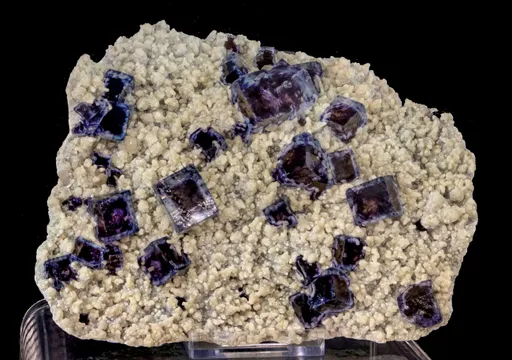
Fluorite is one of Huanggang’s signature display species and appears in several distinct styles: transparent to translucent octahedra in pink-red, purple, bluish purple, and colorless tones; dark inky blue to indigo fluorite coating milky quartz; and rounded “blueberry” or botryoidal-looking crusts that give some quartz plates a grape-like surface. The best octahedra can reach several centimeters, with well-defined edges, strong luster, visible color zoning or internal veils, and desirable associations with quartz, calcite, mica, chlorite, arsenopyrite, löllingite, helvine-group minerals, or ilvaite. No. 5 and No. 6 labels are especially desirable when credible, and the strongest pieces are those that combine undamaged octahedral form with vivid color, depth, and a sculptural matrix rather than flat crusts of small, bruised crystals.
Quartz from Huanggang is far more than a neutral matrix mineral: it is one of the locality’s defining visual anchors. It occurs as milky white crystals supporting blue or purple fluorite, as gray glassy crystals with pink manganoan calcite, as prase quartz with green amphibole inclusions, as smoky and amethystine material, and as included crystals whose dark hairlike to fibrous internal minerals made the locality important to gemological researchers. The prase and green rutilated-looking quartz from Huanggangliang owes its color to dense Ca-Fe-rich amphibole inclusions, chiefly ferro-actinolite with some ferro-hornblende, trapped during late quartz growth. Fine specimens show sharp terminations, attractive translucency, strong color contrast with fluorite or ilvaite, and minimal bruising to exposed points.
Huanggang calcite is best known to collectors in pale pink to rose manganoan crystals and in white to colorless calcite associated with fluorite, quartz, scheelite, magnetite, and arsenides. The pink material can form stacked, platy to rosette-like aggregates or blockier masses partly intergrown with gray glassy quartz, while later calcite veins are also documented cutting skarn-magnetite ore. Fine pieces depend on color and architecture: clean pink calcite with glassy quartz is more desirable than chalky, cleaved masses, and fluorite-calcite combinations are strongest when the calcite frames or contrasts the fluorite rather than burying it. Calcite from Huanggang may fluoresce red to orange-red where manganese is present, making intact pieces doubly appealing for collectors who display both in daylight and under ultraviolet light.
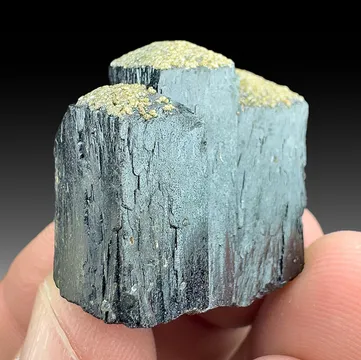
Ilvaite is the mineral that made Huanggang famous. The best crystals are jet-black to iron-black, thick prismatic, vertically striated, lustrous to almost metallic, and commonly set against quartz, fluorite, calcite, or skarn matrix. Individual crystals and clusters can be dramatically larger than many older classic-locality examples, with reported crystals reaching cabinet scale and exceptional pieces approaching or exceeding 20 cm. Early No. 1 and No. 2 mining-area material established the locality’s reputation, and good pieces are judged by complete terminations, high luster, sharp blocky form, contrast against pale quartz or calcite, and freedom from the edge bruising and broken tips that are common in such brittle, exposed black prisms.
Arsenopyrite from Huanggang occurs as bright metallic silver-white to steel-gray crystals and clusters, commonly associated with ilvaite, quartz, fluorite, hedenbergite or related dark skarn silicates, löllingite, pyrite, and other sulfides. Early field notes singled out No. 2 as a productive area for arsenopyrite, including good specimens from the top of the area, and the best pieces have a lively sculptural quality rather than appearing as massive sulfide. Because arsenopyrite is visually close to löllingite and other arsenides in the district, the best collector specimens have sharp identifiable crystals, crisp striated faces, minimal tarnish, and a paragenetic association that makes sense for Huanggang—especially fluorite or ilvaite combinations rather than anonymous metallic lumps on skarn.
Hedenbergite and hedenbergite-labeled material are central to the Huanggang look, whether as dark green to green-black prismatic crystals, fibrous to acicular inclusions in quartz, or massive skarn matrix associated with ilvaite, garnet, fluorite, arsenopyrite, and quartz. Early collector accounts linked No. 1 and No. 2 mining areas with hedenbergite associations, and much trade material uses “hedenbergite” broadly for dark Ca-Fe silicate material in this skarn system. Good specimens are those in which the hedenbergite is not merely a dark base but a visible crystallized participant: sharp sprays, lustrous green-black prisms, or attractive inclusions that color quartz. Analytical caution is worthwhile, because amphibole-group inclusions and other pyroxene-group compositions can complicate simple visual labeling.
Borcarite is one of the rarer Huanggang-region borate-carbonate prizes, typically known as pale greenish, bluish green, nearly colorless, or whitish crystalline aggregates rather than bold single crystals. Collector specimens attributed to Huanggang commonly gained extra interest from small associated cahnite crystals, and early market discussion eventually raised the possibility that some borcarite pieces sold as Huanggang Mine may actually have come from the nearby Shijiangshan, or Dashishan, mine within the broader Huanggang-area complex. For that reason, the best borcarite specimens are not just attractive; they are well provenanced. Fine pieces should show fresh, discernible borcarite crystals or aggregates, verified cahnite where claimed, and an old, reliable label or analytical support rather than a vague “Huanggang” attribution.
Löllingite from Huanggang became famous because it appeared in a size and abundance that astonished collectors familiar with the species mostly as small metallic crystals from older localities. Specimens are typically bright silvery to tin-white, often flattened, bladed, foliated, or blocky, and associated with quartz, fluorite, arsenopyrite, scheelite, magnetite, and dark skarn minerals. Dealer reports from the early 2010s described the Huanggang löllingites as vastly larger than most previous world examples, and good pieces remain immediately recognizable when they show clean metallic faces, strong crystal form, and attractive contrast with white quartz or colored fluorite. The main collecting caution is identification: arsenopyrite and löllingite can be confused visually, so analytical confirmation or a reputable source matters for high-value specimens.
Magnetite is both an ore mineral and a collector mineral at Huanggang. In the deposit it occurs as disseminated, massive, granular, coarse, and acicular magnetite replacing skarn minerals and later being overprinted or replaced by cassiterite and sulfides, especially in the more evolved Fe-Sn and Pb-Zn portions of the system. Collector specimens include sharp black octahedral to modified crystals, massive magnetite with quartz or calcite, and high-contrast pieces with fluorite, scheelite, arsenopyrite, or chlorite. Fine Huanggang magnetite stands out when the crystals are distinct rather than simply massive ore, with bright luster, crisp octahedral geometry, and matrix associations that identify the locality; large heavy pieces need careful inspection for edge bruising, cleaved contacts, and old repairs.
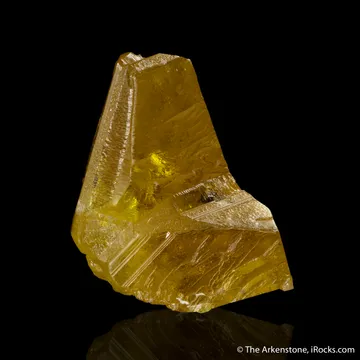
Genthelvite from Huanggang belongs to the locality’s important helvine-group suite and usually appears as small yellow, orange-yellow, brownish, or greenish tetrahedral to pseudo-tetrahedral crystals nestled with fluorite, quartz, chlorite, calcite, and skarn matrix. Some specimens labeled genthelvite from the locality have been shown or suspected to be danalite or other helvine-group compositions, which makes Huanggang genthelvite a mineral where visual ID alone is not enough for expensive examples. The best pieces show distinct, well-formed tetrahedral crystals in pleasing contrast with fluorite or quartz, not merely scattered grains, and a strong label should ideally preserve analytical or dealer history. In display terms, genthelvite’s value at Huanggang is often in the association: small honey-yellow crystals punctuating red or blue fluorite can be more desirable than larger but isolated, ambiguous grains.
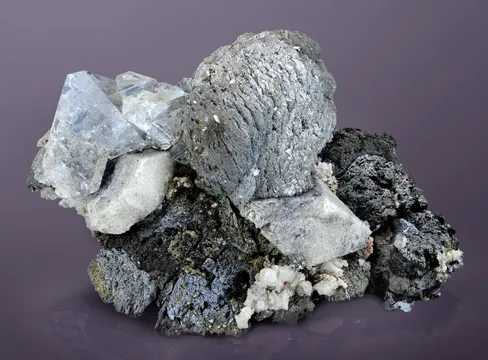
Scheelite from Huanggang is a distinctive skarn-style material: pale gray-white, creamy, greenish, smoky, or silvery crystals, usually tetragonal dipyramidal, associated with magnetite, calcite, fluorite, quartz, arsenopyrite, löllingite, and sometimes molybdenite inclusions. The best pieces are not necessarily the most gemmy; they are the ones that show sharp dipyramids rising clearly from dark iron-rich matrix or paired with fluorite and calcite. A documented Huanggang scheelite-calcite specimen shows scheelite fluorescing white under shortwave UV, yellow under midwave UV, and remaining non-fluorescent under longwave UV, while associated calcite can fluoresce red to orange-red. Collectors should judge Huanggang scheelite by crystal definition, fluorescence, intact edges, and locality-characteristic associations rather than by color alone.
Helvite from Huanggang is another member of the locality’s helvine-group story, typically occurring as yellow-brown, orange-brown, reddish brown, or honey-colored tetrahedral crystals in association with fluorite, quartz, calcite, chlorite, and skarn minerals. Like genthelvite, it is commonly small but visually potent, especially when perched between white quartz points and saturated fluorite. Good specimens show isolated, recognizable tetrahedra or clusters rather than dusty coatings, and the finest pieces have enough contrast that the helvite can be read without magnification. Because helvite, genthelvite, and danalite form a chemically related group, Huanggang labels should be treated cautiously unless the crystals have been analyzed or come from a source with a record of careful testing.
Sphalerite at Huanggang is tied to the polymetallic sulfide stages, especially in the more evolved tin- and Pb-Zn-bearing parts of the deposit. Geological studies document sphalerite replacing magnetite and chalcopyrite in SK III, as veins and cluster-like masses in skarn and marble, and as part of the later sulfide-quartz assemblage. Collector specimens are typically dark brown to black, reddish brown, honey-brown, or cleiophane-like pale material depending on composition, with quartz, fluorite, calcite, magnetite, pyrite, galena, and arsenopyrite possible companions. The best Huanggang sphalerites are crystallized, lustrous, and compositionally interesting; ordinary pieces can look like dark sulfide patches, so sharp crystal form, transparency at the edges, and strong association with fluorite or quartz raise the specimen considerably.
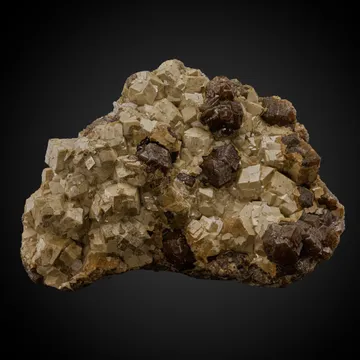
Andradite from Huanggang occurs in the garnet-rich skarns that form the backbone of the deposit, commonly as olive-green, yellowish brown, reddish brown, dark brown, or nearly black dodecahedral to trapezohedral crystals on skarn matrix, hedenbergite-like silicates, quartz, calcite, and fluorite. Modern work on Huanggang garnets shows strong zoning and compositions ranging through the andradite-grossular series, so “andradite” on a label is sometimes a simplification rather than a precise analysis. Fine collector pieces show sharp, glassy crystals with stepped or beveled faces, strong color, and three-dimensional coverage rather than dull granular skarn. Larger, clean crystals over a centimeter are more desirable, but a well-composed miniature with bright olive-green dodecahedra can be superior to a bigger, dark, abraded matrix plate.
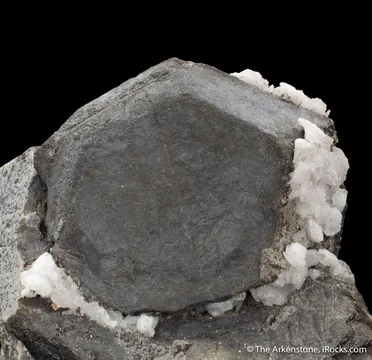
Hematite at Huanggang is part of the iron-rich evolution of the skarn system, occurring both as oxidation or replacement of magnetite and as specular to reddish iron-oxide material associated with garnet, chlorite, quartz, calcite, and magnetite. Geological work in SK III documents hematite replacing garnet, with chlorite veins cutting both hematite and garnet, which fits the locality’s broader story of repeated fluid overprints. Collector specimens are less common than magnetite or fluorite and are best when the hematite is visibly crystallized, metallic, and aesthetic rather than simply a reddish stain. Because iron oxides can be abundant and visually ambiguous in skarn material, good Huanggang hematite labels should be supported by crystal habit, association, or analysis when the specimen is significant.
Dolomite is a quieter but useful component of the Huanggang collector suite, reflecting the carbonate-rich host environment and later carbonate veining that accompanied the skarn and ore stages. Specimens may show pale rhombohedral dolomite or carbonate matrix with quartz, fluorite, calcite, sulfides, and skarn minerals, though dolomite rarely dominates the most famous Huanggang pieces. Good examples depend on freshness and contrast: clean, sharp rhombs on fluorite or quartz are far more collectable than massive carbonate, especially where the label preserves a specific mine association. Because calcite is abundant at Huanggang and may be pink, white, or colorless, dolomite identifications should be treated carefully unless the crystal habit, reaction behavior, or analysis supports the label.
Chlorite at Huanggang is both an alteration mineral and a visual accent. In the ore system it replaces earlier skarn and ore minerals, accompanies magnetite, quartz, fluorite, and cassiterite in retrograde assemblages, and appears in veins cutting earlier iron-rich material. On specimens it often occurs as dark green to gray-green coatings, botryoidal or oolitic-looking aggregates, or fine included material that deepens the color of quartz and fluorite-bearing plates. Good chlorite-bearing Huanggang specimens are those where the chlorite improves the piece—adding a dark green contrast under red fluorite, blue fluorite, or white quartz—rather than merely dulling the luster. It should not be overvalued as a species specimen unless clearly crystallized, but it is often an important locality cue in multi-mineral combinations.
“Garnet” is a practical heading for Huanggang because many specimens labeled simply as garnet represent zoned grandite compositions, ranging between andradite- and grossular-rich material. Garnet is one of the most widespread skarn minerals in the deposit and occurs with diopside, hedenbergite-like pyroxene, magnetite, fluorite, quartz, calcite, chlorite, and sulfides. Collector specimens range from olive to brown dodecahedra and trapezohedra to massive garnet skarn, with the best pieces showing sharp crystals, high luster, color zoning, and strong contrast with pale carbonates or quartz. For serious collectors, “garnet from Huanggang” is acceptable on older labels, but high-value pieces should be described more precisely where possible as andradite, grossular, or grandite garnet supported by analysis.
Other minerals documented from the Huanggang Fe-Sn deposit and its numbered mine areas include cassiterite, molybdenite, pyrite, chalcopyrite, galena, stannite, tetrahedrite-group minerals, epidote, diopside, actinolite, tremolite, vesuvianite, datolite, laumontite, stilbite-Ca, hisingerite, stokesite, humite, aquamarine or beryl reported in early field accounts, and rare unnamed or questionable sulfide phases that require analytical caution. No valid new mineral species is widely credited to the Huanggang Fe-Sn deposit itself, but the broader Huanggang-area skarn district has produced rare borates and unusual Ca-Fe-Zn-Be silicate-sulfide assemblages that continue to attract micromount collectors and analysts. The safest approach is to treat unusual Huanggang labels as hypotheses until supported by reliable analysis, especially for helvine-group members, borates, and metallic arsenides.
Huanggang is abundant enough that common material is widely available, but it is complex enough that top specimens still require discrimination. The locality has produced a large volume of small and mid-range fluorite, quartz, calcite, ilvaite, and skarn combinations, so ordinary examples should not be priced as rarities merely because they carry the Huanggang name. Rarity rises sharply for undamaged, well-balanced, cabinet-quality pieces with strong locality character: large lustrous ilvaite, saturated octahedral fluorite on matrix, clean “blueberry” fluorite over quartz, pink manganoan calcite with quartz, sharp scheelite with fluorescence, large löllingite, analyzed helvine-group specimens, and borcarite with reliable provenance.
Mislabelling is the main authenticity problem. “Huanggang” has been used broadly in the trade for material from the Huanggang Fe-Sn deposit, nearby Huanggang-area mines, and sometimes simply for Inner Mongolian skarn or fluorite material. Old labels may use “Huanggang Mine,” “Huanggangliang,” “Keshiketeng,” “Chifeng,” “Ulanhad,” or “Inner Mongolia”; some older trade labels used imprecise or erroneous regional designations. When possible, prefer labels that include the mine number or shaft, especially No. 1, No. 2, No. 5, or No. 6, and keep dealer invoices or old collection tags with the specimen.
Species misidentification is especially important for Huanggang. Arsenopyrite and löllingite can be difficult to distinguish visually in complex metallic aggregates. Helvine, genthelvite, and danalite form a chemically related group, and some “genthelvite” labels from the locality have been questioned or corrected by analysis. Hedenbergite labels may cover a range of dark Ca-Fe silicates, including amphibole-rich included quartz material. Garnet labels may hide zoned andradite-grossular compositions. Borcarite attributed to Huanggang may need particular provenance scrutiny because some material reportedly came from nearby Shijiangshan rather than the main Huanggang Mine.
Condition issues are typical of skarn specimens but worth emphasizing. Fluorite octahedra bruise easily on exposed edges, and colorless or pale crystals can hide cleaves until angled in strong light. Ilvaite terminations chip and break; many otherwise impressive clusters have contacted tips or repaired crystals. Quartz points on fluorite plates are often dinged, and calcite is soft enough to abrade during extraction, cleaning, or shipping. Metallic arsenides and sulfides may tarnish or become dull; avoid washing complex arsenopyrite-löllingite-pyrite pieces aggressively, and keep them dry.
Fluorescence adds real collecting value for some Huanggang pieces. Scheelite may fluoresce strongly under shortwave ultraviolet light, with some molybdenum-bearing material shifting toward white or yellowish responses, while manganese-bearing calcite can glow red to orange-red. Fluorite from No. 6 associations has been documented as blue under longwave UV, and calcite in the same association as red. UV response should be treated as a bonus rather than a sole identification tool, but it is useful for display and for separating some mixed scheelite-calcite-fluorite assemblages visually.
Handling requires ordinary but firm mineral hygiene. Arsenopyrite and löllingite contain arsenic; they are safe as display specimens when intact and handled sensibly, but they should not be cut, ground, tumbled, soaked in acids, or stored where children can handle them. Wash hands after handling arsenide-rich material, keep dust out of display cases, and avoid humid storage for sulfide- and arsenide-bearing specimens. Heavy magnetite-rich pieces should be mounted securely: Huanggang specimens can be deceptively dense, and a fall that barely marks the magnetite can destroy fluorite, calcite, quartz, or ilvaite.
The modern Huanggang story begins with the speed of discovery. Around June 2010, collectors and dealers began to realize that the strange new ilvaite from Inner Mongolia was not an isolated oddity. Within months the locality was producing a widening cast of minerals: transparent octahedral fluorite, arsenopyrite with pink or red fluorite, quartz, hedenbergite-labeled skarn silicates, pyrite, aquamarine, pink calcite, and more. The first impression from early field accounts was not tidy taxonomy, but astonishment: the species list seemed to grow faster than anyone could organize it.
A June 2011 visit by Chen Xiaojun, known to many collectors as John Chen, captures Huanggang at exactly the moment when it was becoming a classic. The trip ran from June 6 to June 17, 2011, and the visitors were not going to a single picturesque pocket but to a scattered mining district with about eight mining areas known to them at the time. Their rough field map was already useful: No. 1 for hedenbergite, garnet, quartz, ilvaite, and fluorite; No. 2 for arsenopyrite, hedenbergite, and ilvaite; No. 5 for calcite and fluorite. That early taxonomy still echoes in good labels today.
The approach to the mines reads like a reminder that specimens have geography. The party rented a local taxi and learned that taking the ReShui line saved time. The route passed through the open country around Keshiketeng Qi, also called Jingpeng, with horses near the road, fresh air, silver birch forest, and the landscape of the local geopark. Near the mine they noted a hunter club. This was not the compact, industrial China many collectors imagine from show labels, but high Inner Mongolia: open roads, broad country, and a mineralized district large enough to conceal multiple productive skarn zones.
The human details are even better. In the No. 1 mining area, Chen described broken ilvaite crystals scattered in a miner’s sleeping room. That image—black crystals lying where miners slept—says more about the early specimen flow than any polished auction caption. Huanggang in 2011 was still raw: bags of new material, miners learning what collectors wanted, buyers trying to understand which numbered area produced which association, and specimens being carried back to Shanghai for cleaning and sorting.
At No. 2, the top of the area was producing good arsenopyrite specimens. The party acquired representative material, including arsenopyrite-hedenbergite-ilvaite associations, and brought it back at the end of the trip. Chen was still cleaning specimens on the night of June 17. Those early Huanggang pieces were not born as “classics” in museum lighting; they became classics through exactly this chain—mine room, rough road, local taxi, dealer table, sink, brush, label.
The most cinematic moment in the early accounts has no mineral in it. On a nighttime return to the mine, a red deer appeared in the headlights and stood there for a while before moving away. Chen regretted missing the photograph. The image remains vivid anyway: a vehicle on an Inner Mongolian mountain road, the mine somewhere in the dark, headlights catching a deer, and one of China’s great modern mineral localities still in the act of revealing itself.
The road itself supplied another small but telling crisis. On the mountain route, the taxi’s brake pad began burning. The travelers stopped and poured water on it before continuing. It is the sort of detail that usually disappears from specimen labels, yet it belongs to the history of the rocks: Huanggang specimens reached the market through difficult roads, improvised logistics, heavy bags, and people willing to chase rumors of new pockets into a remote skarn district.
By 2012, the locality had already become show news. Dealers and writers were describing the Inner Mongolian skarns as still “cranking out” good specimens, with a road leading to the Huanggang mines and many smaller deposits in the wider zone being worked in a much less orderly way. The sense at the time was not that Huanggang had been solved, but that the region’s potential was enormous. That uncertainty proved part of the appeal: every show season seemed to bring another association—löllingite, helvite, genthelvite, red fluorite, blue fluorite, scheelite, magnetite, borates—that forced collectors to revise what “Huanggang” meant.


_(43556234741).jpg)