A collector's guide to Weilasituo Li-(Rb)-Sn-W deposit, China: its geology, mining history and notable minerals, illustrated with the 26 specimens documented from this locality on EarthWonders.
Key facts
Weilasituo is one of the most interesting modern Chinese localities for collectors because it sits at the point where two worlds overlap: a serious, newly defined rare-metal ore system and a small but distinctive stream of cabinet specimens. The deposit lies in Hexigten Banner, Chifeng City, Inner Mongolia, on the southern Great Xing’an Range, within the eastern Central Asian Orogenic Belt. Geologically, it is centered on Early Cretaceous, highly evolved quartz porphyry to alkali-feldspar granite, including amazonitized and albitized facies, with Li-Rb-Sn-W mineralization close to the granite and outward zoning into Cu-Zn and Pb-Zn-Ag vein systems in metamorphic wall rocks.
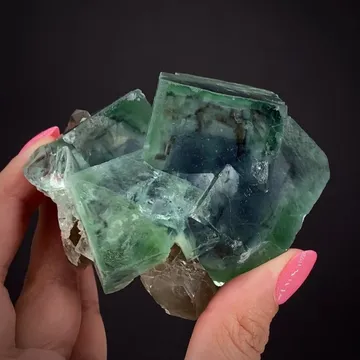
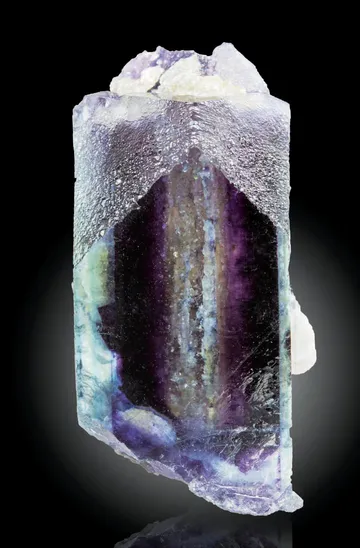
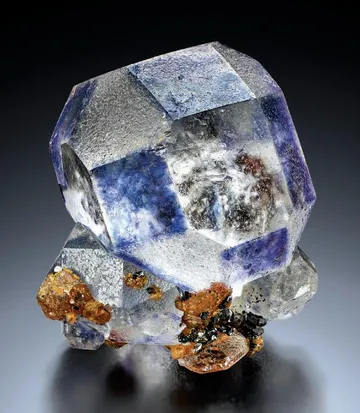
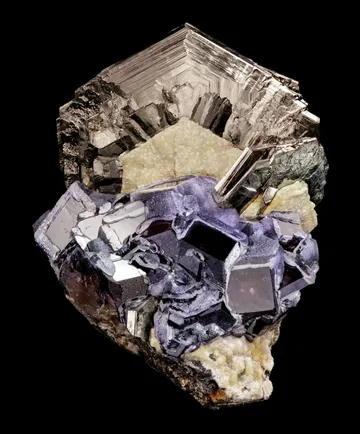
For collectors, the name “Weilasituo” most often appears on fluorite, pyrrhotite, calcite, cassiterite, muscovite, topaz, quartz, and mixed sulfide specimens. The best fluorites are not the massive commercial fluorspar of stereotype, but individual crystals and combination pieces: blue, blue-green, lavender, purple, and sometimes green fluorite, commonly with internal phantoms or color zoning, set against bronze pyrrhotite, white calcite, silvery muscovite, dark cassiterite, or quartz. The finest pyrrhotite-fluorite-calcite combinations from the small 2018–2019 find have a surprisingly sculptural look: mirror-bright bronze pyrrhotite plates rising from stepped, zoned purple fluorite, with ivory calcite in the recesses.
Regional View
Country View
Weilasituo’s importance has grown well beyond specimen circles. The Li-Sn discovery made during exploration from 2013 to 2017 transformed what had been known largely as a Cu-Zn-Ag-W mining district into a nationally significant rare-metal deposit. Scientific work now treats the Weilasituo-Bairendaba district as a magmatic-hydrothermal system with a high-temperature Sn-W-Li core, middle-temperature Cu-Zn mineralization, and lower-temperature Pb-Zn-Ag mineralization farther outward. That zonation is also the reason collector labels can be confusing: pieces may appear in the market as Weilasituo, Weilasituo Ag-polymetallic deposit, Yindu, or occasionally in relation to the broader Bairendaba district. The specimens themselves are often the most reliable clue: Weilasituo collector material tends toward fluorite with purple phantoms, bronze pyrrhotite, muscovite-rich matrices, cassiterite, topaz, quartz, and late calcite rather than the more familiar Huanggang look from elsewhere in Inner Mongolia.
Search for specimens: View all specimens from Weilasituo Li-(Rb)-Sn-W deposit, China
The Weilasituo Li-(Rb)-Sn-W deposit is in Baiyinchagan Sumu, Hexigten Banner, Chifeng City, Inner Mongolia, China. In the modern literature it is described as part of the Weilasituo ore district, close to the Bairendaba Ag-Pb-Zn deposit and the older Weilasituo Cu-Zn deposit. The district belongs to the southern Great Xing’an Range metallogenic belt, and the ore system is associated with Early Cretaceous felsic magmatism. The key intrusive body is commonly described as quartz porphyry or fine-grained porphyritic alkali-feldspar granite, with amazonitized and albitized zones at depth and greisenized portions nearer the mineralized cupola.
The deposit is best understood as a zoned magmatic-hydrothermal rare-metal and polymetallic system. Close to the granite, Li-Rb mineralization is developed in greisen and crypto-explosive breccia above the amazonite-bearing granite. Sn-W-Mo mineralization occurs in quartz veins and greisened zones, while Cu-Zn-Ag and related base-metal sulfide veins extend outward into the Paleoproterozoic Xilinguole, or Xilinhot, metamorphic complex and associated intrusive rocks. This zoning is not merely academic; it explains why collector specimens from the area may emphasize either rare-metal minerals such as cassiterite, topaz, zinnwaldite, columbite-tantalite group minerals, and fluorite, or sulfide combinations with pyrrhotite, sphalerite, chalcopyrite, galena, and calcite.
Several papers divide the paragenesis into a sequence beginning with zinnwaldite-topaz-fluorite Li-Rb mineralization, followed by quartz-arsenopyrite-cassiterite-sphalerite-wolframite Sn-W assemblages, molybdenite-bearing polymetallic stages, quartz-arsenopyrite-pyrite-chalcopyrite, a pyrrhotite-sphalerite-chalcopyrite-galena stage, and finally quartz-calcite-fluorite. This is why fluorite is not a single “look” at Weilasituo: it appears early with zinnwaldite and topaz in the rare-metal system and again late with calcite in open-space fillings and specimen pockets. Likewise, pyrrhotite belongs to the main sulfide stage and is meaningful as more than just matrix; in the best specimens it is the visual anchor of the piece.
Mining history at Weilasituo begins, in the modern company sense, with Inner Mongolia Weilasituo Mining Co., Ltd., founded in November 2006. The company started construction in 2007 and entered commercial production in 2008, initially focusing on copper, zinc, silver, and tungsten concentrates from the existing polymetallic resources. Contemporary reporting described a 1,000 tonne-per-day beneficiation capacity, later associated with ore processing of roughly 330,000 tonnes per year. By 2020, company management publicly stated that the existing zinc-copper polymetallic mine had been halted because of resource depletion, while the plant continued operating on stockpiled ore.
The major change came from exploration of the lithium-tin deposit between 2013 and 2017. A 2020 industry interview reported total ore reserves of 34.75 million tonnes, including 6.8 million tonnes of tin ore and 27.8 million tonnes of lithium ore, with metal reserves listed as 58,000 tonnes tin, 357,000 tonnes Li2O, 50,000 tonnes zinc, and 9,000 tonnes WO3. Later trade reporting in April 2025 stated that the Weilasituo Li-Sn polymetallic mine had received a mining license on April 21, 2025, and described a larger proven ore volume of 55.27 million tonnes, including Li2O ore and tin ore with tungsten and zinc as accompanying metals. The exact numbers vary by reporting date and reserve category, but the trend is clear: Weilasituo moved from a polymetallic base-metal mine into a strategic Li-Sn-W-Rb rare-metal project.
For collectors, access should be considered closed and industrial. This is not a casual field-collecting site; it is an active or developing mining property with corporate operators, beneficiation facilities, resource reporting, and government permitting. Specimens that reach the market come through mine-associated salvage, dealer channels, local intermediaries, and small lots, not from open public collecting. Serious buyers should expect imperfect locality information in older labels, especially where “Yindu” was used as a trade or company-associated name for material from mines in this district.
The best documented specimen-producing events are small and sporadic rather than steady. The 2018–2019 pyrrhotite-fluorite-calcite find produced the most memorable collector pieces: large, bright, hexagonal to platy bronze pyrrhotite crystals with zoned purple fluorite and calcite. Around 2021–2022, dealers began reporting Weilasituo cassiterite combinations, including cassiterite with muscovite, fluorite, quartz, arsenopyrite, and topaz; these were regarded as an important modern Chinese cassiterite occurrence, but many pieces were damaged or visually crowded. More recent fluorite specimens, including pieces with purple phantoms and pyrrhotite, continue to appear in small numbers rather than as a large, consistent supply.
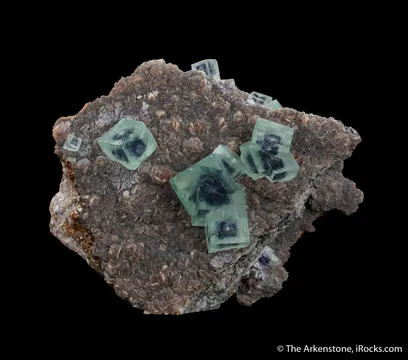
Fluorite from Weilasituo is most prized in combination specimens: blue to blue-green, lavender, purple, and occasionally green crystals, commonly cubic to cubo-octahedral, with sharp internal phantoms, stepped zoning, or overgrowths that record more than one generation of growth. The locality’s strongest pieces tend to be miniatures and small cabinets rather than large plates; documented examples include compact 4 cm fluorite-pyrrhotite miniatures with purple phantoms, flattened spinel-twinned fluorite with calcite around 6 cm, cassiterite-on-fluorite pieces in the 5–8 cm range, and larger but often more damaged cassiterite-muscovite-fluorite plates. Associations are a major part of the appeal: pyrrhotite, calcite, muscovite, cassiterite, quartz, arsenopyrite, pyrite, and sphalerite all occur with fluorite here. The difference between ordinary and excellent Weilasituo fluorite is usually condition and contrast: transparent crystals with undamaged edges, clear purple or blue phantoms, and a sculptural placement on metallic pyrrhotite or lustrous cassiterite rise well above the more common etched, scuffed, or crowded material.
Pyrrhotite is the signature metallic species in the most distinctive Weilasituo combinations, where it occurs as bronze, highly lustrous, hexagonal to platy crystals associated with purple fluorite and late calcite. The celebrated 2018–2019 find produced specimens in which a single bright pyrrhotite crystal could dominate the composition; one documented 9.1 x 9.0 x 3.5 cm specimen carried a sharply formed pyrrhotite crystal measuring about 4.7 cm across, set amid two generations of zoned purple fluorite and ivory calcite. Geologically, pyrrhotite belongs to the Cu-Zn sulfide stage with chalcopyrite, sphalerite, galena, pyrite, and quartz, and microscopic studies have recorded chalcopyrite exsolution in pyrrhotite. The best collector pieces are sharp, reflective, and fresh, with minimal oxidation or bruising, and they gain much of their value from balanced placement against translucent fluorite rather than from pyrrhotite alone.
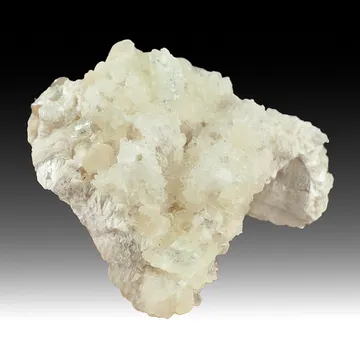
Beyond fluorite and pyrrhotite, Weilasituo has a much richer mineralogical identity than its specimen output alone suggests. The rare-metal system is built around zinnwaldite, topaz, fluorite, cassiterite, wolframite group minerals, scheelite, molybdenite, Rb-bearing feldspar and mica, and columbite-tantalite group minerals, with sphalerite carrying notable In and Cd in some studies. Collector pieces also document cassiterite with muscovite, fluorite, quartz, arsenopyrite, and topaz; topaz-rich plates with interspersed cassiterite are unusual and very locality-specific. The broader Weilasituo polymetallic assemblage includes sphalerite, chalcopyrite, galena, arsenopyrite, pyrite, magnetite, marcasite, tetrahedrite-group minerals, silver-bearing tetrahedrite, native silver, allargentum, dyscrasite, matildite, stannite, calcite, dolomite, sericite, monazite group minerals, zircon, and amazonite.
The primary authenticity issue with Weilasituo specimens is not artificial manufacture but locality drift. In the mineral trade, pieces from the Weilasituo-Bairendaba-Yindu area have been labeled inconsistently, and “Yindu” has often been used where the better geographic or mine-specific label should be Weilasituo or Bairendaba. This matters because Inner Mongolia has several famous fluorite-producing districts, and Chinese fluorite is frequently sold with broad or approximate labels. A Weilasituo attribution is strongest when the specimen matches known associations: purple-phantom fluorite with pyrrhotite and calcite; fluorite with muscovite and cassiterite; cassiterite with topaz, quartz, mica, or arsenopyrite; or blue-green fluorite on the distinctive Weilasituo-style matrices.
Condition is the central grading issue. Fluorite cleaves and bruises easily, and several dealer reports note that many Weilasituo fluorite and cassiterite combinations were damaged, etched, rubbed, or visually crowded. Inspect fluorite edges, phantom-bearing corners, and contact points where crystals meet pyrrhotite or cassiterite. On cassiterite pieces, check for broken crystal tips and scuffed faces; on muscovite-rich matrices, look for compressed or flaking mica that may have suffered during trimming or shipping. Pyrrhotite brings its own problem: it can tarnish and, in some sulfide specimens, deteriorate if stored in damp conditions. Keep pyrrhotite-bearing specimens dry, avoid rapid humidity changes, and do not wash them unnecessarily.
Fluorescence is not the main reason to collect Weilasituo fluorite, although some dealer listings mention long- and short-wave UV response on related Yindu/Weilasituo-labeled fluorite. Buy these specimens for daylight aesthetics first: color zoning, transparency, sharpness, metallic contrast, and the balance of the association. If fluorescence is important, require actual UV photographs under specified wavelength rather than relying on locality assumptions.
No well-documented, locality-specific treatments or fakes dominate the market, but repaired fluorite, reattached crystals, and selectively trimmed matrices are always possible in modern Chinese fluorite. Ask for close photographs of junctions between fluorite and matrix, pyrrhotite and calcite, and any large crystal that appears improbably balanced. For higher-value pieces, a clean provenance trail is especially useful because Weilasituo’s market supply is episodic and terminology has shifted.
In availability, Weilasituo is a niche locality rather than a mass-market one. Small fluorite and pyrrhotite-fluorite pieces do appear, but the outstanding 2018–2019 pyrrhotite combinations are limited. Cassiterite combinations from the early 2020s are more find-specific and uneven in condition, with better, undamaged examples increasingly absorbed into collections. The strongest buying strategy is to be patient and choose pieces with unmistakable locality character rather than settling for a damaged specimen simply because the label is fashionable.
The Weilasituo story begins as a mining-company pivot. Inner Mongolia Weilasituo Mining Co., Ltd. was formed in 2006, built out the mine in 2007, and entered commercial production in 2008 as a copper-zinc-silver-tungsten producer. By 2014 the older mining resource was declining, and by 2020 the company was describing the original zinc-copper polymetallic mine as halted. Then the ground changed the company’s future. Exploration from 2013 to 2017 outlined a large lithium-tin body inside the mining area, with tin, lithium, zinc, and tungsten all present in meaningful quantities. The discovery was later counted among the Geological Society of China’s “2018 top ten geological prospecting achievements,” a striking turn for a mine that might otherwise have been remembered as a declining base-metal operation.
Collectors experienced Weilasituo differently: not through reserve tables, but through small, high-impact lots. A dealer traveling in China described the cassiterite-bearing Weilasituo material as one of the “interesting surprises” of the trip. The best cabinet pieces were not large clean single crystals, but dense black cassiterite crystals on muscovite, fluorite, quartz, and topaz. The material had problems: many pieces were broken, rubbed, or so densely packed that the crystals became a “solid black mass.” But when the composition worked, the locality suddenly joined the short list of Chinese cassiterite sources that serious collectors had to know, beside Mt. Xuebaoding, Jiangxi, and Yunnan.
The fluorite brought its own drama. One Weilasituo fluorite-on-cassiterite-and-muscovite specimen was singled out because the large purplish blue fluorite octahedron sat on a plate of muscovite and lustrous cassiterite, even though the surface was partly altered and whitish. Most available fluorite examples from that lot were described as “beaten beyond recognition” or reduced to tiny crystals hidden somewhere on matrix. That makes the surviving clean examples more telling: Weilasituo fluorite is not abundant because fluorite is abundant in the ore system; it is scarce because attractive, undamaged fluorite survived only in select pockets and selected hands.
The 2018–2019 pyrrhotite-fluorite-calcite find is the locality’s most memorable specimen episode. The standout pieces had a composition that seemed almost staged: a central bronze pyrrhotite crystal, sharply hexagonal and reflective, ringed by lavender to dark purple fluorite and patched with white-yellow calcite. One documented crystal measured 4.7 cm across, large enough to command the entire specimen. The visual contrast is why collectors remember the find: pyrrhotite is usually admired by specialists, but at Weilasituo it became the centerpiece of a colorful fluorite specimen.
The label story may prove just as important as the finds. For years, some specimens from this part of Inner Mongolia circulated under “Yindu,” a name collectors knew but did not always understand. Later clarification in collector literature emphasized that Bairendaba and Weilasituo material had been referred to as Yindu because of the Yindu Mining Company’s role, not because “Yindu” was necessarily the correct mine locality for every specimen. That kind of correction matters. In a province crowded with modern fluorite localities—Huanggang, Bairendaba, Yindu-labeled material, Weilasituo, and others—a precise label is not pedantry; it is the difference between a pretty Chinese fluorite and a specimen that documents a specific rare-metal ore system.