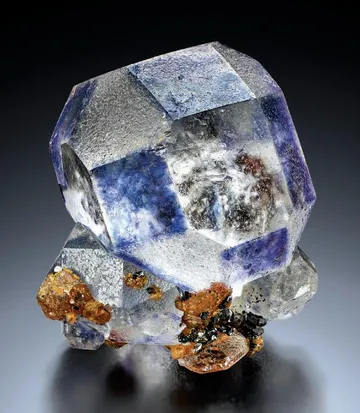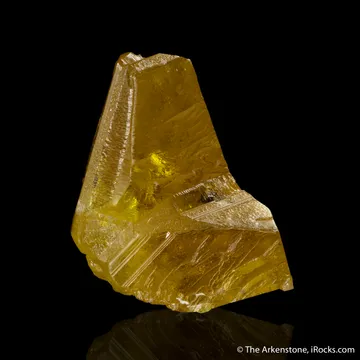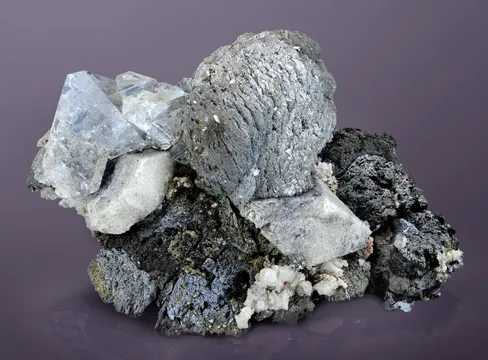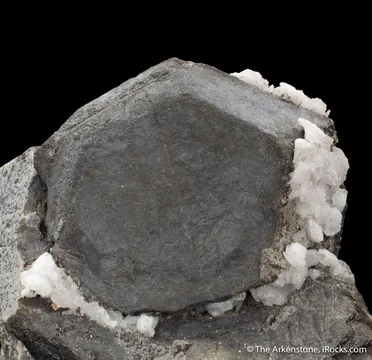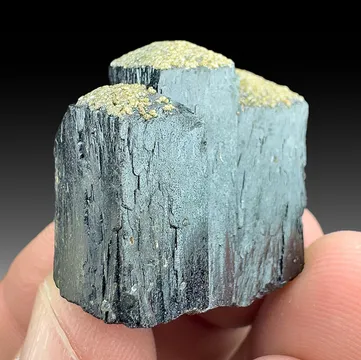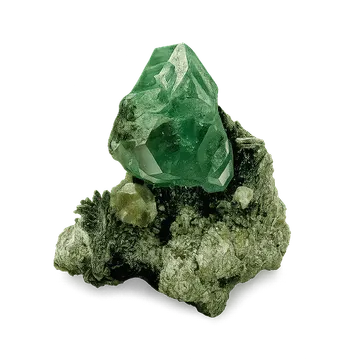
Andradite from Huanggang Mine, Inner Mongolia — olive to near-black dodecahedra with metallic luster, chemically zoned grandites, and skarn provenance.
Key facts
Andradite from the Huanggang Mine is one of the more interesting modern garnet occurrences because it sits at the intersection of specimen abundance, complicated skarn chemistry, and the still-unfolding story of a locality that entered the international collector market only in the early 2010s. The best pieces are not shy minerals: they show glossy dodecahedra and trapezohedra in olive green, golden brown, reddish brown, and near-black tones, often crowded into crystallized mounds or perched over green pyroxene, pale calcite, quartz, and other skarn minerals. On fine specimens the faces can be sharply stepped, bevelled, and glassy enough to give the crystals a metallic flash in strong light.
The locality belongs to the Huanggangliang iron-tin polymetallic skarn system of Hexigten Banner, Chifeng City, Inner Mongolia. In specimen labels and dealer listings it is variously rendered as Huanggang, Huanggangliang, Huanggang Mine, or Huanggang Mines; serious collectors should treat these as names for a large mine complex rather than a single pocket. The deposit is a classic contact-metasomatic system formed where Early Cretaceous granitoid intrusions interacted with carbonate-bearing Permian rocks. Garnet is not a side note in this system: garnet-rich skarns are one of the dominant alteration products, and modern analytical work has shown that the garnets range through the andradite-grossular series rather than representing one simple, uniform species.
That last point is central to collecting Huanggang andradite well. Much material in the trade has been sold simply as “andradite,” but the deposit produces chemically zoned garnets, grossular-rich garnets, and intermediate grandite compositions. The most desirable labeled andradites are therefore the pieces that combine strong aesthetics with credible provenance: sharp crystals, good luster, attractive color, minimal bruising on exposed edges, and—when possible—analytical confirmation or a reliable collection history.
Historically, Huanggang became famous first for its spectacular ilvaite, which reached the market around 2010 and quickly drew attention to the broader mineralogical richness of the mine complex. Andradite followed as one of the locality’s important collector species. Early auction descriptions from 2012–2013 repeatedly described the andradite as a newly exploited skarn-zone find, with olive-green dodecahedra and crystals commonly under about a centimeter, though larger and more robust pieces also appeared. Later examples show that the locality can produce cabinet-sized masses of lustrous, dark golden-brown crystals and unusual combinations on hedenbergite or similar pyroxene-group matrices.
Search for specimens: View all andradite specimens from Huanggang Mine, Inner Mongolia, China
The Huanggang Mine is part of the Huanggang Fe-Sn deposit in Hexigten Banner, Chifeng City, Inner Mongolia, northeastern China. It is better understood as a mining complex than as a single collector pocket. The deposit is worked through numbered mining areas, commonly cited as Nos. 1 through 7, spread across a long mineralized belt. The western portion contains more isolated, iron-rich skarn orebodies, while the eastern portion includes a more continuous tin-rich skarn zone developed in marble near the contact with intrusive rocks.
Geologically, Huanggang is a calcareous skarn system associated with granitoid intrusions—especially moyite and related A-type granitic rocks—emplaced during Early Cretaceous magmatism in the southern Great Xing’an Range. The skarn and ore bodies occur mainly in the contact zone involving the lower Permian Dashizhai and Huanggangliang formations. The important host rocks include andesite of the Dashizhai Formation and marble of the Huanggangliang Formation, and the system records a progression from prograde skarn through retrograde alteration and sulfide-stage mineralization.
The mineralized zone is large by specimen-locality standards. Published geological descriptions place the ore-body exposures along a northeast-trending belt roughly 19 km long, with widths on the order of hundreds of meters to a few kilometers depending on the section. Garnet-rich skarns, pyroxene-garnet skarns, vesuvianite-garnet skarns, magnetite ore bodies, fluorite replacement zones, quartz-calcite veins, and sulfide-bearing assemblages all occur within this broader system.
Mining activity is industrial, not casual collecting. The deposit is an iron-tin-polymetallic system with magnetite, cassiterite, scheelite, molybdenite, sphalerite, chalcopyrite, galena, arsenopyrite, pyrite, hematite, tetrahedrite, and stannite reported among the ore minerals. The great majority of collector specimens reached the market through miners, dealers, and Chinese specimen channels rather than through open recreational collecting. Anyone considering a visit should assume that permission from mine operators and mineral-rights holders is required, that access conditions can change, and that underground or active open-pit areas are not safe collecting venues.
For collectors, Huanggang’s modern specimen story begins around 2010, when excellent ilvaite and associated skarn minerals started moving into the international market. Dealer and field reports from 2011–2012 describe a sudden expansion of available species: ilvaite, arsenopyrite, fluorite, quartz, hedenbergite, garnet, aquamarine, calcite, and other minerals appeared in quantity. Andradite from newly exploited skarn zones was already being marketed by early 2012. Many of those early pieces were olive-green to brown, relatively sharp dodecahedral or trapezohedral garnets on matrix, and some auction descriptions noted that the material seemed to dry up quickly after the initial find.
The mine complex has continued to yield collectible minerals over a much longer period, but not always in the same styles or abundance. Huanggang is particularly prone to broad locality labeling. Specimens may be labeled “Huanggang Mine,” “Huanggang Mines,” “Huanggangliang Mine,” “Inner Mongolia,” “Chifeng,” or occasionally with older or imprecise regional wording. Some older labels also used “Baotou District,” a locality convention now regarded as erroneous for Huanggang material. For fine andradite, the best labels preserve the mine complex, district, and collection history rather than relying on a vague “Inner Mongolia” designation.
Huanggang andradite is most familiar as sharp to semi-sharp garnet crystals in dodecahedral habit, commonly with trapezohedral modifications. Many specimens show stepped growth, bevelled edges, and stacked, mounded crystal aggregates. The classic collector look is a crowded surface of olive-green to brown dodecahedra on skarn matrix, but the locality also produced golden-brown, reddish-brown, dark brown, and nearly black garnets.
Crystal size varies widely. Many trade specimens feature crystals in the 5–13 mm range, especially on miniature and small-cabinet matrix pieces. Some early auctioned examples reported individual crystals around 8 mm, 11 mm, 1.1 cm, and 1.3 cm. Larger crystals occur, and one early “new find” cabinet specimen was described with stepped olive-green dodecahedra to 3.0 cm, which is notably large for display-quality Huanggang andradite. At the other end of the scale, drusy coatings and dense granular garnet surfaces are common and are valued more for overall sparkle and color than for individual crystal size.
The most attractive colors are the saturated olive greens and dark golden browns, especially when the crystals are translucent on the edges. Reddish-brown and jet-black material can be very handsome when the luster is strong. Some black garnet skarn is recorded in geological work, and dark collector specimens can look almost metallic under direct light. Color alone, however, is not a reliable species test at Huanggang because the garnets can grade through andradite-grossular compositions.
Huanggang garnets are chemically complex. Published analyses describe compositions ranging from andradite-rich to grossular-rich, with reported andradite components spanning a broad interval. Early-stage garnets may be close to andradite in composition, while other skarn stages can be grossular-rich. Modern studies also emphasize oscillatory zoning, core-rim textures, replacement, fracturing, and differences between prograde and retrograde garnet generations. In collector terms, that means a specimen that looks like “andradite” may still deserve the more cautious label “andradite-grossular series” unless supported by analysis or reliable prior testing.
Associated minerals are a major part of the locality’s appeal. Andradite may occur with quartz, calcite, fluorite, hedenbergite or related pyroxene, diopside, magnetite, ilvaite, arsenopyrite, helvine, and other skarn species depending on the mining area and pocket. Particularly showy combinations include olive-green andradite sprinkled over dark green prismatic pyroxene, andradite with calcite, and andradite in broader skarn assemblages that also include quartz and magnetite. Some specimens sold as andradite on hedenbergite are visually dramatic, though the exact identity of green pyroxene-group or amphibole-group matrices from Huanggang should not be assumed without testing.
Quality is judged by several locality-specific factors. First is species confidence: for higher-priced pieces, “garnet from Huanggang” is not the same thing as verified andradite. Second is crystal definition: the best specimens show discrete, sharp, lustrous faces rather than massive garnet crust. Third is color contrast: olive to golden-brown crystals on pale matrix, green garnet over darker pyroxene, or brown-black garnet with white calcite can be especially effective. Fourth is condition: garnet edges and points tend to reveal pocket wear, extraction bruising, and contact damage readily, especially on densely crystallized mounds.
The chief authenticity issue is not artificial treatment but identity. Huanggang garnets are commonly sold as andradite, yet the deposit produces a broad andradite-grossular solid solution. A visually identified specimen may be perfectly legitimate Huanggang garnet but not chemically dominant andradite. Serious buyers should look for one of three things: analytical support such as XRF, Raman, EPMA, or other testing; a dealer or collection label from a source known to be careful with Huanggang material; or a cautious label that acknowledges the andradite-grossular series.
Locality precision is the second concern. Huanggang is a famous and marketable name, and Inner Mongolia contains many mineral-producing districts. Broad “Inner Mongolia” labels, old “Baotou” labels, and specimens attributed only to “Huanggang” without a species or mine-complex context should be evaluated carefully. The issue is especially important for combinations, because some minerals once circulated under Huanggang labels have later been reconsidered or tied to nearby districts. That does not make a specimen false, but it does mean provenance should be weighed as part of value.
There are no widely documented treatments specific to Huanggang andradite comparable to dyeing, irradiation, or oiling in the gem trade. The more realistic market risks are misidentification, overly optimistic species naming, repaired matrix on large cabinet pieces, and undisclosed contact damage. Garnet itself is durable, but Huanggang specimens are often dense, three-dimensional skarn aggregates with exposed crystal edges. Chips on high points, bruised trapezohedral faces, and broken crystals along the perimeter are common condition issues.
Be cautious with “rainbow andradite” claims. Iridescent Huanggang andradite has been discussed in collector circles as a small 2010–2011 occurrence, but examples are uncommon and can be confused with ordinary garnet surfaces coated by chalcopyrite or other metallic films. A true, naturally iridescent Huanggang andradite should have strong provenance and ideally microscopic or analytical support. Without that, the premium attached to the word “rainbow” is risky.
Market availability is moderate but uneven. Small and miniature Huanggang andradites remain obtainable, especially as older dealer stock and secondary-market specimens. Large, sharp, lustrous cabinet pieces from the better early finds are much scarcer. Auction records and dealer listings show a wide range: inexpensive small examples, mid-range cabinet pieces, and higher-end specimens with large crystals, excellent condition, strong color, or notable provenance. Pieces from the early 2011–2012 production, particularly with sharp golden-brown to olive crystals and documented collection history, are more desirable than anonymous recent stock.
The Huanggang story reached collectors with the speed and disorder of a modern Chinese mineral rush. In 2010, fine ilvaite from the mine complex began appearing, and by the following year the locality had become a name dealers watched closely. Robert Lavinsky and Xiaojun “John” Chen later described the complex as a locality some dealers were already calling the “New Dal’negorsk,” a comparison that made sense to collectors who remembered how Russia’s Dalnegorsk had flooded the market with a startling range of skarn and ore minerals during the late twentieth century.
John Chen’s 2011 field account captures the locality at that early, exploratory moment. His trip ran from June 6 to June 17, 2011, when Huanggang was still new enough to the specimen world that every mining area seemed to promise another species. He noted that interesting ilvaite had appeared first, followed by transparent octahedral fluorite, arsenopyrite, pink or red fluorite, quartz, hedenbergite, pyrite, aquamarine, pink calcite, and garnet. He called it “another good locality for China Minerals career,” a dealer’s phrase, but also a collector’s excitement: the sense that the mine was no longer just an industrial deposit but a source of objects that could change cabinets around the world.
The landscape in that account matters because it explains why Huanggang material felt remote when it first reached the market. Chen described Keshiketeng Qi, also called Jingpeng, as a place of open scenery, fresh air, horses along the road, silver birch forest, and a nearby hunter club. The party rented a local taxi and took the ReShui line to save time. On the mountain roads, the taxi’s brake pad overheated and began burning; they had to stop and pour water on it before continuing. It is a small detail, but it gives the mineral locality a real geography: not a clean label on a case, but a rough road into a high, cold, working mining district.
His notes from the mine are equally vivid. At No. 1 he listed hedenbergite, garnet, quartz, ilvaite, and fluorite. At No. 2 he saw arsenopyrite, hedenbergite, and ilvaite, with good arsenopyrite coming from the top of the area. At No. 5 he recorded calcite and fluorite. In one photograph caption he pictured Chen Xiaojun “looking or thinking,” surrounded by many small broken ilvaite crystals in a miner’s sleeping room. That single room—half workplace, half shelter, with broken crystals scattered where miners lived—is exactly the kind of setting from which early Huanggang specimens entered commerce.
The most memorable moment in the account is not mineralogical at all. On a night return to the mine, the visitors met a red deer in the headlights. It stood for a while in front of the vehicle, then vanished before anyone took a photograph. Chen’s regret—“It is a pity that did not take a photo”—is the kind of field-note detail that collectors remember because it places the specimens in their actual terrain: a remote Inner Mongolian mine road, headlights, cold air, and a wild animal briefly frozen in the beam.
Berthold Ottens and Günther Neumeier, “The Huanggang mine, Inner Mongolia, China,” The Mineralogical Record 43(5), 529–563, 2012 — The major collector-oriented reference for the Huanggang mine complex and its specimen minerals.
Robert Lavinsky and Xiaojun Chen, “Visiting the Huanggang mines,” The Mineralogical Record 43(5), 571–581, 2012 — Field-oriented companion article documenting early collector access and the emerging importance of the locality.
Huanggang Fe-Sn deposit locality page, Mindat — Essential locality framework, including the numbered mines, species list, references, and cautions about garnet composition and labeling.
Andradite from the Huanggang Fe-Sn deposit, Mindat locality entry — Focused species-locality entry for andradite records and associated photo listings.
No. 1 Mine, Huanggang Fe-Sn deposit, Mindat — Useful sublocality page for one of the better-known specimen-producing mining areas, listing andradite with calcite, fluorite, hedenbergite, helvine, ilvaite, magnetite, quartz, and arsenopyrite.
Wei Mei, Banxiao Ruan, and Hongyu Liu, “In Situ LA-ICP-MS of Zoned Garnets from the Huanggang Skarn Iron–Tin Polymetallic Deposit, Southeastern Mongolia, Northern China,” Minerals 13(3), 450, 2023 — Open-access study of oscillatory zoned andradite-grossular garnets and hydrothermal-fluid evolution in the skarn system.
Yongshun Li et al., “Garnet geochronology, major and trace element geochemistry of the Huanggangliang Fe-Sn polymetallic deposit, NE China,” Ore Geology Reviews 168, 106048, 2024 — Open-access research using garnet chemistry and U-Pb dating to constrain hydrothermal activity and skarn formation.
Hanwen Xue et al., “Ore Genesis of the Huanggang Iron-Tin-Polymetallic Deposit, Inner Mongolia: Constraints from Fluid Inclusions, H–O–C Isotopes, and U-Pb Dating of Garnet and Zircon,” Minerals 15(5), 518, 2025 — Modern open-access synthesis of ore genesis, fluid inclusions, isotope data, and garnet/zircon U-Pb ages.
Qu Hongyi, Sha Xin, Yu Haiyan, and Li Dongsheng, “Mineralogical and Spectral Characteristics of Garnet from the Huanggangliang Fe-Sn Deposit, Inner Mongolia,” Journal of Gems & Gemmology 24(4), 10–17, 2022 — Gemological and spectroscopic treatment of grossular-andradite garnets from the deposit.
Wang Lijuan, Hidehiko Shimazaki, and Yoshihide Shiga, “Skarns and Genesis of the Huanggang Fe-Sn Deposit, Inner Mongolia, China,” Resource Geology 51(4), 359–376, 2001 — Foundational skarn-genesis paper cited widely in later Huanggang studies.
Cheng Wang et al., “Trace Element Geochemistry of Magnetite: Implications for Ore Genesis of the Huanggangliang Sn-Fe Deposit, Inner Mongolia, Northeastern China,” Minerals 8(5), 195, 2018 — Useful for understanding the ore-forming system that hosts the garnet-bearing skarns.
Mindat — Huanggang Fe-Sn deposit — Best single reference page for locality hierarchy, species, sublocalities, and bibliography.
Mindat — Andradite from Huanggang Fe-Sn deposit — Species-specific entry for andradite records and photo references.
Mindat — No. 1 Mine, Huanggang Fe-Sn deposit — Sublocality details for one of the key specimen areas associated with garnet, ilvaite, fluorite, and pyroxene-group minerals.
John Chen — China Minerals trip: HuangGang mine, Keshiketeng Qi, Chifeng, Inner Mongolia, 2011 — Early field account from the period when Huanggang was emerging as a major specimen source.
Mineralogical Record — China-IV, Vol. 43 No. 5 — Issue containing the major Huanggang locality article and the field report “Visiting the Huanggang mines.”
Crystalline Treasures — Resources — Context for Chinese mineral collecting and the “Visiting the Huanggang Mine” reference.
Minerals 2023 — In Situ LA-ICP-MS of Zoned Garnets from the Huanggang Skarn Iron–Tin Polymetallic Deposit — Open-access technical study of zoned andradite-grossular garnets.
Ore Geology Reviews 2024 — Garnet geochronology, major and trace element geochemistry of the Huanggangliang Fe-Sn polymetallic deposit — Open-access garnet geochronology and trace-element paper.
Minerals 2025 — Ore Genesis of the Huanggang Iron-Tin-Polymetallic Deposit — Recent open-access paper on fluid inclusions, isotopes, and U-Pb dating.
Mineral Auctions — Andradite Garnet on Hedenbergite, Huanggang mines — Useful market example with provenance, dimensions, association, and auction result.
Mineral Auctions — Andradite new find, Huanggang Mine — Early 2012 auction record documenting large stepped olive-green crystals from a newly exploited skarn zone.
Minfind — Andradite from Huanggang Mine — Recent market listing showing a higher-end, lustrous red-brown Huanggang andradite specimen.