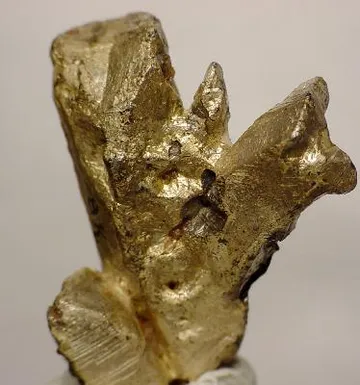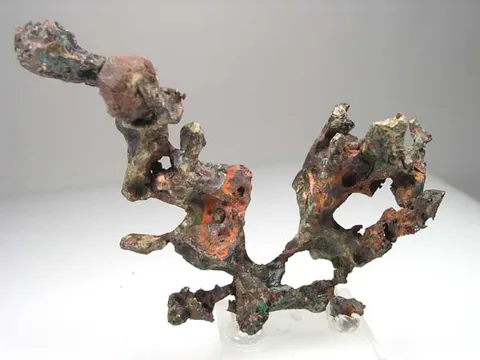
Holloway Quarry, USA — premier celestine locality in SE Michigan, yielding gray-blue tabular crystals with amber calcite; prized for cabinet-worthy specimens.
Key facts
Holloway Quarry, better known to many older-label collectors as the Rockwood Stone or Rockwood Quarry near Newport, is one of southeastern Michigan’s essential celestine localities. It lies in Berlin Charter Township, Monroe County, on the low, industrial carbonate-and-sandstone country near Lake Erie, where Silurian–Devonian evaporitic and carbonate units of the Michigan Basin are close enough to the surface to be quarried. Its collector importance rests on vugs and solution cavities in dolomitic limestone and related Sylvania Sandstone–Detroit River Group rocks that yielded gray-blue celestine, pale amber calcite, brown fluorite, quartz, and strontianite.
The Holloway look is unmistakably Great Lakes: tabular to prismatic celestine crystals in cool gray-blue, sometimes partly transparent, sometimes milky, with bright chisel-like terminations and occasional stepped or compound growth; amber to honey calcite forms sharp scalenohedrons, often acting as the warm counterpoint to the celestine. Good specimens have the architectural simplicity collectors prize from the Findlay Arch–southeastern Michigan belt: a few strong crystals, clean edges, glassy faces, and color contrast rather than sheer abundance.
Regional View
Country View
Holloway is also a locality where labels matter. The adjacent Newport Quarry, historically the Thompson-McCully operation, sits next door on Reaume Road but is treated as a separate quarry. Old “Newport,” “Rockwood,” “Holloway,” and “Rockwood Stone” labels can therefore describe very similar-looking mineralization from separate but adjoining operations. The best Holloway pieces remain classic American celestines rather than simply “Michigan celestites”: large enough for cabinet display, distinctive in habit, and often enhanced by small calcites or rare fluorite.

Photo: Wikimedia Commons
Holloway Quarry is located at Newport, Berlin Charter Township, Monroe County, Michigan, in the southeastern rim of the Michigan Basin. Mineralogically it belongs with the Findlay Arch and southeastern Michigan–northwestern Ohio celestine-fluorite-calcite belt, a region where strontium- and fluorine-bearing mineralization appears in cavities, seams, geodes, and brecciated carbonate zones within Devonian and Silurian strata. The immediately relevant section in Monroe County includes carbonate rocks and sandstone of the Bass Islands, Sylvania Sandstone, Detroit River, Dundee, and related units; older literature commonly used broader Monroe Formation terminology for some of these beds.
The specimen-producing cavities at Holloway are reported in dolomitic limestone and limestone, with celestine associated particularly with calcite and fluorite. Regional geological descriptions of the Sylvania Sandstone and adjacent Detroit River Group beds are important because the same strontium-rich mineralizing system is expressed repeatedly across the nearby Rockwood, Newport, Maybee, Sylvania Minerals, and Monroe County quarries. The Sylvania is a clean, light-colored quartz sandstone, locally calcite-cemented, with vugs and geodes reported to contain calcite, celestite, sulfur, and pyrite; overlying and adjacent dolomitic units carry similar cavity mineralization. Holloway’s best-known collector material, however, is not loose sand-pocket material but solid vug specimens: blue-gray celestine and amber calcite on limestone or dolomitic matrix.
The quarry has been recorded under several names. Mindat lists Holloway Quarry with the historical names Rockwood Quarry and Newport quarry, while noting that it should not be confused with the adjacent Newport Quarry, formerly Thompson-McCully, which lies immediately next door but is a separate operation. A 2009 locality discussion placed the Newport Quarry at 7250 Reaume Road and Holloway/Rockwood at 7500 Reaume Road; later Michigan mineral-producer directories list a Rockwood Quarry at 7500 Reaume Road in the E/2 of Section 3, T6S, R10E. Operator names have changed through time: Great Lakes Aggregates was cited for the Holloway/Rockwood operation in 2009, while a 2017 Michigan Mineral Producers directory listed Stoneco, Inc. for the Rockwood Quarry at that Reaume Road address.
Specimen production was tied to quarrying rather than to a specimen mine. Collectors and dealers encountered the best material when blasting or bench work opened vugs large enough to preserve celestine crystals before crushing. The geological pattern is familiar to anyone who has chased Midwestern quarry minerals: long stretches of barren or low-grade rock, then a seam or pocket zone containing a few cabinet-quality plates and many broken fragments. At Holloway, the memorable pockets produced celestine crystals several centimeters long, calcite scalenohedrons to cabinet scale, and unusually large brown fluorite crystals for Michigan.
Collecting access today should be treated as closed unless explicit permission is granted by the operator. Holloway is an industrial quarry, not a public rockhounding site, and the locality has a long history of label confusion partly because material passed through local collectors, dealers, club networks, and old collections. Serious buyers should expect good Holloway pieces to come with older labels, collector provenance, or publication history; “Newport/Rockwood/Holloway” labels deserve close attention because nearby quarries produced related but separately attributable specimens.
Celestine is the signature mineral of Holloway Quarry, occurring as pale gray-blue to blue-gray crystals several centimeters long in a variety of tabular, bladed, prismatic, and compound habits, commonly in vugs in dolomitic limestone with calcite and locally fluorite. The best examples show lustrous, translucent to transparent faces, sharply developed chisel or pinacoid-style terminations, and enough three-dimensional separation to keep the crystals from reading as a broken mass; some specimens are simple single blades, while better cabinet pieces carry parallel-growth clusters or crossed groups on matrix. Compared with more ordinary Holloway pieces, which may be milky, cleaved, or packed tightly into matrix, the top material has clean terminations, blue-gray zoning, glassy luster, and balanced contrast with amber calcite or drusy calcite coatings.
Calcite from Holloway Quarry is best known as pale amber to honey-colored scalenohedral crystals, reported to reach about 8 cm, usually associated with celestine in the same vug assemblage. On strong combination specimens the calcite acts as more than background: bright golden scalenohedrons may line an edge or rise between blue-gray celestine blades, creating the classic Michigan color pairing. Distinctive Holloway calcites include elongated rhombic to scalenohedral forms, partial second-generation growth, and small gray to colorless calcite coatings on celestine; the most desirable pieces are those where the calcite crystals are sharp, translucent, undamaged, and compositionally integrated with the celestine rather than scattered as bruised druse on broken matrix.
Other documented Holloway minerals include fluorite, quartz, and strontianite. Fluorite is the standout rarity: pale brown to transparent, sometimes iridescent cubic crystals have been reported to 9 cm with celestine in limestone vugs, making Holloway/Rockwood one of Michigan’s most important fluorite occurrences. Mindat’s current species list for the quarry is short—calcite, celestine, fluorite, quartz, and strontianite—and no type-locality mineral species are documented for Holloway in the checked locality records. Quartz is a subordinate vug companion, while strontianite is significant because it records the same strontium-rich geochemical system that made the celestine famous.
Holloway specimens raise fewer treatment concerns than provenance concerns. The principal collecting problem is not faking the mineral species, but assigning the correct quarry. Holloway/Rockwood, Newport/Thompson-McCully, Ottawa Silica Rockwood, Sylvania Minerals, Maybee, Lime City, Pugh, and other Findlay Arch quarries all produced blue-gray celestine, calcite, and occasional fluorite. Old labels reading only “Newport,” “Rockwood,” or “Michigan” may be ambiguous. A high-end Holloway attribution is strongest when accompanied by an old collector label, a known local collector provenance such as Medici, Feist, Ed David, or similar Midwest collections, or a match to published and photographed material.
Condition is critical. Celestine has excellent cleavage, and the broad tabular crystals that make Holloway attractive are also prone to edge chips, bruised terminations, and basal cleaves. Inspect the ends of blades carefully: a clean chisel termination is worth far more than a similarly colored crystal that has simply cleaved to a bright flat face. Matrix specimens often show sawed backs, trimmed limestone, or broken pocket edges; those are not necessarily defects, but the display face should be natural, coherent, and free of obvious glue or sprayed-on luster.
Calcite on Holloway pieces is more robust but still commonly bruised on scalenohedral tips. Yellow to amber calcites can hide internal cleaves, so examine them under strong side light. Fluorite from Holloway is much scarcer than celestine or calcite; brown cubes with good transparency, iridescence, or size should be treated as significant locality specimens, especially when associated with celestine. Fluorescence is worth checking on any fluorite-bearing piece from the district, but do not assume every Holloway specimen will respond dramatically.
Market availability is moderate for celestine and limited for strong combinations. Small to cabinet celestines appear periodically from old Midwest collections and dealer stock, while truly fine, damage-free, matrix-supported examples are much less common. Calcite-only Holloway specimens are scarcer in commerce than celestine, and fluorite from the quarry is genuinely uncommon. The best Holloway pieces compete with better-known Ohio and Michigan celestines by quality of crystal, not by name recognition alone.
One of the better modern Holloway stories began not in a quarry but with a problematic label. In 2021 a collector posted a 19 x 13 x 10 cm celestine-on-matrix specimen that he had acquired in 2001 through an exchange with an American source. The mineral identification had been checked by SEM/EDX—only sulfur and strontium were detected, with no barium—but the handwritten locality read “Sweet Bay, Michigan.” Experienced Michigan collectors immediately recognized the problem: no such locality was known. The discussion moved through the usual suspects of the Findlay Arch district—Maybee, Ottawa Silica Rockwood, Holloway—and the label mystery became a lesson in how easily great regional celestines drift away from their true quarry names. Kevin Conroy noted that crystals of that size and shape were not uncommon for Holloway, but a cluster of that quality was “extremely rare.” Then Robert Nowakowski closed the loop: he remembered the actual find. The collector who recovered the piece had stopped at his house on the way home from the quarry to show it to him. The final conclusion was unusually satisfying for a mislabelled quarry specimen: not merely “probably Michigan,” but “definitely from Holloway Quarry.”
Another recurring Holloway story is the almost comical closeness of the quarries themselves. Collectors trying to sort old “Newport” celestines have had to account for two separate operations beside one another on Reaume Road: the Newport Quarry at 7250 Reaume Road and the Holloway/Rockwood Quarry at 7500 Reaume Road. A few hundred yards of geography can change a label, even when the rock and the mineralization look nearly identical. In one 2009 exchange, a collector had bought two “fantastic” Newport-area specimens, including a larger one more than a foot across, and was trying to decide which quarry they came from. The locality answer depended on which operation was closest to Lake Erie, which company was operating which gate, and whether the visual style matched known Holloway material. That kind of detective work is typical for southeastern Michigan quarry minerals: the specimen may be beautiful, but the label is often where the real collecting begins.
The A. E. Seaman Mineral Museum’s Holloway material gave the locality a different kind of afterlife. In a museum-forum post about the Seaman collections, Holloway was singled out as having produced some of North America’s finest celestines as well as Michigan’s largest and best fluorite crystals. The accompanying display photographs showed large-cabinet celestines and a full case of Holloway minerals—exactly the scale at which the locality becomes more than another Midwestern quarry. For collectors who know Michigan chiefly through Keweenaw copper, those cases made a pointed argument: the southeastern corner of the state has its own classics, and Holloway celestine belongs among them.
Holloway Quarry locality page, Mindat — Core locality record for Holloway Quarry, including coordinates, alternate names, relationship to the adjacent Newport Quarry, and the documented mineral list.
Celestine from Holloway Quarry, Mindat occurrence record — Species-specific record documenting celestine at Holloway, with associated minerals and a gallery of locality photographs.
Robinson, G. W. 2004. Mineralogy of Michigan by E. W. Heinrich, updated and revised. A. E. Seaman Mineral Museum, Michigan Technological University, 252 pp. — Celestine PDF — Records Holloway celestine as pale gray-blue crystals several centimeters long with calcite and fluorite in vugs in dolomitic limestone; also figures A. E. Seaman Mineral Museum specimen DM 23028 from Holloway.
Robinson, G. W. 2004. Mineralogy of Michigan by E. W. Heinrich, updated and revised. A. E. Seaman Mineral Museum, Michigan Technological University, 252 pp. — Calcite PDF — Records Holloway calcite as pale amber scalenohedral crystals to 8 cm with celestine.
Robinson, G. W. 2004. Mineralogy of Michigan by E. W. Heinrich, updated and revised. A. E. Seaman Mineral Museum, Michigan Technological University, 252 pp. — Fluorite PDF — Records Holloway fluorite as pale brown transparent, partly iridescent cubic crystals to 9 cm with celestine in limestone vugs.
Vasichko, Joseph W. 2018. “Fluorite of the Findlay Arch Mineral District, Ohio, Michigan, and Indiana.” Rocks & Minerals 93(2): 110–135. DOI: 10.1080/00357529.2018.1405218 — Places Holloway/Rockwood and Newport in the wider Findlay Arch fluorite district and illustrates Holloway fluorite.
Scovil, Jeffrey A. 2016. “Tucson (Dis)Plays the Blues: A Pictorial.” Rocks & Minerals 91(1): 18–27. DOI: 10.1080/00357529.2016.1099129 — Includes a figured 12.3 cm celestine with calcite from Holloway Quarry, Newport, Michigan.
Tom Morris. 1983. “Michigan Mineralogy: A Locality Index.” Rocks & Minerals 58(3): 107–113. DOI: 10.1080/00357529.1983.11767128 — Locality-index reference cited in later Michigan mineral records for the Newport-area quarry assemblages.
A. E. Seaman Mineral Museum: Celestine, Holloway Quarry, Monroe County, Michigan — Museum collection page for a Holloway celestine specimen.
Wikimedia Commons: Celestine-Calcite-249306.jpg — Published photograph of a 9.2 x 4.5 x 1.5 cm Holloway celestine-calcite combination, ex John Medici Collection, photographed by Rob Lavinsky.
Holloway Quarry, Newport, Berlin Charter Township, Monroe County, Michigan, Mindat — Best starting point for locality hierarchy, coordinates, alternate names, and the verified mineral list.
Celestine from Holloway Quarry, Mindat — Species-specific page with photo data and references for Holloway celestine.
Calcite from Holloway Quarry, Mindat — Species-specific page for Holloway calcite and its associated locality data.
A. E. Seaman Mineral Museum, Mineralogy of Michigan: Celestine — Essential Michigan reference for celestine occurrences, including Holloway and nearby Monroe County quarries.
A. E. Seaman Mineral Museum, Mineralogy of Michigan: Calcite — Documents Holloway’s pale amber calcite with celestine and provides regional calcite context.
A. E. Seaman Mineral Museum, Mineralogy of Michigan: Fluorite — Records Holloway’s notable pale brown fluorite crystals, an important rarity for Michigan collectors.
USGS Geolex: Sylvania Sandstone publications — Concise geological reference for the Sylvania Sandstone’s Devonian age, Michigan Basin setting, and silica-sand character.
Vasichko, Joseph W. “Fluorite of the Findlay Arch Mineral District, Ohio, Michigan, and Indiana,” Rocks & Minerals — Important district-scale article for understanding Holloway fluorite in regional context.
Mindat discussion: “Newport Celestite — Michigan — What Quarry?” — Useful collector discussion on distinguishing Holloway/Rockwood and Newport quarry labels.
Mindat discussion: “Celestine from the Findlay Arch District” — A revealing provenance discussion showing how high-quality Holloway material can be mislabelled and later reattributed.