Himmelsfürst Mine, Germany - classic Erzgebirge silver locality with native silver, argyrodite; historic mining, and collector appeal.
Key facts
Himmelsfürst is one of the great classic silver localities of the Erzgebirge: a mine whose specimens bridge early European cabinet mineralogy, Saxon mining history, and the birth of a chemical element. The workings lie near Brand-Erbisdorf, on the southern side of the Freiberg mining district, where steep hydrothermal veins cut the gneissic basement of the Ore Mountains. In collector terms, Himmelsfürst is above all a silver-sulfosalt locality: native silver, acanthite, pyrargyrite, stephanite, freieslebenite, polybasite, proustite, freibergite-group minerals, and the type-locality argyrodite form a suite that is as historically important as it is visually distinctive. The best pieces have the unmistakable old-European look—wires and ropes of warm-toned silver, black metallic acanthite, white to cream calcite, brownish siderite and dolomite, and compact dark sulfosalt ores that reward a close lens more than a casual glance.
Himmelsfürst mattered economically because it became one of Saxony’s richest silver mines, particularly after the mid-18th-century opening of exceptionally rich ore shoots. It mattered scientifically because argyrodite from the mine led Clemens Winkler to germanium in 1886, confirming one of Mendeleev’s predicted periodic-table gaps. It matters to collectors because its finest silver specimens have the sculptural fluency of Kongsberg wire silvers but with a different personality: tighter, denser, often rising from dark acanthite or carbonate matrix, with a patina and cabinet history that place them firmly among the German classics.
Regional View
Country View
The Himmelsfürst assemblage is tied to the Freiberg district’s polymetallic vein system, especially the silver-rich carbonate assemblages historically called the Edle-Braunspat formation. These veins produced both ore and specimens: black silver sulfides and sulfosalts in carbonate gangue, argentiferous galena and sphalerite, pyrite and arsenopyrite, and late open-space crystallization where silver and sulfosalts could develop the forms collectors prize. Many old labels use broader names such as Freiberg, Brand-Erbisdorf, or simply Saxony; careful provenance is therefore central to judging Himmelsfürst specimens.

Photo: Wikimedia Commons
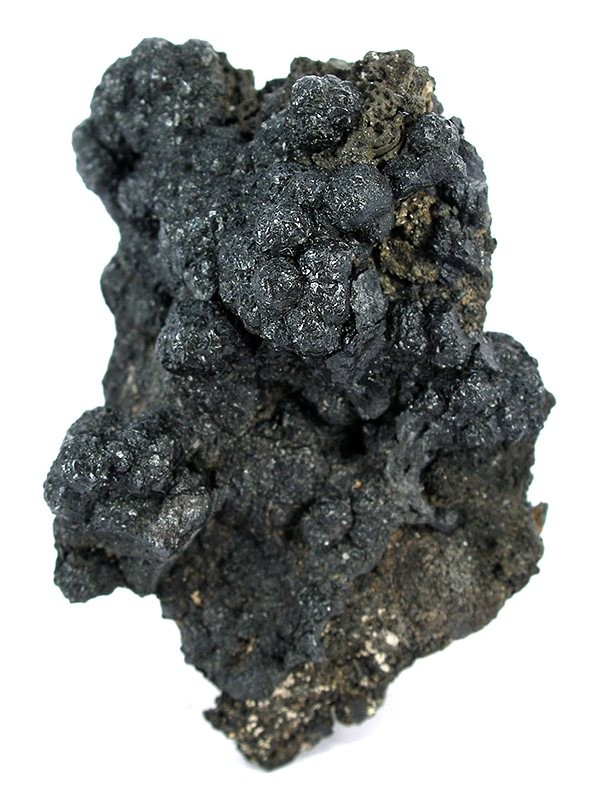
Photo: Wikimedia Commons

Photo: Wikimedia Commons
Search for specimens: View all specimens from Himmelsfürst Mine, Germany
Himmelsfürst Mine, or Himmelsfürst Fundgrube, is in the Brand-Erbisdorf part of the Freiberg mining district in Saxony, Germany. The mine sits in the Erzgebirge, a region famous for long-lived polymetallic vein mining. Its ores belong to the Freiberg vein field, where hydrothermal fractures host silver, lead, zinc, copper, arsenic, antimony, iron, barium, fluorine and carbonate mineralization. In the Brander Revier, the country rock is dominantly gneiss, and the ore veins belong chiefly to the Freiberg district’s older Variscan mineralization cycle, with overprinting and crosscutting by later vein events.
The collector’s Himmelsfürst is essentially a carbonate-rich silver-sulfide and silver-sulfosalt locality. The economically important silver-bearing assemblage is closely allied to the Edle-Braunspat formation, in which siderite, rhodochrosite, ankerite, dolomite and calcite form important gangue with silver-rich sulfides and sulfosalts. The district also contains the older kiesig-blendige Bleierz formation—quartz with pyrite, arsenopyrite, sphalerite, chalcopyrite and galena—and Himmelsfürst specimens may show intimate intergrowths of these older base-metal sulfides with younger carbonate-silver assemblages. On historical ore specimens the visual language is therefore mixed: white or buff carbonates, darker iron carbonates, black acanthite and other silver minerals, brassy pyrite and arsenopyrite, and argentiferous galena and sphalerite.
Several named veins and shafts are important in the historical record. Veins associated with the mine include Himmelsfürst Flacher, Kalb Stehender, Wiedergefunden Glück Stehender, Jupiter Stehender, Vertrau auf Gott Flacher and Dorothea Stehender. The Teich Flacher vein became legendary for the great native-silver finds of 1749 and 1750. Later shaft names include the Frankenschacht, Glück-Auf-Schacht, Reicheltschacht, Albertschacht, Lade-des-Bundes-Schacht and Vertrau auf Gott-Schacht. The Glück-Auf-Schacht, begun in the 1860s, opened the western part of the mine field and became one of the major later installations.
The history is long enough that even the starting date requires care. Brand-Erbisdorf’s municipal history preserves a 1572 grant date for Himmelsfürst, while other mining histories note that the working generally meant by Himmelsfürst was first named in 1596 and that a 1572 reference may belong to a similarly named claim. In either case, Himmelsfürst was a modest mine through much of its early life. Silver was first paid out to shareholders in the 1620s, work was disrupted during the Thirty Years’ War, and regular production resumed in the later 17th century. Its great transformation began in the 1740s, when improved water-handling made deeper workings practicable and rich silver ores were opened.
The mid-18th century gave Himmelsfürst its reputation. A pumping installation was built in 1746; rich silver ores were encountered from 1747 onward; and in 1749, in the Kunstschacht on the Teich Flacher vein, miners recovered a native-silver ore piece weighing 68 kilograms. The following year a still larger silver piece of 141 kilograms was taken out. These were not merely mineralogical curiosities—they were ore bonanzas that helped establish Himmelsfürst as one of Saxony’s great silver mines. By the late 18th and 19th centuries the mine was profitable, expanding, and technologically important, with deepening workings, new shafts, drainage improvements, and later steam-powered hoisting.
During the 19th century Himmelsfürst became, together with the Himmelfahrt mine at Freiberg, one of the best-known and most productive Saxon ore mines. The mine field grew by acquisition, including neighboring ground such as Gelobt Land, and reached roughly 12 square kilometers at its maximum extent. Its workforce rose dramatically; sources record around 500 to 600 men in the 1790s, about 1,500 after mid-19th-century expansion, and 1,770 workers in 1886. That year the Saxon state bought Himmelsfürst along with other major mines as the silver price crisis threatened the survival of the district. Modernization followed, but the economics of silver mining did not recover sufficiently, and operations were closed in 1913.
Mining did not end permanently in 1913. After the Second World War, SAG Wismut explored the area for uranium, with only minor uranium mineralization. From 1951 the Brander Revier became part of the VEB Bleierzgruben “Albert Funk” Freiberg, and lead-zinc ore mining resumed. A major later engineering achievement was the roughly 9-kilometer transport crosscut linking the Brander and Freiberg central districts; from 1965 ore and waste transport went through this route to the Davidschacht in Freiberg. Final closure came in 1969, not because the ore was exhausted, but because mining had become uneconomic against cheaper imported ores.
Today the mine is not a collecting locality in the old sense. The underground workings are closed, surviving buildings have been converted or preserved in new uses, and the Himmelsfürst settlement and surrounding dumps form part of a mining landscape rather than an active specimen source. The former mine dumps are historically sensitive, and collectors should assume that access is private, restricted, or regulated unless permission is explicit. For most serious collectors, Himmelsfürst means old-time specimens: pieces from 18th- and 19th-century mining, specimens dispersed from institutional collections, and occasional old-labeled pieces entering the market from European and American cabinets.
Native silver is the emblematic Himmelsfürst specimen mineral, occurring as wires, ropes, curls, arborescent growths and compact metallic masses, commonly associated with acanthite and calcite and more rarely with quartz, dolomite, canfieldite or polybasite. The largest historical finds were ore pieces rather than cabinet specimens—the 68-kilogram Teich Flacher find of 1749 and the 141-kilogram find of 1750—but the collector pieces that define the locality are hand-size and miniature groups of lustrous, curved silver wires rising from dark silver sulfide or white carbonate. Good Himmelsfürst silvers show undisturbed attachment, three-dimensional form, an old but not dead patina, and convincing association with acanthite or carbonate matrix; ordinary pieces are flatter, acid-stripped, broken away from matrix, or suspiciously assigned to Himmelsfürst without old labels or strong provenance.
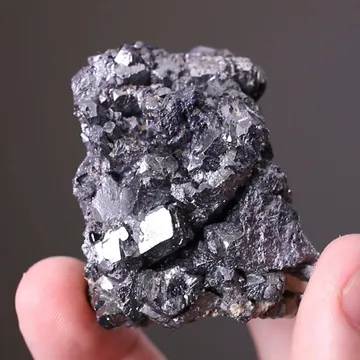
Himmelsfürst acanthite occurs as black to metallic gray crystals and aggregates, including classic pseudocubic crystals after high-temperature argentite and elongated or modified forms on carbonate or quartz-bearing matrix. Documented market and collection pieces show crystals from millimetric druses to prominent individual crystals around 1 to 1.5 cm, while older mineralogical references note exceptional Saxon acanthite crystals reaching several centimeters at Himmelsfürst. The best examples are sharply crystallized, lustrous, and three-dimensional, ideally with old labels and associations such as native silver, calcite, siderite, dolomite or quartz; lesser pieces are massive silver glance, rubbed black crusts, or damaged acanthite that has lost the crisp pseudomorph habit that makes the locality desirable.
Stephanite from Himmelsfürst is part of the mine’s late silver-sulfosalt suite, a dark lead-gray to iron-black Ag-Sb sulfosalt occurring in the carbonate-silver assemblage with acanthite, pyrargyrite, polybasite, native silver, chalcopyrite, pyrite, siderite, quartz and calcite. Himmelsfürst pieces are usually judged as much by context as by size: a sharp metallic stephanite perched with other silver minerals on carbonate matrix is far more desirable than an indistinct black ore patch. Good specimens show identifiable crystals or bright crystal faces, secure old Freiberg/Brand-Erbisdorf provenance, and association with other named silver minerals; because stephanite is also famous from the broader Freiberg district, labels that say only “Freiberg” need careful interpretation before they are assigned to Himmelsfürst.
Argyrodite is the scientific celebrity of Himmelsfürst, the type-locality Ag8GeS6 mineral from which Clemens Winkler discovered germanium in 1886. At Himmelsfürst it typically appears as dark gray to blackish, subtly metallic or slightly iridescent crusts, botryoidal to nubby aggregates, and small clustered crystals rather than bright showy crystals; associated minerals include pyrite, arsenopyrite, pyrargyrite, marcasite, sphalerite and other silver ores. Displayable thumbnails and miniatures are scarce, and the best pieces offer recognizable three-dimensional argyrodite coverage with historic provenance, ideally free of destructive marcasite alteration; ordinary examples are visually dull black ore unless the label, association and analysis make the species certain.
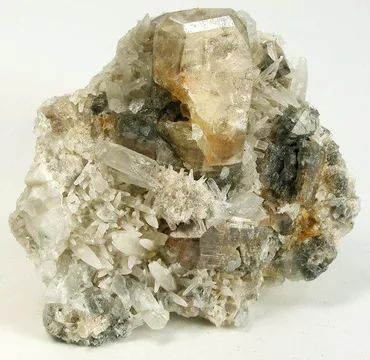
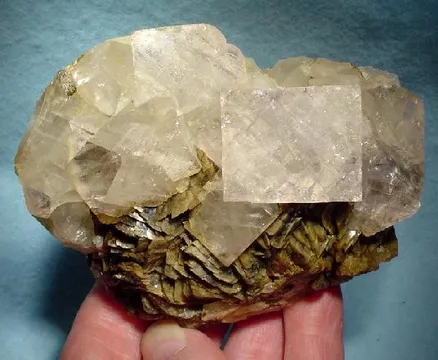
Calcite at Himmelsfürst is chiefly a gangue and matrix mineral of the silver-bearing carbonate assemblage, occurring as white to cream crystals, granular carbonate, and vein-filling material with acanthite, silver, pyrargyrite, stephanite, galena, sphalerite and iron carbonates. It is important to collectors less as a standalone calcite locality than as the clean pale stage that sets off black silver sulfides and native silver wires; some silver specimens retain calcite naturally, while others have been etched or trimmed to expose metallic growths. Good Himmelsfürst calcite specimens are those in which the carbonate forms an undisturbed pocket association with the silver minerals, not simply anonymous white vein calcite with a vague Freiberg label.
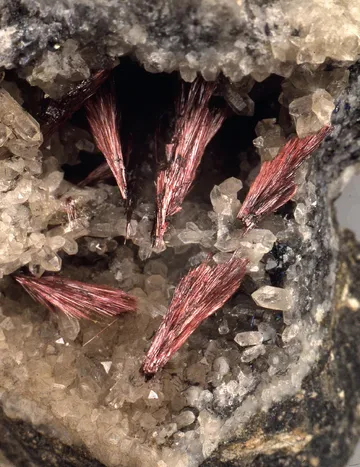
Pyrargyrite from Himmelsfürst belongs to the classic “dark ruby silver” assemblage of the Freiberg district, occurring with pyrite, arsenopyrite, argyrodite, sphalerite, marcasite and occasionally stephanite. Himmelsfürst examples range from small dark red to nearly black crystals and patches in silver ore to more attractive vug specimens with acanthite, calcite or siderite; strong transmitted-red color is not always obvious on old pieces, especially where crystals are thick or tarnished. The best specimens show distinct crystal form, an undamaged surface, visible ruby tone at edges or under strong light, and convincing old provenance from Brand-Erbisdorf; mediocre examples are easily confused with other dark silver sulfosalts unless analyzed or supported by authoritative labels.
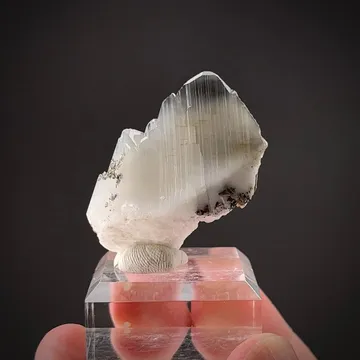
Quartz is a fundamental vein mineral at Himmelsfürst, especially in the older base-metal quartz association and in composite veins where quartz, pyrite, sphalerite and galena are intergrown with later carbonate-silver mineralization. It occurs as massive milky quartz, small crystals, chalcedony and quartz-rich vein pieces rather than as the principal show species. Collector value comes when quartz preserves a clear paragenetic setting—acanthite or silver on quartz, quartz with galena-sphalerite-pyrite ore, or old Freiberg labels documenting Himmelsfürst shaft material. Freestanding quartz specimens from this mine are far less important than quartz as a matrix for the silver suite, and many unlabeled white quartz pieces from the district cannot be assigned reliably to Himmelsfürst.
Beyond the headline species, Himmelsfürst is a type-locality and rarity mine of unusual depth. Argyrodite, freieslebenite, xanthoconite, jordisite and kenoargentotetrahedrite-(Fe) are documented from the mine as type-locality species or type-locality components, and the broader list includes proustite, pyrostilpnite, polybasite, canfieldite, chlorargyrite, freibergite-group minerals, galena, sphalerite, chalcopyrite, arsenopyrite, pyrite, marcasite, siderite, dolomite, ankerite, rhodochrosite, fluorite and baryte. For collectors, the rarities are often modest visually but heavy with history: black, gray or reddish microcrystals on sulfide-carbonate ore, commonly requiring labels, analysis, and patience under magnification.
Himmelsfürst specimens reward provenance. The mine is old, the labels are often older than modern locality conventions, and many specimens entered collections under broad names such as Freiberg, Freiberg District, Brand, Erbisdorf, Saxony, or Erzgebirge. A label reading “Freiberg” alone is not proof of Himmelsfürst; the Freiberg district contains many classic silver mines, including Himmelfahrt, Beschert Glück, Neue Hoffnung Gottes and others. Stronger labels mention Himmelsfürst, Brand-Erbisdorf, St. Michaelis, specific shafts or veins, or come with an unbroken institutional or dealer history.
Native silver is the area of greatest caution. Fine wire silvers have been attributed to Himmelsfürst since the late 20th century, but mineral dealers and locality databases have noted doubts about some assignments, and questioned wire silvers from other localities have circulated in the market. The safest pieces have undisturbed attachment to acanthite or carbonate matrix, consistent old patina, older labels, and no signs of recent mounting, soldering, artificial placement, or aggressive acid preparation. Silver wires can be naturally exposed from calcite, but acid-etched pieces may look unnaturally clean or unsupported; that is not automatically fakery, but it changes both aesthetics and confidence.
Condition is a major issue. Silver wires bend, detach and snap easily; old repairs may be subtle. Acanthite is soft and commonly rubbed on high points. Pyrargyrite and proustite are photosensitive to varying degrees and should be protected from prolonged intense light. Argyrodite specimens require special care because associated marcasite and pyrite may oxidize; keep them dry, stable, and away from humidity swings. Any sulfate efflorescence, acidic smell, crumbling matrix, or yellow-white alteration around marcasite should be treated as a warning sign.
Market availability is uneven. Small acanthite, silver, and mixed silver-mineral specimens appear regularly enough in old collections and specialist inventories, but truly fine Himmelsfürst silver on matrix is scarce and expensive. Argyrodite from the type locality is far rarer as a good display specimen than its name recognition might suggest; most pieces are small, dark, and historically interesting rather than flashy. Good old labels from Freiberg institutions, early European collections, or named modern collections add real value, especially for the type-locality minerals.
The defining Himmelsfürst story begins underground in the 1740s, when better water control changed a marginal mine into a Saxon legend. In 1746 a pumping installation was set in what became the mine’s later center; from 1747 the workings began to yield unusually rich silver ores. Then, in 1749, miners working the Teich Flacher vein in the Kunstschacht brought out a native-silver ore piece weighing 68 kilograms, valued at 2,500 thalers. A year later they surpassed it with a 141-kilogram silver piece worth more than 4,800 thalers. These were the sort of finds that made a mine’s reputation for generations—not merely “rich ore,” but physical masses of native metal large enough to be spoken of like trophies.
The mine’s success became public culture. In 1818, Himmelsfürst’s half-century of continuous profit distribution was commemorated with a special Ausbeutemedaille tied to the fiftieth regnal jubilee of King Friedrich August. The point was not subtle: a profitable silver mine was a matter of state pride, investor confidence, skilled labor, and regional identity. Long before mineral specimens were traded internationally as collector objects, Himmelsfürst silver had already become a symbol.
A more domestic glimpse survives in the story of the mine smithy. The Bergschmiede was not just a place where troughs, wagons and horseshoes were repaired; as a mining building it stood under mining jurisdiction and enjoyed special legal status. One privilege mattered to tired miners at the end of a shift: beer could be served there as a “Labetrank,” a refreshment drink. The old smithy had several fires rather than one, and an Obersteiger lived in the building. When the older shop became too small, a new smithy was built in 1893–1894. After the mine closed in 1913 the buildings survived as storage spaces; the old smithy was finally demolished in 1945.
The most far-reaching episode began with an ore that did not add up. In the summer of 1885, a rich and unusual silver ore was found at Himmelsfürst. Albin Weisbach recognized it as a new mineral species and named it argyrodite. When Clemens Winkler analyzed it, silver and sulfur explained most of the material, but not all of it; repeated careful analysis left a persistent missing fraction. Winkler eventually recognized a new element and named it germanium. The story is famous because it confirmed Mendeleev’s predicted “ekasilicon,” but the mineralogical footnote is equally memorable: argyrodite was not a large, recurring bonanza. Winkler later wrote of the difficulty caused by the lack of material, noting that the occurrence had been transient, that the ore had essentially been mined out, and that the best remaining pieces were too valuable as specimens or too rich in silver to sacrifice casually for chemistry.
Himmelsfürst’s final chapter is more industrial than romantic. After the Second World War the workings were revisited in the search for uranium, but the uranium proved too slight to make the mine a Wismut success. Lead-zinc mining resumed under East German administration, and the district was modernized. A 9-kilometer transport crosscut linked the Brander workings with the Freiberg central district, and from 1965 ore and waste moved through that system to the Davidschacht. When mining stopped in 1969, remaining reserves were reportedly sufficient for about twenty more years under similar technical conditions; economics, not empty veins, ended the mine.